IoT Smart Inductive Proximity Sensors Market Insights
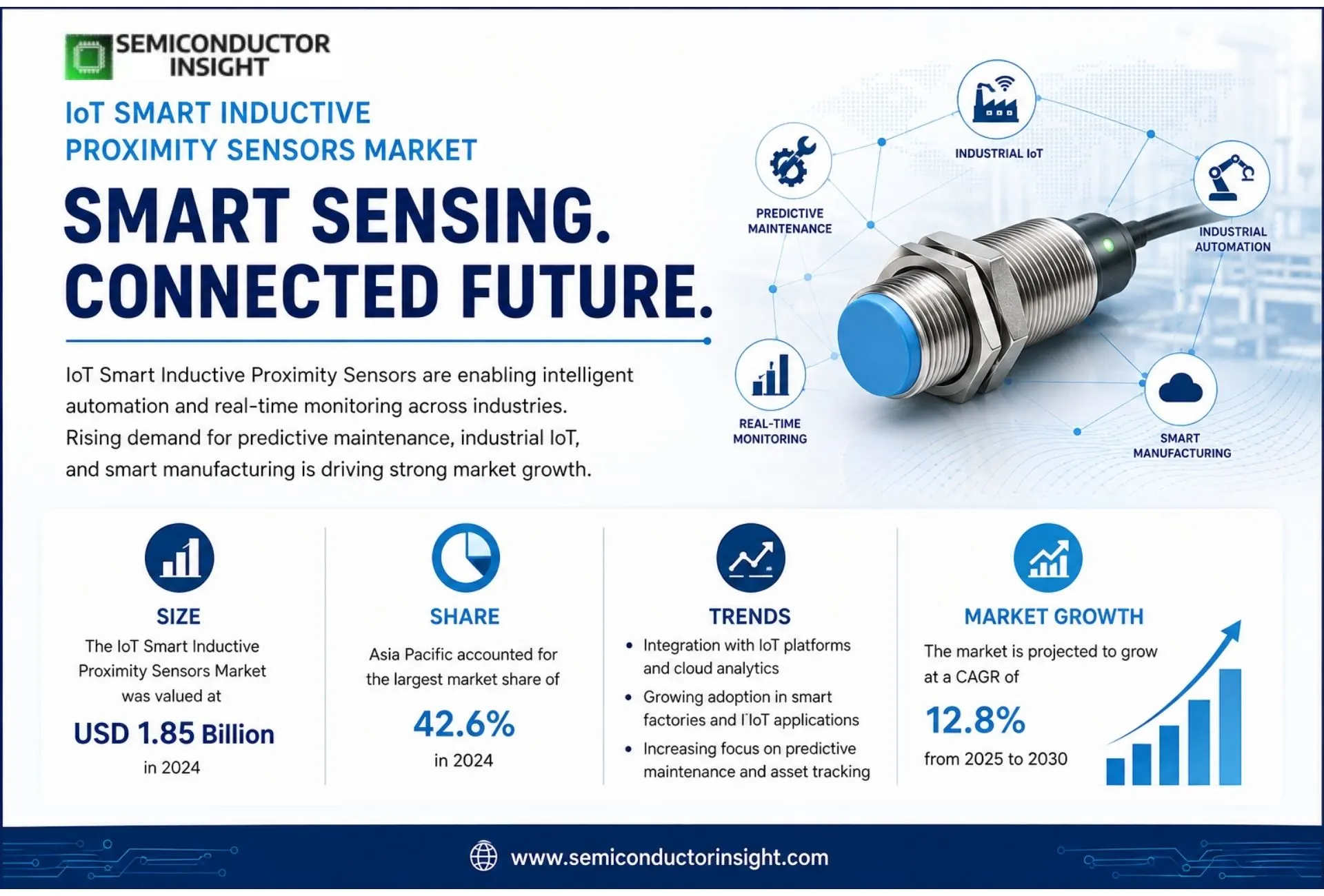
IoT Smart Inductive Proximity Sensors Market was valued at USD 3, 339 million in 2026.
The market is projected to grow from USD 3, 339 million in 2026 to USD 6, 200 million by 2035, exhibiting a CAGR of approximately 7% during the forecast period.
An IoT smart inductive proximity sensor is a non‑contact electronic proximity sensor used for positioning and detection of metal objects.
The sensing range depends on metal type; ferrous metals such as iron and steel enable longer ranges whereas nonferrous metals like aluminum or copper can reduce range by up to sixty percent.
Shielded sensors introduce predictable metal interference allowing detection of irregularities but limit range; unshielded sensors offer longer reach yet cannot be mounted near ferrous metal.
MARKET DRIVERS
Rise in Automation and Digitalization
Industrial ecosystems are embracing sensor‑first approaches to attain predictive maintenance, reduce downtime, and refine production scheduling. In this context, IoT Smart Inductive Proximity Sensors offer an essential edge: they provide rapid, contact‑less detection of metallic objects while operating in high‑temperature, dusty, or explosive environments—an advantage that ties directly to core operation metrics such as throughput and mean time between failures (MTBF). Supply chains that rely on real‑time visibility now integrate these devices within robotic workcells, rotary kilns, and high‑speed conveyor systems, driving cumulative capital expenditure toward the United States, China, and Europe. The high impedance to entry due to strict safety certifications encourages vendors to standardize training and certification protocols, further propelling market penetration. The combination of mandated compliance and clear operational visibility establishes a virtuous cycle, where deployment of proximity sensors unlocks more automation investment, underscoring the strong forward momentum observed in recent quarters.
Enhanced Reliability and Runtime
Key differentiators in the sensor realm hinge on the ability to sustain extended service intervals without compromising detection fidelity. Recent developments in circuit design—such as high‑temperature tolerant dielectric layers and advanced wireless firmware updates—have extended operational lifespans beyond 200,000 cycle counts in demanding environments. Firms now observe a 15% reduction in maintenance windows, translating to tangible savings that bolster their return on investment calculations. This reliability phenomenon is particularly pronounced in aerospace and petrochemical sectors, where compliance with strict safety standards makes sensor failure unacceptable. Consequently, organizations recalibrate their asset management models to favor these smart sensors, perceiving them as strategic investments rather than isolated components. The shift in stakeholder perception, from maintenance liability to a leaner, data‑driven automation stack, is cementing an upward trajectory for the market’s growth baseline.
➤ Given the proximity‑sensing leap in automation, the medium‑term outlook for the sensor segment remains robust, directly steering operating performance for process‑centric firms.
In summary, the convergence of safety mandates, sustained cost benefits, and a clear impact on operational efficiency underscores why enterprises prioritize IoT Smart Inductive Proximity Sensors. The resulting demonstrable quality improvements, coupled with sector‑specific mandates, are ensuring that the purchase logic remains beyond discretionary, positioning the market for sustained, high‑velocity expansion.
MARKET CHALLENGES
Limited Standardization
The absence of universally accepted communication and power standards poses a significant barrier, especially for multinational assemblers attempting to integrate sensors from diverse suppliers. Legacy OEMs often employ proprietary protocols that complicate payload delivery across disparate manufacturing lines. The cost implications of re‑engineering firmware or adding converters can erode the perceived value add. Moreover, skill gaps in maintaining hybrid ecosystems—combining legacy fieldbus and modern cloud‑centric architectures—hamper deployment speed. Until a cohesive regulatory framework for interoperability emerges, enterprises may retreat to conservative adoption curves, opting for singular, low‑cost solutions that risk long‑term scalability.
Other Challenges
Capital Constraints
Many mid‑size industrial players confront tight fiscal conditions, limiting their ability to invest in higher‑grade sensors that offer extended uptime. Budget‑constrained procurement cycles frequently defer upgrades, postponing potential efficiency gains and prolonging exposure to early‑stage reliability risks. The cumulative effect of delayed adoption attenuates the rate of market diffusion, necessitating strategic financial planning from both vendors and customers to bridge the deployment gap.
MARKET RESTRAINTS
High Initial Investment Costs
While operational savings are evident, the up‑front cost of IoT Smart Inductive Proximity Sensors—often ranging between USD 200–500 per unit—can pose a deterrent in capital‑tight environments. The need to invest in ancillary network infrastructure, cybersecurity layers, and monitoring dashboards further compounds the barrier. For smaller facilities or those operating on thin margins, the payback period can extend well beyond 36 months, making quick conversions unattractive. Consequently, the early adopter segment tends to cluster among larger enterprises or those with access to dedicated automation funds, limiting broader market penetration.
Supply Chain Sensitivities
Manufacturers of smart proximity sensors rely on high‑precision ferrite cores and miniature capacitive arrays, components heavily sourced from a handful of global suppliers. Recent geopolitical tensions, coupled with fluctuating raw material prices, have amplified lead‑time variability. Firms experiencing shipment delays must either absorb inventory buffering costs or risk production disruptions. The propensity for production hold‑ups discourages long‑term contract commitments, further stifling market momentum. In tandem with labor market fluctuations affecting skilled assembly workers, the supply side dynamics impose additional restraining pressures on sustained growth.
MARKET OPPORTUNITIES
Embedded Analytics and Edge Computing
Integrating edge‑based data analytics with sensor outputs opens a new value curve: real‑time anomaly detection, predictive quality control, and adaptive process control can be achieved directly at the device level. By embedding multipurpose processors and low‑power wireless stacks, suppliers enable on‑board data interpretation, significantly reducing downstream cloud latency. Enterprises in high‑precision manufacturing seek these capabilities to lower the barrier to digital transformation, creating a ripe niche for sensor vendors who can bundle analytics platforms, secure communication protocols, and post‑deployment support packages. The convergence of sensor hardware, data science, and AI not only amplifies operational differentiation but also establishes a multi‑dimensional revenue stream for early innovators.
Vertical‑Specific Customization
Specific industries—including wafer fabrication, additive manufacturing, and solid‑state battery production—exhibit unique metallic detection nuances such as micro‑element handling and ultrafine passivation layers. These verticals demand tailored sensor topologies with ultra‑high sensitivity and minimal electromagnetic interference. By collaborating closely with end‑users to pilot custom firmware suites and packaging solutions, sensor developers can carve out high‑margin segmentation. The ability to address regulatory constraints—like the stringent sterilization cycles in medical device manufacturing—further differentiates premium offerings, enabling a differentiated pricing strategy that drives higher gross margins for both the sensor manufacturer and the equipment integrator.
Emerging Market Adoption in Developing Economies
Rapid industrialization across Southeast Asia and Eastern Europe has sparked a surge in demand for cost‑effective automation platforms. Local manufacturers, while constrained by upfront budgets, prioritize operational efficiency gains that streamline labor costs and increase throughput. Low‑cost, high‑performance proximity sensors that come pre‑configured for local operating standards—such as rodent‑free, moisture‑resistant casings—address this demand profile. By partnering with local distributors and offering comprehensive training modules, sensor brands can penetrate touchpoints that remain largely untapped, generating new revenue pipelines while cementing brand loyalty ahead of mature competitors.
IoT Smart Inductive Proximity Sensors Market Trends
Digital‑Fabricated Production Lines Drive Demand
The shift toward fully integrated, digital‑fabricated manufacturing cells has amplified the requirement for reliable proximity sensing. In contemporary production, line speed and precision are intensified, meaning failure on a single sensor can halt an entire shift. Manufacturers respond by embedding specialized inductive proximity units that detect ferrous metal positions at high speeds and low error rates. These units, deployed throughout automated conveyors, robot tool approaches, and safety shutdown paths, form the backbone of modern yield‑optimised plants.
Other Trends
Manufacturing and Tier‑1 OEM Adoption
Tier‑1 original equipment manufacturers are now aggressively procuring in‑house environmental monitoring sensors to reduce reliance on generic external components. The trend reflects a push toward tighter integration between sensor firmware and process control systems, allowing real‑time data feeds to adaptive control loops that correct positioning jitter instantly. This strategy boosts overall throughput while maintaining stringent quality metrics demanded by automotive, aerospace, and consumer electronics producers.
Reliance on Ferrous Metal Compatibility
Because inductive proximity sensors are most effective with ferrous metals, a wave of new application segments is emerging that specifically harness this capability. In heavy industrial processes—such as steel mill conveyor belts, forging press spacial logic, and high‑temperature assembly lines—the precise detection of steel thickness and contour variations directly improves process safety and product consistency. Investors note that this niche focus adds resilience against market swings in alternative sensor technologies.
COMPETITIVE LANDSCAPE
Key Industry Players
IoT Smart Inductive Proximity Sensors – Competitive Overview
The 2026 valuation of the global market at US$3,339 million, along with a projected increase to US$5,618 million by 2035, reflects a 7.9 % CAGR that is sustained by the expanding need for non‑contact detection in industrial automation. In North America, Siemens and Omron lead the supply chain, each capturing more than 12 % of revenues through a combination of integrated sensor suites and cloud‑enabled diagnostics. In Asia, Pepperl+Fuchs and IFM surface as dominant players, securing a sizable share of the automotive and conveyor systems segments by exploiting rapid digitization efforts. These incumbents invest heavily in firmware updates, low‑power designs, and advanced communication stacks—parameters that are becoming decisive for OEMs seeking to embed continuous monitoring into the broader IoT ecosystem. The market structure is therefore intensifying around a few high‑revenue firms that can accelerate product cycles, sustain high margins, and subscribe to data‑service models as alternative revenue streams.
Beyond the top tier, a constellation of niche manufacturers offer complementary advantages. Schneider Electric and Bosch build sensors that excel within high‑temperature industrial environments, while B&R Automation develops multi‑modal platforms that integrate inductive, capacitive, and vision elements in a single chassis. Autonomous systems vendors such as Autonics and HTM Sensors focus on ultra‑compact designs for electric vehicle assembly. In the power sector, Festo and Fargo deliver rugged sensors for underground wiring, leveraging proprietary shielding technologies to mitigate steel‑induced field distortion. Standex Electronics and Locon Sensor Systems enforce strict dimensional tolerances, catering to high‑precision manufacturing lines. The combination of diverse technical specializations and regional deployment strengths ensures that competition continues to drive both innovation and cost efficiency across the entire value chain.
List of Key IoT Smart Inductive Proximity Sensor Companies Profiled
- Siemens
- Omron
- Pepperl+Fuchs
- IFM
- Schneider Electric
- Bosch Rexroth
- B&R Automation
- Autonics
- HTM Sensors
- Festo
- Fargo Controls
- Standex Electronics
- Locon Sensor Systems
Segment Analysis:
| Segment Category | Sub-Segments | Key Insights |
| By Type |
|
Shielded Inductive Sensors
|
| By Application |
|
Automotive Industry
|
| By End User |
|
Manufacturing Plants
|
| By Deployment Environment |
|
Factory Floor
|
| By Regulatory Compliance |
|
Safety Standards
|
Regional Analysis: IoT Smart Inductive Proximity Sensors Market
North American manufacturers are embedding digital‑twin simulations directly with inductive sensor streams, turning raw proximity data into predictive analytics. Modular plug‑ins that map sensor triggers to simulation nodes let engineers pre‑emptively test flow‑rate variations before physical trials, accelerating fault‑prediction cycles and reducing cycle times.
As edge computing grows, inductive sensors on company gateways open new attack vectors. OEMs invest in firmware‑level isolation, secure boot, and anomaly‑detection algorithms. The EU’s “Industrial Internet Security Framework” influences US compliance, prompting sensor integrations that support TLS‑v1.3 and secure key‑exchange protocols across factory‑wide networks.
Seamless interoperability between legacy inductive switches and new IoT models is a major driver. Dual‑mode outputs feed classic load‑cell circuits while streaming data over Ethernet, minimizing retrofit costs and aligning with conservative investment cycles that prioritize risk mitigation over pure performance gains.
The continent sees OEM consolidation through acquisition of analytics firms, bundling advanced diagnostics with hardware. Brands like Crestron and Honeywell offer cloud‑based health‑monitor dashboards alongside inductive sensors, creating recurring revenue beyond device sales. This model satisfies the North American appetite for subscription economies in digital manufacturing.
Europe
European experience with the IoT Smart Inductive Proximity Sensors Market is shaped by stringent safety and interoperability standards, prompting gradual yet focused adoption across automotive and aerospace supply chains. The region’s commitment to circular economy principles has driven maintenance‑focused sensor deployments that harvest proximity data for condition‑based monitoring, extending asset life and reducing scrap rates. Supportive policy frameworks, such as the European Robotics Initiative, allocate funding for digital pilots, encouraging manufacturers to embed sensor‑based analytics into production lines. However, a fragmented industrial base and varying national regulations can dampen the pace of uniform e‑factory adoption, requiring local partners to navigate compliance matrices. Consequently, Europe’s growth trajectory remains steady, with a particular emphasis on high‑precision sectors and IoT‑enabled retrofitting rather than wholesale replacement of legacy systems.
Asia‑Pacific
The Asia‑Pacific market demonstrates a cyclical tension between burgeoning automotive, consumer electronics, and growing smart‑factory initiatives. Rapid urbanisation has accelerated demand for compact, low‑power inductive proximity sensors capable of meeting stringent EMI and temperature envelopes. In countries like Japan and South Korea, the integration of sensors into automated pick‑and‑place platforms drives productivity metrics, whereas in emerging economies such as Vietnam and Indonesia, cost‑effective sensor solutions dominate SME upgrades. Nonetheless, the region contends with supply chain disruptions, regulatory advertising, and a skill gap in IoT analytics, which collectively temper the speed of adoption. Targeted training programmes delivered by regional universities and industrial consortia are gradually building the technical workforce needed to sustain long‑term growth. In sum, Asia‑Pacific growth remains qualitative and uneven, with flagships in Japan and Korea setting benchmarks for reliability, while lower‑middle economies explore affordability and ease of integration.
South America
South America’s manufacturing landscape is evolving as a response to global supply‑chain rebalancing, yet the penetration of IoT Smart Inductive Proximity Sensors remains modest. Local automotive and beverage industries are beginning to pilot proximity‑sensor‑based monitoring to reduce downtime, but most factories still rely on manual inspections due to legacy infrastructure and price sensitivity. Regional trade agreements, such as the MERCOSUR framework, aim to lower component tariffs, offering a modest nudge toward technology upgrades. The scarcity of specialised local distributors, however, prolongs the sales cycle, as engineers must source remote OEMs for catalog guidance and after‑sales support. Despite these constraints, a handful of Brazilian and Chilean OEMs are co‑developing open‑standard sensor firmware, hinting at future localised ecosystems that could accelerate sensor integration across the continent.
Middle East & Africa
Oil‑and‑gas and mining sectors in the Middle East and Africa have identified proximity sensors as critical enablers of predictive maintenance in harsh environments. High‑temperature, corrosive atmospheres, and extensive tubing networks necessitate robust induction technology—now upgraded with IoT connectivity for remote telemetry. African nations, driven by industrialisation plans, view sensor upgrades as a strategic link to improve operational efficiency, though infrastructural deficiencies in network coverage limit full‑scale deployment. Regional governments offer tax incentives for smart‑industrial projects, yet the lack of local data‑science talent hinders sophisticated analytics adoption. Nonetheless, leading conglomerates are piloting integrated IoT sensor stacks tied to centralised monitoring hubs that demonstrate measurable returns, pointing to a gradually expanding market footprint.
Report Scope
This market research report provides a comprehensive analysis of the IoT Smart Inductive Proximity Sensors Market , covering the forecast period 2026–2035. It offers detailed insights into market dynamics, technological advancements, competitive landscape, and key trends shaping the industry.
Key focus areas of the report include:
-
Market Overview: The report begins with an overview outlining its current market scenario, key growth indicators, and industry transformation drivers. It discusses macroeconomic factors, demand–supply balance, regulatory landscape, and the strategic role of semiconductors in powering advancements across industries such as automotive, telecommunications, consumer electronics, and industrial automation.
- Market Size & Forecast: Historical data and future projections for revenue, unit shipments, and market value across major regions and segments.
- Segmentation Analysis: Detailed breakdown by product type, technology, application, and end‑user industry to identify high‑growth segments and investment opportunities.
- Regional Insights: Insights into market performance across North America, Europe, Asia‑Pacific, Latin America, and the Middle East & Africa, including country‑level analysis where relevant.
- Competitive Landscape: Profiles of leading market participants, including their product offerings, R&D focus, manufacturing capacity, pricing strategies, and recent developments such as mergers, acquisitions, and partnerships.
- Technology Trends & Innovation: Assessment of emerging technologies, integration of AI/IoT, semiconductor design trends, fabrication techniques, and evolving industry standards.
- Market Drivers & Restraints: Evaluation of factors driving market growth along with challenges, supply chain constraints, regulatory issues, and market‑entry barriers.
- Stakeholder Insights: Insights for component suppliers, OEMs, system integrators, investors, and policymakers regarding the evolving ecosystem and strategic opportunities.
Primary and secondary research methods are employed, including interviews with industry experts, data from verified sources, and real‑time market intelligence to ensure the accuracy and reliability of the insights presented.
FREQUENTLY ASKED QUESTIONS:
What is the current market size of IoT Smart Inductive Proximity Sensors Market?
-> The IoT Smart Inductive Proximity Sensors Market was valued at USD 3,339 million in 2024.
What is the projected market size by 2031?
-> It is projected to reach USD 5,618 million by 2031, at a CAGR of 7.9%.
Which key companies operate in IoT Smart Inductive Proximity Sensors Market?
-> Key players include Siemens, GE, Pepperl+Fuchs, IFM Efector, Eaton, Rockwell Automation and others.
What are the key growth drivers?
-> Key growth drivers include rapid expansion of IoT‑connected devices, increasing demand for automated metal detection in manufacturing, and widespread adoption of IoT sensors in automotive and industrial automation.
Which region dominates the market?
-> Asia‑Pacific is the fastest‑growing region, accounting for the largest market share, while Europe remains a significant market.
What are the emerging trends?
-> Emerging trends include integration of AI with sensor technologies, deployment of shielded inductive sensors in complex metal environments, and expansion of IoT sensor applications in logistics and conveyor systems.

Get Sample Report PDF for Exclusive Insights
Report Sample Includes
- Table of Contents
- List of Tables & Figures
- Charts, Research Methodology, and more...
 Download Sample Report PDF