Industrial Touch Panel PC Market Insights
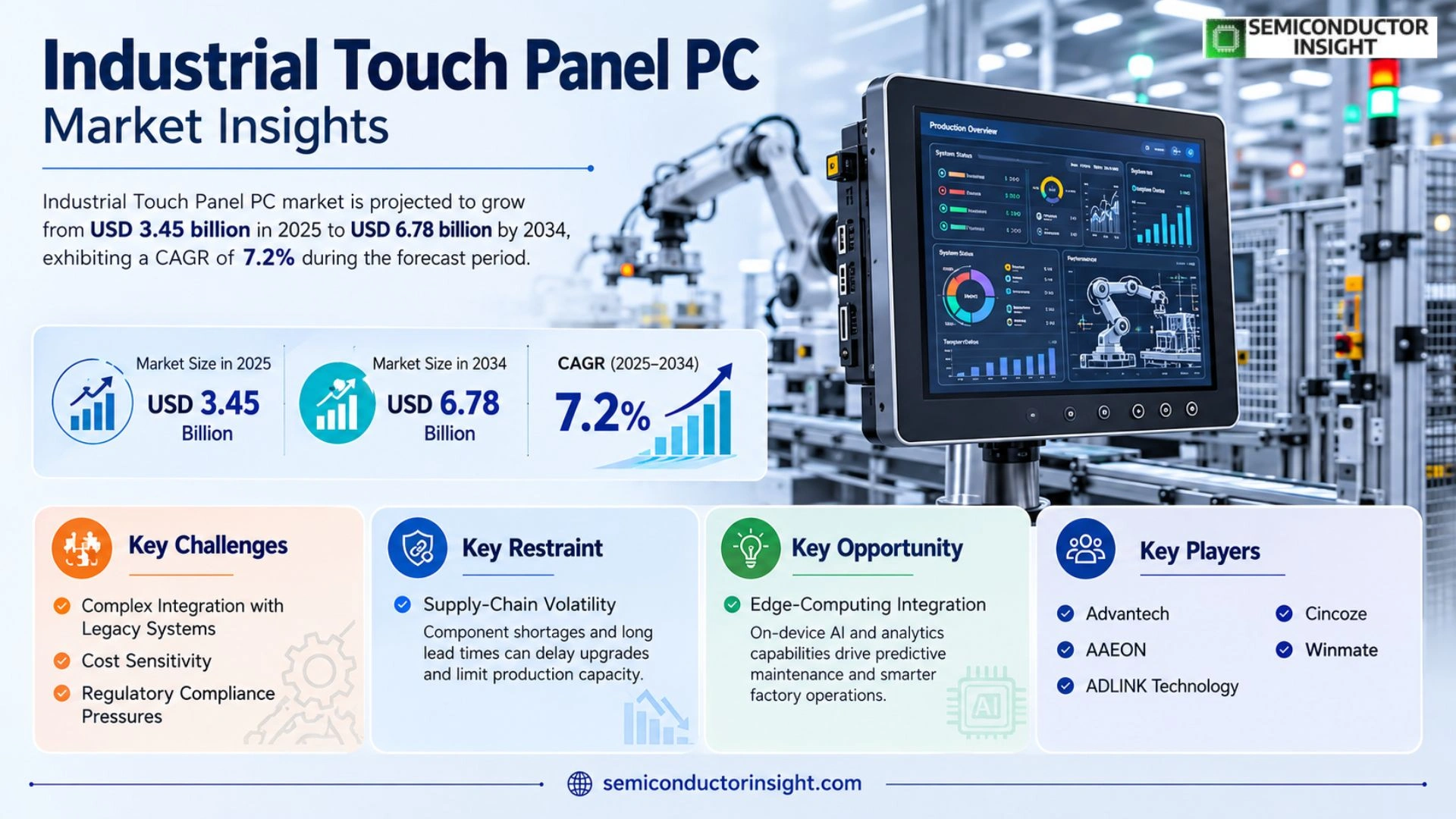
Industrial Touch Panel PC market is projected to grow from USD 3.45 billion in 2025 to USD 6.78 billion by 2034, exhibiting a CAGR of 7.2% during the forecast period.
A panel PC combines a rugged touchscreen display with an embedded computer, delivering a durable human‑machine interface (HMI) for manufacturing floors, logistics hubs, medical facilities and autonomous vehicles. Its sealed construction withstands vibration, dust and extreme temperatures, making it suitable for harsh industrial environments.
The sector benefits from expanding automation initiatives, increasing demand for real‑time data visualization and the rollout of Industry 4.0 standards across factories worldwide. Moreover, advances in multi‑touch technology and edge‑computing capabilities enable more sophisticated control panels without sacrificing reliability. Leading suppliers such as Advantech, Siemens Digital Industries and Axiomtek have announced new product lines in early 2024 that integrate AI‑ready processors and enhanced connectivity options, reinforcing competitive pressure while driving overall market momentum.
MARKET DRIVERS
Rise of Automation in Manufacturing
Industrial Touch Panel PC Market is buoyed by manufacturers that are embedding interactive displays into production lines to reduce manual intervention. Real‑time data visualization on rugged screens shortens decision cycles, allowing plants to keep pace with tighter delivery windows. Companies that adopt these panels often report measurable gains in equipment uptime, a factor that directly improves bottom‑line performance.
Demand for Harsh‑Environment Interfaces
Operations located in extreme temperatures, high dust, or corrosive atmospheres require interfaces built to IP‑rated standards. Suppliers that engineer panels to survive such conditions capture a niche yet expanding slice of Industrial Touch Panel PC Market. The resilience of these devices translates into lower total cost of ownership because fewer replacements are needed over a plant’s lifecycle.
➤ Enterprises that align UI design with operator ergonomics see a 12‑15% reduction in training time, accelerating ROI on touch panel deployments.
Beyond the factory floor, logistics hubs are retrofitting sorting stations with touch‑enabled PCs to streamline order triage. This cross‑sector adoption deepens the market’s foundations, ensuring that growth is not confined to a single industry vertical.
MARKET CHALLENGES
Complex Integration with Legacy Systems
Older PLCs and SCADA platforms frequently lack native support for modern touch interfaces, forcing system integrators to develop custom middleware. The extra engineering effort raises project budgets and can introduce latency, which dampens the perceived advantage of interactive panels within Industrial Touch Panel PC Market.
Other Challenges
Cost Sensitivity
While durability commands a premium, many mid‑size manufacturers operate on thin margins and hesitate to allocate capital toward high‑spec panels. This price pressure pushes OEMs to balance robustness with affordability, often limiting feature sets such as high‑resolution displays or advanced connectivity.
Regulatory compliance adds another layer of difficulty, especially in sectors like food processing where sanitary design and certification are mandatory. Navigating these requirements without compromising the tactile experience can delay time‑to‑market for new panel models.
MARKET RESTRAINTS
Supply‑Chain Volatility
Fluctuations in semiconductor availability and the limited number of qualified manufacturers for hardened enclosures constrain production capacity. When component lead times extend, end users of Industrial Touch Panel PC Market may defer upgrades, opting to extend the service life of existing equipment rather than risk prolonged delays.
MARKET OPPORTUNITIES
Edge‑Computing Integration
Embedding AI inference engines directly on touch panel PCs enables on‑device analytics, reducing reliance on centralized servers. As factories pursue predictive maintenance strategies, panels that process sensor data locally become valuable nodes in an edge‑centric architecture, opening a lucrative avenue for vendors within Industrial Touch Panel PC Market.
Industrial Touch Panel PC Market Trends
Edge Computing Integration Fuels Adoption
The convergence of edge analytics with rugged human‑machine interfaces has become the most visible catalyst for Industrial Touch Panel PC Market this decade. By processing sensor data locally, manufacturers can bypass latency constraints inherent in cloud‑centric architectures, enabling real‑time feedback loops on the shop floor. This functional shift reshapes procurement criteria: buyers now prioritize low‑power processors, hardened I/O, and firmware that supports containerized workloads. As a result, vendors that bundle edge‑ready operating systems with certified protective enclosures are capturing projects that previously favored traditional PLCs. The ripple effect extends to service contracts, where predictive maintenance models rely on on‑board diagnostics, turning hardware sales into recurring revenue streams for system integrators.
Other Trends
Modular Form Factors Expand Physical Flexibility
Manufacturing lines are increasingly reconfigured to accommodate product‑mix variability. A one‑size‑fits‑all panel no longer satisfies the spatial constraints of constrained conveyor bays or mobile robotic cells. Suppliers respond with modular chassis that allow operators to swap display sizes, add or remove I/O modules, and integrate custom mounting solutions without redesigning the entire enclosure. This approach shortens engineering cycles, reduces capital outlay, and aligns equipment lifecycles with the fast‑changing demands of Industry 4.0 deployments. Companies that offer a catalog of interchangeable components report higher repeat‑order rates because end users can upgrade functionality as processes evolve.
Supply Chain Resilience Becomes Competitive Lever
Recent geopolitical tensions and logistics disruptions exposed the vulnerability of elongated component pipelines. Manufacturers of industrial panels have therefore shifted sourcing strategies toward regionalized component pools and diversified semiconductor vendors. The outcome is a measurable reduction in lead times for critical parts such as AMOLED displays and ruggedized connectors. Firms that publicize transparent inventory dashboards gain trust from OEMs seeking certainty in project timelines. Moreover, the ability to guarantee on‑time delivery has begun to factor into bid evaluations, turning supply‑chain robustness into a differentiator rather than a back‑office concern. This emerging focus nudges the overall market toward a more stable growth trajectory, as customers feel less pressure to over‑stock inventory and can allocate capital toward system innovation instead.
COMPETITIVE LANDSCAPE
Key Industry Players
Industrial Touch Panel PC market – competitive overview
Advantech remains the dominant force in Industrial Touch Panel PC arena, leveraging a worldwide sales network and a portfolio that spans entry‑level panels to high‑performance, ruggedized units for harsh environments. Its strategy combines organic product development with targeted acquisitions that broaden component sourcing and deepen integration capabilities for automation customers. The company’s ability to offer end‑to‑end solutions,from silicon to software,creates a barrier for smaller OEMs and positions Advantech as the benchmark for reliability and lifecycle support. AAEON, operating as Advantech’s design‑centric subsidiary, pushes the envelope on compact form factors and AI‑enabled edge computing, further consolidating the group’s influence across multiple verticals such as manufacturing, logistics, and medical imaging.
Beyond the market leaders, a cluster of specialized firms fuels competitive tension. Cincoze and Winmate command strong footholds in European and Asian niche markets by emphasizing ultra‑thin, fan‑less designs suited for clean‑room and aerospace applications. Axiomtek and ADLINK focus on modular platforms that can be rapidly reconfigured for emerging Industry 4.0 workloads. Companies such as Teguar Computers and NEXCOM differentiate through rugged certifications and localized support in the Middle East and Southeast Asia, respectively. Meanwhile, Beckhoff Automation, Secu6 Technology, and STX Technology cater to automation integrators that demand tight coupling with PLC ecosystems. This dispersion of capabilities ensures that customers can select vendors aligned with specific regulatory, environmental, or integration requirements, reinforcing a fragmented yet vibrant supplier landscape.
List of Key Industrial Touch Panel PC Companies Profiled
- Advantech
- AAEON
- ADLINK Technology
- Cincoze
- Winmate
- Axiomtek
- Teguar Computers
- DFI
- ProDVX
- NEXCOM
- Elgens
- Beckhoff Automation
- Secu6 Technology
- STX Technology
Segment Analysis:
| Segment Category | Sub-Segments | Key Insights |
| By Type |
|
Multi-touch drives the market by offering intuitive interaction for complex HMI tasks.
|
| By Application |
|
Manufacturing remains the primary application, powering real‑time control and data capture.
|
| By End User |
|
Operators value the immediacy and clarity of touch‑panel interfaces.
|
| By Connectivity |
|
Ethernet continues to anchor industrial deployments due to its reliability.
|
| By Operating Environment |
|
Harsh Industrial segments dominate due to extreme durability requirements.
|
Regional Analysis: Industrial Touch Panel PC Market
Factories are replacing legacy keypads with touch panels to streamline workflow. The tactile feedback and customizable interfaces allow operators to switch between tasks without re‑training, which shortens change‑over periods and improves overall equipment effectiveness.
Robotics cells increasingly rely on touch panels for quick parameter adjustments. The ability to overlay sensor data directly on the screen reduces the need for separate control consoles, consolidating hardware footprints on production floors.
Localized component sourcing in the United States mitigates disruptions that affect overseas manufacturers. This resilience allows vendors to maintain delivery commitments even when global logistics face strain.
Stringent safety certifications such as UL and IEC are more readily achieved in North America, giving suppliers an advantage when targeting regulated industries like food processing and pharmaceuticals.
Europe
European manufacturers are capitalising on the continent’s strong emphasis on Industry 4.0 standards. Companies are integrating touch panels with predictive‑maintenance platforms, turning operator inputs into actionable data streams. Environmental regulations push firms toward energy‑efficient devices, prompting a shift toward low‑power displays with extended lifespans. The fragmented market, characterized by numerous mid‑size system integrators, encourages modular solutions that can be quickly adapted to diverse production environments. As a result, vendors that offer flexible software stacks see higher acceptance across automotive, chemicals, and renewable‑energy sectors.
Asia‑Pacific
The Asia‑Pacific region exhibits a fast‑moving adoption curve driven by large‑scale electronics assembly and high‑volume consumer‑goods production. Labor cost considerations incentivise the use of intuitive touch interfaces to reduce reliance on skilled technicians. In addition, government initiatives supporting smart‑factory transformations create a fertile ground for pilots that later scale into enterprise deployments. However, the market remains price‑sensitive; manufacturers often prioritise ruggedness and cost balance over premium features, prompting suppliers to diversify product lines to meet divergent expectations across China, India, and Southeast Asian hubs.
South America
South American adopters are navigating a landscape marked by infrastructure variability and fluctuating capital availability. Touch panel deployments are most evident in mining and agribusiness, where harsh environments demand durable hardware. Local partnerships with distributors who understand regional logistics are crucial for ensuring serviceability. Although overall spend is modest compared with more mature markets, the region shows a willingness to invest in solutions that demonstrably uplift operational safety and reduce downtime, especially in remote extraction sites.
Middle East & Africa
In the Middle East & Africa, oil‑and‑gas projects and emerging petrochemical complexes drive demand for rugged touch panels capable of withstanding extreme temperatures. The market is also influenced by sovereign wealth funds allocating capital toward diversification into high‑tech manufacturing. African nations, meanwhile, are beginning to pilot touch‑panel‑enabled assembly lines in automotive knock‑down factories, leveraging the technology to bridge skills gaps. Vendor success hinges on after‑sales support structures that can operate across dispersed geographies while complying with local certification requirements.
Report Scope
This market research report provides a comprehensive analysis of the Industrial Touch Panel PC Market , covering the forecast period 2026–2034. It offers detailed insights into market dynamics, technological advancements, competitive landscape, and key trends shaping the industry.
Key focus areas of the report include:
- Market Overview: The report begins with an overview outlining its current market scenario, key growth indicators, and industry transformation drivers. It discusses macroeconomic factors, demand–supply balance, regulatory landscape, and the strategic role of semiconductors in powering advancements across industries such as automotive, telecommunications, consumer electronics, and industrial automation.
- Market Size & Forecast: Historical data and future projections for revenue, unit shipments, and market value across major regions and segments.
- Segmentation Analysis: Detailed breakdown by product type, technology, application, and end-user industry to identify high-growth segments and investment opportunities.
- Regional Insights: Insights into market performance across North America, Europe, Asia-Pacific, Latin America, and the Middle East & Africa, including country-level analysis where relevant.
- Competitive Landscape: Profiles of leading market participants, including their product offerings, R&D focus, manufacturing capacity, pricing strategies, and recent developments such as mergers, acquisitions, and partnerships.
- Technology Trends & Innovation: Assessment of emerging technologies, integration of AI/IoT, semiconductor design trends, fabrication techniques, and evolving industry standards.
- Market Drivers & Restraints: Evaluation of factors driving market growth along with challenges, supply chain constraints, regulatory issues, and market-entry barriers.
- Stakeholder Insights: Insights for component suppliers, OEMs, system integrators, investors, and policymakers regarding the evolving ecosystem and strategic opportunities.
Primary and secondary research methods are employed, including interviews with industry experts, data from verified sources, and real-time market intelligence to ensure the accuracy and reliability of the insights presented.
FREQUENTLY ASKED QUESTIONS:
What is the current market size of Industrial Touch Panel PC Market?
-> Industrial Touch Panel PC market is projected to grow from USD 3.45 billion in 2025 to USD 6.78 billion by 2034, exhibiting a CAGR of 7.2% during the forecast period.
Which key companies operate in Industrial Touch Panel PC Market?
-> Key players include Cincoze, Winmate, Axiomtek, Teguar Computers, Advantech, AAEON, Tek-Industrial, Contec, ADLINK Technology, DFI, ProDVX, NEXCOM, Elgens, STX Technology, Beckhoff Automation, Secu6 Technology.
What are the key growth drivers?
-> Key growth drivers include increased automation in manufacturing, logistics, and healthcare, rising demand for rugged HMI solutions, and growing investment in industrial IoT applications.
Which region dominates the market?
-> Asia holds a leading position due to extensive manufacturing activities, while Europe and North America also show strong adoption.
What are the emerging trends?
-> Emerging trends include expansion into healthcare and logistics applications, integration with AI/IoT for smarter interfaces, and heightened investment in durable, rugged touch panels.

Get Sample Report PDF for Exclusive Insights
Report Sample Includes
- Table of Contents
- List of Tables & Figures
- Charts, Research Methodology, and more...
 Download Sample Report PDF