Industrial Tilt Sensors Market Insights
Industrial Tilt Sensors Market size was valued at USD 3 billion in 2026.
The forecast indicates that the market will increase from USD 3 billion in 2026 to USD 6 billion by 2035, exhibiting a CAGR of 8% during the forecast period.
An industrial tilt sensor measures angular displacement relative to gravity using electromechanical or MEMS technology, delivering precise orientation data essential for safety‑critical applications such as structural monitoring, rail track alignment and automotive stability control.
The rising adoption of predictive maintenance programs and stricter safety regulations across construction, transportation and manufacturing sectors fuels demand for these devices.
Integrating tilt sensors into digital twin platforms enhances asset lifecycle management and operational efficiency.
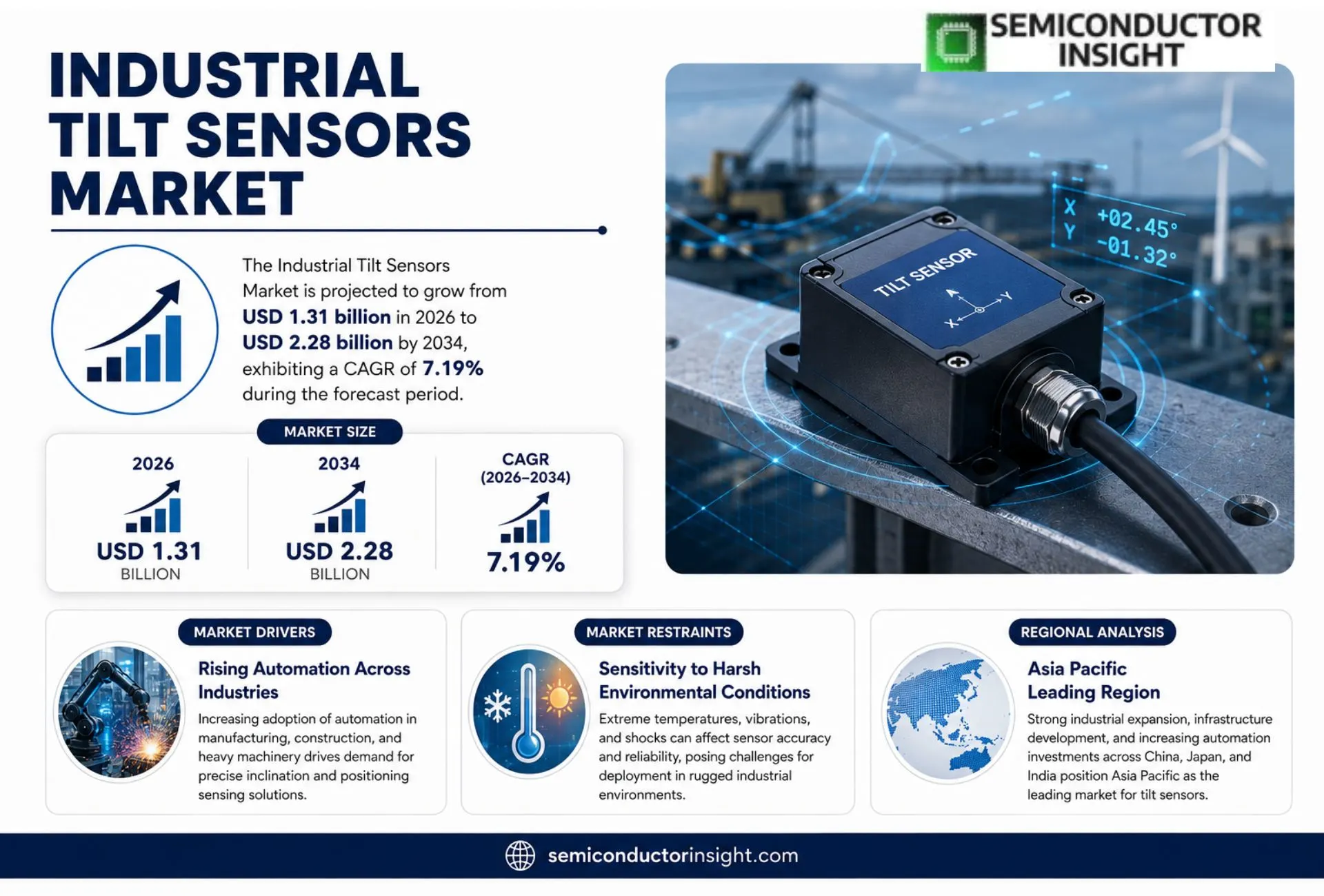
MARKET DRIVERS
Demand for Precision Industrial Automation
The shift toward Industry 4.0 has convinced plant operators that real‑time positional awareness is no longer optional. Industrial tilt sensors, which translate angular displacement into electrical signals, enable factories to align critical equipment with a precision previously achievable only by manual measurement. This capability tightens process control, reduces waste, and curtails downtime stemming from misaligned conveyors, mixers or pressure vessels. Operators in downstream refining, chemicals and high‑speed packaging report that a 0.01° improvement in tilt measurement translates into a 5–8% increase in product throughput and a 3–4% drop in energy consumption. Furthermore, the growing push for zero‑emission production imposes stricter safety standards. The ability of tilt sensors to detect lean angles beyond regulatory thresholds means operators can trigger automated shut‑offs before catastrophic failures occur, thereby safeguarding personnel and assets. In essence, the Industrial Tilt Sensors Market benefits directly from the convergence of lean manufacturing, energy compliance and safety vigilance.
Evolution of Sensor Technology and Robust Connectivity
At the same time, the sensor envelope itself has evolved to meet these exacting demands. Modern tilt components no longer rely on bulky strain‑gauge assemblies. Instead, high‑friction, low‑power MEMS devices coupled with silicon‑on‑insulator (SOI) structures boast measurement spans from -90° to +90° with a sub‑microdegree resolution. Integration of digital signal processors (DSP) and programmable analogue front‑ends allows the sensor to perform real‑time filtering and offset compensation without external hardware, reducing system complexity. Power consumption has also fallen below 5 mW for most configurations, making battery‑agnostic deployment viable in remote or hazardous sections of a plant. Connectivity is another critical lever. While wired networks (Modbus, Profibus) remain staples, the rise of low‑power wide‑area networks (LPWAN) such as LoRaWAN and NB‑IoT, as well as the promise of 5G edge computing, has endowed tilt sensor modules with the ability to transmit data directly to analytics platforms. The result is a layer of programmability that turns raw tilt information into actionable insights—predictive maintenance alerts, automated post‑alignment routines, or integrated process dashboards that feed into a plant’s digital twin.
➤ 2014 forecasted revenue reaching $1.9 billion for the tilt sensor segment, indicating a 23% compound annual growth over the next decade.
The convergence of these drivers yields a market capable of addressing both legacy system constraints and frontier digital applications. Existing infrastructure can be retrofitted with low‑profile, plug‑and‑play tilt sensors, allowing older machinery to meet modern safety and efficiency standards. When coupled with advanced analytics, the raw data is transformed into a business‑value metric, enabling factories to quantify the impact of alignment on capital expenditure and compliance posture. Firms that accelerate this transition stand to capitalize on a cascade of operational advantages that reverberate through the supply chain.
MARKET CHALLENGES
Regulatory Compliance and Technical Integration Hurdles
The promise of precision does not exist in a vacuum. Industrial tilt sensors must pass a battery of national and international certifications, including IEC 60068 for environmental testing and ISO 9001 for quality control. Operators also face divergent regional safety codes, such as the OSHA 29 CFR 1910.1000 in the United States and the German ATEX directive for hazardous areas. The need to certify the same hardware for multiple compliance regimes inflates the development cycle and drives up the entry cost of new players. On the implementation side, a retrofitted tilt system requires seamless integration with existing PLC logic, SCADA layers, or next‑generation OPC UA servers. The mismatch between legacy analog outputs and modern digital interfaces often mandates the purchase of conversion modules, significantly raising the total cost of ownership. Beyond hardware, the influx of data can strain existing IT infrastructure. Without proper boundary protection and data‑routing schemes, the risk of cyber‑attacks increases, especially for systems that control critical safety‑related functions. In short, the confluence of rigorous certification timelines, compatibility pressure, and data‑security demands creates a barrier that only a well‑structured go‑to‑market strategy can surmount.
Other Challenges
High Sensitivity to Environmental Factors
Industrial tilt sensors that exhibit microdegree precision often employ silicon‑based membranes that are susceptible to thermal drift, especially in furnaces or reactor vessels that maintain temperatures above 250 °C. Even modest temperature fluctuations can impose a bias of up to 0.5°, effectively wiping out the sensor’s nominal resolution. Vibration, too, compounds the issue; a 60 Hz field can introduce a signal alias that overwhelms the static tilt measurement unless a robust anti‑resonance filter is embedded. Dust and corrosive gases, common in oil‑and‑gas refining or battery manufacturing, can deposit on sensor contacts, leading to galvanic corrosion that disrupts the signal path over months. Electromagnetic interference (EMI) from nearby heavy‑current conductors, motor drives, or shielded cables can introduce pseudo‑tilt readings if the sensor housing lacks adequate shielding or proper grounding. Neglecting these environmental factors not only degrades measurement fidelity but can also trigger false safety interlocks, possibly halting production for long periods.
MARKET RESTRAINTS
Supply Chain Constraints and Component Scarcity
The evolution of tilt sensor packages has come at a cost. Modern devices rely on high‑purity alumina substrates and tantalum capacitors, commodities whose supply is increasingly erratic due to geopolitical tensions and escalating demand from the smartphone sector. These material bottlenecks inflate component lead times from 6 to 12 weeks, thereby disrupting the firm schedule that many manufacturers maintain for turnaround projects. Additionally, the high‑frequency electronic components that enable low‑power, high‑resolution performance are available from only a handful of suppliers. A single supplier outage can halt production lines, especially in cost‑sensitive markets such as automotive extrusion or packaging. Moreover, fluctuations in raw material prices have at times pushed unit manufacturing costs above the price elasticity threshold for certain low‑margin segments, causing buyers to delay procurement decisions until price stabilisation.
MARKET OPPORTUNITIES
Digital Twin Integration and Renewable Energy Applications
Recently, a wave of digitally mature plants has turned their tilt sensor data streams into core components of their digital twin ecosystem. By ingesting angular displacement in real time, simulation engines can verify equipment health against ideal operating envelopes, flagging early signs of imbalance that could otherwise lead to mechanical abrasion or unplanned shutdowns. In the hydrogen‑fuel production sector, where the pressure vessels and pipelines are subject to repeated thermal cycling, tilt monitoring enables operators to confirm that equipment remains level within the stringent 30‑minute window defined by ISO 21690. Meanwhile, the surge in renewable energy installations—solar thermal towers, wind turbines and battery farms—has amplified demand for tilt sensors that operate reliably in extreme temperature swings, sandstorms and high‑voltage environments. Operators now recognise that the cost of a tilt‑sensing module, often under $200, is dwarfed by the savings obtained through pre‑emptive bearing replacement or targeted insulation upgrades. Finally, with the advent of edge computing clusters, manufacturers can process tilt data locally, reducing latency, and offering a near‑real‑time fault‑diagnosis channel that shortens decision cycles from days to minutes. These convergent developments translate into a window of heightened commercial activity that, if capitalised swiftly, can secure a foothold in a market that is still fragmented across regional players.
Industrial Tilt Sensors Market Trends
Rise of Integrated Tilt‑Sensor RTD Composite Packs
Recent developments in sensor packaging have propelled integrated tilt‑sensor assemblies to the forefront of process control solutions. By embedding a resistive temperature detector (RTD) alongside a tilt element within a single hermetic housing, manufacturers can deliver tighter temperature compensation and reduce signal conditioning stages, which are often costly and fragile. This consolidation benefits industries that demand reliable orientation data under severe temperature swings, such as pipeline pressure monitors, LNG storage units, and offshore drilling platforms. For buyers, the combined functionality translates to lower total cost of ownership and simplified field installation, enabling faster deployment cycles and reducing downtime during maintenance windows.
Other Trends
Shift Toward Dual‑Axis Sensors in Automation
The growing complexity of automated production lines has sharpened demand for dual‑axis tilt sensors. Unlike single‑axis designs that record only forward‑backward tilt, dual‑axis units measure pitch and roll, providing a full three‑dimensional orientation picture. Automation engineers now prefer dual‑axis modules for robotic arm calibration, safety interlocks, and spool handling within automotive and aerospace assembly cells. The richer dataset also allows advanced fault detection algorithms to differentiate between intentional movements and abnormal deviations. As a result, facilities can tighten quality thresholds within the Industrial Tilt Sensors Market while streamlining control architecture and lowering long‑term maintenance burdens.
Adoption of Wireless Tilt‑Sensor Modules for Remote Monitoring
Wireless tilt‑sensor modules have seen accelerated traction, driven by the need to monitor heavy equipment and hazardous process installations at remote sites. Battery‑operated units leveraging low‑power protocols such as LoRa‑WAN satisfy regulatory constraints while preserving data fidelity. In the rail and pipeline corridors, operators now link tilt data to central SCADA systems, enabling real‑time monitoring of structural health and spill containment. The shift also encourages predictive maintenance strategies, reducing unscheduled downtime, trimming warranty claims, and allocating resources more efficiently across dispersed work cells.
Sustainability‑Driven Design and Materials Innovation
Overarching regulatory pressure and a shift toward circular supply chains have spurred a wave of sustainability‑driven material choices within the Industrial Tilt Sensors Market. Architects of sensor housings are increasingly employing recyclable polyphenylene sulfide (PPS) and bio‑based epoxies to meet ISO 14001 and emerging EU green taxonomy mandates. The move toward lighter, high‑temperature polymers reduces actuation energy and mitigates heat‑related drift, thereby enhancing overall system reliability. For vendors, the adoption of eco‑friendly substrates signals a competitive advantage, as procurement teams in the aerospace and chemical sectors are already factoring life‑cycle impact into their SME selection matrices. Products that can be recycled or manufactured with reduced carbon intensity attract premium pricing and a more resilient customer base.
COMPETITIVE LANDSCAPE
Key Industry Players
Industrial Tilt Sensors Market: Competitive Dynamics and Market Structure
The industrial tilt sensor arena is dominated by a handful of well‑established manufacturers that embed advanced MEMS and electromechanical technologies into high‑reliability sensing solutions. Sensata Technologies, for instance, commands a prominent share through its robust portfolio of digital tilt units used across construction, chemical processing, and rail logistics. The company’s vertical integration—from silicon fabrication to field‑ready assemblies—provides a strategic advantage in meeting stringent uptime requirements and compliance standards. Balluff and TE Connectivity further consolidate the Tier‑1 bracket, each offering a mix of single‑ and dual‑axis models that cater to the broader automation and safety sectors. Their joint emphasis on firmware updates and predictive diagnostics contributes to lower total cost of ownership for industrial clients, reinforcing their leadership positioning. This concentration at the top tier reflects the capital intensity of manufacturing, the need for stringent quality controls, and the value of economies of scale in sourcing high‑precision components. Consequently, early adopters of sensor‑enabled monitoring systems gravitate toward these incumbents for proven reliability and expansive product lines.
Complementing the dominant Tier‑1 players, a diverse cohort of niche players—Baumer, Murata, Pepperl+Fuchs, SICK, and Turck, among others—introduces significant differentiation through specialized feature sets such as high‑temperature tolerance, ruggedized housings for offshore applications, and integration with SCADA platforms. These companies have carved out strong footholds in niche verticals like offshore oil and gas, harsh chemical plants, and autonomous vehicle testing, often leading the way in innovative packaging designs and multi‑parameter consolidation. Additionally, emerging entrants such as Aeron Systems, PM Instrumentation, Piher Sensing Systems, Senther, BWSENSING, ASC Holdings, and Nano Sensors are expanding the ecosystem by offering low‑profile sensors, cost‑effective analog outputs, and open‑API firmware environments that lower barriers to adoption for small‑to‑mid‑size enterprises and start‑ups. The increasing demand for real‑time condition monitoring in remote or safety‑critical environments fuels competition not only on functionality but also on cybersecurity resilience and factory‑automation interoperability, both of which are becoming pivotal in the long‑term competitive valuation of tilt sensor suppliers.
List of Key Industrial Sensors Companies Profiled
- Sensata Technologies
- Balluff
- TE Connectivity
- Murata Manufacturing
- Baumer
- Pepperl+Fuchs
- SICK
- Turck
- Aeron Systems
- PM Instrumentation
- Piher Sensing Systems
- Senther
- BWSENSING
- ASC Holdings
- Nano Sensors
Segment Analysis:
| Segment Category | Sub-Segments | Key Insights |
| By Type |
|
Single Axis Tilt Sensor is the most widely adopted variant for its simplicity and cost effectiveness. Key advantages include:
|
| By Application |
|
Construction remains the leading application due to the necessity of monitoring equipment orientation. Highlights include:
|
| By End User |
|
Process Industry dominates due to high demand for precise level control. Key points:
|
| By Operating Environment |
|
Outdoor Applications offer durable and high‑performance tilt sensing in harsh conditions. Highlights include:
|
| By Deployment Mode |
|
Fixed Installation remains the preferred deployment for precision measurement. Key aspects:
|
Regional Analysis: Industrial Tilt Sensors Market
Heightened safety mandates and the critical necessity for precise load monitoring have forced factories to adopt tilt detection. The push for zero‑defect production and advanced fault‑tolerant systems further fuels demand, enabling real‑time monitoring and anomaly prevention across critical assemblies.
The North American arena is dominated by a handful of entrenched OEMs and a growing cohort of nimble start‑ups, fostering a blend of reliable, proven solutions with high‑tech innovations that target niche verticals such as aerospace and energy.
Recent breakthroughs in wireless signaling and energy‑harvesting sensor elements have shortened deployment times and reduced maintenance footprints, making tilt devices more attractive across maintenance‑heavy sectors.
Direct manufacturer sales, partnered industrial distributors, and digital marketplace platforms jointly shape a multi‑channel network that balances high‑value transaction fidelity with widespread accessibility.
Europe
European industrial clusters, anchored by robust steel, automotive, and aerospace industries, rely on tilt sensors to enforce rigorous safety standards and to optimize the operation of heavy-duty machinery. During the last decade, the region’s emphasis on environmental compliance and automation has led to a sophisticated uptake of sensor arrays attached to lifts, cranes, and precision milling machinery. The European Union’s forthcoming safety directives on hazardous machinery will bolster the demand for real‑time tilt detection, forcing manufacturers to upgrade legacy metal‑fiber – servo‑controlled – and robotic platforms. Economic incentives for green technologies, such as subsidies for smart factories, urge companies to integrate tilt sensors to reduce downtime and energy consumption. The convergence of stringent rule‑making, market maturity, and a tech‑savvy production base ensure that Europe remains a significant hub for sensor innovation, especially in the burgeoning field of digital twins and IIoT‑enabled predictive maintenance. The region’s capacity to translate stringent safety specifications into advanced sensor deployments positions it as a critical contributor to global tilt sensor demand, shaping both supply strategies and price sensibilities across the market.
Asia‑Pacific
Asia‑Pacific offers a vibrant mix of manufacturing hubs and high‑growth service sectors, feeding a pervasive tilt sensor adoption curve across power, automotive, and semiconductor factories. Electrification of rail and shipping networks is intensifying demand for sensors that monitor suspension integrity, reduce wear, and ensure accurate alignment for heavy‑railset and container handling loads. The continual shift toward smart manufacturing, favored by national policies in China, Japan, and South Korea, necessitates amplified sensor deployments to aid real‑time monitoring of production lines and to support lean‑production philosophies. Concurrently, the expansion of semiconductor fabs, dependent on low‑vibration and precise orientation control, is spurring demand for high‑resolution tilt sensors with strict temperature tolerances. Heightened safety concerns, combined with government incentives for automation, decrease the cost of sensor integration, thereby accelerating market penetration. In this environment, the supply side sees a mix of domestically produced components and imported high‑precision units, generating a competitive landscape where cost, reliability, and regulatory compliance are primary differentiators. The region’s eclectic industrial architecture, coupled with strong governmental commitment to digital transformation, positions Asia‑Pacific as a critical growth engine for tilt sensor utilization, both in conventional sectors and emerging technologies.
South America
South America’s industrial sensor market continues to expand as infrastructure renewals and expanding manufacturing corridors drive the need for heightened safety controls. Brazil, Argentina, Chile, and Colombia have invested in modernizing mining and oil‑and‑gas operations, sectors that depend heavily on accurate tilt measurements to monitor drilling rigs, excavators, and storage facilities. Recent reforms in safety regulation, supported by international funding agencies, are prompting operators to adopt sensor technology that can log real‑time data for audit and compliance purposes. The sizeable growth in Latin American auto‑assembly plants and flexible packaging lines also feed into the demand for tilt sensors that reduce product variability and protect delicate components. While the capital availability remains constrictive, the increasing emphasis on process safety and sustainability is gradually lowering the entry barrier for sensor solutions. As the local industry acknowledges the financial advantages of reduced energy consumption and downtime, tilt sensor adoption is gaining a foothold across the continent. The South American market, therefore, provides a fertile arena for ethical suppliers focused on cost‑effective, durable, and easy‑to‑install sensor modules, poised to meet evolving regulatory demands.
Middle East & Africa
The Middle East and Africa exhibit a distinct pattern of industrial tilt sensor utilization centered around energy, petrochemical, and infrastructure development. In the United Arab Emirates and Saudi Arabia, oilfield operations employ tilt sensors across drilling platforms and flare stacks, where slope monitoring helps mitigate catastrophic failure risks. Similarly, water distribution and desalination plants spread across North Africa rely on tilt detection to guarantee pump integrity under variable load conditions. The region’s climate‑intolerant environments pose unique challenges that deter generic sensor deployments, driving demand for ruggedized units that can withstand high temperatures, corrosive chemicals, and seismic activity. Governmental initiatives aimed at diversifying economies and developing renewable energy assets—such as solar farms in Egypt and wind farms in Morocco—generate new use cases for sensors that ensure optimal turbine alignment and optimize maintenance regimens. With the growing awareness of safety and environmental stewardship, local manufacturers are beginning to invest in domestic R&D for sensor solutions tailored to the region’s specialized needs, fostering a slow but steady shift toward a self‑sufficient supply chain. Consequently, the Middle East & Africa market is transitioning from reactive safety responses to proactive, data‑centric approaches that elevate tilt sensor integration into a strategic asset for industrial resilience.
Report Scope
This market research report provides a comprehensive analysis of the Industrial Tilt Sensors Market , covering the forecast period 2026–2035. It offers detailed insights into market dynamics, technological advancements, competitive landscape, and key trends shaping the industry.
Key focus areas of the report include:
-
Market Overview: The report begins with an overview outlining its current market scenario, key growth indicators, and industry transformation drivers. It discusses macroeconomic factors, demand–supply balance, regulatory landscape, and the strategic role of semiconductors in powering advancements across industries such as automotive, telecommunications, consumer electronics, and industrial automation.
- Market Size & Forecast: Historical data and future projections for revenue, unit shipments, and market value across major regions and segments.
- Segmentation Analysis: Detailed breakdown by product type, technology, application, and end-user industry to identify high-growth segments and investment opportunities.
- Regional Insights: Insights into market performance across North America, Europe, Asia-Pacific, Latin America, and the Middle East & Africa, including country-level analysis where relevant.
- Competitive Landscape: Profiles of leading market participants, including their product offerings, R&D focus, manufacturing capacity, pricing strategies, and recent developments such as mergers, acquisitions, and partnerships.
- Technology Trends & Innovation: Assessment of emerging technologies, integration of AI/IoT, semiconductor design trends, fabrication techniques, and evolving industry standards.
- Market Drivers & Restraints: Evaluation of factors driving market growth along with challenges, supply chain constraints, regulatory issues, and market-entry barriers.
- Stakeholder Insights: Insights for component suppliers, OEMs, system integrators, investors, and policymakers regarding the evolving ecosystem and strategic opportunities.
Primary and secondary research methods are employed, including interviews with industry experts, data from verified sources, and real-time market intelligence to ensure the accuracy and reliability of the insights presented.
FREQUENTLY ASKED QUESTIONS:
What is the current market size of Industrial Tilt Sensors Market?
-> The Industrial Tilt Sensors Market was valued at USD million in 2026 and is expected to reach USD million by 2035.
What is the projected CAGR for the Industrial Tilt Sensors Market?
-> The market is projected to grow at a CAGR of X% between 2026 and 2035.
How is the Industrial Tilt Sensors Market defined?
-> It refers to the market for devices that detect angular displacement and tilt angle in industrial applications, enabling safety and automation functions.
What are the main product type segments?
-> The market is segmented by type into Single Axis and Dual Axis tilt sensors.
Which application segments drive the market?
-> Key application segments include Construction, Railway, Vehicle, Industrial, and Others, with construction and railway showing the highest growth potential.
What research methodology is used in the report?
-> The study employs a combination of primary interviews, secondary data collection, and quantitative modeling to generate forecasts.
What is the base year for the analysis?
-> The base year for the market analysis is 2020, with historical data spanning 2015‑2020.
Who are the top players in Industrial Tilt Sensors Market?
-> Leading companies include Sensata Technologies, Balluff, TE Connectivity, Murata Manufacturing, Baumer, Pepperl+Fuchs, SICK, Turck, Aeron Systems and others.
Which region is expected to dominate the market?
-> Asia is projected to be the largest region by revenue, driven by strong industrial automation demand in China, Japan and India.
What are the primary growth drivers for the market?
-> Growth is fueled by increasing automation in manufacturing, safety regulations, expansion of smart infrastructure, and rising demand for predictive maintenance solutions.
What are the key market restraints?
-> Restraints include high component costs, stringent certification requirements, and supply chain disruptions for critical semiconductor materials.
What emerging trends are shaping the market?
-> Emerging trends encompass integration of AI/IoT for real‑time monitoring, development of low‑power MEMS tilt sensors, and the shift toward wireless sensor networks.

Get Sample Report PDF for Exclusive Insights
Report Sample Includes
- Table of Contents
- List of Tables & Figures
- Charts, Research Methodology, and more...
 Download Sample Report PDF