IGBT FZ Silicon Market Insights
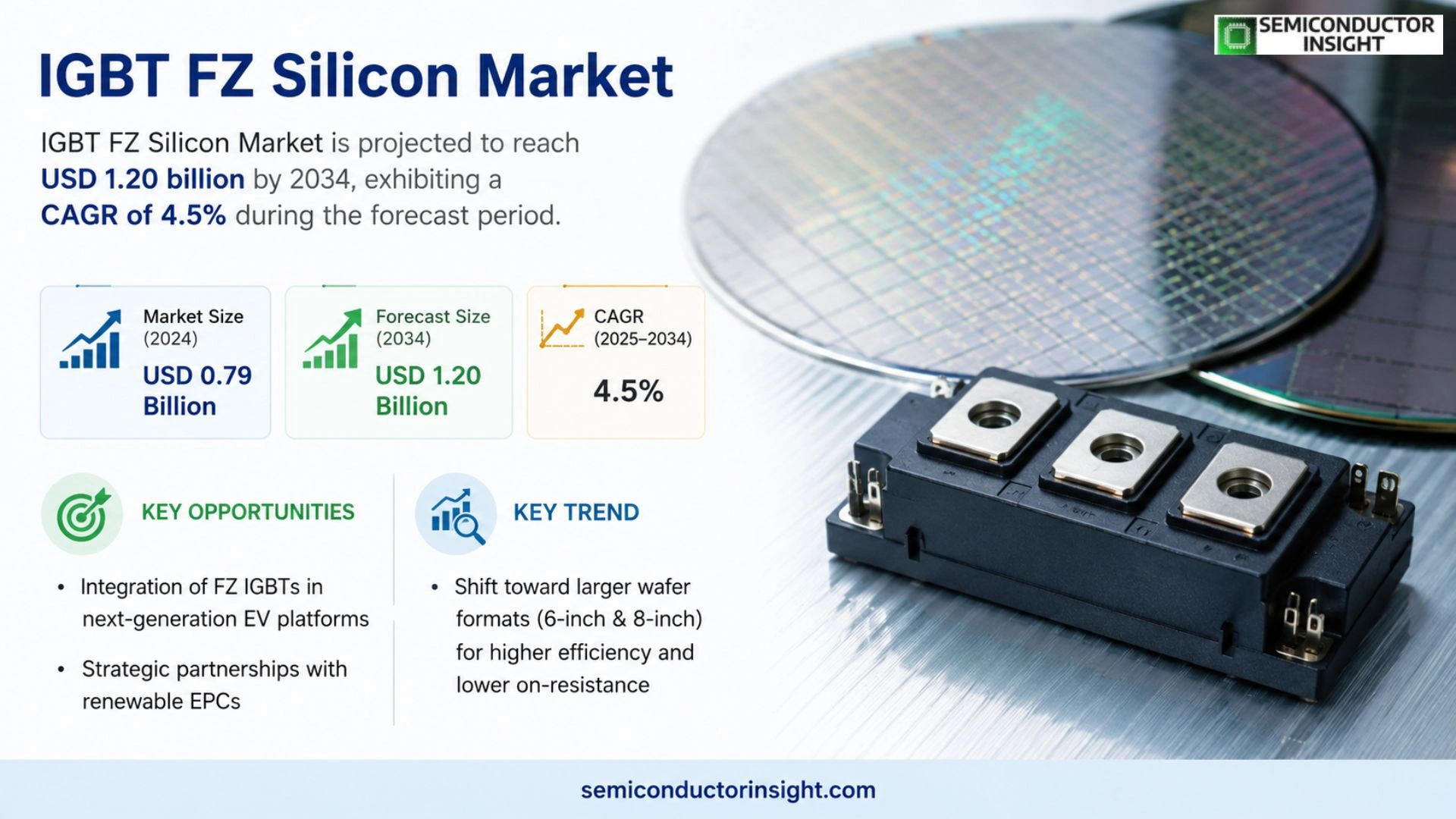
Global IGBT FZ Silicon Market size was valued at USD 850 million in 2024 and is projected to reach USD 1.20 billion by 2034, exhibiting a CAGR of 4.5% during the forecast period.
IGBT FZ silicon denotes high‑purity float‑zone silicon wafers employed in the fabrication of insulated‑gate bipolar transistors (IGBTs). Its low defect density and extended carrier lifetime enable power devices that combine high efficiency with rapid switching,attributes critical for automotive converters, renewable‑energy inverters, and rail‑transit traction systems.
The market gains traction as automotive electrification standards tighten and utility‑scale solar and wind projects seek more reliable power conversion hardware. Recent capacity expansions announced by leading producers such as Wacker Chemie and Shin‑Etsu Chemical reinforce confidence in sustained demand. In March 2024, TOPSIL GlobalWafers disclosed a joint venture with a major semiconductor foundry to secure supply of six‑inch wafers for next‑generation IGBT modules, highlighting the strategic importance of this substrate.
MARKET DRIVERS
Rising Demand for High‑Efficiency Power Conversion
IGBT FZ Silicon Market is being propelled by automotive manufacturers’ shift toward electrified drivetrains. As vehicles adopt higher voltage architectures, designers turn to Fast Switching (FZ) IGBTs for their ability to minimize conduction losses while delivering robust thermal performance. This efficiency gain translates directly into longer driving ranges and lower cooling system complexity, a value proposition that resonates across OEMs.
Expansion of Renewable Energy Infrastructure
Utility‑scale solar and wind projects increasingly rely on inverter topologies that demand fast, reliable switching devices. FZ‑type IGBTs meet these requirements by offering tighter turn‑on/turn‑off times, which improves grid‑integration stability and reduces harmonic distortion. Consequently, investors in renewable assets view IGBT FZ Silicon Market as a strategic component for achieving higher plant availability.
➤ Manufacturers that accelerate their FZ‑process line upgrades can capture early‑mover advantages in both automotive and renewable segments.
Beyond the core applications, industrial motor drives are adopting 800 V and 1200 V platforms where the voltage margin afforded by FZ silicon enables designers to shrink passive components. This trend drives a cascade of cost reductions that further incentivizes adoption across factories seeking to modernize equipment.
MARKET CHALLENGES
Supply Chain Volatility for High‑Purity Silicon
Fabrication of FZ IGBTs depends on ultra‑pure silicon wafers, a material whose global supply is constrained by limited polysilicon production capacity. When demand spikes, lead times extend, prompting manufacturers to hold larger inventories and eroding profit margins. Companies that fail to secure stable wafer contracts may experience delayed product launches.
Other Challenges
Manufacturing Yield Sensitivity
The aggressive doping profiles required for FZ performance increase the probability of crystal defects. Even modest yield drops can inflate unit costs substantially, pressuring price‑sensitive customers in emerging markets.
MARKET RESTRAINTS
Regulatory Hurdles in Automotive Safety Standards
New safety regulations for electric vehicles mandate rigorous testing of power semiconductors under extreme thermal cycling. The certification process for FZ IGBTs is more complex than for conventional devices, extending time‑to‑market for novel designs. This regulatory load can deter smaller OEMs from adopting the latest silicon technologies.
Cost Competition from Alternative Materials
Competing technologies such as silicon carbide (SiC) and gallium‑nitride (GaN) are narrowing the performance gap with FZ silicon, especially in high‑frequency applications. When customers evaluate total cost of ownership, the premium associated with FZ processing may tilt decisions toward these alternatives, limiting market expansion.
MARKET OPPORTUNITIES
Integration of FZ IGBTs in Next‑Generation EV Platforms
Upcoming EV models targeting 400 kW and higher power trains are architecting inverter topologies that exploit the low‑loss profile of FZ IGBTs. Suppliers that align their product roadmaps with these power thresholds can secure design‑win contracts, unlocking revenue streams that outpace legacy silicon offerings.
Strategic Partnerships with Renewable EPCs
Engineering‑procurement‑construction firms developing large‑scale solar farms are seeking turnkey inverter solutions. By collaborating with EPCs to co‑develop FZ‑based inverter modules, semiconductor manufacturers can embed themselves early in the supply chain, ensuring recurring demand as projects scale.
IGBT FZ Silicon Market Trends
Shift Toward Larger Wafer Formats
IGBT FZ Silicon Market is seeing a pronounced migration from 5‑inch to 6‑inch and 8‑inch wafer platforms. Manufacturers such as Wacker Chemie and Shin‑Etsu Chemical have expanded capacity on 6‑inch lines to accommodate automotive power‑module orders that require higher current ratings while keeping unit cost competitive. This transition is not merely a capacity adjustment; it reflects a strategic response to OEM specifications that prioritize lower on‑resistance and higher thermal performance. As supply chains realign, downstream fabricators are re‑tooling their assembly lines, creating a feedback loop that reinforces the preference for larger formats.
Other Trends
Application‑Driven Diversification
Rail‑transit projects and smart‑grid installations are accelerating the demand for IGBT FZ Silicon components that can operate under wide voltage swings and harsh environmental conditions. Aerospace programs, while still a niche segment, are requesting silicon that meets stricter radiation‑hardness standards, prompting niche suppliers like Grinm Semiconductor to develop specialized grades. Automotive manufacturers, especially those venturing into electric‑vehicle power‑train architectures, are prioritizing wafers that support higher switching frequencies, which in turn drives R&D investments in low‑loss crystal growth techniques.
Competitive Consolidation and Innovation
The competitive landscape of IGBT FZ Silicon Market is tightening as the top five players collectively command a substantial revenue share. Companies such as TCL Zhonghuan and SUMCO have entered strategic alliances to share epitaxial‑growth facilities, reducing capital intensity while expanding product portfolios. Meanwhile, emerging entrants like PlutoSemi are leveraging advanced defect‑reduction processes to carve out market niches in high‑voltage applications. This blend of consolidation and disruptive innovation is reshaping pricing dynamics; buyers now negotiate contracts that balance volume discounts with technology‑access clauses, ensuring supply security without sacrificing performance gains.
COMPETITIVE LANDSCAPE
Key Industry Players
Competitive Positioning in the Global IGBT FZ Silicon Market
Wacker Chemie remains the benchmark supplier for high‑purity FZ silicon, leveraging a vertically integrated production chain that couples crystal growth with advanced wafer slicing. Its European headquarters host a deep‑tech R&D hub that continuously refines defect‑density control, giving it a pricing edge and fostering long‑term contracts with automotive and rail‑transit OEMs. The company’s scale permits simultaneous investment in 8‑inch and emerging 12‑inch furnace lines, a strategic move that cushions it against volatility in raw‑material pricing while preserving a dominant share of the global revenue pool. Smaller regional firms must navigate a landscape where Wacker’s extensive logistics network and proven reliability set the bar for customer expectations, shaping the overall competitive structure into a handful of global leaders backed by a constellation of specialized players.
Beyond the market leader, Shin‑Etsu Chemical, SUMCO, and TCL Zhonghuan anchor the Asian segment with aggressive capacity expansions that target the high‑volume 6‑inch and 8‑inch wafer corridors. Shin‑Etsu’s focus on defect‑free crystal orientation has earned it a reputation among power‑electronics designers seeking tighter breakdown voltage margins. SUMCO complements this strength through a diversified product slate that includes both standard and custom‑thickness wafers, enabling it to satisfy niche requirements in aerospace and smart‑grid applications. TCL Zhonghuan, backed by a strong domestic supply chain, pursues cost leadership while investing in next‑generation furnace technology to improve throughput. Additional players such as Topsil GlobalWafers, Grinm Semiconductor, Beijing Jingyuntong, PlutoSemi, Infineon Technologies, ON Semiconductor, STMicroelectronics, and NXP Semiconductors round out the competitive field, each exploiting distinct regional partnerships or application‑specific expertise to capture market share.
List of Key IGBT FZ Silicon Companies Profiled
- Wacker Chemie
- Shin‑Etsu Chemical
- TCL Zhonghuan
- SUMCO
- Topsil GlobalWafers
- Grinm Semiconductor
- Beijing Jingyuntong
- PlutoSemi
- Infineon Technologies
- ON Semiconductor
- STMicroelectronics
- NXP Semiconductors
Segment Analysis:
| Segment Category | Sub-Segments | Key Insights |
| By Type |
|
5‑Inch
|
| By Application |
|
Rail Transit
|
| By End User |
|
Renewable Energy
|
| By Process Technology |
|
Epitaxial
|
| By Innovation Focus |
|
Advanced Packaging
|
Regional Analysis: IGBT FZ Silicon Market
Asia‑Pacific
Tier‑1 fabs have commissioned additional epitaxial reactors, effectively lifting yearly output by a meaningful margin. Capacity expansions are synchronized with OEM forecasts, ensuring that volume growth does not outpace wafer availability.
Regional logistics hubs now host integrated buffer stocks, reducing lead‑time volatility caused by geopolitical shifts. Partnerships between substrate suppliers and device assemblers have hardened the downstream flow.
Tight emissions standards and energy‑saving mandates compel governments to prioritize silicon‑based power devices. Certification pathways have been streamlined, allowing quicker market entry for new IGBT families.
High‑density data‑center converters and offshore wind infeed systems are creating niche demand spikes, prompting design houses to tailor FZ devices for elevated temperature operation.
North America
North America retains a sophisticated design ecosystem, where leading automotive and industrial players conduct early‑stage validation of IGBT FZ Silicon components. Although domestic wafer output lags behind Asia‑Pacific, strategic alliances with Asian manufacturers mitigate shortfalls. The region’s emphasis on reliability testing and compliance with stringent UL standards translates into higher per‑unit margins, encouraging niche suppliers to specialize in high‑power, low‑loss variants for aerospace and rail applications.
Europe
European manufacturers benefit from a tightly regulated market that rewards energy‑efficiency gains. Initiatives such as the EU Green Deal have spurred investment in renewable‑energy converters, where FZ silicon devices excel in high‑voltage, high‑temperature environments. Collaborative research programs among German, French, and Swedish universities accelerate material‑engineering breakthroughs, subtly shifting the competitive balance toward domestically sourced modules.
South America
In South America, IGBT FZ Silicon Market is still emerging, with growth anchored to expanding renewable‑energy projects, particularly in Brazil’s hydro‑electric sector. Local assemblers are beginning to source silicon wafers from nearby Asian suppliers, reducing import duties and fostering a modest domestic ecosystem. Market participants focus on cost‑effective solutions for utility‑scale inverters, where durability outweighs premium performance.
Middle East & Africa
The Middle East & Africa region experiences demand driven by large‑scale solar‑farm deployments and gas‑turbine retrofits. While most silicon components are imported, regional hubs in the United Arab Emirates are establishing testing facilities that certify FZ devices for desert‑operating conditions. This move signals a gradual shift from pure import reliance to a value‑added service model that could attract niche manufacturers.
Report Scope
This market research report provides a comprehensive analysis of the IGBT FZ Silicon Market , covering the forecast period 2026–2034. It offers detailed insights into market dynamics, technological advancements, competitive landscape, and key trends shaping the industry.
Key focus areas of the report include:
- Market Overview: The report begins with an overview outlining its current market scenario, key growth indicators, and industry transformation drivers. It discusses macroeconomic factors, demand–supply balance, regulatory landscape, and the strategic role of semiconductors in powering advancements across industries such as automotive, telecommunications, consumer electronics, and industrial automation.
- Market Size & Forecast: Historical data and future projections for revenue, unit shipments, and market value across major regions and segments.
- Segmentation Analysis: Detailed breakdown by product type, technology, application, and end-user industry to identify high-growth segments and investment opportunities.
- Regional Insights: Insights into market performance across North America, Europe, Asia-Pacific, Latin America, and the Middle East & Africa, including country-level analysis where relevant.
- Competitive Landscape: Profiles of leading market participants, including their product offerings, R&D focus, manufacturing capacity, pricing strategies, and recent developments such as mergers, acquisitions, and partnerships.
- Technology Trends & Innovation: Assessment of emerging technologies, integration of AI/IoT, semiconductor design trends, fabrication techniques, and evolving industry standards.
- Market Drivers & Restraints: Evaluation of factors driving market growth along with challenges, supply chain constraints, regulatory issues, and market-entry barriers.
- Stakeholder Insights: Insights for component suppliers, OEMs, system integrators, investors, and policymakers regarding the evolving ecosystem and strategic opportunities.
Primary and secondary research methods are employed, including interviews with industry experts, data from verified sources, and real-time market intelligence to ensure the accuracy and reliability of the insights presented.
FREQUENTLY ASKED QUESTIONS:
What is the current market size of IGBT FZ Silicon Market?
-> IGBT FZ Silicon Market size is projected to reach USD 1.20 billion by 2034, exhibiting a CAGR of 4.5% during the forecast period.
Which key companies operate in IGBT FZ Silicon Market?
-> Key players include Wacker Chemie, Shin-Etsu Chemical, TCL Zhonghuan, SUMCO, Topsil GlobalWafers, Grinm Semiconductor, Beijing Jingyuntong, PlutoSemi, among others.
What are the key growth drivers?
-> Key growth drivers include rising demand in automotive, smart grid, rail transit, and aerospace applications, as well as ongoing advancements in semiconductor wafer technology.
Which region dominates the market?
-> Asia dominates the market, with China representing a significant share of regional growth.
What are the emerging trends?
-> Emerging trends include development of larger‑diameter wafers (5‑inch, 6‑inch, 8‑inch), increased focus on high‑efficiency IGBT devices, and integration of advanced materials to improve performance.
Get Sample Report PDF for Exclusive Insights
Report Sample Includes
- Table of Contents
- List of Tables & Figures
- Charts, Research Methodology, and more...
 Download Sample Report PDF