High Voltage IGBT (≥3.3kV) Market Insights
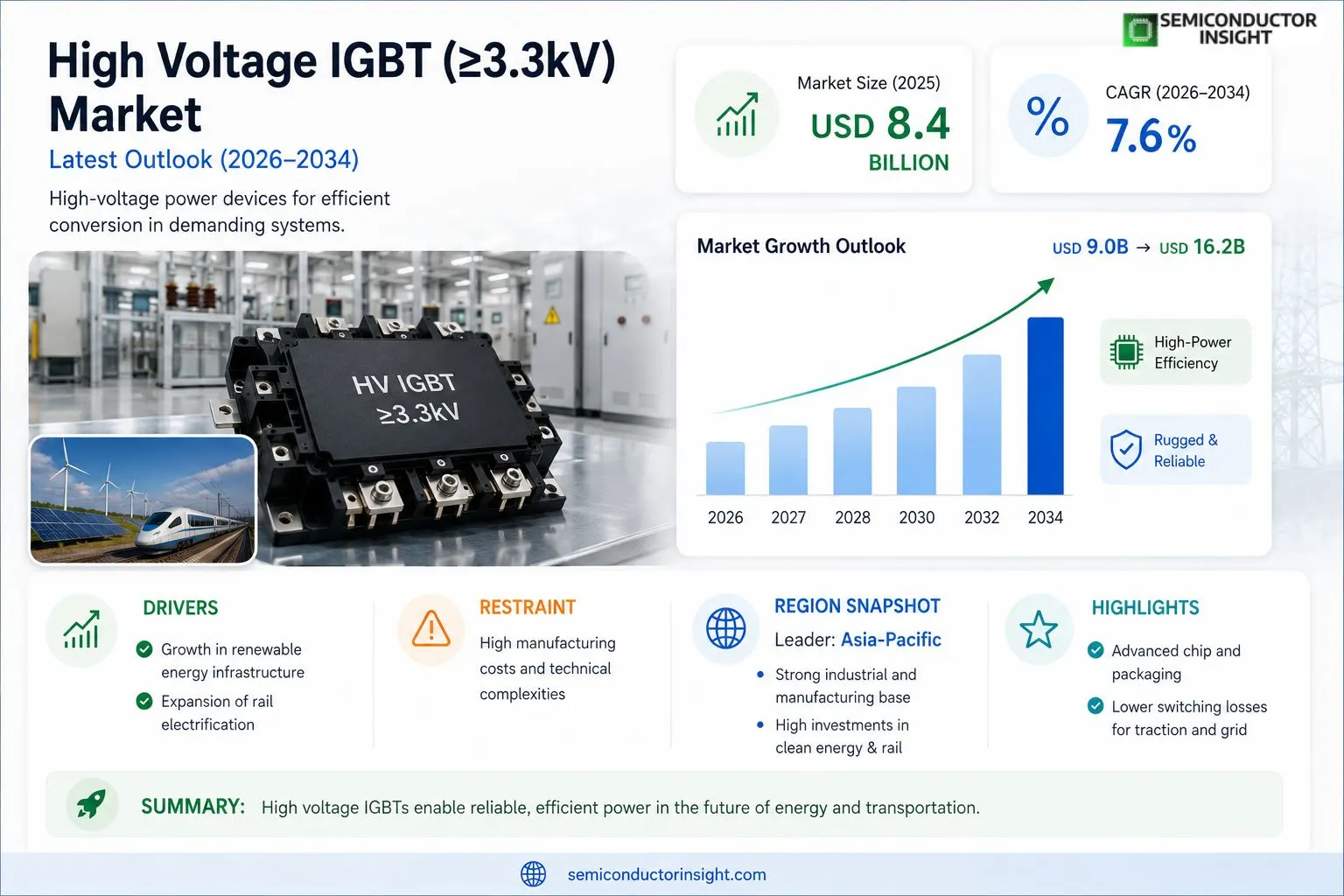
Global High Voltage IGBT (≥3.3kV) Market size was valued at USD 8.4 billion in 2025. The market is projected to grow from USD 9.0 billion in 2026 to USD 16.2 billion by 2034, exhibiting a CAGR of 7.6% during the forecast period.
High Voltage IGBTs rated at 3.3 kV and above are advanced power semiconductor devices that combine the high input impedance of MOSFETs with the high-current handling capability of bipolar transistors. These components enable efficient switching and control of large electrical loads in demanding environments, offering low conduction losses and robust performance under high-voltage stress. They are essential for applications requiring reliable power conversion and inversion at elevated voltage levels.
The market is experiencing steady growth due to several factors, including the expansion of renewable energy infrastructure, increasing adoption of rail electrification, and rising demand for high-power industrial drives. Furthermore, the push toward modernizing power grids with HVDC transmission systems and STATCOM solutions is accelerating the need for these reliable high-voltage modules. Initiatives by key players continue to drive innovation, with advancements in chip technology and packaging enhancing efficiency and thermal performance. For instance, manufacturers are introducing next-generation designs with improved carrier control and lower switching losses tailored for traction and grid applications. Infineon Technologies, Mitsubishi Electric, Fuji Electric, and Semikron Danfoss are among the leading companies operating in this space with comprehensive portfolios of high-voltage IGBT modules.
MARKET DRIVERS
Rising Demand in Renewable Energy and Grid Infrastructure
High Voltage IGBT (≥3.3kV) Market is propelled by Global expansion of renewable energy systems, particularly in utility-scale solar inverters and wind turbines. These devices enable efficient power conversion and handling of high voltages essential for grid integration, supporting the transition to cleaner energy sources with improved thermal stability and reliability.
Expansion of Rail Traction and Electrified Transportation
High Voltage IGBT modules are critical for railway propulsion systems and high-speed trains, where they deliver rugged performance in harsh environments. Innovations such as Mitsubishi Electric’s next-generation 4.5kV/1,200A HVIGBT modules enhance operational longevity and efficiency in traction applications, driving sustained market demand amid global rail electrification initiatives.
➤ Growth in high-voltage applications continues as IGBTs maintain dominance in scenarios requiring robust high-power handling, with the broader IGBT module market showing strong CAGRs supported by industrial and energy sectors.
Additionally, increasing adoption in industrial motor drives and HVDC systems further accelerates demand, as these semiconductors provide cost-effective solutions for high-power conversion while manufacturers focus on advanced designs that improve switching performance and power density.
MARKET CHALLENGES
Competition from Wide-Bandgap Semiconductors
The emergence of Silicon Carbide (SiC) and Gallium Nitride (GaN) devices presents a notable challenge for High Voltage IGBT (≥3.3kV) adoption, particularly in applications prioritizing higher efficiency and compactness. While IGBTs retain advantages in certain high-voltage, high-power scenarios, SiC alternatives are gaining traction in medium-to-high voltage ranges for renewable energy and industrial uses.
Other Challenges
Thermal Management and Design Complexity
High Voltage IGBT modules operating at elevated ratings require sophisticated cooling solutions and careful thermal design to manage junction temperatures and switching losses, increasing system complexity and development costs for integrators.
Supply Chain and Manufacturing Constraints
Extended lead times for specialized high-voltage components, combined with silicon wafer availability issues, can delay production schedules and impact large-scale deployments in rail, grid, and renewable projects.
MARKET RESTRAINTS
High Manufacturing Costs and Technical Barriers
Production of High Voltage IGBT (≥3.3kV) modules involves significant costs related to advanced packaging, materials, and qualification processes for reliability in demanding applications. These elevated expenses can limit adoption among smaller players and in cost-sensitive projects, despite performance benefits.
The sophisticated integration requirements, including specialized gate drivers and protection circuits for high-voltage operation, further restrain broader market penetration by demanding substantial R&D investment and expertise.
MARKET OPPORTUNITIES
Technological Advancements and Emerging Applications
Ongoing innovations in HVIGBT design, such as improved soft-punch-through structures and higher current ratings, open opportunities for enhanced efficiency in next-generation rail, renewable inverters, and grid stabilization systems. These developments allow IGBTs to maintain competitiveness against alternatives while addressing demands for higher power density. Expansion into energy storage, smart grids, and high-voltage industrial drives presents significant growth potential, as global electrification trends and infrastructure investments drive the need for reliable high-voltage power electronics solutions.
High Voltage IGBT (≥3.3kV) Market Trends
Expansion of Renewable Energy and Rail Electrification Driving Demand
High Voltage IGBT modules rated at 3.3 kV and above continue to see robust adoption as critical components in power electronics systems. These devices combine the high input impedance characteristics of MOSFETs with the superior current-handling capabilities of bipolar transistors, delivering efficient switching and control for large electrical loads under high-voltage conditions. Their ability to manage low conduction losses while maintaining robust performance makes them indispensable in applications that require reliable power conversion at elevated voltage levels.The market is experiencing steady growth fueled by the ongoing expansion of renewable energy infrastructure, which demands advanced power semiconductors for efficient energy conversion and grid integration. Similarly, increasing adoption of rail electrification projects worldwide is boosting the requirement for high-voltage IGBTs in traction systems. These trends reflect the broader shift toward electrified transportation and sustainable power generation, where high-performance switching devices are essential for system reliability and efficiency.
Other Trends
Grid Modernization and HVDC Transmission Advancements
Modernization efforts targeting power grids, including the deployment of HVDC transmission systems and STATCOM solutions, are creating sustained opportunities for high voltage IGBT technology. These applications benefit from the modules’ capability to handle high-voltage stress while providing precise control. Leading manufacturers are focusing on innovations in chip technology and packaging to further improve thermal performance and overall efficiency in such demanding grid environments.
Technological Innovations Enhancing Performance in Industrial Applications
Key players in the sector, including Infineon Technologies, Mitsubishi Electric, Fuji Electric, and Semikron Danfoss, maintain comprehensive portfolios of high-voltage IGBT modules tailored for traction and grid applications. Next-generation designs emphasize improved carrier control and reduced switching losses, enabling better performance in high-power industrial drives and other heavy-duty power conversion systems. These advancements support the reliable operation of equipment in challenging industrial settings while contributing to overall energy efficiency gains across multiple sectors.The combination of these factors positions high voltage IGBT (≥3.3kV) solutions as foundational elements in the transition to more resilient and sustainable electrical infrastructure. Continued focus on application-specific optimizations ensures these devices meet the evolving requirements of modern power systems without compromising on durability or operational stability.
COMPETITIVE LANDSCAPE
Key Industry Players
High Voltage IGBT (≥3.3kV) Market Features a Consolidated Competitive Landscape Dominated by Established Power Semiconductor Leaders
High Voltage IGBT (≥3.3kV) Market is led by a select group of global innovators with deep expertise in power electronics. Infineon Technologies stands out as a dominant player, leveraging its advanced chip technologies and robust module portfolios to serve demanding applications in renewable energy, rail traction, and HVDC systems. The market structure is moderately consolidated, with these leaders investing heavily in next-generation designs that deliver lower switching losses, improved thermal management, and enhanced reliability under high-voltage stress.
Other significant players focus on niche strengths such as specialized traction modules and industrial drive solutions. Companies like Mitsubishi Electric and Fuji Electric maintain strong positions through continuous innovation in high-power IGBT modules tailored for grid modernization and electrified transport. Collaborative efforts and strategic advancements in packaging and carrier control technologies further intensify competition, driving overall market efficiency and performance benchmarks.
List of Key High Voltage IGBT Companies Profiled
- Infineon Technologies
- Mitsubishi Electric Corporation
- Fuji Electric Co., Ltd.
- Semikron Danfoss
- Hitachi Energy
- ON Semiconductor (onsemi)
- Renesas Electronics
- ABB Power Grids (Hitachi)
- Toshiba Electronic Devices
- IXYS Corporation (Littelfuse)
- Powerex Inc.
- GeneSiC Semiconductor
- Wolfspeed (Cree)
- CRRC Times Electric
- STMicroelectronics
Segment Analysis:
| Segment Category | Sub-Segments | Key Insights |
| By Type |
|
Trench Gate Field Stop IGBT leads due to its superior balance of low conduction losses and fast switching characteristics, making it highly suitable for high-voltage applications requiring efficient power handling. This type offers enhanced thermal performance and ruggedness under extreme electrical stress. Manufacturers continue to refine gate structures for reduced tail current and improved short-circuit withstand capability, enabling reliable operation in demanding environments. Key advantages include better controllability and lower overall system losses in high-power conversion systems. |
| By Application |
|
Rail Traction emerges as a prominent segment owing to Global emphasis on sustainable transportation and high-speed rail networks. These IGBTs provide precise power control essential for electric locomotives and traction converters operating under variable load conditions. Their robustness supports frequent start-stop cycles and regenerative braking systems. Innovations focus on compact modules with superior vibration resistance and extended operational life, critical for reliable railway infrastructure performance across diverse climates and terrains. |
| By End User |
|
Power Utilities represent a key end-user group driven by the modernization of electrical grids and integration of renewable sources. High voltage IGBT modules enable efficient power flow management in substations, FACTS devices, and energy storage systems. They facilitate stable grid operations through reactive power compensation and voltage regulation. End users prioritize devices offering long-term reliability, minimal maintenance, and compatibility with smart grid technologies to support increasing renewable penetration and peak demand management. |
| By Voltage Rating |
|
6.5 kV and Above stands out for ultra-high voltage applications demanding exceptional insulation and breakdown strength. These modules excel in long-distance HVDC links and heavy industrial converters where minimizing the number of series-connected devices is advantageous. Enhanced designs focus on optimized carrier lifetime control for reduced losses at elevated voltages. This category supports large-scale power infrastructure projects with emphasis on system compactness and improved fault tolerance. |
| By Packaging Technology |
|
Press-Pack packaging gains preference in high-reliability scenarios due to its double-sided cooling capability and superior thermal management. This technology ensures even pressure distribution and redundancy in case of device failure, vital for mission-critical power systems. It offers excellent surge current handling and mechanical robustness, making it ideal for harsh operating conditions in transmission and heavy traction uses. Ongoing developments target lower thermal resistance and enhanced pressure contact designs. |
Regional Analysis: High Voltage IGBT (>3.3kV) Market
Asia-Pacific
Asia-Pacific’s integrated semiconductor manufacturing base provides unparalleled advantages for High Voltage IGBT (>3.3kV) production. Established supply networks ensure timely access to specialized materials while skilled engineering talent drives process optimization. This ecosystem enables faster prototyping and scaling of advanced IGBT designs suited for demanding high voltage environments.
Extensive development of renewable energy projects creates significant demand for High Voltage IGBT (>3.3kV) solutions in power conversion and transmission. Regional strategies emphasize seamless grid interconnection of large-scale solar and wind installations, requiring robust power electronics capable of handling fluctuating loads with maximum reliability.
Ongoing upgrades to aging power infrastructure and expansion of high-speed rail networks drive adoption of sophisticated High Voltage IGBT (>3.3kV) modules. These technologies support efficient energy distribution and traction systems while enhancing overall grid stability across rapidly developing economies.
Collaborative research initiatives focus on enhancing switching performance and thermal resilience of High Voltage IGBT (>3.3kV) devices. Regional firms prioritize intellectual property development to maintain competitive edges in high-power semiconductor applications.
North America
North America demonstrates steady progress in the High Voltage IGBT (>3.3kV) market through focused investments in grid resilience and clean energy transitions. Utility companies prioritize technologies that enhance transmission efficiency and support microgrid deployments. The region’s emphasis on research-driven innovation encourages development of specialized IGBT solutions for extreme weather conditions and critical infrastructure protection. Industrial sectors, particularly in heavy manufacturing and data centers, increasingly adopt high voltage power electronics for improved energy management. Strategic collaborations between technology providers and end-users facilitate tailored implementations that address specific reliability requirements.
Europe
Europe maintains a strong position in the High Voltage IGBT (>3.3kV) market driven by ambitious decarbonization targets and cross-border energy interconnectors. Stringent environmental regulations accelerate the shift toward efficient power conversion systems in renewable projects and electrified transportation. Manufacturers emphasize sustainable production methods and recyclability while delivering high-performance modules for offshore wind and HVDC applications. The region’s collaborative framework promotes standardization and interoperability of power electronics across diverse national grids, supporting seamless energy trading and system stability.
South America
South America shows emerging potential in the High Voltage IGBT (>3.3kV) market as countries expand hydroelectric and renewable capacities. Infrastructure development initiatives create demand for robust high voltage solutions capable of operating in varied topographies. Focus areas include enhancing transmission networks to reduce losses and support remote mining operations with reliable power electronics. Growing awareness of energy efficiency benefits encourages gradual technology adoption despite economic variability across the region.
Middle East & Africa
Middle East & Africa exhibit growing interest in High Voltage IGBT (>3.3kV) technologies amid diversification efforts beyond traditional energy sources. Smart city projects and renewable integration programs drive requirements for advanced power management systems. The region’s harsh environmental conditions necessitate durable IGBT solutions with excellent thermal characteristics. Strategic infrastructure investments aim to strengthen grid reliability and support industrial expansion through efficient high voltage power electronics.
Report Scope
This market research report provides a comprehensive analysis of the High Voltage IGBT (?3.3kV) Market , covering the forecast period 2026–2034. It offers detailed insights into market dynamics, technological advancements, competitive landscape, and key trends shaping the industry.
Key focus areas of the report include:
- Market Overview: The report begins with an overview outlining its current market scenario, key growth indicators, and industry transformation drivers. It discusses macroeconomic factors, demand–supply balance, regulatory landscape, and the strategic role of semiconductors in powering advancements across industries such as automotive, telecommunications, consumer electronics, and industrial automation.
- Market Size & Forecast: Historical data and future projections for revenue, unit shipments, and market value across major regions and segments.
- Segmentation Analysis: Detailed breakdown by product type, technology, application, and end-user industry to identify high-growth segments and investment opportunities.
- Regional Insights: Insights into market performance across North America, Europe, Asia-Pacific, Latin America, and the Middle East & Africa, including country-level analysis where relevant.
- Competitive Landscape: Profiles of leading market participants, including their product offerings, R&D focus, manufacturing capacity, pricing strategies, and recent developments such as mergers, acquisitions, and partnerships.
- Technology Trends & Innovation: Assessment of emerging technologies, integration of AI/IoT, semiconductor design trends, fabrication techniques, and evolving industry standards.
- Market Drivers & Restraints: Evaluation of factors driving market growth along with challenges, supply chain constraints, regulatory issues, and market-entry barriers.
- Stakeholder Insights: Insights for component suppliers, OEMs, system integrators, investors, and policymakers regarding the evolving ecosystem and strategic opportunities.
Primary and secondary research methods are employed, including interviews with industry experts, data from verified sources, and real-time market intelligence to ensure the accuracy and reliability of the insights presented.
FREQUENTLY ASKED QUESTIONS:
What is the current market size of High Voltage IGBT (?3.3kV) Market?
-> High Voltage IGBT (?3.3kV) Market was valued at USD 8.4 billion in 2025 and is expected to reach USD 16.2 billion by 2034.
Which key companies operate in High Voltage IGBT (?3.3kV) Market?
-> Key players include Infineon Technologies, Mitsubishi Electric, Fuji Electric, and Semikron Danfoss, among others.
What are the key growth drivers?
-> Key growth drivers include expansion of renewable energy infrastructure, increasing adoption of rail electrification, and rising demand for high-power industrial drives.
Which region dominates the market?
-> Asia-Pacific is the fastest-growing region, while Europe remains a dominant market.
What are the emerging trends?
-> Emerging trends include advancements in chip technology and packaging, next-generation designs with improved carrier control, and lower switching losses for traction and grid applications.

Get Sample Report PDF for Exclusive Insights
Report Sample Includes
- Table of Contents
- List of Tables & Figures
- Charts, Research Methodology, and more...
 Download Sample Report PDF