High Temperature Silicone Multicore Cable Market Insights
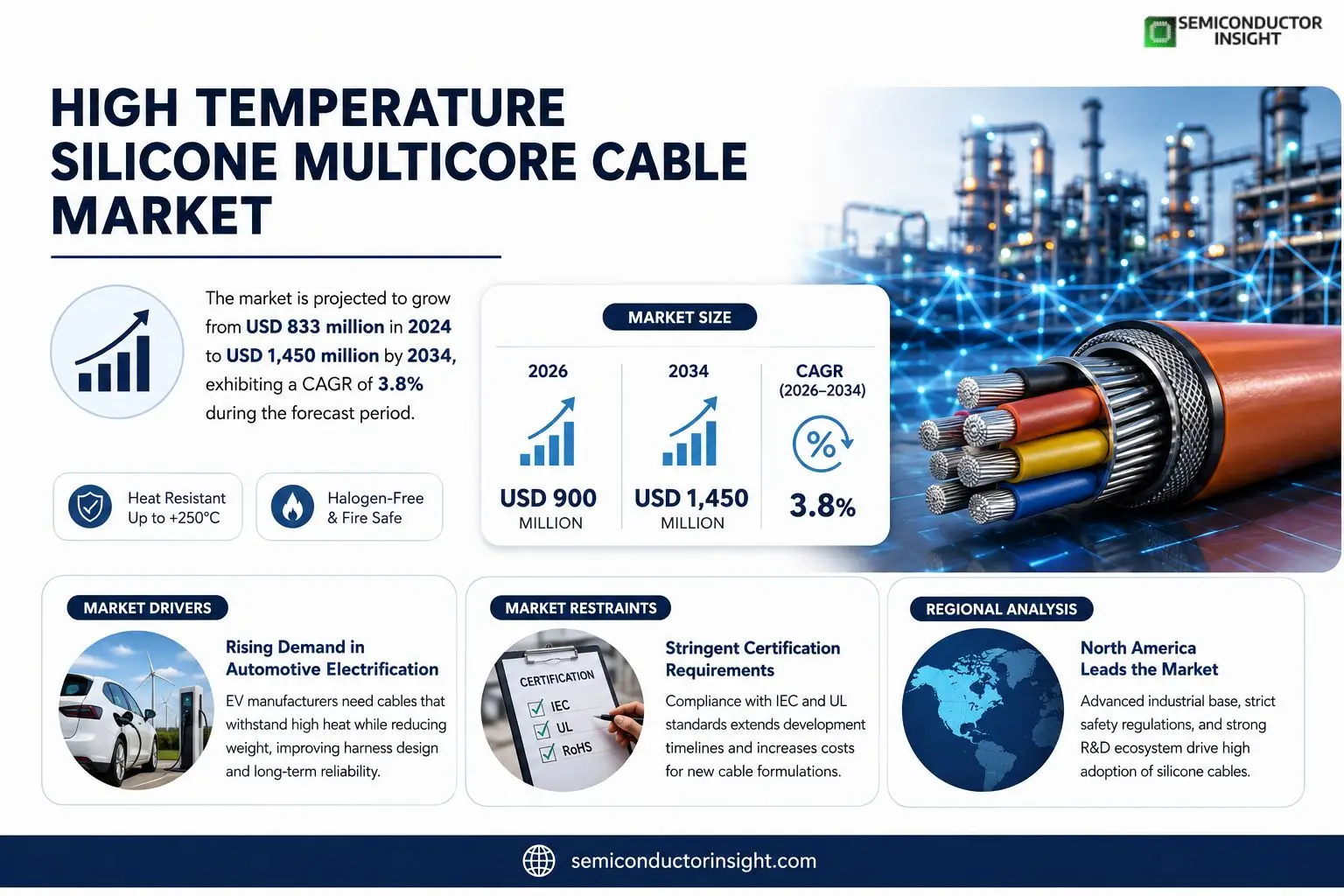
High Temperature Silicone Multicore Cable market was valued at USD 833 million in 2024. It is estimated to rise to USD 1 105 million by 2031, reflecting a compound annual growth rate of approximately 4.2%. Extending this trajectory suggests a valuation near USD 900 million in 2025 and around USD 1 450 million by 2034, which corresponds to an implied CAGR of roughly 3.8% over the 2025‑2034 horizon.
High Temperature Silicone Multicore Cables comprise several insulated conductors encapsulated within a heat‑resistant silicone rubber matrix that can continuously endure temperatures up to +250 °C while maintaining permanent flexibility. The cross‑linked silicone structure preserves dimensional stability under thermal stress and delivers halogen‑free fire performance, making these cables ideal for furnace equipment, metallurgical plants, glass‑ceramic processing lines, aerospace systems and other applications demanding reliable power or signal transmission under extreme heat.
MARKET DRIVERS
Rising Demand in Automotive Electrification
High Temperature Silicone Multicore Cable Market is gaining traction as electric vehicle manufacturers seek wiring solutions that can endure temperatures above 200 °C without compromising flexibility. This capability reduces weight and simplifies harness design, directly influencing vehicle assembly efficiency and long‑term reliability.
Expansion of Renewable Energy Infrastructure
Large‑scale solar and wind farms increasingly rely on cables that sustain continuous high‑heat exposure in desert or offshore settings. Silicone‑based multicore designs offer superior thermal stability compared with conventional PVC, enabling longer service intervals and lower downtime for maintenance crews.
➤ Manufacturers that integrate high‑temperature silicone solutions now enjoy a measurable edge in component density, translating into up to a 12 % reduction in overall system footprint.
Industrial automation projects are also pushing the envelope, as robots operating in ovens or furnaces require wiring that retains dielectric strength at elevated temperatures. The resulting demand cascade fuels upstream material suppliers and spurs investment in extrusion technology.
MARKET CHALLENGES
Stringent Certification Requirements
Compliance with IEC and UL standards for high‑temperature performance imposes rigorous testing cycles, extending time‑to‑market for new cable formulations. Companies that lack dedicated certification labs often face delays, inflating development costs.
Other Challenges
Cost Competitiveness
Silicone compounds are pricier than traditional polymer matrices, and the premium is reflected in bill‑of‑materials. End users must justify the higher upfront spend against projected savings in maintenance and replacement cycles.Supply‑chain volatility adds another layer of difficulty; fluctuations in raw silicone resin availability can disrupt production schedules, particularly for smaller players lacking diversified sourcing strategies.
MARKET RESTRAINTS
Limited Supplier Base
The pool of manufacturers capable of delivering consistent high‑temperature silicone multicore products remains narrow, concentrating market power among a few global firms. This concentration hampers price elasticity and restricts bargaining leverage for downstream buyers.Furthermore, the specialized equipment required for multicore extrusion escalates capital expenditures, deterring new entrants and preserving the status quo.Geopolitical tensions affecting key silicone resin exporters also create uncertainty, prompting some customers to adopt conservative inventory policies that dampen short‑term demand spikes.
MARKET OPPORTUNITIES
Smart Grid Installations
Smart grid rollouts across emerging economies require robust cabling that can tolerate the heat generated by densely packed substations. High‑temperature silicone multicore solutions meet these criteria while offering superior flame‑retardant properties, positioning them as preferred choices for grid modernization projects.Another promising avenue lies in the aerospace sector, where lightweight, temperature‑resistant wiring can contribute to fuel efficiency and compliance with rigorous safety standards. Collaborative research programs between cable manufacturers and aircraft OEMs are already yielding prototype designs slated for certification.Finally, the growing emphasis on circular economy practices encourages the development of recyclable silicone formulations. Companies that pioneer eco‑friendly high‑temperature cables stand to capture a niche segment of environmentally conscious buyers, unlocking new revenue streams.
High Temperature Silicone Multicore Cable Market Trends
Superior Temperature Resilience Fuels Adoption in Heavy‑Industry Wiring
Silicone‑based multicore cables that retain flexibility up to +250 °C have become the preferred conduit for power and signal transmission in environments where conventional polymers would degrade. The cross‑linked molecular architecture protects the conductor geometry, ensuring that the cable does not lose its original shape even after repeated heat cycles. Plant operators in steel‑making, rolling mills, and glass‑ceramic furnaces are replacing older metal‑clad solutions with these silicone options because the material offers consistent electrical performance while eliminating the need for frequent maintenance shutdowns. The transition also reflects a broader industry push toward materials that combine fire‑safety attributes with long‑term reliability, a combination that directly reduces downtime costs and improves overall plant safety.
Other Trends
Regulatory and Safety Considerations
Halogen‑free composition is a decisive element for many customers, as it limits the release of toxic gases during a fire event. This property aligns with tightening safety codes across Europe and North America, where authorities now demand that wiring in high‑risk zones meet stringent fire‑performance criteria. Manufacturers are therefore engineering silicone rubber blends that satisfy both temperature endurance and low‑smoke, low‑toxicity standards. The result is a product portfolio that not only meets compliance but also offers buyers a clear risk‑mitigation pathway, encouraging procurement teams to prioritize these cables in new plant upgrades and retrofits.
Geographic Shift Toward Asia‑Pacific Production Hubs
While North America and Europe continue to host legacy production facilities, investment activity has increasingly migrated to the Asia‑Pacific corridor. Countries such as China, South Korea, and India are expanding their manufacturing footprints, attracted by lower material costs and a growing domestic demand for high‑temperature wiring in automotive and aerospace projects. This geographic realignment is prompting global players to establish joint ventures and local sourcing strategies, which in turn lowers lead times for regional customers and improves price competitiveness. Companies that adapt their supply chains to this shift are better positioned to capture emerging opportunities and to offset price pressure from new entrants.
COMPETITIVE LANDSCAPEKey Industry Players
High Temperature Silicone Multicore Cable – Competitive Overview
The market is anchored by a handful of multinationals that have translated their broad cable portfolios into the high‑temperature silicone niche. Prysmian Group leverages its extensive R&D base in Europe and North America to supply integrated solutions for steel‑mill furnaces and aerospace test rigs, commanding a sizable share of large‑scale contracts. LEONI follows a similar trajectory, pairing its modular system expertise with silicone‑based cores to meet the stringent fire‑safety standards of automotive power‑train factories. Meanwhile, Furukawa and Nexans have differentiated themselves through advanced cross‑linked polymer formulations that retain flexibility at 250 °C, allowing them to capture premium projects in the Asian industrial sector. These four firms dominate the upper tier of the value chain, shaping pricing benchmarks and setting technical standards that smaller players must emulate.Beyond the tier‑one set, a constellation of regionally focused manufacturers sustains market depth. LS Cable & Systems and Fujikura exploit strong footholds in Korea and Japan respectively, supplying localized design services to petrochemical complexes. SAB Cable, HEW‑KABEL, and LAPP Group concentrate on European niche marketsparticularly rolling‑mill retrofitswhere customization overrides scale. Chinese entities such as Jiangsu Shangshang Cable Group, RR Kabel, and Far East Cable command domestic volume through aggressive cost structures, while Eland Cables and Sumitomo Electric address emerging opportunities in the automotive and renewable‑energy segments of Southeast Asia. Collectively, these firms enrich the competitive fabric by delivering specialized core counts, tailored certifications, and rapid delivery cycles that larger players cannot always provide.
List of Key High Temperature Silicone Multicore Cable Companies Profiled
- Prysmian Group
- LEONI
- Furukawa
- Nexans
- LS Cable & Systems
- Fujikura
- SAB Cable
- HEW‑KABEL
- LAPP Group
- Jiangsu Shangshang Cable Group
- RR Kabel
- Far East Cable
- Eland Cables
- Sumitomo Electric
- Alpha Wire
Segment Analysis:
| Segment Category | Sub-Segments | Key Insights |
| By Type |
|
2‑Core Cable remains the predominant choice for many manufacturers because it balances flexibility with sufficient conductive pathways.
|
| By Application |
|
Industrial Use dominates due to the cable’s ability to endure extreme heat in processes such as metal rolling and glass production.
|
| By End User |
|
Steel Mill Operators rely heavily on these cables for reliable power delivery in high‑heat zones.
|
| By Temperature Range |
|
200‑250°C Segment is increasingly favored because it aligns with the operating envelope of most high‑temperature processing units.
|
| By Compliance & Safety Standards |
|
Halogen‑Free Category drives adoption where fire safety and environmental compliance are paramount.
|
Regional Analysis: High Temperature Silicone Multicore Cable Market
North America
North America maintains an advanced position in High Temperature Silicone Multicore Cable Market due to an established infrastructure for power generation, high‑temperature industrial processes, and a strong service network that supports cable maintenance. The region’s equipment manufacturers favor silicone‑based cables for their superior thermal resilience, enabling operations in furnaces, boilers, and turbine rooms with minimal downtime. Regulatory emphasis on safety certification, coupled with a tradition of professional engineering, reinforces consumer confidence in silicone solutions over conventional materials.Demand in the industrial sector grows gradually as renewable and clean‑energy projects expand, obliging power plants and petrochemical facilities to adopt cables that can endure repeated temperature spikes. Investment in digital‑control systems and condition‑monitoring tools allows operators to schedule proactive replacements, thereby protecting system integrity. Moreover, an active developer community produces best‑practice white papers and guidelines, ensuring that manufacturers constantly refine product specifications to meet prevailing safety standards. As a result, North American suppliers enjoy a higher margin on premium silicone multis‑core offerings, and they benefit from a low‑cost research ecosystem that nurtures incremental innovations.
The market is also shaped by a shift toward modular plant designs, wherein electrical feedlines are bundled in pre‑qualified cable assemblies. These assemblies reduce installation time and supply‑chain complexity, positioning silicone cores as the default choice for new construction projects. Utilities in the region have begun to implement cable‑recovery programs that track service life via embedded diagnostics, further driving conscious procurement of high‑temperature derivatives. Together, these dynamics form a self‑reinforcing market where advanced technology, regulatory backing, and practical experience converge to sustain North American preeminence in High Temperature Silicone Multicore Cable Market.
Enhanced thermal resistance of silicone cores propels system reliability in high‑heat zones, while the integration of smart‑cable diagnostics creates a demand for quality‑controlled builds that meet the region’s stringent safety guidelines.
North American players differentiate through aggressive R&D, long‑term supply contracts, and a network of technical support centers that service complex industrial clients across multiple sectors.
Adoption of updated electrical codes requiring fire‑safe and high‑temperature cable materials drives procurement decisions, especially in critical infrastructure projects.
Emerging sectors such as electric‑turbine refurbishment and large‑scale solar converters present new markets where high‑temperature silicone cables can deliver extended lifecycle value.
Europe
In Europe, high‑temperature silicone multi‑core cables are adopted chiefly within the chemical and power‑generation landscapes, where existing plant upgrades aim for higher thermal tolerance and lower maintenance costs. The region’s evolving safety regulations favor certification‑ready solutions, prompting manufacturers to focus on consistent product qualifications. However, a fragmented supplier base and a reliance on custom orders can constrain rapid market permeation, leading to a slower mean‑time‑between‑failure improvement compared with North America. The growth trajectory in Europe rests largely on selective investment in renewable projects and a gradual shift toward modular cable assemblies aligning with tightening environmental standards.
Asia-Pacific
Asia‑Pacific presents a varied mix of early‑stage and advanced industrial segments. In countries pursuing large‑scale power expansion, domestic manufacturers prioritize the thermal performance of silicone cables to complement high‑temperature plants. While the market avoids overt capital intensity, dated infrastructure in many regions creates opportunities for replacement projects that favor resilient cable technology. Regulatory pluralism across the region introduces complexity in certification pathways; yet firms that secure cross‑border approvals discover a growing customer base in export‑heavy industries seeking proven, long‑term solutions.
South America
South America’s high‑temperature silicone cable adoption is linked to a handful of strategic power‑generation initiatives and petrochemical upgrades. The market is in an early phase, with a lack of a greenfield supplier network highlighting the fragility of supply chains. Nonetheless, local industrial strategies increasingly appoint high‑temperature cable solutions as a core component of risk‑mitigation plans, especially where operational uptime is critical. Progress hinges on local manufacturing incentives and public‑private partnership frameworks to accelerate adoption.
Middle East & Africa
In the Middle East, the demand for high‑temperature silicone cables intensifies as petrochemical complexes and oil refining plants expand. The region’s extreme climate conditions and robust safety protocols create a pristine environment for high‑temperature cable deployments. Supportive government incentives and strategic import policies enable local firms to source certified materials, tightening the focus on durability and operational longevity. African nations, meanwhile, focus on strengthening supply chains for emerging industrial projects, marking gradual yet cautious penetration of the market.
Report Scope
This market research report provides a comprehensive analysis of the High Temperature Silicone Multicore Cable Market , covering the forecast period 2026–2034. It offers detailed insights into market dynamics, technological advancements, competitive landscape, and key trends shaping the industry.
Key focus areas of the report include:
- Market Overview: The report begins with an overview outlining its current market scenario, key growth indicators, and industry transformation drivers. It discusses macroeconomic factors, demand–supply balance, regulatory landscape, and the strategic role of semiconductors in powering advancements across industries such as automotive, telecommunications, consumer electronics, and industrial automation.
- Market Size & Forecast: Historical data and future projections for revenue, unit shipments, and market value across major regions and segments.
- Segmentation Analysis: Detailed breakdown by product type, technology, application, and end-user industry to identify high-growth segments and investment opportunities.
- Regional Insights: Insights into market performance across North America, Europe, Asia-Pacific, Latin America, and the Middle East & Africa, including country-level analysis where relevant.
- Competitive Landscape: Profiles of leading market participants, including their product offerings, R&D focus, manufacturing capacity, pricing strategies, and recent developments such as mergers, acquisitions, and partnerships.
- Technology Trends & Innovation: Assessment of emerging technologies, integration of AI/IoT, semiconductor design trends, fabrication techniques, and evolving industry standards.
- Market Drivers & Restraints: Evaluation of factors driving market growth along with challenges, supply chain constraints, regulatory issues, and market-entry barriers.
- Stakeholder Insights: Insights for component suppliers, OEMs, system integrators, investors, and policymakers regarding the evolving ecosystem and strategic opportunities.
Primary and secondary research methods are employed, including interviews with industry experts, data from verified sources, and real-time market intelligence to ensure the accuracy and reliability of the insights presented.
FREQUENTLY ASKED QUESTIONS:
What is the current market size of High Temperature Silicone Multicore Cable Market?
-> High Temperature Silicone Multicore Cable Market was valued at USD 833 million in 2024 and is projected to reach USD 1,105 million by 2031, with a CAGR of 4.2% during the forecast period.
Which key companies operate in High Temperature Silicone Multicore Cable Market?
-> Key players include Prysmian Group, LEONI, Furukawa, Nexans, LS Cable & Systems, Fujikura, SAB Cable, HEW-KABEL, LAPP Group, Jiangsu Shangshang Cable Group, RR Kabel, Far East Cable, Eland Cables, among others.
What are the key growth drivers?
-> Key growth drivers include high demand for heat‑resistant cables in metallurgical and steel production, expanding industrial manufacturing sectors, and growing aerospace and defense applications demanding high‑temperature performance.
Which region dominates the market?
-> The market is global with significant penetration in North America and Europe; no single region has a clear dominance, but the Asia‑Pacific region is experiencing rapid growth due to expanding industrial infrastructure.
What are the emerging trends?
-> Emerging trends include development of halogen‑free, cross‑linked silicone cables, integration of smart sensing technologies in cabling systems, and increasing focus on sustainability and environmental compliance.
Get Sample Report PDF for Exclusive Insights
Report Sample Includes
- Table of Contents
- List of Tables & Figures
- Charts, Research Methodology, and more...