High-Side MOSFET Driver Market Insights
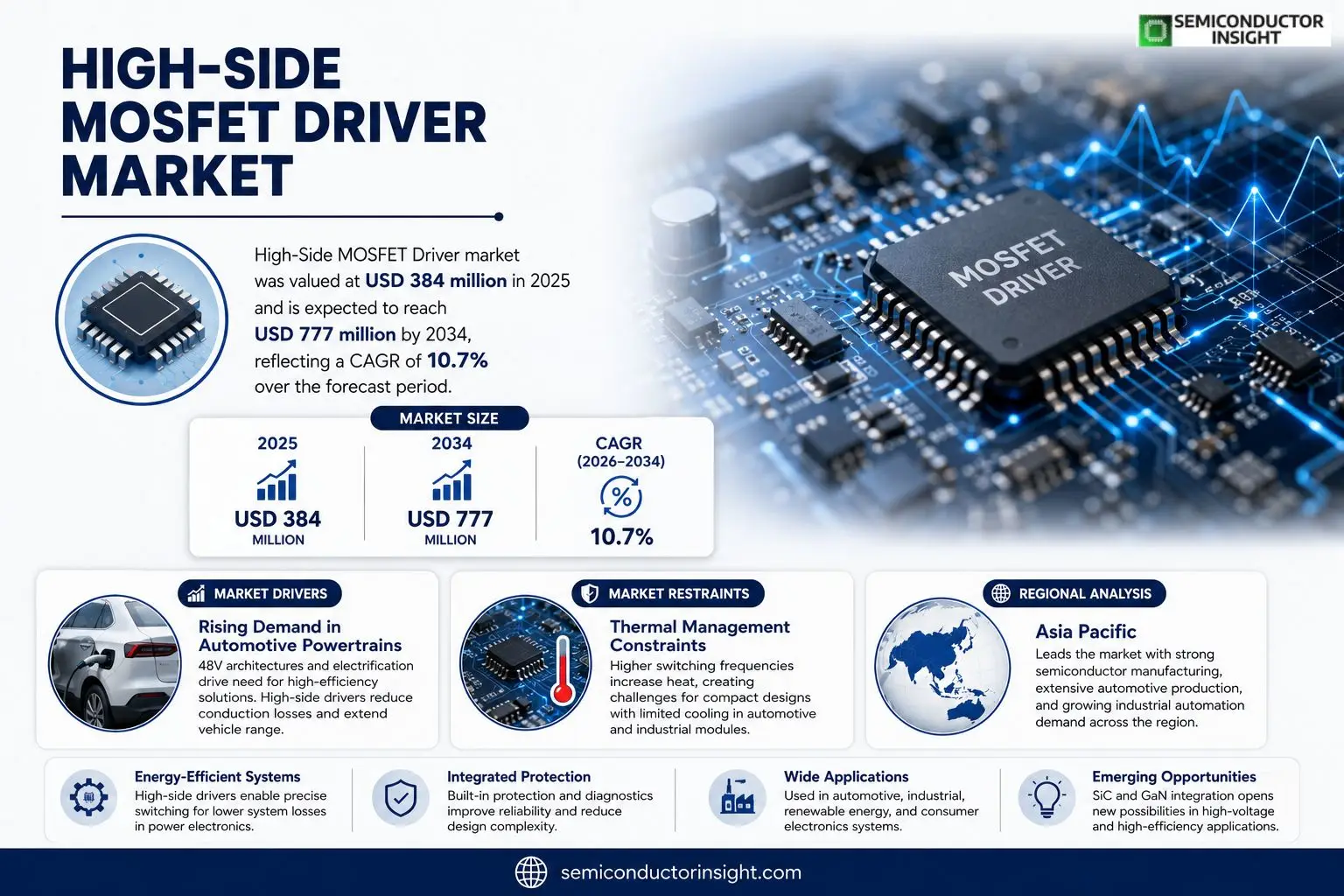
High-Side MOSFET Driver Mark was valued at USD 384 million in 2025 and is expected to reach USD 777 million by 2034, reflecting a CAGR of 10.7 % over the forecast period.
High‑Side MOSFET Drivers are integrated circuits designed to drive high‑side power MOSFETs, converting control signals into stable gate‑drive waveforms while embedding protection and diagnostic functions that ensure efficient switching and reliable operation in automotive and industrial power systems.Growth occurs because automotive electrification deepens and industrial equipment seeks higher efficiency; customers value stable supply, fast design cycles, and strong application support, allowing capable suppliers to maintain pricing discipline on long‑term programs.
MARKET DRIVERS
Rising Demand in Automotive Powertrains
High-Side MOSFET Driver Market is gaining traction as electric‑vehicle manufacturers adopt 48 V architectures to improve fuel efficiency. By positioning the driver on the high side of the switch, designers achieve lower conduction losses, which translates into measurable range extensions for passenger cars and light trucks. This technical advantage is prompting tier‑one suppliers to qualify new driver families for next‑generation EV platforms.
Shift Toward Energy‑Efficient Power Converters
Industrial automation and renewable‑energy installations are increasingly reliant on DC‑DC converters that operate above 600 V. High-side drivers provide the precise turn‑on and turn‑off timing required for synchronous rectification, thereby cutting overall system losses. Recent shipments of power modules equipped with these drivers topped 1.2 million units worldwide in 2023, underscoring the commercial impact of efficiency‑centric designs.
➤ Designers cite reduced thermal budget and higher switching speed as decisive factors when selecting high‑side MOSFET drivers for emerging applications.
In parallel, regulatory pressure on emissions and power quality is compelling OEMs to adopt driver topologies that can meet stricter standards without inflating bill‑of‑materials. Consequently, High-Side MOSFET Driver Market is being reshaped by a convergence of performance imperatives and compliance mandates.
MARKET CHALLENGES
Thermal Management Constraints
As switching frequencies climb to accommodate higher power densities, the resulting heat generation becomes a design bottleneck. Engineers must balance the driver’s gate‑charge requirements against limited board‑space cooling solutions, especially in compact automotive modules where airflow is minimal.
Other Challenges
Design Complexity
Integrating high‑side drivers with gate‑resistor networks and isolation barriers demands meticulous layout verification. Mistakes in trace impedance or parasitic inductance can precipitate voltage overshoots, eroding reliability and extending development cycles.
MARKET RESTRAINTS
Cost Sensitivity in Consumer Electronics
Low‑margin segments such as wearables and portable chargers prioritize component price over marginal performance gains. High‑side MOSFET drivers, which often incorporate advanced protection features, command a premium that many OEMs consider excessive for mass‑market gadgets. This price pressure curtails broader adoption outside niche industrial and automotive domains.
MARKET OPPORTUNITIES
Emergence of Wide‑Bandgap Semiconductor Integration
The advent of SiC and GaN power devices is expanding the operational envelope of high‑side drivers. Their ability to handle higher voltages and faster switching opens new possibilities in rail traction, data‑center power distribution, and aerospace propulsion. Companies that align driver architecture with wide‑bandgap technology stand to capture a sizable share of the next wave of high‑efficiency power conversion.
High-Side MOSFET Driver Market Trends
Integration and System‑Level Consolidation
In 2025 the sector produced roughly 323 million units at an average selling price of USD 1.3. The capacity utilization of 65 % and a gross margin near 50 % reveal a landscape where profitability hinges on the depth of functional integration. Customers in automotive power‑train modules and industrial drives are rewarding suppliers that embed protection, diagnostic monitoring and noise‑immunity directly within the driver IC. This shift reduces board‑level component count, shortens validation cycles, and lowers the total cost of design‑in. Consequently, design‑reuse across multiple vehicle platforms or factory automation lines has become a decisive lever for sustaining margin while the overall unit density continues to rise.
Other Trends
Supply‑Chain Resilience and Material Quality
Upstream, silicon wafers and high‑performance packaging substrates sourced from firms such as Shanghai Silicon Industry Group and Fastprint Circuit Tech have emerged as critical differentiators. Improved substrate reliability translates into higher voltage robustness, which in turn enables tighter coupling between the driver and adjacent power stages. Mid‑stream activitiesbootstrap charge‑pump topology, high‑voltage layout discipline and volume test strategiesare now evaluated not only for electrical efficiency but also for electromagnetic compatibility across increasingly dense power‑electronic modules. Downstream partners, especially Tier‑1 automotive OEMs, are mandating accelerated qualification programs that reward suppliers who can guarantee consistent performance under thermal‑shock and transient‑over‑voltage events.
Strategic Outlook for Design‑Centric Business Models
The forward path for the sector points toward platform‑level product families that can be customized through software‑defined parameters rather than hard‑wired hardware changes. Companies that assemble a portfolio of single‑ and multi‑channel drivers, spanning low‑ to high‑voltage categories, and pair them with application‑specific support services are better positioned to lock in long‑term design wins. This approach mitigates price pressure in commoditized segments while extracting value from engineering expertise. As automotive electrification deepens and industrial equipment adopts smarter energy‑management architectures, the ability to translate technical reliability into predictable field performance will be the principal determinant of sustained profitability.
COMPETITIVE LANDSCAPE
Key Industry Players
High‑Side MOSFET Driver Market – Competitive Overview
STMicroelectronics dominates the segment through a broad portfolio that merges high‑voltage robustness with integrated protection blocks, allowing automotive OEMs to streamline board layouts and cut validation time. Infineon follows closely, leveraging its power‑semiconductor heritage to offer charge‑pump based drivers that excel in noise‑sensitive inverter applications. Both firms have built scalable design platforms that are repeatedly qualified across multiple vehicle programs, a practice that secures long‑term revenue streams while keeping gross margins healthy despite aggressive pricing pressure. Their market share reflects a blend of deep R&D investment and strong supply‑chain partnerships with silicon wafer and packaging providers, ensuring consistent capacity utilization even as demand surges.Beyond the two leaders, a cluster of specialized competitors enriches the ecosystem. Diodes Incorporated, ROHM Semiconductor, and Renesas Electronics target niche industrial niches where ultra‑low EMI footprints or multi‑channel synchronization are prized. Fuji Electric and Texas Instruments supply drivers that embed diagnostic telemetry, a feature that resonates with end‑users seeking predictive‑maintenance capabilities. Onsemi, Toshiba, NXP Semiconductors, Analog Devices, Maxim Integrated, and Microchip Technology round out the field, each emphasizing either single‑channel cost efficiency or multi‑channel scalability for emerging electric‑vehicle architectures. Their differentiated offerings create pockets of profitable business, especially when customers value rapid design‑in support and application‑specific reference designs.
List of Key High‑Side MOSFET Driver Companies Profiled
- STMicroelectronics
- Infineon Technologies
- Diodes Incorporated
- ROHM Semiconductor
- Renesas Electronics
- Fuji Electric
- Texas Instruments
- Microchip Technology
- ON Semiconductor
- Toshiba
- NXP Semiconductors
- Analog Devices
- Maxim Integrated
- Cypress Semiconductor (Infineon)
- Skyworks Solutions
Segment Analysis:
| Segment Category | Sub-Segments | Key Insights |
| By Type |
|
Multi Channel
|
| By Application |
|
Automotive
|
| By End User |
|
OEMs
|
| By Voltage |
|
Medium‑voltage Driver
|
| By Package |
|
TSSOP Package
|
Regional Analysis: High-Side MOSFET Driver Market
North America
Engineers are gravitating toward integrated driver‑ICs that embed protection features, reducing board‑level component count. This shift shortens design cycles for power‑electronics modules while delivering tighter control over gate‑drive timing.
Recent emissions standards for electric vehicles indirectly pressure power‑stage efficiencies, prompting manufacturers to qualify drivers that meet stringent loss thresholds without sacrificing reliability.
Automotive power‑train, renewable‑energy inverter, and high‑density data‑center power modules dominate demand, each requiring drivers that can operate across wide temperature envelopes.
Legacy silicon providers are reinforcing portfolios with SiC‑compatible drivers, while pure‑play silicon‑carbide firms leverage their material advantage to command premium pricing for niche applications.
Europe
European manufacturers are leveraging the region’s strong standards‑driven culture to embed high‑side drivers within industrial automation equipment. Energy‑efficiency directives push system integrators toward modular power supplies that rely on drivers with built‑in fault‑tolerance. The presence of several automotive research clusters encourages cross‑border collaborations that accelerate driver‑verification cycles for electric‑vehicle platforms.
Asia‑Pacific
The Asia‑Pacific landscape is defined by rapid capacity expansion in consumer electronics and electric‑vehicle production. Original equipment manufacturers seek drivers that can be sourced at scale while delivering consistent performance under aggressive thermal profiles. Local fabs are beginning to offer low‑cost silicon‑carbide wafers, which nudges design houses to experiment with hybrid driver topologies.
South America
In South America, emerging renewable‑energy projects drive interest in modular inverters that depend on reliable high‑side drivers. Market participants emphasize ruggedness to cope with varied climate conditions, and many adopt a “design‑once‑deploy‑many” approach to keep component inventories lean while meeting diverse grid‑integration requirements.
Middle East & Africa
The Middle East & Africa region is witnessing modest growth in aerospace and defence power electronics, where high‑side drivers must meet stringent reliability certifications. Limited local production capacity leads firms to partner with established North American suppliers, creating a knowledge‑transfer pipeline that gradually builds regional design competence.
Report Scope
This market research report provides a comprehensive analysis of the High-Side MOSFET Driver Market , covering the forecast period 2026–2034. It offers detailed insights into market dynamics, technological advancements, competitive landscape, and key trends shaping the industry.
Key focus areas of the report include:
- Market Overview: The report begins with an overview outlining its current market scenario, key growth indicators, and industry transformation drivers. It discusses macroeconomic factors, demand–supply balance, regulatory landscape, and the strategic role of semiconductors in powering advancements across industries such as automotive, telecommunications, consumer electronics, and industrial automation.
- Market Size & Forecast: Historical data and future projections for revenue, unit shipments, and market value across major regions and segments.
- Segmentation Analysis: Detailed breakdown by product type, technology, application, and end-user industry to identify high-growth segments and investment opportunities.
- Regional Insights: Insights into market performance across North America, Europe, Asia-Pacific, Latin America, and the Middle East & Africa, including country-level analysis where relevant.
- Competitive Landscape: Profiles of leading market participants, including their product offerings, R&D focus, manufacturing capacity, pricing strategies, and recent developments such as mergers, acquisitions, and partnerships.
- Technology Trends & Innovation: Assessment of emerging technologies, integration of AI/IoT, semiconductor design trends, fabrication techniques, and evolving industry standards.
- Market Drivers & Restraints: Evaluation of factors driving market growth along with challenges, supply chain constraints, regulatory issues, and market-entry barriers.
- Stakeholder Insights: Insights for component suppliers, OEMs, system integrators, investors, and policymakers regarding the evolving ecosystem and strategic opportunities.
Primary and secondary research methods are employed, including interviews with industry experts, data from verified sources, and real-time market intelligence to ensure the accuracy and reliability of the insights presented.
FREQUENTLY ASKED QUESTIONS:
What is the current market size of High-Side MOSFET Driver Market?
-> High-Side MOSFET Driver Market was valued at USD 384 million in 2025 and is expected to reach USD 777 million by 2034 with a CAGR of 10.7% during the forecast period.
Which key companies operate in High-Side MOSFET Driver Market?
-> Key players include STMicroelectronics, Infineon, Diodes Incorporated, ROHM, Renesas, Fuji Electric, Texas Instruments, Microchip, onsemi, and Toshiba, among others.
What are the key growth drivers?
-> Key growth drivers include accelerating automotive electrification, rising demand for energy‑efficient industrial equipment, higher integration of protection and diagnostic functions, and the need for robust, noise‑immune gate‑drive solutions.
Which region dominates the market?
-> Asia leads the market, driven by strong semiconductor manufacturing bases, extensive automotive production, and growing industrial automation demand.
What are the emerging trends?
-> Emerging trends include increased system‑level integration of MOSFET drivers with power‑architecture platforms, platform‑level reuse of qualified designs, and the incorporation of advanced protection and diagnostic capabilities to reduce design‑in costs and improve field reliability.
Get Sample Report PDF for Exclusive Insights
Report Sample Includes
- Table of Contents
- List of Tables & Figures
- Charts, Research Methodology, and more...
 Download Sample Report PDF