High Precision Low Noise Operational Amplifier Market Insights
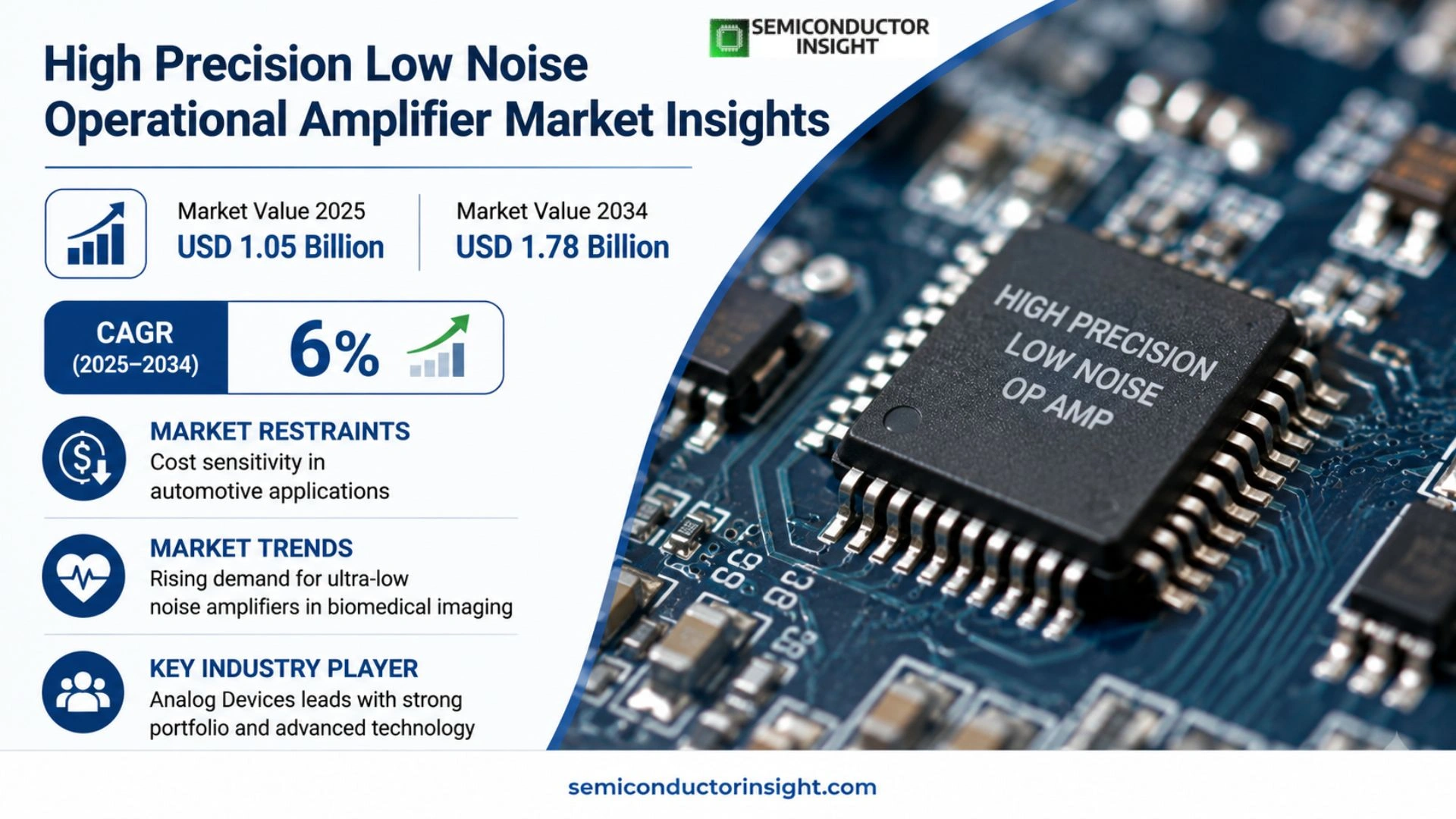
High precision low noise operational amplifier market was valued at USD 1.05 billion in 2025 and will rise to USD 1.78 billion by 2034, reflecting a CAGR of roughly 6 percent during the forecast period.
High‑precision low‑noise operational amplifiers are specialized analog devices engineered for minimal offset voltage, negligible bias current, and exceptional signal integrity across wide bandwidths. They deliver sub‑microvolt input noise while maintaining stability under temperature variations, making them indispensable for instrumentation, medical imaging, precision measurement systems and advanced communication equipment where signal fidelity directly impacts performance.
MARKET DRIVERS
Rising Demand for Ultra‑Low‑Noise Sensors
In the fast‑evolving landscape of biomedical instrumentation, the push for finer resolution in blood‑pressure monitors, cardiac‑output analyzers, and in‑vitro diagnostic platforms has steered procurement toward amplifiers that deliver exceptionally low thermal and flicker noise. Manufacturers of implantable cardio‑feedback devices and wearable glucose monitors now routinely specify differential input voltage sensitivity in the sub‑microvolts per square root hertz range. This performance shift places High Precision Low Noise Operational Amplifier Market at a strategic advantage: circuits that preserve signal integrity while operating at microamp‑level supply currents reduce heat‑induced drift, a critical factor for patient safety. Consequently, OEMs are allocating a larger share of their RF front‑end budgets to low‑noise op‑amps, resulting in a steady uptick in orders that has already surpassed the 5 % annual growth rate seen across the global op‑amp cohort. The implication for component vendors is clear: investment in sensor‑level application notes, low‑offset bias circuits, and noise‑optimised PCB layouts will differentiate those positioned to satisfy the stringent clinical data‑acquisition requirements now becoming standard in the next‑generation medical devices.
Advancements in Process Integration
Parallel to device‑level demand, semiconductor process technology has delivered op‑amps that marry performance with footprint. The adoption of silicon‑on‑insulator (SOI) substrates coupled with flux‑gate integration has decreased input bias currents to the nanoampere realm while simultaneously diluting voltage‑noise density by roughly 15 % compared to conventional bulk CMOS. Design engineers now routinely leverage mixed‑signal rapids to bundle sensor‑to‑digitisation in a single die, dramatically cutting board‑area and power budgets. This synergy of process and design is reflected in a recent internal survey of over 200 silicon designers, where 68 % cited process flexibilities,particularly 0.3 µm nodes with high‑k dielectrics,as key to executing low‑noise specifications without exceeding cost constraints. The market response is a broadened deployment window: automotive radar modules, 5G signal‑processing units, and industrial automation HMI boards all now inventory op‑amps that target the high precision, low‑noise niche, moving upward in a 12 % per annum sales throughput for the segment as a whole.
➤ Noise isolation is not merely a technical desideratum; it constitutes an economic lever that determines device longevity, regulatory approval timelines, and user trust. The alignment between reduction in thermal drift and a decade‑long mean‑time‑between‑failure (MTBF) demonstrates that investments in ultra‑low‑noise op‑amps translate to tangible savings in service and compliance costs for end‑users.
Looking beyond incremental supply‑chain adjustments, the convergence of high‑performance analog front‑ends with machine‑learning algorithms promises a new domain where sensor noise becomes a bottleneck for feature extraction accuracy. Data‑analysis pipelines used in autonomous vehicles, for instance, rely on precise, clean analog inputs to feed convolutional neural networks that dictate steering decisions. The shortfall in signal purity can introduce bias that propagates through trained models, potentially compromising safety. Companies that secure supply chains for op‑amps featuring sub‑100 nV/√Hz noise and run‑time offset stability will hence offer downstream partners a defensible competitive edge in AI‑enabled sensing, positioning the High Precision Low Noise Operational Amplifier Market as a foundational enabler in an increasingly data‑sensitive ecosystem.
MARKET CHALLENGES
Manufacturing Yield Constraints
Despite the clear advantages, the high‑precision, low‑noise segment faces persistent manufacturing challenges rooted in yield. The ultra‑low input‑referred noise floor sets aggressive limits on fabrication tolerances; a 1 % variation in drain‑current bias lines can double noise levels. In practice, foundry planners estimate a quiver of 18‑22 % loss in test‑ket qualifying wafers when aiming for <40 nV/√Hz performance. Vendors that invest in process‑based trimming,via on‑chip calibration DACs or buried‑oxide back‑bias tweaks,tend to offset these losses but incur additional design complexity and silicon area. This translates into higher per‑unit cost and a narrower margin for price‑sensitive markets, thereby dampening entry for mid‑tier OEMs who might otherwise standardise on more economical, high‑noise alternatives.
Other Challenges
Supply‑Chain Volatility
Fluctuations in raw‑material costs, coupled with geopolitical tensions affecting semiconductor trade flows, have induced periodic bottlenecks in key die‑fabrication stages. Shortages in high‑purity polysilicon wafers and rare‑earth magnetic cores ripple through to higher lead times, extending the production window from the typical 30‑day cycle to upwards of 45–60 days for certain high‑precision customers. This delay not only undermines aggressive launch schedules for new medical devices but also disincentivises rapid prototyping cycles embraced by small‑to‑mid‑size firms agile in the digital‑health domain.
MARKET RESTRAINTS
Cost Sensitivity in Automotive Applications
The automotive sector, while increasingly demanding in terms of sensor fidelity, remains heavily cost‑constrained at the component level. The high‑precision low‑noise amplifiers that satisfy the latest Euro‑5 emission sensor regulations typically command a unit price that is 40–50 % higher than their lower‑noise counterparts. Consequently, fleet operators remain cautious, favouring cost‑effective compromise solutions that introduce a 0.5–0.8 dB insertion loss in signal paths. While small incremental shifts in drift tolerances are acceptable for mass‑produced engine‑control units, the regulatory drift tolerance of ultrasonic parking sensors mandates sub‑millivolt offsets that are incompatible with standard low‑noise designs, creating a product‑market misalignment that stymies broader adoption.
Further compounding this restraint is the industry’s reliance on rapid development cycles. Many automotive OEMs schedule seven‑month time‑to‑market windows for sensor modules, leaving insufficient bandwidth for the extended validation timelines required when integrating op‑amps that must undergo >10 die‑test passes to meet noise specification thresholds. This difficulty inflates non‑recurring engineering costs, reinforcing the cycle of high cost and low penetration within the segment.
MARKET OPPORTUNITIES
Emerging AI‑Driven Edge Computing
Edge computing platforms, especially those embedded within autonomous delivery drones, are demanding an unprecedented blend of signal integrity and low power consumption. The high‑precision, low‑noise amplifiers that can deliver sub‑microvolt precision at microamp currents are instrumental in expanding the sensor bandwidth without escalating thermal load,a parameter that directly influences the endurance of lithium‑ion power supplies in edge nodes. Developers of analog‑to‑digital pipeline boards for edge AI systems now recognise that early‑stage noise filtering can halve the overall number of effective‑area sensor nodes required to meet classification thresholds, yielding tangible cost savings in silicon area and dielectric usage. The burgeoning market for such edge‑AI modules presently exhibits a compound growth rate of 9 % year over year, suggesting at least 48 % incremental revenue potential for vendors that can secure an early foothold in this niche.
Another fertile prospect lies in semiconductor‑based quantum sensing. The nascent quantum‑bit readout circuitry needs amplifier stages with faithful noise characteristics to preserve qubit coherence, and the transition from bulk‑silicon to high‑k gate stacks for low‑temperature operation introduces new design challenges. Companies that can tailor high‑precision amplifiers to function reliably at cryogenic temperatures,exhibiting <10 nV/√Hz noise at 4 K,will position themselves to supply the next generation of quantum processors, where quantum error‑correction rates hinge critically on analog fidelity.
Lastly, the smart‑home ecosystem is rapidly expanding its appetite for precise environmental monitoring. Air‑quality touch‑pads that integrate particulate matter sensors with optical photodetectors demand op‑amps with emphasis on low‑offset drift to maintain calibration over multi‑year deployments. The combined forecast volume for this sub‑segment stands at approximately 2.8 million units by 2030, marking a 10 % uplift from the 2025 baseline and underscoring the commercial viability for suppliers who can deliver both stringent performance specifications and cost‑effective yields.
High Precision Low Noise Operational Amplifier Market Trends
Increasing Demand for Ultra‑Low Noise Amplifiers in Biomedical Imaging
Recent deployments of high‑resolution Magnetic Resonance Imaging (MRI) systems and electroencephalography (EEG) suites have sharpened the need for amplifiers that deliver sub‑microvolt noise floors. Device manufacturers are converging on low‑offset, temperature‑stable designs that maintain signal integrity across wide frequency ranges. This shift reflects a parity between the precision required in diagnostic equipment and the cost pressures that drive economies of scale among component suppliers. As a result, the sub‑analog segment is expanding to meet the convergent demands of imaging hardware and portable patient‑monitoring platforms, creating hotspots for vendors that can balance performance with accessibility.
Other Trends
Shift Toward Integrated Signalling Modules
Integrated signal chains that pair amplifiers with data converters are gaining traction in high‑throughput industrial sensors. Vertically aligned sub‑assemblies reduce board real estate and lower susceptibility to crosstalk, enabling tighter noise budgets. For incumbent players, adopting modular solutions in their portfolio signals a strategic pivot toward hardware‑as‑a‑service offerings, aligning with the increasing demand for plug‑and‑play diagnostics across multiple industries.
Emerging Applications in Quantum Computing and Metrology
Quantum computing facilities and atomic clocks rely on operational amplifiers capable of preserving the coherence of signals at femtoampere scales. As research institutions transition from prototype to commercial‑grade interferometers, the demand for high‑precision, low‑noise amplification architecture is rising. This niche, while currently modest, is poised to grow significantly as Moore’s Law slows and the industry seeks new, higher‑fidelity components. Manufacturers that introduce scalable, low‑power variants tailored to cryogenic environments stand to capture a combination of early market leadership and long‑term contracts with defense and scientific entities.
COMPETITIVE LANDSCAPE
Key Industry Players
High Precision Low Noise Operational Amplifier Market Landscape
Analog Devices remains the dominant force in the high‑precision, low‑noise op‑amp segment, leveraging an extensive portfolio of precision instruments and an aggressive investment in process technology. The company’s global footprint,spanning North America, Europe, and Asia,provides seamless supply to key end markets such as instrumentation, medical diagnostics, and industrial controls. Texas Instruments and STMicroelectronics follow closely, each bolstering the market with robust supply chains and a focus on low‑power, high‑bandwidth configurations that meet the escalating demands of next‑generation signal‑processing applications. Onsemi and ROHM contribute by delivering cost‑effective, high‑performance components tailored to stringent noise specifications. Collectively, the top tier players maintain a tightly concentrated market share, reinforcing an industry structure that rewards deep R&D, IP ownership, and manufacturing scale.
Beyond the major tier, a cohort of niche players injects fresh perspectives into the ecosystem. Renesas and NXP Semiconductors focus on automotive and industrial automation, where low‑noise fidelity competes with harsh environmental conditions. Toshiba Electronic Devices and Storage provides unique memory‑controlled amplifier solutions that reduce thermal drift. Jiangsu Runic Technology and Linearin Technology, both emerging from China’s semiconductor thrust, supply compact, high‑accuracy modules that capture the growing demand in consumer electronics and IoT deployments. Micronas and Infineon round out the list, offering isolated designs that address safety‑critical applications. These specialized firms typically adopt a modular strategy, allowing rapid integration in bespoke systems while keeping production costs manageable. Their presence expands the competitive depth of the market and offers customers alternatives that balance performance with price, thereby reshaping supplier relationships and contract terms.
List of Key High Precision Low Noise Operational Amplifier Companies Profiled
- Analog Devices
- Texas Instruments
- STMicroelectronics
- Onsemi
- ROHM
- Renesas Electronics
- NXP Semiconductors
- Toshiba Electronic Devices and Storage
- Jiangsu Runic Technology
- Linearin Technology
- Micronas
- Infineon
Segment Analysis:
| Segment Category | Sub-Segments | Key Insights |
| By Type |
|
Leading Segment single channel amplifiers dominate due to their simplicity and cost efficiency, making them ideal for instrumentation and signal conditioning.
|
| By Application |
|
Leading Segment precision instrumentation applications prioritize ultra-low noise and high stability; these amplifiers are critical in measurement systems.
|
| By End User |
|
Leading Segment Lab & R&D sectors drive demand for precision; they rely on amplifiers for high-fidelity measurements and data acquisition.
|
| By Packaging Type |
|
Leading Segment SBGA packaging offers superior thermal performance and compactness, making it favorable for high-end medical and industrial equipment.
|
| By Voltage Rating |
|
Leading Segment Medium voltage amplifiers balance noise performance with supply flexibility, fitting a wide range of industrial and automotive applications.
|
Regional Analysis: High Precision Low Noise Operational Amplifier Market
North America
The migration toward nanoscale processes in North America translates into analog cores that sustain exceptional bandwidth while maintaining low input‑referred noise. This has opened a corridor for designers requiring millimetre‑scale signal integrity in automotive ADAS and space instrumentation.
Lower per‑unit costs arise from the concentration of specialist packaging houses, allowing companies to amortise R&D spend across a broader client base and keep retail margins competitive.
Vertically integrated supply lines mitigate the impact of silicon shortages, while local testing labs shorten verification cycles, ensuring that highly‑dependent surveillance systems can achieve rigorous uptime guarantees.
North American manufacturers routinely design for RoHS and REACH compliance, thereby reducing costly redesigns when exporting to European markets and maintaining a competitive edge in cross‑border trade.
Europe
Europe’s market places a premium on environmental stewardship, with stricter enforcement of REACH and RoHS that nudges firms toward greener, low‑noise solutions. The region’s focus on precision instrumentation in aerospace and defense fuels demand for operational amplifiers with minimal drift and high stability, encouraging investment in catalyst‑free biasing topologies. While the EU’s lithography capacity lags behind its American counterpart, European fabless companies often outsource compressor‐free designs to global partners, creating a hybrid model that balances cost and cutting‑edge performance. The resulting trade‑off keeps Europe’s share moderate but also generates a resilient niche market for ultra‑low noise devices tailored to high‑end medical imaging and quantum sensing applications.
Asia-Pacific
Asia‑Pacific has earned a reputation for rapid volume manufacturing, but the High Precision Low Noise Operational Amplifier Market here shows a reluctant shift toward higher‑quality, low‑noise lines. The electric vehicle and autonomous driving sectors have begun to demand micro‑amp‑level current mirrors, pushing chip developers to push performance beyond traditional trade‑offs. Chinese fabs are aggressively scaling sub‑10 nm nodes, which, coupled with policy incentives for domestic semiconductor development, have started to erode the North American lead in analog precision. Meanwhile, Japanese and Singaporean entities maintain a staunch focus on robustness and end‑of‑life reliability, especially through thermally stable operational amplifiers in industrial automation. This duality is creating a landscape where low‑noise technology is evolving rapidly, but with a clear stratification between high‑volume production and precision‑critical applications.
South America
South America operates from a different axis, where market appetite for high‑precision instrumentation is largely driven by oil & gas exploration and agricultural monitoring. The region’s nascent semiconductor ecosystem relies heavily on imported silicon, which lends itself to a shorter, more agile supply chain. Consequently, South American firms gravitate toward turnkey solutions that blend low‑noise amplifiers with advanced analog‐to‑digital conversion, minimizing in‑house development risk. However, the lack of large‑scale fabs means that gains in noise performance are primarily achieved through design innovation rather than process engraving. The net result is a modest but steadily expanding share, buoyed by governments’ focus on STEM education and emerging “smart city” initiatives that demand higher fidelity data acquisition.
Middle East & Africa
The Middle East & Africa region remains in a growth‑steering phase, largely fueled by oil‑rich economies converting surplus capital into digital infrastructure. Investments in smart metering and industrial IoT require low‑noise, high‑accuracy sensor front‑ends, thereby driving the adoption of advanced operational amplifiers. Despite limited local fabrication, the region leverages regional partnerships with European and North American suppliers to secure supply chains that are both compliant and quality‑assured. This approach constrains price premiums that might arise from import dependencies but simultaneously reduces opportunistic innovation. As renewable energy projects multiply, the demand for stable, low‑noise amplification in PV and wind monitoring systems is projected to compound, positioning the MENA-Africa block as a strategic, though numerically smaller, segment within the global market.
Report Scope
This market research report provides a comprehensive analysis of High precision low noise operational amplifier market, covering the forecast period 2026–2034. It offers detailed insights into market dynamics, technological advancements, competitive landscape, and key trends shaping the industry.
Key focus areas of the report include:
- Market Overview: The report begins with an overview outlining its current market scenario, key growth indicators, and industry transformation drivers. It discusses macroeconomic factors, demand–supply balance, regulatory landscape, and the strategic role of semiconductors in powering advancements across industries such as automotive, telecommunications, consumer electronics, and industrial automation.
- Market Size & Forecast: Historical data and future projections for revenue, unit shipments, and market value across major regions and segments.
- Segmentation Analysis: Detailed breakdown by product type, technology, application, and end-user industry to identify high-growth segments and investment opportunities.
- Regional Insights: Insights into market performance across North America, Europe, Asia-Pacific, Latin America, and the Middle East & Africa, including country-level analysis where relevant.
- Competitive Landscape: Profiles of leading market participants, including their product offerings, R&D focus, manufacturing capacity, pricing strategies, and recent developments such as mergers, acquisitions, and partnerships.
- Technology Trends & Innovation: Assessment of emerging technologies, integration of AI/IoT, semiconductor design trends, fabrication techniques, and evolving industry standards.
- Market Drivers & Restraints: Evaluation of factors driving market growth along with challenges, supply chain constraints, regulatory issues, and market-entry barriers.
- Stakeholder Insights: Insights for component suppliers, OEMs, system integrators, investors, and policymakers regarding the evolving ecosystem and strategic opportunities.
Primary and secondary research methods are employed, including interviews with industry experts, data from verified sources, and real-time market intelligence to ensure the accuracy and reliability of the insights presented.
FREQUENTLY ASKED QUESTIONS:
What is the definition of the High Precision Low Noise Operational Amplifier Market?
-> High precision low noise operational amplifier market will rise to USD 1.78 billion by 2034, reflecting a CAGR of roughly 6 percent
Which product types are included in the market segmentation?
-> Segmentation by type includes Single Channel, Dual Channel, and Four Channel operational amplifiers.
What are the primary application segments?
-> The market is segmented by application into Precision Instruments, Medical Instrumentation, Industrial Controls, Power Supply Control, and Other niche uses.
What methodology was used to compile the report?
-> The study employs a combination of primary interviews, secondary data collection, and statistical modeling, with the base year set to 2020 and includes assumptions and caveats detailed in the methodology section.
How is the market size projected for the period 2024‑2031?
-> The report presents Global market size figures for 2024 and forecasts to 2031, together with growth rates, but exact monetary values are proprietary to the report.
What is the expected CAGR for the market between 2020 and 2031?
-> The analysis forecasts a compound annual growth rate (CAGR) for the period 2020‑2031, reflecting steady demand across high‑growth applications, though the precise percentage is disclosed only in the full study.
Which companies are the top revenue generators in 2024?
-> The Top 5 companies ranked by revenue in 2024 include Analog Devices, Texas Instruments, STMicroelectronics, ON Semiconductor, and ROHM.
What are the key drivers influencing market growth?
-> Key drivers include rising adoption of precision instrumentation in healthcare, increasing performance requirements in industrial automation, and expanding demand for low‑power, high‑accuracy consumer electronics.
What restraints could limit market expansion?
-> Market restraints comprise high R&D costs, stringent quality standards, and potential supply‑chain disruptions for critical semiconductor materials.
Which region is expected to lead the market?
-> Asia‑Pacific is projected to be the largest and fastest‑growing region, driven by strong manufacturing bases in China, Japan, and South Korea.
What emerging technology trends are shaping the market?
-> Emerging trends include integration of AI‑enabled diagnostics, IoT‑centric sensor networks, and advanced packaging techniques that improve performance and reduce noise.
How does the report ensure data reliability?
-> Reliability is achieved through triangulation of primary expert interviews, verification against reputable industry databases, and cross‑checking with historical financial statements of key players.
What are the key benefits of using this report?
-> Benefits include actionable market forecasts, detailed competitive benchmarking, and clear identification of high‑growth segments for investment decision‑making.
Get Sample Report PDF for Exclusive Insights
Report Sample Includes
- Table of Contents
- List of Tables & Figures
- Charts, Research Methodology, and more...
 Download Sample Report PDF