High Power Gallium Nitride (GaN) Transistor Market Insights
Global High Power Gallium Nitride (GaN) Transistor market was valued at USD 1.45 billion in 2025 and is forecasted to climb to USD 3.12 billion by 2034, reflecting a compound annual growth rate of approximately 7.8% over the period.
High Power GaN transistors are wide‑bandgap semiconductor devices that deliver high switching speeds, superior thermal conductivity and low on‑resistance, making them ideal for power conversion in data‑center servers, electric‑vehicle chargers and aerospace radars.
The expansion is supported by rising demand for energy‑efficient power electronics, increasing adoption of renewable‑energy systems and the rollout of 5G infrastructure, which together push manufacturers toward GaN solutions that can operate at higher voltages while reducing system size.
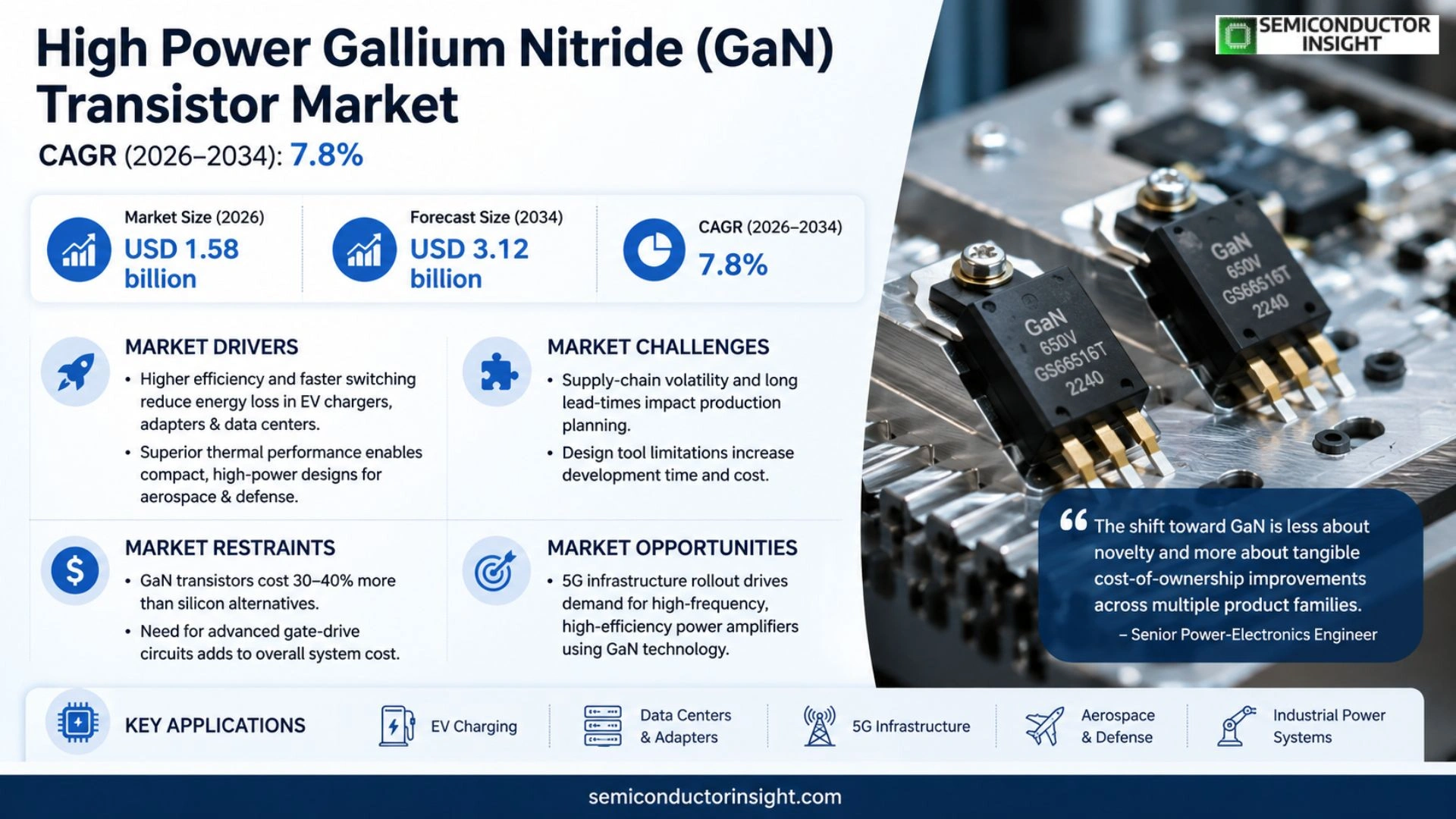
MARKET DRIVERS
Efficiency Gains in Power Conversion
Design teams are increasingly adopting High Power Gallium Nitride (GaN) Transistor Market solutions because the devices deliver lower on‑resistance and faster switching compared with silicon equivalents. This translates into measurable reductions in energy loss for data‑center adapters and electric‑vehicle chargers, prompting OEMs to prioritize GaN‑based architectures.
Thermal Management Advantages
GaN transistors sustain higher current densities while operating at cooler junction temperatures, which eases the burden on heat‑sink design. Manufacturers of aerospace and defense electronics are leveraging this attribute to meet stringent weight‑and‑size constraints, thereby creating a ripple effect across adjacent system‑level markets.
➤ “The shift toward GaN is less about novelty and more about tangible cost‑of‑ownership improvements across multiple product families.” – Senior Power‑Electronics Engineer
Beyond the immediate performance boost, the reliability record of GaN devices under high‑stress cycles is encouraging longer product lifecycles. Companies that integrate these transistors can differentiate themselves with warranty extensions and lower field‑failure rates, a competitive edge that resonates with end‑users seeking total‑cost‑of‑ownership transparency.
MARKET CHALLENGES
Supply‑Chain Volatility
Global semiconductor fab capacity remains stressed, and the niche nature of GaN epitaxy adds a layer of fragility. Procurement teams report lead‑times extending beyond six months for high‑volume orders, forcing manufacturers to hold larger safety stocks and eroding margins.
Other Challenges
Design‑Tool Compatibility
Legacy simulation suites often lack calibrated GaN models, obliging engineers to invest in specialized add‑ons or develop custom libraries. This extra effort slows time‑to‑market and raises development costs for firms transitioning from silicon platforms.
MARKET RESTRAINTS
Cost Premium Over Silicon
Although the efficiency gains are compelling, the unit price of GaN transistors still exceeds comparable silicon devices by 30‑40 %. For price‑sensitive segments such as consumer electronics, this differential restricts adoption unless the performance benefit can be clearly monetized.
Furthermore, the need for higher‑precision gate‑drive circuitry to fully exploit GaN’s speed adds ancillary expense, making the overall system cost a decisive factor for many budget‑conscious customers.
MARKET OPPORTUNITIES
Emerging 5G Infrastructure
The rollout of 5G base stations demands power amplifiers that can handle higher frequencies with minimal loss. GaN transistors meet these criteria, and infrastructure providers are actively seeking suppliers capable of delivering scalable, high‑power modules, opening a sizable revenue channel for early entrants.
Another fertile arena lies in renewable‑energy converters, where inverter efficiency directly influences project economics. By replacing silicon IGBT stacks with GaN switches, developers can shave off several percentage points of conversion loss, translating into tangible OPEX savings over the life of a solar or wind farm.
Finally, the advent of compact electric‑propulsion systems for aerospace applications creates a niche for ultra‑lightweight, high‑efficiency power electronics. Companies that align their product roadmaps with these specifications stand to capture a premium market segment that values performance over cost.
High Power Gallium Nitride (GaN) Transistor Market Trends
Shift Toward GaN‑on‑SiC Platforms
The adoption of GaN devices built on silicon‑carbide substrates is reshaping the competitive arena. Engineers favor SiC as a base because it tolerates higher voltage stress while preserving the fast switching characteristics of GaN. This material pairing reduces thermal management requirements, which translates into smaller cooling solutions for power converters. As manufacturers integrate SiC together with GaN, the overall bill of materials contracts, making premium‑grade power modules viable for mid‑range applications that previously relied on silicon. This transition is reinforced by the need for higher efficiency in data‑center power supplies and renewable‑energy inverters, where even modest loss reductions generate sizable operational cost savings.
Other Trends
Regional Consumption Patterns
Asia remains the dominant demand engine, with Taiwan, mainland China, and South Korea accounting for the majority of semiconductor material purchases. Taiwan’s foundry capacity and packaging expertise sustain its leadership position, while China’s rapid year‑over‑year growth reflects aggressive government investment in domestic chip capability. North America and Europe retain relevance in high‑value segments such as aerospace and defense, where strict reliability standards favor established suppliers. The geographical split creates a bifurcated supply chain: volume‑driven production in East Asia and specialty‑oriented sourcing in the West, prompting multinational firms to balance regional footprints to meet divergent customer expectations.
Emerging Applications in Mobility and Defense
Electric‑vehicle powertrains and advanced‑flight control systems are introducing new performance criteria that align with GaN’s strengths. The ability to operate at higher frequencies enables lighter‑weight inverters, directly impacting vehicle range and aircraft payload. Simultaneously, defense programs require radiation‑hard and thermally resilient components; GaN‑on‑SiC satisfies both criteria, prompting defense contractors to specify these transistors in next‑generation radar and directed‑energy modules. As OEMs pursue higher power density, the market witnesses a migration from legacy silicon devices toward GaN solutions that deliver both efficiency and form‑factor benefits.
COMPETITIVE LANDSCAPE
Key Industry Players
High Power GaN Transistor Market Competitive Overview
Wolfspeed, the former Cree business, dominates the high‑power GaN transistor segment with a portfolio that spans automotive inverters, data‑center power supplies, and 5G radio‑frequency front‑ends. Its vertical integration,from epitaxial wafer growth to advanced packaging,allows it to capture a disproportionate share of revenue despite a limited number of direct rivals. The company’s aggressive rollout of 150‑mm wafers and its strategic alliances with major OEMs in North America and Europe have reinforced a market structure where a handful of technologically advanced firms command most of the premium space, while smaller outfits compete on niche applications or price‑sensitive tiers.
Beyond Wolfspeed, a constellation of specialized players shapes the competitive fabric. Infineon and STMicroelectronics leverage their broader semiconductor ecosystems to offer GaN devices that complement existing silicon portfolios, targeting automotive and industrial power modules. Qorvo, Transphorm, and MACOM focus on RF and power‑conversion markets, each differentiating through proprietary substrate technologies or proprietary packaging. Asian contributors such as Mitsubishi Electric, Ampleon, and Sumitomo bring strong domestic supply chains and government backing, enabling rapid scaling in China, Japan, and South Korea. Meanwhile, boutique firms like BeRex, KCB Solutions, RFHIC, and Wavice Inc. sustain niche innovation in high‑frequency and defense‑grade transistors, often partnering with system integrators to access specialized end‑markets.
List of Key High Power GaN Transistor Companies Profiled
- Wolfspeed
- Infineon Technologies
- STMicroelectronics
- Qorvo
- Transphorm
- MACOM
- Ampleon
- Mitsubishi Electric
- Sumitomo
- BeRex
- KCB Solutions
- RFHIC
- Wavice Inc.
- Microchip Technology
Segment Analysis:
| Segment Category | Sub-Segments | Key Insights |
| By Type |
|
GaN on SiC emerges as the leading sub‑type because it delivers superior breakdown voltage and thermal conductivity, enabling designers to push power densities.
|
| By Application |
|
Aerospace is the dominant application segment, driven by the need for lightweight, high‑efficiency power converters.
|
| By End User |
|
Telecom Infrastructure leads the end‑user landscape because network operators demand compact, high‑efficiency power stages for 5G and future 6G deployments.
|
| By Performance Requirement |
|
High Frequency stands out as the most compelling performance driver, reshaping system architectures across multiple domains.
|
| By Integration Strategy |
|
Integrated Modules dominate the integration narrative as manufacturers seek to accelerate time‑to‑market while delivering superior performance.
|
Regional Analysis: High Power Gallium Nitride (GaN) Transistor Market
Domestic wafer fabrication capacity has expanded modestly, reducing reliance on Asian foundries and shortening lead times for high‑power GaN wafers, which improves responsiveness to automotive OEM ramp‑ups.
Aerospace and defense programs prioritize GaN for radar and electronic warfare, driving early‑stage volume orders that validate long‑term commercial viability beyond consumer electronics.
Federal grants targeting low‑carbon power conversion have accelerated pilot projects in renewable‑energy converters, positioning GaN as a preferred technology for grid‑edge applications.
Concentrated engineering talent in semiconductor hubs such as Silicon Valley and Austin fuels continuous innovation, while university‑industry consortia streamline technology transfer.
Europe
European manufacturers are leveraging strict energy‑efficiency directives to justify the switch to High Power Gallium Nitride (GaN) Transistor solutions in industrial drives and railway traction systems. The region’s strong emphasis on sustainability translates into procurement policies that favor components with lower losses, making GaN an attractive substitute for legacy silicon devices. Cross‑border collaboration among EU research programs has produced a pipeline of application‑specific designs, particularly for offshore wind‑farm converters where weight and reliability are critical. However, fragmented standards across member states can delay widespread adoption, prompting industry groups to lobby for harmonized certification pathways. Companies that can navigate these regulatory nuances while offering turnkey GaN modules are likely to capture premium market share.
Asia‑Pacific
Asia‑Pacific’s growth narrative is anchored by aggressive electrification targets in China, Japan, and South Korea, where automotive manufacturers are scaling up electric‑vehicle line‑ups that demand high‑efficiency power stages. Local silicon fabs are gradually retooling to accommodate GaN epitaxy, but the transition remains capital‑intensive, leading many OEMs to source from established U.S. and European suppliers. Meanwhile, the region’s burgeoning renewable‑energy sector is experimenting with GaN‑based inverters to improve conversion efficiency in solar farms. Intellectual‑property considerations and export controls add a layer of complexity, encouraging joint‑venture models that blend Asian manufacturing scale with Western technology leadership.
South America
In South America, the market is still nascent, yet it is shaped by rising demand for telecom infrastructure and modest automotive electrification programs in Brazil and Mexico. Infrastructure investors view GaN transistors as a pathway to reduce operational expenditures in remote base‑station sites, where power‑loss mitigation yields tangible cost savings. Limited domestic semiconductor production forces regional distributors to rely on imports, creating price sensitivity that can be offset by the long‑term total‑cost‑of‑ownership benefits of GaN. Early adopters are predominantly large utilities and telecom operators that can justify higher upfront investment.
Middle East & Africa
The Middle East & Africa region is driven by expansive data‑center deployments and oil‑field automation projects that require robust, high‑temperature power solutions. GaN’s ability to operate efficiently under extreme thermal conditions aligns with the operational environment of offshore platforms and desert‑based renewable installations. While the overall market remains small, sovereign wealth funds are beginning to allocate capital toward advanced semiconductor ventures, signaling a strategic shift toward technology diversification. Companies that can offer ruggedized GaN modules with localized support stand to gain early footholds in these high‑value niches.
Report Scope
This market research report provides a comprehensive analysis of the High Power Gallium Nitride (GaN) Transistor Market , covering the forecast period 2026–2034. It offers detailed insights into market dynamics, technological advancements, competitive landscape, and key trends shaping the industry.
Key focus areas of the report include:
- Market Overview: The report begins with an overview outlining its current market scenario, key growth indicators, and industry transformation drivers. It discusses macroeconomic factors, demand–supply balance, regulatory landscape, and the strategic role of semiconductors in powering advancements across industries such as automotive, telecommunications, consumer electronics, and industrial automation.
- Market Size & Forecast: Historical data and future projections for revenue, unit shipments, and market value across major regions and segments.
- Segmentation Analysis: Detailed breakdown by product type, technology, application, and end-user industry to identify high-growth segments and investment opportunities.
- Regional Insights: Insights into market performance across North America, Europe, Asia-Pacific, Latin America, and the Middle East & Africa, including country-level analysis where relevant.
- Competitive Landscape: Profiles of leading market participants, including their product offerings, R&D focus, manufacturing capacity, pricing strategies, and recent developments such as mergers, acquisitions, and partnerships.
- Technology Trends & Innovation: Assessment of emerging technologies, integration of AI/IoT, semiconductor design trends, fabrication techniques, and evolving industry standards.
- Market Drivers & Restraints: Evaluation of factors driving market growth along with challenges, supply chain constraints, regulatory issues, and market-entry barriers.
- Stakeholder Insights: Insights for component suppliers, OEMs, system integrators, investors, and policymakers regarding the evolving ecosystem and strategic opportunities.
Primary and secondary research methods are employed, including interviews with industry experts, data from verified sources, and real-time market intelligence to ensure the accuracy and reliability of the insights presented.
FREQUENTLY ASKED QUESTIONS:
What is the current market size of High Power Gallium Nitride (GaN) Transistor Market?
-> High Power Gallium Nitride (GaN) Transistor market is forecasted to climb to USD 3.12 billion by 2034, reflecting a compound annual growth rate of approximately 7.8%
Which key companies operate in High Power Gallium Nitride (GaN) Transistor Market?
-> Key players include BeRex, KCB Solutions, RFHIC, Microchip Technology, Qorvo, WAVEPIA, Wolfspeed, Infineon, MACOM, Ampleon, NXP, Wavice Inc, Mitsubishi Electric, Transphorm, STMicroelectronics, Sumitomo, Integra, Fujitsu.
What are the key growth drivers?
-> Key growth drivers include high‑performance computing, artificial intelligence, cloud computing, servers, 5G, and electric vehicles (EV).
Which region dominates the market?
-> Asia holds the largest share, driven by strong demand in China Taiwan, China mainland, South Korea, Japan and the United States.
What are the emerging trends?
-> Emerging trends include development of new semiconductor materials, advanced packaging technologies, and higher transistor‑density chips.
Get Sample Report PDF for Exclusive Insights
Report Sample Includes
- Table of Contents
- List of Tables & Figures
- Charts, Research Methodology, and more...
 Download Sample Report PDF