Key Statistics
Key Takeaways
- Market value expands from USD 13.82 billion in 2025 to USD 35.32 billion in 2034, with an 11.0% CAGR during 2026–2034 as accelerated computing moves from specialized supercomputing environments into AI training, scientific simulation, engineering, analytics and cloud infrastructure.
- GPU architectures hold the strongest current demand position because parallel processing, high-bandwidth memory and mature accelerator software stacks map directly to AI training and mixed AI/HPC workloads, while CPUs remain essential for orchestration, scalar code and memory-intensive tasks.
- Cloud service providers are the strongest growth-oriented end-user group as customers consume accelerator capacity through managed instances rather than owning every cluster, which shifts procurement toward large-scale platform qualification, networking integration and predictable accelerator supply.
- North America leads the market while Asia Pacific has the strongest structural growth drivers, reflecting the concentration of leading accelerator vendors, hyperscale buyers and U.S. exascale systems alongside expanding Asian semiconductor manufacturing and national computing programs.
- Power, cooling and advanced packaging are becoming binding system constraints; the commercial contest is no longer only transistor performance, because memory bandwidth, chiplet integration, interconnect efficiency, rack power density and liquid-cooling readiness now determine usable cluster throughput.
High Performance Computing Chipset Market Overview
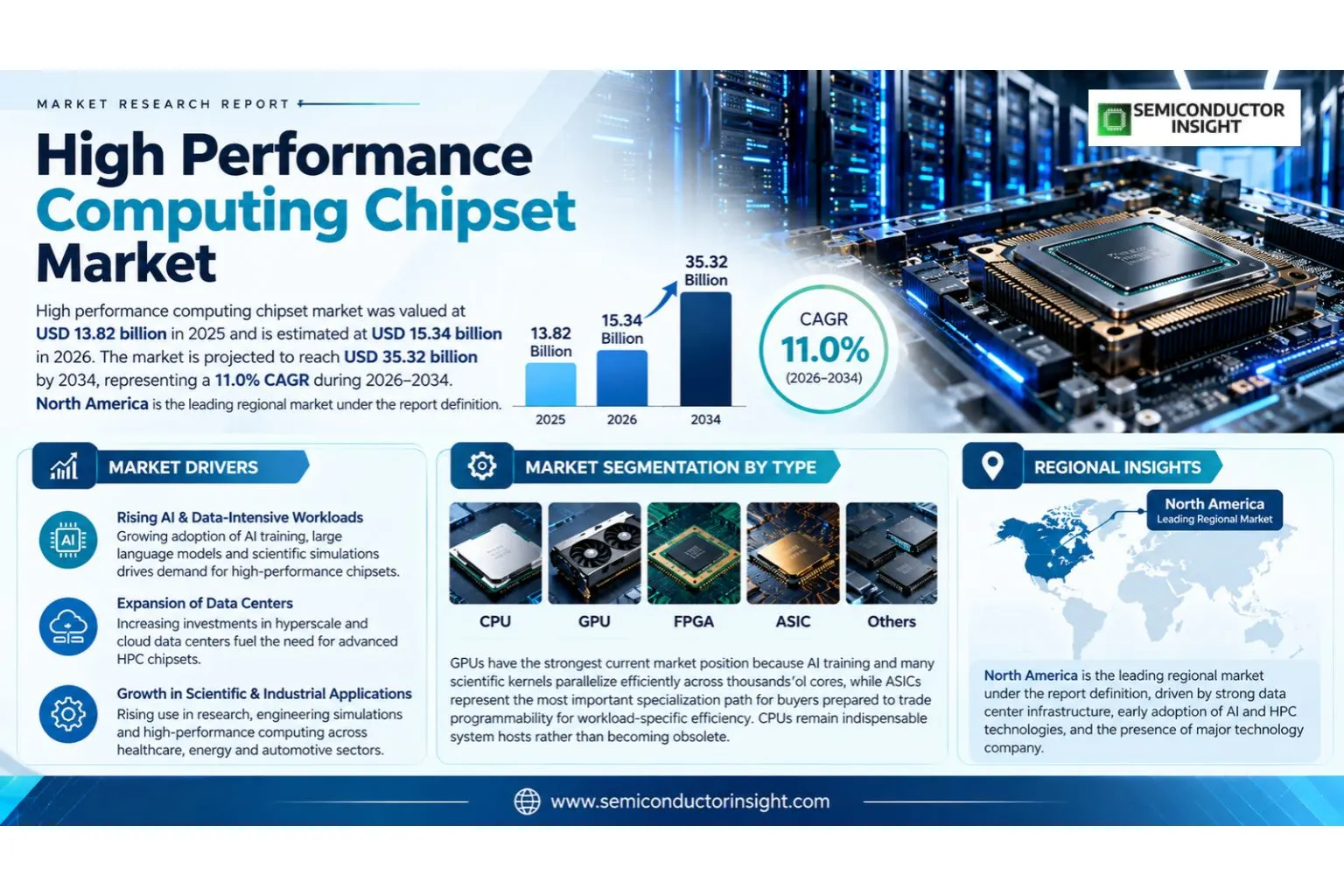
High performance computing chipset market was valued at USD 13.82 billion in 2025 and is estimated at USD 15.34 billion in 2026. The market is projected to reach USD 35.32 billion by 2034, representing a 11.0% CAGR during 2026–2034. North America is the leading regional market under the report definition.
High-performance computing chipsets are processors and accelerator devices engineered for workloads that demand far more arithmetic throughput, memory bandwidth and interconnect performance than general-purpose client computing. The report scope includes CPUs, GPUs, FPGAs, ASICs and other specialized processors used across life science, bioscience, automotive, aerospace and additional applications. Commercial value is created not by a chip in isolation, but by the ability to sustain application performance across processors, memory, networking, software libraries and increasingly dense power and cooling infrastructure.
The architecture is moving toward heterogeneous computing. CPUs continue to coordinate operating systems, scheduling, serial workloads and memory-rich tasks, while GPUs and custom accelerators execute highly parallel numerical kernels and AI operations. FPGAs retain relevance where determinism, reconfigurability or low-latency pipelines justify programming complexity. ASICs increasingly appear as domain-specific accelerators in cloud and enterprise platforms. This mix makes software portability, compiler maturity, memory hierarchy and fabric bandwidth decisive commercial attributes because customers evaluate time-to-solution rather than peak specification alone.
Demand is changing rapidly because AI and traditional HPC are converging at the infrastructure level. The same large clusters increasingly support model training, scientific simulation, digital twins, computational chemistry, weather analysis and engineering workloads. That convergence raises accelerator utilization but also intensifies pressure on memory bandwidth and network scale-up. TOP500 data in June 2025 showed three exascale systems in U.S. Department of Energy laboratories, demonstrating that the leading edge now depends on tightly integrated CPU, accelerator and high-speed fabric architectures rather than a single processor category.
Segment Analysis: By Type
By type, the market is segmented into CPU, GPU, FPGA, ASIC and Others. GPUs have the strongest current market position because AI training and many scientific kernels parallelize efficiently across thousands of cores, while ASICs represent the most important specialization path for buyers prepared to trade programmability for workload-specific efficiency. CPUs remain indispensable system hosts rather than becoming obsolete.
| Type | Technical role | Market position |
|---|---|---|
| CPU | General-purpose processors execute operating systems, orchestration, scalar code, memory-rich analytics and workloads that do not map efficiently to massively parallel accelerators. Modern server CPUs also provide large memory channels, vector extensions and high-speed I/O needed to keep accelerators fed. | A foundational segment with broad deployment across every HPC node. Growth is steadier than accelerators because CPU sockets are routinely bundled into systems, yet platform transitions such as Intel Xeon 6 and AMD EPYC continue to raise memory bandwidth, core count and accelerator connectivity. |
| GPU | GPUs use massive parallelism, high-bandwidth memory and specialized matrix engines to accelerate AI training, inference, molecular dynamics, computational fluid dynamics and other throughput-oriented workloads. Their programming ecosystems have become a major part of the product proposition. | The leading demand segment in accelerated HPC. NVIDIA Blackwell and AMD Instinct products demonstrate how competitive differentiation now combines compute precision, HBM capacity, bandwidth, interconnect scale and software support rather than raw floating-point throughput alone. |
| FPGA | FPGAs implement reconfigurable logic that can create deterministic pipelines, custom data paths and low-latency processing without a full custom-silicon cycle. They are suited to signal processing, networking, finance, edge inference and prototyping where workload structure is stable enough to justify hardware-oriented development. | A specialized segment with lower volume than CPUs or GPUs but defensible value in latency-sensitive and reconfigurable workloads. Adoption depends heavily on programming tools and developer availability, which makes software abstraction and pre-built IP important to commercial expansion. |
| ASIC | Application-specific integrated circuits are optimized for a defined workload or operator requirement, allowing designers to target power efficiency, latency, memory movement and cost at scale. Cloud providers increasingly use custom accelerators where deployment volumes justify the non-recurring engineering expense. | A strategic growth segment in hyperscale and AI infrastructure. The model favors organizations with sustained workload volume and strong internal silicon teams, while merchant suppliers compete by offering domain-specific devices that preserve broader programmability. |
| Others | Other HPC chipsets include specialized DSPs, network offload engines, data-processing units and emerging processor architectures that relieve CPUs or accelerators of communication, storage and application-specific tasks. Their value depends on removing a measurable system bottleneck rather than replacing the main compute device. | A fragmented but important innovation pool. These devices gain share when system architects can prove that offload reduces expensive accelerator idle time, lowers data movement or allows more useful compute within a fixed rack-power envelope. |
Memory bandwidth and interconnect increasingly determine effective chipset value
The competitive boundary between processor types is increasingly defined by data movement. AMD lists 256 GB of HBM3E and 6 TB/s memory bandwidth for the MI325X accelerator, while NVIDIA has continued increasing NVLink bandwidth across accelerator generations. These specifications matter because many HPC and AI workloads stall when processors cannot access memory or exchange data fast enough. As a result, buyers evaluate accelerator memory capacity, scale-up fabric, host I/O, software libraries and power density as one architecture rather than selecting processors on peak compute alone.
Segment Analysis: By Application
By application, the market covers Life Science, Bioscience, Automotive, Aerospace and Others. Life science and bioscience remain computation-intensive because genomics, molecular simulation and drug discovery process large datasets and complex models, while automotive and aerospace increasingly use accelerated computing for simulation, autonomy, digital engineering and design validation. The resulting procurement pattern favors platforms that can demonstrate measurable application value, software compatibility and operational efficiency at production scale rather than relying on isolated benchmark specifications.
| Application | Demand characteristics |
|---|---|
| Life Science | Purchasing is triggered by workloads such as genomic analysis, imaging, molecular modeling and AI-assisted drug discovery that need high throughput without allowing turnaround time to become the research bottleneck. Buyers value mixed-precision acceleration, large memory and mature scientific software. The commercial opportunity expands when a platform can support both classical simulation and machine-learning pipelines inside the same cluster. |
| Bioscience | Bioscience users require repeatable computational pipelines for protein analysis, structural biology, bioinformatics and multi-omics research. Demand often originates in universities, national laboratories, pharmaceutical research and cloud-based science platforms. System qualification emphasizes software ecosystem support and the ability to scale jobs efficiently because utilization rates, queue times and reproducibility directly affect research output and infrastructure economics. |
| Automotive | Automotive demand is linked to autonomous-driving development, perception-model training, computational fluid dynamics, crash simulation, battery engineering and digital twins. The chipset opportunity spans centralized data-center training and engineering clusters rather than only in-vehicle processors. Procurement favors platforms that shorten design iterations, support large AI datasets and integrate with established engineering software while controlling power and cluster operating cost. |
| Aerospace | Aerospace and defense workloads use HPC for aerodynamic simulation, structural analysis, mission modeling, satellite data processing and increasingly AI-assisted engineering. Long program lifecycles and software qualification requirements make platform stability important, while national security controls can influence supplier eligibility. Performance matters, but procurement also weighs reproducibility, security, support horizons and compatibility with validated scientific codes. |
| Others | Other applications include weather and climate modeling, financial analytics, energy exploration, manufacturing simulation, academic research and large-scale generative AI. Their common purchasing trigger is a workload whose economic value rises when time-to-solution falls. This broad category therefore supports multiple chipset architectures, with selection depending on arithmetic intensity, memory footprint, latency sensitivity, software stack and the buyer’s willingness to optimize code. |
Regional Analysis
North America leads the market under the report’s primary regional statement, while Asia Pacific carries the strongest manufacturing and capacity-expansion drivers. The U.S. combines major chipset designers, hyperscale cloud operators and three Department of Energy exascale systems documented by TOP500 in June 2025. Europe is strengthening sovereign HPC through EuroHPC, and Asia Pacific combines large end markets with the world’s most important advanced semiconductor manufacturing ecosystem.
How does regional demand differ across the high performance computing chipset market?
Regional demand is shaped by different bottlenecks. North America monetizes accelerator design, cloud deployment and national-laboratory procurement. Europe uses public supercomputing programs to build sovereign capability and energy-efficient infrastructure. Asia Pacific combines semiconductor manufacturing, cloud growth and national computing investment. South America has a smaller installed base centered on research, energy and cloud access, while the Middle East and Africa are building new HPC capacity around sovereign AI, energy, weather, research and digital infrastructure projects.
| Region | Position | Growth outlook | Demand profile | What decides supplier selection |
|---|---|---|---|---|
| North America | Largest | High | Hyperscale, AI and national labs | Performance per watt, software ecosystem, supply assurance and export compliance |
| Europe | Second tier | High | Public HPC and industrial simulation | Energy efficiency, sovereign access, procurement rules and software portability |
| Asia Pacific | Fastest structural expansion | Highest | Manufacturing, cloud and national programs | Availability, local ecosystems, export controls and price/performance |
| South America | Developing | Moderate | Research, energy and cloud-led | Budget efficiency, cloud access, service capability and import economics |
| Middle East & Africa | Developing from smaller base | High from low base | Sovereign AI, energy and research | Turnkey deployment, cooling, power availability and vendor support |
Get Sample Report PDF for Exclusive Insights
Report Sample Includes
- Table of Contents
- List of Tables & Figures
- Charts, Research Methodology, and more...
 Download Sample Report PDF