Key Statistics
Key Takeaways
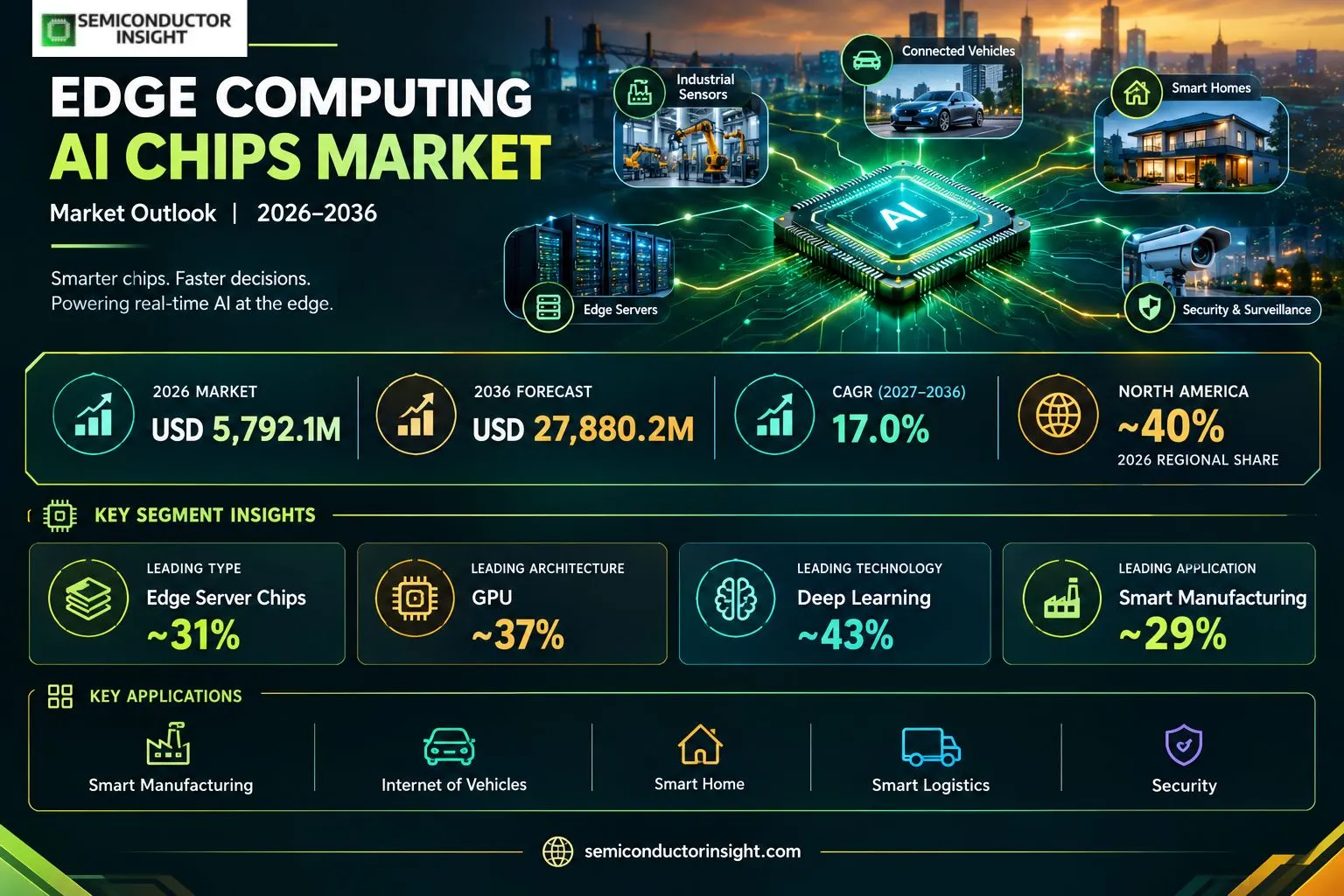
- Market value: The edge computing ai chips market stands at USD 5,792.1 million in 2026 and is projected to reach USD 27,880.2 million by 2036 at a CAGR of 17.0% during 2027–2036. The buying environment is shaped by on-device imaging, factory perception, mobile robotics and local AI gateways and the need to reconcile performance with availability, qualification and ownership costs.
- Edge Server Chips: leads the type classification with an estimated ~31% of 2026 revenue; inference per watt, deterministic latency, operating-system support and on-device model performance define why this offering reaches the largest customer base, while differently configured products compete on cost, deployment restrictions and future upgrade paths.
- Smart Manufacturing: accounts for an estimated ~29% of 2026 revenue, reflecting on-device imaging, factory perception, mobile robotics and local AI gateways; purchasing tends to follow equipment approval, system design and long-term service arrangements instead of isolated chip or hardware demonstrations.
- North America: holds an estimated ~40% of global market revenue in 2026. The regional growth pattern is uneven: Asia-Pacific has an estimated ~19.1% annual growth outlook, and access to product qualification routes differs by geography.
- Key constraint: Model portability, security patches, chip-design costs and supply-chain constraints limit conversion of planned technology spend into deliveries. Customers purchasing distributed edge inference processors need supplier evidence that parts remain supported, compatible and serviceable over extended deployments, particularly when a product becomes part of critical infrastructure.
Edge Computing AI Chips Market Overview
Edge computing AI chips market was valued at USD 5,792.1 million in 2026 and is projected to reach USD 27,880.2 million by 2036, expanding at a CAGR of 17.0% during 2027–2036. North America represented the largest regional revenue share in 2026, estimated at ~40%, reflecting its central role in the supply or procurement of distributed edge inference processors.
Edge Computing AI Chips is shaped by the design and deployment of mixed CPU, GPU, NPU and DSP paths that process sensor or application data close to its origin. For edge computing ai chips, buyers evaluate inference per watt, deterministic latency, operating-system support and on-device model performance during qualification rather than in isolated benchmarks. For edge computing ai chips, challenges involving model portability, security patches, chip-design costs and supply-chain constraints remain adoption hurdles, affecting pricing, validation and repeat orders.
Purchasing edge computing ai chips revenue boundary depends on the sale of distributed edge inference processors rather than all equipment or cloud services that incorporate them. When selecting edge computing ai chips revenue boundary, system architects compare sales eligibility, product configuration and exclusion of adjacent system revenue for Edge Computing AI Chips against long-term integration cost and readiness. For edge computing ai chips revenue boundary, challenges involving double counting the same component through suppliers and system integrators remain adoption hurdles, affecting pricing, validation and repeat orders.
Within technology architecture, mixed CPU, GPU, NPU and DSP paths that process sensor or application data close to its origin; inputs include logic wafers, semiconductor IP, integrated SRAM, advanced interfaces and low-power packaging affects supplier qualification for technology architecture. When qualifying technology architecture, customers place particular weight on inference per watt, deterministic latency, operating-system support and on-device model performance, because deployment performance matters more than peak specifications. For technology architecture, challenges involving model portability, security patches, chip-design costs and supply-chain constraints remain adoption hurdles, affecting pricing, validation and repeat orders.
A defining feature of edge computing ai chips end-customer demand is on-device imaging, factory perception, mobile robotics and local AI gateways. For edge computing ai chips end-customer demand, engineers balance long-term availability and qualified performance from suppliers of distributed edge inference processors with lifecycle support and deployment reliability. For edge computing ai chips end-customer demand, challenges involving deployment timing and the availability of compatible infrastructure remain adoption hurdles, affecting pricing, validation and repeat orders.
Current industry transition is shaped by rising local inference workloads with tighter data sovereignty and network-latency requirements. For current industry transition, buyers evaluate cost per deployed workload and the maturity of accompanying software and supply contracts for Edge Computing AI Chips during qualification rather than in isolated benchmarks. In the market for current industry transition, model portability, security patches, chip-design costs and supply-chain constraints can delay conversion of an engineering prototype into a purchased production system with assured support.
Segment Analysis: By Type
Type segmentation is shaped by 5 published type categories: Edge Terminal Equipment Chips, Edge Server Chips, Embedded AI Chips, Vision Processing Units, Others; Edge Server Chips leads at an estimated ~31%. For type segmentation, buyers evaluate inference per watt, deterministic latency, operating-system support and on-device model performance during qualification rather than in isolated benchmarks. In type segmentation, risks tied to model portability, security patches, chip-design costs and supply-chain constraints shift the configurations that win volume and determine whether deployments expand beyond the initial site.
| Type | Function | Market position |
|---|---|---|
| Edge Terminal Equipment Chips | Purchasing edge terminal equipment chips type depends on its use within mixed CPU, GPU, NPU and DSP paths that process sensor or application data close to its origin for on-device imaging, factory perception, mobile robotics and local AI gateways. When selecting edge terminal equipment chips type, system architects compare operating limits, interoperability and technical qualification specific to Edge Terminal Equipment Chips in Edge Computing AI Chips against long-term integration cost and readiness. In the market for edge terminal equipment chips type, model portability, security patches, chip-design costs and supply-chain constraints can delay conversion of an engineering prototype into a purchased production system with assured support. | A defining feature of edge terminal equipment chips commercial position is an estimated ~26% of 2026 category revenue and ~14.9% annual growth to 2036. For edge terminal equipment chips commercial position, engineers balance commercial selection of Edge Terminal Equipment Chips on inference per watt, deterministic latency, operating-system support and on-device model performance with lifecycle support and deployment reliability. Buyers of edge terminal equipment chips commercial position must also account for model portability, security patches, chip-design costs and supply-chain constraints, which shapes design margins and lifetime costs after the first shipment. |
| Edge Server Chips | Within edge server chips type, its use within mixed CPU, GPU, NPU and DSP paths that process sensor or application data close to its origin for on-device imaging, factory perception, mobile robotics and local AI gateways affects supplier qualification for edge server chips type. When qualifying edge server chips type, customers place particular weight on operating limits, interoperability and technical qualification specific to Edge Server Chips in Edge Computing AI Chips, because deployment performance matters more than peak specifications. In the market for edge server chips type, model portability, security patches, chip-design costs and supply-chain constraints can delay conversion of an engineering prototype into a purchased production system with assured support. | Edge Server Chips commercial position is shaped by an estimated ~31% of 2026 category revenue and ~19.1% annual growth to 2036. For edge server chips commercial position, buyers evaluate commercial selection of Edge Server Chips on inference per watt, deterministic latency, operating-system support and on-device model performance during qualification rather than in isolated benchmarks. In edge server chips commercial position, risks tied to model portability, security patches, chip-design costs and supply-chain constraints shift the configurations that win volume and determine whether deployments expand beyond the initial site. |
| Embedded AI Chips | A defining feature of embedded ai chips type is its use within mixed CPU, GPU, NPU and DSP paths that process sensor or application data close to its origin for on-device imaging, factory perception, mobile robotics and local AI gateways. For embedded ai chips type, engineers balance operating limits, interoperability and technical qualification specific to Embedded AI Chips in Edge Computing AI Chips with lifecycle support and deployment reliability. In the market for embedded ai chips type, model portability, security patches, chip-design costs and supply-chain constraints can delay conversion of an engineering prototype into a purchased production system with assured support. | Purchasing embedded ai chips commercial position depends on an estimated ~22% of 2026 category revenue and ~17.5% annual growth to 2036. When selecting embedded ai chips commercial position, system architects compare commercial selection of Embedded AI Chips on inference per watt, deterministic latency, operating-system support and on-device model performance against long-term integration cost and readiness. In embedded ai chips commercial position, risks tied to model portability, security patches, chip-design costs and supply-chain constraints shift the configurations that win volume and determine whether deployments expand beyond the initial site. |
| Vision Processing Units | Vision Processing Units type is shaped by its use within mixed CPU, GPU, NPU and DSP paths that process sensor or application data close to its origin for on-device imaging, factory perception, mobile robotics and local AI gateways. For vision processing units type, buyers evaluate operating limits, interoperability and technical qualification specific to Vision Processing Units in Edge Computing AI Chips during qualification rather than in isolated benchmarks. Buyers of vision processing units type must also account for model portability, security patches, chip-design costs and supply-chain constraints, which shapes design margins and lifetime costs after the first shipment. | Within vision processing units commercial position, an estimated ~14% of 2026 category revenue and ~16.1% annual growth to 2036 affects supplier qualification for vision processing units commercial position. When qualifying vision processing units commercial position, customers place particular weight on commercial selection of Vision Processing Units on inference per watt, deterministic latency, operating-system support and on-device model performance, because deployment performance matters more than peak specifications. In vision processing units commercial position, risks tied to model portability, security patches, chip-design costs and supply-chain constraints shift the configurations that win volume and determine whether deployments expand beyond the initial site. |
| Others | Purchasing others type depends on its use within mixed CPU, GPU, NPU and DSP paths that process sensor or application data close to its origin for on-device imaging, factory perception, mobile robotics and local AI gateways. When selecting others type, system architects compare operating limits, interoperability and technical qualification specific to Others in Edge Computing AI Chips against long-term integration cost and readiness. Buyers of others type must also account for model portability, security patches, chip-design costs and supply-chain constraints, which shapes design margins and lifetime costs after the first shipment. | A defining feature of others commercial position is an estimated ~7% of 2026 category revenue and ~13.9% annual growth to 2036. For others commercial position, engineers balance commercial selection of Others on inference per watt, deterministic latency, operating-system support and on-device model performance with lifecycle support and deployment reliability. In others commercial position, risks tied to model portability, security patches, chip-design costs and supply-chain constraints shift the configurations that win volume and determine whether deployments expand beyond the initial site. |
Secondary segmentation: architecture and technology
Purchasing architectural segmentation depends on GPU, ASIC, FPGA and CPU designs differ in compute flexibility, memory behaviour and power requirements for on-device imaging, factory perception, mobile robotics and local AI gateways. When selecting architectural segmentation, system architects compare inference per watt, deterministic latency, operating-system support and on-device model performance against long-term integration cost and readiness. In architectural segmentation, risks tied to model portability, security patches, chip-design costs and supply-chain constraints shift the configurations that win volume and determine whether deployments expand beyond the initial site.
| Axis | Members | Commercial role |
|---|---|---|
| By Architecture | GPU; ASIC; FPGA; CPU; Others | A defining feature of gpu architecture is an estimated ~37% of 2026 revenue, with ASIC, FPGA and CPU designs supporting different embedded inference requirements. For gpu architecture, engineers balance inference per watt, deterministic latency, operating-system support and on-device model performance with lifecycle support and deployment reliability. In gpu architecture, risks tied to model portability, security patches, chip-design costs and supply-chain constraints shift the configurations that win volume and determine whether deployments expand beyond the initial site. |
| By Technology | Machine Learning; Deep Learning; Computer Vision; Natural Language Processing | Deep Learning is shaped by an estimated ~43% of 2026 edge processor usage related to deep learning oriented workloads. For deep learning, buyers evaluate inference per watt, deterministic latency, operating-system support and on-device model performance during qualification rather than in isolated benchmarks. For deep learning, challenges involving model portability, security patches, chip-design costs and supply-chain constraints remain adoption hurdles, affecting pricing, validation and repeat orders. |
Segment Analysis: By Application
A defining feature of application segmentation is Smart Manufacturing is the leading end use at an estimated ~29% of 2026 revenue among 5 application classes. For application segmentation, engineers balance on-device imaging, factory perception, mobile robotics and local AI gateways with lifecycle support and deployment reliability. For application segmentation, challenges involving model portability, security patches, chip-design costs and supply-chain constraints remain adoption hurdles, affecting pricing, validation and repeat orders.
| Application | Demand characteristics |
|---|---|
| Smart Manufacturing | Purchasing smart manufacturing application depends on an estimated ~29% of 2026 application revenue and a modeled ~17.5% CAGR, with demand from on-device imaging, factory perception, mobile robotics and local AI gateways. When selecting smart manufacturing application, system architects compare integration testing, operational reliability and buying cycles for Smart Manufacturing uses of distributed edge inference processors against long-term integration cost and readiness. In the market for smart manufacturing application, model portability, security patches, chip-design costs and supply-chain constraints can delay conversion of an engineering prototype into a purchased production system with assured support. |
| Smart Home | Within smart home application, an estimated ~16% of 2026 application revenue and a modeled ~15.8% CAGR, with demand from on-device imaging, factory perception, mobile robotics and local AI gateways affects supplier qualification for smart home application. When qualifying smart home application, customers place particular weight on integration testing, operational reliability and buying cycles for Smart Home uses of distributed edge inference processors, because deployment performance matters more than peak specifications. In the market for smart home application, model portability, security patches, chip-design costs and supply-chain constraints can delay conversion of an engineering prototype into a purchased production system with assured support. |
| Smart Logistics | A defining feature of smart logistics application is an estimated ~16% of 2026 application revenue and a modeled ~17.6% CAGR, with demand from on-device imaging, factory perception, mobile robotics and local AI gateways. For smart logistics application, engineers balance integration testing, operational reliability and buying cycles for Smart Logistics uses of distributed edge inference processors with lifecycle support and deployment reliability. In the market for smart logistics application, model portability, security patches, chip-design costs and supply-chain constraints can delay conversion of an engineering prototype into a purchased production system with assured support. |
| Internet of Vehicles | Internet of Vehicles application is shaped by an estimated ~23% of 2026 application revenue and a modeled ~18.6% CAGR, with demand from on-device imaging, factory perception, mobile robotics and local AI gateways. For internet of vehicles application, buyers evaluate integration testing, operational reliability and buying cycles for Internet of Vehicles uses of distributed edge inference processors during qualification rather than in isolated benchmarks. Buyers of internet of vehicles application must also account for model portability, security patches, chip-design costs and supply-chain constraints, which shapes design margins and lifetime costs after the first shipment. |
| Security Prevention and Control | Purchasing security prevention and control application depends on an estimated ~16% of 2026 application revenue and a modeled ~13.8% CAGR, with demand from on-device imaging, factory perception, mobile robotics and local AI gateways. When selecting security prevention and control application, system architects compare integration testing, operational reliability and buying cycles for Security Prevention and Control uses of distributed edge inference processors against long-term integration cost and readiness. Buyers of security prevention and control application must also account for model portability, security patches, chip-design costs and supply-chain constraints, which shapes design margins and lifetime costs after the first shipment. |
Application purchasing channels is shaped by most deployments depend on the larger system integrator which qualifies distributed edge inference processors within an end product. For application purchasing channels, buyers evaluate inference per watt, deterministic latency, operating-system support and on-device model performance during qualification rather than in isolated benchmarks. In the market for application purchasing channels, model portability, security patches, chip-design costs and supply-chain constraints can delay conversion of an engineering prototype into a purchased production system with assured support.
Regional Analysis
Within global regional markets, North America leads with ~40% estimated share, followed by Asia-Pacific (~30%) and Europe (~21%), while Asia-Pacific has ~19.1% annual growth affects supplier qualification for global regional markets. When qualifying global regional markets, customers place particular weight on inference per watt, deterministic latency, operating-system support and on-device model performance, because deployment performance matters more than peak specifications. Buyers of global regional markets must also account for model portability, security patches, chip-design costs and supply-chain constraints, which shapes design margins and lifetime costs after the first shipment.
How do regional requirements differ for distributed edge inference processors?
A defining feature of regional differences is five market geographies have different roles in on-device imaging, factory perception, mobile robotics and local AI gateways, with qualification and manufacturing centers separated across borders. For regional differences, engineers balance inference per watt, deterministic latency, operating-system support and on-device model performance with lifecycle support and deployment reliability. Buyers of regional differences must also account for model portability, security patches, chip-design costs and supply-chain constraints, which shapes design margins and lifetime costs after the first shipment.
| Region | Position | Growth outlook | Demand profile | What decides supplier selection |
|---|---|---|---|---|
| North America | Largest (~40%) | ~16.2% CAGR | North America demand profile is shaped by platform designers, major software ecosystems and robotics developers specify edge chips before products reach international assembly lines. For north america demand profile, buyers evaluate inference per watt, deterministic latency, operating-system support and on-device model performance during qualification rather than in isolated benchmarks. In north america demand profile, risks tied to model portability, security patches, chip-design costs and supply-chain constraints shift the configurations that win volume and determine whether deployments expand beyond the initial site. | Within north america vendor access, platform designers, major software ecosystems and robotics developers specify edge chips before products reach international assembly lines affects supplier qualification for north america vendor access. When qualifying north america vendor access, customers place particular weight on inference per watt, deterministic latency, operating-system support and on-device model performance, because deployment performance matters more than peak specifications. For north america vendor access, challenges involving model portability, security patches, chip-design costs and supply-chain constraints remain adoption hurdles, affecting pricing, validation and repeat orders. |
| Europe | Rank 3 (~21%) | ~15.7% CAGR | Purchasing europe demand profile depends on industrial automation, automotive engineering and privacy-sensitive deployments reward well-supported low-power inference hardware. When selecting europe demand profile, system architects compare inference per watt, deterministic latency, operating-system support and on-device model performance against long-term integration cost and readiness. In europe demand profile, risks tied to model portability, security patches, chip-design costs and supply-chain constraints shift the configurations that win volume and determine whether deployments expand beyond the initial site. | A defining feature of europe vendor access is industrial automation, automotive engineering and privacy-sensitive deployments reward well-supported low-power inference hardware. For europe vendor access, engineers balance inference per watt, deterministic latency, operating-system support and on-device model performance with lifecycle support and deployment reliability. For europe vendor access, challenges involving model portability, security patches, chip-design costs and supply-chain constraints remain adoption hurdles, affecting pricing, validation and repeat orders. |
| Asia-Pacific | Rank 2 (~30%) | ~19.1% CAGR | Within asia-pacific demand profile, large electronics manufacturing clusters, mobility OEMs and smart production facilities purchase edge chips for local inference affects supplier qualification for asia-pacific demand profile. When qualifying asia-pacific demand profile, customers place particular weight on inference per watt, deterministic latency, operating-system support and on-device model performance, because deployment performance matters more than peak specifications. In asia-pacific demand profile, risks tied to model portability, security patches, chip-design costs and supply-chain constraints shift the configurations that win volume and determine whether deployments expand beyond the initial site. | Asia-Pacific vendor access is shaped by large electronics manufacturing clusters, mobility OEMs and smart production facilities purchase edge chips for local inference. For asia-pacific vendor access, buyers evaluate inference per watt, deterministic latency, operating-system support and on-device model performance during qualification rather than in isolated benchmarks. In the market for asia-pacific vendor access, model portability, security patches, chip-design costs and supply-chain constraints can delay conversion of an engineering prototype into a purchased production system with assured support. |
| South America | Rank 4 (~5%) | ~15.0% CAGR | A defining feature of south america demand profile is transport and utilities install edge inference gateways where upstream network reliability and cloud transmission costs matter. For south america demand profile, engineers balance inference per watt, deterministic latency, operating-system support and on-device model performance with lifecycle support and deployment reliability. In south america demand profile, risks tied to model portability, security patches, chip-design costs and supply-chain constraints shift the configurations that win volume and determine whether deployments expand beyond the initial site. | Purchasing south america vendor access depends on transport and utilities install edge inference gateways where upstream network reliability and cloud transmission costs matter. When selecting south america vendor access, system architects compare inference per watt, deterministic latency, operating-system support and on-device model performance against long-term integration cost and readiness. In the market for south america vendor access, model portability, security patches, chip-design costs and supply-chain constraints can delay conversion of an engineering prototype into a purchased production system with assured support. |
| Middle East & Africa | Rank 5 (~4%) | ~17.3% CAGR | Middle East & Africa demand profile is shaped by smart infrastructure deployments and remote industrial facilities use local inference to reduce dependence on continuous backhaul. For middle east & africa demand profile, buyers evaluate inference per watt, deterministic latency, operating-system support and on-device model performance during qualification rather than in isolated benchmarks. For middle east & africa demand profile, challenges involving model portability, security patches, chip-design costs and supply-chain constraints remain adoption hurdles, affecting pricing, validation and repeat orders. | Within middle east & africa vendor access, smart infrastructure deployments and remote industrial facilities use local inference to reduce dependence on continuous backhaul affects supplier qualification for middle east & africa vendor access. When qualifying middle east & africa vendor access, customers place particular weight on inference per watt, deterministic latency, operating-system support and on-device model performance, because deployment performance matters more than peak specifications. In the market for middle east & africa vendor access, model portability, security patches, chip-design costs and supply-chain constraints can delay conversion of an engineering prototype into a purchased production system with assured support. |
Competitive Landscape
Within competition and supplier positioning, NVIDIA; Qualcomm Technologies; Intel; AMD; Samsung Electronics participate in the supply chain for distributed edge inference processors affects supplier qualification for competition and supplier positioning. When qualifying competition and supplier positioning, customers place particular weight on inference per watt, deterministic latency, operating-system support and on-device model performance, because deployment performance matters more than peak specifications. In the market for competition and supplier positioning, model portability, security patches, chip-design costs and supply-chain constraints can delay conversion of an engineering prototype into a purchased production system with assured support.
A defining feature of principal direct suppliers is qualified commercial offerings from NVIDIA; Qualcomm Technologies; Intel; AMD; Samsung Electronics. For principal direct suppliers, engineers balance inference per watt, deterministic latency, operating-system support and on-device model performance with lifecycle support and deployment reliability. In the market for principal direct suppliers, model portability, security patches, chip-design costs and supply-chain constraints can delay conversion of an engineering prototype into a purchased production system with assured support.
Specialist supplier channel is shaped by Ambarella; Huawei Technologies; Google (certain device silicon) participate in the wider competitive environment. For specialist supplier channel, buyers evaluate traceable product capabilities and fulfilment of Edge Computing AI Chips specifications during qualification rather than in isolated benchmarks. Buyers of specialist supplier channel must also account for model portability, security patches, chip-design costs and supply-chain constraints, which shapes design margins and lifetime costs after the first shipment.
Purchasing edge computing ai chips integration ecosystem depends on Arm (processor IP); ADLINK and OnLogic (systems integrators); other ecosystem participants can influence integration while not automatically counting toward the same revenue boundary. When selecting edge computing ai chips integration ecosystem, system architects compare inference per watt, deterministic latency, operating-system support and on-device model performance against long-term integration cost and readiness. Buyers of edge computing ai chips integration ecosystem must also account for confusing component and complete-system revenues, which shapes design margins and lifetime costs after the first shipment.
Within procurement competition, rising local inference workloads with tighter data sovereignty and network-latency requirements affects both established and challenger suppliers affects supplier qualification for procurement competition. When qualifying procurement competition, customers place particular weight on secure lead time and technical support in the Edge Computing AI Chips supply chain, because deployment performance matters more than peak specifications. Buyers of procurement competition must also account for model portability, security patches, chip-design costs and supply-chain constraints, which shapes design margins and lifetime costs after the first shipment.
Tier structure
| Tier | Companies | Basis of competition |
|---|---|---|
| Tier 1 | NVIDIA; Qualcomm Technologies; Intel; AMD; Samsung Electronics | A defining feature of tier-one competition is complete supplier offerings for on-device imaging, factory perception, mobile robotics and local AI gateways. For tier-one competition, engineers balance inference per watt, deterministic latency, operating-system support and on-device model performance with lifecycle support and deployment reliability. Buyers of tier-one competition must also account for model portability, security patches, chip-design costs and supply-chain constraints, which shapes design margins and lifetime costs after the first shipment. |
| Tier 2 | Ambarella; Huawei Technologies; Google (certain device silicon) | Tier-two competition is shaped by focus on selected applications and specific integration pathways for distributed edge inference processors. For tier-two competition, buyers evaluate inference per watt, deterministic latency, operating-system support and on-device model performance during qualification rather than in isolated benchmarks. In tier-two competition, risks tied to model portability, security patches, chip-design costs and supply-chain constraints shift the configurations that win volume and determine whether deployments expand beyond the initial site. |
| Tier 3 | Arm (processor IP); ADLINK and OnLogic (systems integrators); other ecosystem participants | Purchasing edge computing ai chips ecosystem support depends on component technology or downstream integration that shapes mixed CPU, GPU, NPU and DSP paths that process sensor or application data close to its origin. When selecting edge computing ai chips ecosystem support, system architects compare inference per watt, deterministic latency, operating-system support and on-device model performance against long-term integration cost and readiness. In edge computing ai chips ecosystem support, risks tied to misclassification of underlying revenue shift the configurations that win volume and determine whether deployments expand beyond the initial site. |
Key companies profiled
- Nvidia Corporation
- Intel Corporation
- Qualcomm Technologies
- Huawei Technologies
- Arm Limited
- Google LLC
- AMD (Xilinx)
- Samsung Electronics
- Ambarella
- Cerebras Systems
Production Capacity Analysis
Within production and capacity, fabless processor design firms and foundry capacity in Asia complemented by testing and system integration worldwide affects supplier qualification for production and capacity. When qualifying production and capacity, customers place particular weight on inference per watt, deterministic latency, operating-system support and on-device model performance, because deployment performance matters more than peak specifications. In production and capacity, risks tied to model portability, security patches, chip-design costs and supply-chain constraints shift the configurations that win volume and determine whether deployments expand beyond the initial site.
A defining feature of production concentration is fabless processor design firms and foundry capacity in Asia complemented by testing and system integration worldwide; output requires logic wafers, semiconductor IP, integrated SRAM, advanced interfaces and low-power packaging. For production concentration, engineers balance inference per watt, deterministic latency, operating-system support and on-device model performance with lifecycle support and deployment reliability. In production concentration, risks tied to model portability, security patches, chip-design costs and supply-chain constraints shift the configurations that win volume and determine whether deployments expand beyond the initial site.
Cross-border sourcing is shaped by subsystem integration for mixed CPU, GPU, NPU and DSP paths that process sensor or application data close to its origin frequently spans foundries, board makers, and qualified manufacturers. For cross-border sourcing, buyers evaluate configuration control and qualified alternatives for Edge Computing AI Chips during qualification rather than in isolated benchmarks. For cross-border sourcing, challenges involving model portability, security patches, chip-design costs and supply-chain constraints remain adoption hurdles, affecting pricing, validation and repeat orders.
Purchasing upstream bottlenecks depends on logic wafers, semiconductor IP, integrated SRAM, advanced interfaces and low-power packaging can become constrained when accelerator or embedded-system demand accelerates. When selecting upstream bottlenecks, system architects compare inference per watt, deterministic latency, operating-system support and on-device model performance against long-term integration cost and readiness. For upstream bottlenecks, challenges involving model portability, security patches, chip-design costs and supply-chain constraints remain adoption hurdles, affecting pricing, validation and repeat orders.
Market Dynamics
Within market drivers, restraints and opportunities, rising local inference workloads with tighter data sovereignty and network-latency requirements; the market must still manage model portability, security patches, chip-design costs and supply-chain constraints affects supplier qualification for market drivers, restraints and opportunities. When qualifying market drivers, restraints and opportunities, customers place particular weight on inference per watt, deterministic latency, operating-system support and on-device model performance, because deployment performance matters more than peak specifications. For market drivers, restraints and opportunities, challenges involving model portability, security patches, chip-design costs and supply-chain constraints remain adoption hurdles, affecting pricing, validation and repeat orders.
MARKET DRIVERS
Drivers Impact Analysis*
| Driver | (~) % impact on CAGR forecast | Geographic relevance | Impact timeline |
|---|---|---|---|
| AI workload localization | +1.5% | North America and Asia-Pacific | 2026–2029 |
| Product performance upgrades | +1.1% | Global AI and compute centers | 2027–2032 |
| Industrial deployment scale | +0.8% | Europe and Asia-Pacific | 2026–2034 |
| Integration ecosystem investment | +0.7% | Cross-region system deployment | 2028–2036 |
| Channel expansion | +0.4% | Regional industrial customers | 2026–2036 |
AI workload localization
AI workload localization is shaped by rising local inference workloads with tighter data sovereignty and network-latency requirements, raising the need for distributed edge inference processors. For ai workload localization, buyers evaluate inference per watt, deterministic latency, operating-system support and on-device model performance during qualification rather than in isolated benchmarks. In the market for ai workload localization, model portability, security patches, chip-design costs and supply-chain constraints can delay conversion of an engineering prototype into a purchased production system with assured support.
Product performance upgrades
Purchasing product performance upgrades depends on rising local inference workloads with tighter data sovereignty and network-latency requirements, raising the need for distributed edge inference processors. When selecting product performance upgrades, system architects compare inference per watt, deterministic latency, operating-system support and on-device model performance against long-term integration cost and readiness. In the market for product performance upgrades, model portability, security patches, chip-design costs and supply-chain constraints can delay conversion of an engineering prototype into a purchased production system with assured support.
Industrial deployment scale
Within industrial deployment scale, rising local inference workloads with tighter data sovereignty and network-latency requirements, raising the need for distributed edge inference processors affects supplier qualification for industrial deployment scale. When qualifying industrial deployment scale, customers place particular weight on inference per watt, deterministic latency, operating-system support and on-device model performance, because deployment performance matters more than peak specifications. In the market for industrial deployment scale, model portability, security patches, chip-design costs and supply-chain constraints can delay conversion of an engineering prototype into a purchased production system with assured support.
Integration ecosystem investment
A defining feature of integration ecosystem investment is rising local inference workloads with tighter data sovereignty and network-latency requirements, raising the need for distributed edge inference processors. For integration ecosystem investment, engineers balance inference per watt, deterministic latency, operating-system support and on-device model performance with lifecycle support and deployment reliability. In the market for integration ecosystem investment, model portability, security patches, chip-design costs and supply-chain constraints can delay conversion of an engineering prototype into a purchased production system with assured support.
MARKET RESTRAINTS
Restraints Impact Analysis*
| Restraint | (~) % impact on CAGR forecast | Geographic relevance | Impact timeline |
|---|---|---|---|
| Integration qualification costs | −0.9% | All regions | 2026–2030 |
| Power and thermal envelope | −0.8% | Asia-Pacific | 2027–2034 |
| Supply and software fragmentation | −0.6% | Industrial projects | 2026–2036 |
| Long-lifecycle replacement risk | −0.5% | Global procurement | 2028–2036 |
Integration qualification costs
Integration qualification costs is shaped by model portability, security patches, chip-design costs and supply-chain constraints change the level of attainable installation and supply. For integration qualification costs, buyers evaluate inference per watt, deterministic latency, operating-system support and on-device model performance during qualification rather than in isolated benchmarks. Buyers of integration qualification costs must also account for model portability, security patches, chip-design costs and supply-chain constraints, which shapes design margins and lifetime costs after the first shipment.
Power and thermal envelope
Purchasing power and thermal envelope depends on model portability, security patches, chip-design costs and supply-chain constraints change the level of attainable installation and supply. When selecting power and thermal envelope, system architects compare inference per watt, deterministic latency, operating-system support and on-device model performance against long-term integration cost and readiness. Buyers of power and thermal envelope must also account for model portability, security patches, chip-design costs and supply-chain constraints, which shapes design margins and lifetime costs after the first shipment.
Supply and software fragmentation
Within supply and software fragmentation, model portability, security patches, chip-design costs and supply-chain constraints change the level of attainable installation and supply affects supplier qualification for supply and software fragmentation. When qualifying supply and software fragmentation, customers place particular weight on inference per watt, deterministic latency, operating-system support and on-device model performance, because deployment performance matters more than peak specifications. Buyers of supply and software fragmentation must also account for model portability, security patches, chip-design costs and supply-chain constraints, which shapes design margins and lifetime costs after the first shipment.
Long-lifecycle replacement risk
A defining feature of long-lifecycle replacement risk is model portability, security patches, chip-design costs and supply-chain constraints change the level of attainable installation and supply. For long-lifecycle replacement risk, engineers balance inference per watt, deterministic latency, operating-system support and on-device model performance with lifecycle support and deployment reliability. Buyers of long-lifecycle replacement risk must also account for model portability, security patches, chip-design costs and supply-chain constraints, which shapes design margins and lifetime costs after the first shipment.
MARKET OPPORTUNITIES
System design wins in underserved verticals
System design wins in underserved verticals is shaped by customer priorities around on-device imaging, factory perception, mobile robotics and local AI gateways shift toward new configurations of mixed CPU, GPU, NPU and DSP paths that process sensor or application data close to its origin. For system design wins in underserved verticals, buyers evaluate inference per watt, deterministic latency, operating-system support and on-device model performance during qualification rather than in isolated benchmarks. In system design wins in underserved verticals, risks tied to model portability, security patches, chip-design costs and supply-chain constraints shift the configurations that win volume and determine whether deployments expand beyond the initial site.
Infrastructure retrofits and upgrades
Purchasing infrastructure retrofits and upgrades depends on customer priorities around on-device imaging, factory perception, mobile robotics and local AI gateways shift toward new configurations of mixed CPU, GPU, NPU and DSP paths that process sensor or application data close to its origin. When selecting infrastructure retrofits and upgrades, system architects compare inference per watt, deterministic latency, operating-system support and on-device model performance against long-term integration cost and readiness. In infrastructure retrofits and upgrades, risks tied to model portability, security patches, chip-design costs and supply-chain constraints shift the configurations that win volume and determine whether deployments expand beyond the initial site.
Local processing in privacy-sensitive sites
Within local processing in privacy-sensitive sites, customer priorities around on-device imaging, factory perception, mobile robotics and local AI gateways shift toward new configurations of mixed CPU, GPU, NPU and DSP paths that process sensor or application data close to its origin affects supplier qualification for local processing in privacy-sensitive sites. When qualifying local processing in privacy-sensitive sites, customers place particular weight on inference per watt, deterministic latency, operating-system support and on-device model performance, because deployment performance matters more than peak specifications. In local processing in privacy-sensitive sites, risks tied to model portability, security patches, chip-design costs and supply-chain constraints shift the configurations that win volume and determine whether deployments expand beyond the initial site.
Supplier partnerships for qualified new products
A defining feature of supplier partnerships for qualified new products is customer priorities around on-device imaging, factory perception, mobile robotics and local AI gateways shift toward new configurations of mixed CPU, GPU, NPU and DSP paths that process sensor or application data close to its origin. For supplier partnerships for qualified new products, engineers balance inference per watt, deterministic latency, operating-system support and on-device model performance with lifecycle support and deployment reliability. In supplier partnerships for qualified new products, risks tied to model portability, security patches, chip-design costs and supply-chain constraints shift the configurations that win volume and determine whether deployments expand beyond the initial site.
Supply Chain Analysis
Supply chain structure is shaped by logic wafers, semiconductor IP, integrated SRAM, advanced interfaces and low-power packaging enter a chain of fabless processor design firms and foundry capacity in Asia complemented by testing and system integration worldwide. For supply chain structure, buyers evaluate inference per watt, deterministic latency, operating-system support and on-device model performance during qualification rather than in isolated benchmarks. For supply chain structure, challenges involving model portability, security patches, chip-design costs and supply-chain constraints remain adoption hurdles, affecting pricing, validation and repeat orders.
Upstream inputs. Purchasing upstream inputs depends on logic wafers, semiconductor IP, integrated SRAM, advanced interfaces and low-power packaging serve a defined position in the supply of distributed edge inference processors. When selecting upstream inputs, system architects compare inference per watt, deterministic latency, operating-system support and on-device model performance against long-term integration cost and readiness. For upstream inputs, challenges involving model portability, security patches, chip-design costs and supply-chain constraints remain adoption hurdles, affecting pricing, validation and repeat orders.
Fabrication and assembly. Within fabrication and assembly, fabless processor design firms and foundry capacity in Asia complemented by testing and system integration worldwide serve a defined position in the supply of distributed edge inference processors affects supplier qualification for fabrication and assembly. When qualifying fabrication and assembly, customers place particular weight on inference per watt, deterministic latency, operating-system support and on-device model performance, because deployment performance matters more than peak specifications. For fabrication and assembly, challenges involving model portability, security patches, chip-design costs and supply-chain constraints remain adoption hurdles, affecting pricing, validation and repeat orders.
System integration. A defining feature of system integration is mixed CPU, GPU, NPU and DSP paths that process sensor or application data close to its origin serve a defined position in the supply of distributed edge inference processors. For system integration, engineers balance inference per watt, deterministic latency, operating-system support and on-device model performance with lifecycle support and deployment reliability. For system integration, challenges involving model portability, security patches, chip-design costs and supply-chain constraints remain adoption hurdles, affecting pricing, validation and repeat orders.
Deployment channel. Deployment channel is shaped by on-device imaging, factory perception, mobile robotics and local AI gateways serve a defined position in the supply of distributed edge inference processors. For deployment channel, buyers evaluate inference per watt, deterministic latency, operating-system support and on-device model performance during qualification rather than in isolated benchmarks. In the market for deployment channel, model portability, security patches, chip-design costs and supply-chain constraints can delay conversion of an engineering prototype into a purchased production system with assured support.
Recent Developments
- 2026-09-09 Published
Purchasing qualcomm 2026-09-09 development depends on the robotics development on iq8/iq9 announcement; Heterogeneous CPU/GPU/NPU/DSP processing supports real-time perception and control.. When selecting qualcomm 2026-09-09 development, system architects compare qualified procurement and integration of distributed edge inference processors against long-term integration cost and readiness. In the market for qualcomm 2026-09-09 development, model portability, security patches, chip-design costs and supply-chain constraints can delay conversion of an engineering prototype into a purchased production system with assured support. Source - 2026-08-20 Announced
Within qualcomm 2026-08-20 development, the industrial dragonwing processor portfolio announcement; IQ6 through IQ9 address multiple embedded AI capability and power tiers. affects supplier qualification for qualcomm 2026-08-20 development. When qualifying qualcomm 2026-08-20 development, customers place particular weight on qualified procurement and integration of distributed edge inference processors, because deployment performance matters more than peak specifications. In the market for qualcomm 2026-08-20 development, model portability, security patches, chip-design costs and supply-chain constraints can delay conversion of an engineering prototype into a purchased production system with assured support. Source - 2026-08-11 Published
A defining feature of qualcomm 2026-08-11 development is the production-ready edge ai applications announcement; The provider explains model optimization and runtime deployment choices.. For qualcomm 2026-08-11 development, engineers balance qualified procurement and integration of distributed edge inference processors with lifecycle support and deployment reliability. In the market for qualcomm 2026-08-11 development, model portability, security patches, chip-design costs and supply-chain constraints can delay conversion of an engineering prototype into a purchased production system with assured support. Source - 2026-07-15 Announced
NVIDIA 2026-07-15 development is shaped by the jetson thor t3000 and t2000 expansion announcement; New production modules support different power, memory and industrial-compute configurations.. For nvidia 2026-07-15 development, buyers evaluate qualified procurement and integration of distributed edge inference processors during qualification rather than in isolated benchmarks. Buyers of nvidia 2026-07-15 development must also account for model portability, security patches, chip-design costs and supply-chain constraints, which shapes design margins and lifetime costs after the first shipment. Source - 2026-06-30 Published
Purchasing qualcomm 2026-06-30 development depends on the iq8/iq9 industrial ai toolchain announcement; Long-term processor availability and interfaces matter for industrial qualification.. When selecting qualcomm 2026-06-30 development, system architects compare qualified procurement and integration of distributed edge inference processors against long-term integration cost and readiness. Buyers of qualcomm 2026-06-30 development must also account for model portability, security patches, chip-design costs and supply-chain constraints, which shapes design margins and lifetime costs after the first shipment. Source - 2026-06-01 Announced
Within qualcomm 2026-06-01 development, the iq10 robotics reference design announcement; The reference design integrates sensing, AI processing and robotics controls. affects supplier qualification for qualcomm 2026-06-01 development. When qualifying qualcomm 2026-06-01 development, customers place particular weight on qualified procurement and integration of distributed edge inference processors, because deployment performance matters more than peak specifications. Buyers of qualcomm 2026-06-01 development must also account for model portability, security patches, chip-design costs and supply-chain constraints, which shapes design margins and lifetime costs after the first shipment. Source - 2026-04-21 Published
A defining feature of onlogic 2026-04-21 development is the industrial edge deployment partnership announcement; The company relationship indicates adoption pathways for embedded inference hardware.. For onlogic 2026-04-21 development, engineers balance qualified procurement and integration of distributed edge inference processors with lifecycle support and deployment reliability. Buyers of onlogic 2026-04-21 development must also account for model portability, security patches, chip-design costs and supply-chain constraints, which shapes design margins and lifetime costs after the first shipment. Source - 2026-03-17 Announced
ADLINK 2026-03-17 development is shaped by the thor industrial module systems announcement; Industrial systems demonstrate how AI accelerators are integrated into qualified edge deployments.. For adlink 2026-03-17 development, buyers evaluate qualified procurement and integration of distributed edge inference processors during qualification rather than in isolated benchmarks. In adlink 2026-03-17 development, risks tied to model portability, security patches, chip-design costs and supply-chain constraints shift the configurations that win volume and determine whether deployments expand beyond the initial site. Source
REPORT SCOPE & SEGMENTATION
| Attribute | Details |
|---|---|
| Report Title | Edge Computing AI Chips Market |
| Study Period | 2021–2036 |
| Historical Period | 2021–2025 |
| Base Year | 2026 |
| Estimated Year | 2027 |
| Forecast Period | 2027–2036 |
| Base Year Market Size | USD 5,792.1 million |
| Estimated Market Size | USD 6,777.7 million |
| Forecast Market Size | USD 27,880.2 million |
| CAGR (2027–2036) | 17.0% |
| Market Revenue Unit | USD million |
| Market Boundary | Commercial revenues attributable to distributed edge inference processors; downstream service revenue and unrelated systems are excluded. |
| By Type | Edge Terminal Equipment Chips · Edge Server Chips · Embedded AI Chips · Vision Processing Units · Others |
| By Application | Smart Manufacturing · Smart Home · Smart Logistics · Internet of Vehicles · Security Prevention and Control |
| By Architecture | GPU · ASIC · FPGA · CPU · Others |
| By Technology | Machine Learning · Deep Learning · Computer Vision · Natural Language Processing |
| By Region | Global geographic analysis across five regions, with base-year revenue shares shown as estimates. North AmericaUnited States · Canada · Mexico EuropeGermany · France · United Kingdom · Netherlands Asia-PacificChina · Japan · South Korea · India South AmericaBrazil · Argentina · Chile Middle East & AfricaSaudi Arabia · United Arab Emirates · South Africa · Egypt |
| Key Companies Profiled | Nvidia Corporation · Intel Corporation · Qualcomm Technologies · Huawei Technologies · Arm Limited · Google LLC · AMD (Xilinx) · Samsung Electronics · Ambarella · Cerebras Systems |
| Customization Scope | Country-level procurement patterns, inference per watt, deterministic latency, operating-system support and on-device model performance, equipment qualification, capacity assumptions and buyer-specific industry segmentation. |
Frequently Asked Questions
What is the edge computing ai chips market size and forecast?
The global edge computing ai chips market was valued at USD 5,792.1 million in 2026 and is projected to reach USD 27,880.2 million in 2036, expanding at a CAGR of 17.0% over 2027–2036. A defining feature of forecast demand is rising local inference workloads with tighter data sovereignty and network-latency requirements. For forecast demand, engineers balance inference per watt, deterministic latency, operating-system support and on-device model performance with lifecycle support and deployment reliability. In forecast demand, risks tied to model portability, security patches, chip-design costs and supply-chain constraints shift the configurations that win volume and determine whether deployments expand beyond the initial site.
Which product type leads the edge computing ai chips market?
Edge Server Chips leadership is shaped by an estimated ~31% of 2026 revenues and continuing demand from on-device imaging, factory perception, mobile robotics and local AI gateways. For edge server chips leadership, buyers evaluate inference per watt, deterministic latency, operating-system support and on-device model performance during qualification rather than in isolated benchmarks. For edge server chips leadership, challenges involving model portability, security patches, chip-design costs and supply-chain constraints remain adoption hurdles, affecting pricing, validation and repeat orders.
What is the leading edge computing ai chips application?
Purchasing smart manufacturing demand depends on an estimated ~29% of 2026 application revenues. When selecting smart manufacturing demand, system architects compare inference per watt, deterministic latency, operating-system support and on-device model performance against long-term integration cost and readiness. For smart manufacturing demand, challenges involving model portability, security patches, chip-design costs and supply-chain constraints remain adoption hurdles, affecting pricing, validation and repeat orders.
Which region has the largest edge computing ai chips market?
Within regional market leader, North America represented an estimated ~40% in 2026 and platform designers, major software ecosystems and robotics developers specify edge chips before products reach international assembly lines affects supplier qualification for regional market leader. When qualifying regional market leader, customers place particular weight on inference per watt, deterministic latency, operating-system support and on-device model performance, because deployment performance matters more than peak specifications. For regional market leader, challenges involving model portability, security patches, chip-design costs and supply-chain constraints remain adoption hurdles, affecting pricing, validation and repeat orders.
Which region is expanding fastest for edge computing ai chips?
A defining feature of fastest regional growth is Asia-Pacific has modeled annual expansion near ~19.1% and large electronics manufacturing clusters, mobility OEMs and smart production facilities purchase edge chips for local inference. For fastest regional growth, engineers balance inference per watt, deterministic latency, operating-system support and on-device model performance with lifecycle support and deployment reliability. For fastest regional growth, challenges involving model portability, security patches, chip-design costs and supply-chain constraints remain adoption hurdles, affecting pricing, validation and repeat orders.
What determines product selection in edge computing ai chips?
Selection requirements is shaped by inference per watt, deterministic latency, operating-system support and on-device model performance are decisive when implementing mixed CPU, GPU, NPU and DSP paths that process sensor or application data close to its origin. For selection requirements, buyers evaluate inference per watt, deterministic latency, operating-system support and on-device model performance during qualification rather than in isolated benchmarks. In the market for selection requirements, model portability, security patches, chip-design costs and supply-chain constraints can delay conversion of an engineering prototype into a purchased production system with assured support.
Which firms participate in the edge computing ai chips market?
Purchasing supplier structure depends on NVIDIA; Qualcomm Technologies; Intel; AMD; Samsung Electronics represent a major part of the commercial supply environment. When selecting supplier structure, system architects compare inference per watt, deterministic latency, operating-system support and on-device model performance against long-term integration cost and readiness. In the market for supplier structure, model portability, security patches, chip-design costs and supply-chain constraints can delay conversion of an engineering prototype into a purchased production system with assured support.
What are the key constraints on edge computing ai chips growth?
Within principal restraints, model portability, security patches, chip-design costs and supply-chain constraints add cost and schedule uncertainty affects supplier qualification for principal restraints. When qualifying principal restraints, customers place particular weight on inference per watt, deterministic latency, operating-system support and on-device model performance, because deployment performance matters more than peak specifications. In the market for principal restraints, model portability, security patches, chip-design costs and supply-chain constraints can delay conversion of an engineering prototype into a purchased production system with assured support.
How do manufacturing and supply affect edge computing ai chips?
A defining feature of manufacturing availability is fabless processor design firms and foundry capacity in Asia complemented by testing and system integration worldwide and the sourcing of logic wafers, semiconductor IP, integrated SRAM, advanced interfaces and low-power packaging. For manufacturing availability, engineers balance inference per watt, deterministic latency, operating-system support and on-device model performance with lifecycle support and deployment reliability. In the market for manufacturing availability, model portability, security patches, chip-design costs and supply-chain constraints can delay conversion of an engineering prototype into a purchased production system with assured support.
What does the edge computing ai chips study cover?
Report scope is shaped by the 2021–2036 study span covers 2026 market revenues across 5 type and 5 application categories with five geographic regions. For report scope, buyers evaluate inference per watt, deterministic latency, operating-system support and on-device model performance during qualification rather than in isolated benchmarks. Buyers of report scope must also account for model portability, security patches, chip-design costs and supply-chain constraints, which shapes design margins and lifetime costs after the first shipment.
Research Sources & Evidence Base

Get Sample Report PDF for Exclusive Insights
Report Sample Includes
- Table of Contents
- List of Tables & Figures
- Charts, Research Methodology, and more...
 Download Sample Report PDF