Mobile Phone ToF Driver IC Market Insights
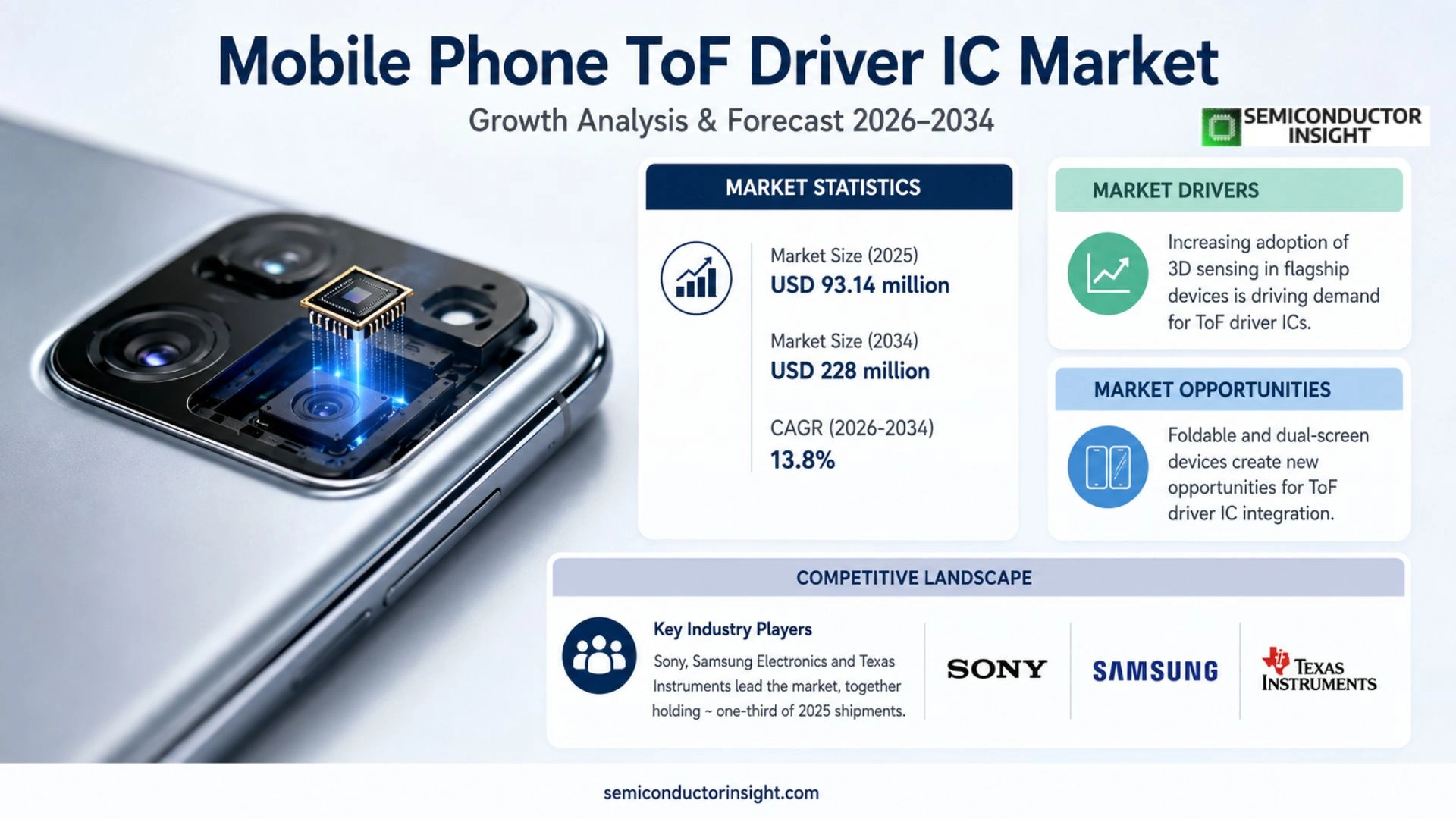
Mobile Phone ToF Driver IC market size was valued at USD 93.14 million in 2025 and is forecasted to climb to USD 228 million by 2034, reflecting a compound annual growth rate of 13.8 percent over the period.
Mobile Phone ToF Driver ICs are specialized control chips that manage three‑dimensional sensing modules in smartphones. By precisely regulating current amplitude, pulse width, and emission frequency for VCSEL or infrared light sources, these ICs enable nanosecond‑level pulse modulation and tight timing synchronization with ToF image sensors, which translates into accurate distance measurement and depth mapping. Key technical attributes include low‑noise design, stable current output, and power‑efficient operation suitable for high‑volume mobile devices.
MARKET DRIVERS
Increasing Adoption of 3D Sensing in Flagship Devices
The integration of Time‑of‑Flight (ToF) driver ICs has become a decisive factor for premium smartphones seeking reliable depth perception. Manufacturers cite superior facial‑unlock performance and more accurate augmented‑reality overlays as primary incentives, prompting a 15 % year‑over‑year rise in component shipments for high‑end models.
Advances in Low‑Power Semiconductor Processes
Recent node shrinkages to 28 nm and below have trimmed power consumption by up to 30 %, enabling thinner modules without compromising measurement range. This efficiency gain aligns with consumer demand for longer battery life, sharpening the competitive edge of devices that embed ToF driver ICs.
➤ Manufacturers that secure early access to next‑generation process technologies can differentiate their product pipelines while preserving pricing power.
Collectively, these dynamics elevate Mobile Phone ToF Driver IC Market, encouraging OEMs to allocate larger design budgets toward depth‑sensing solutions and reinforcing the strategic importance of this component class.
MARKET CHALLENGES
Cost Sensitivity in Mid‑Tier Smartphones
Price‑competitive segments, which still represent a sizable share of global shipments, exhibit reluctance to adopt ToF driver ICs because the added bill‑of‑materials can erode thin profit margins. Vendors responding with economical integration kits have observed modest uptake, yet the overall cadence remains restrained.
In addition, end‑users frequently prioritize camera resolution over depth accuracy, a perception that limits demand for premium sensor stacks in cost‑focused models.
Other Challenges
Supply Chain Volatility
Fluctuations in semiconductor fab capacity, triggered by geopolitical tensions and pandemic‑related disruptions, have introduced lead‑time uncertainties. Companies that lack diversified sourcing strategies risk inventory gaps, which can delay product launches and diminish market share.
MARKET RESTRAINTS
Regulatory Constraints on Emission Levels
Emerging regional standards governing electromagnetic emissions place tighter limits on the active circuitry of ToF modules. Compliance often necessitates additional shielding or redesign, inflating development costs and elongating time‑to‑market cycles.
Moreover, certification procedures differ across major markets, requiring multiple test cycles that strain engineering resources for manufacturers seeking global reach.
These regulatory hurdles temper the speed at which new ToF driver IC generations can be adopted, especially for firms lacking dedicated compliance teams.
MARKET OPPORTUNITIES
Emergence of Foldable and Dual‑Screen Form Factors
Foldable smartphones and dual‑screen devices present a fresh design canvas where depth sensing can unlock novel user experiences, such as gesture‑based navigation across multiple displays. Early adopters are already showcasing prototypes that meld ToF driver ICs with flexible substrates, hinting at a potential 8 % incremental demand within three years.
Beyond consumer electronics, automotive infotainment systems and industrial handhelds are exploring compact ToF solutions, expanding the addressable market for Mobile Phone ToF Driver IC Market beyond traditional mobile segments.
Strategic partnerships between semiconductor firms and device manufacturers, focused on co‑development of custom driver architectures, are poised to accelerate time‑to‑revenue and differentiate product portfolios in a crowded landscape.
Mobile Phone ToF Driver IC Market Trends
Integration of ToF Driver ICs with Sensor‑Fusion Platforms
The most visible development this cycle is the deepening of hardware‑software co‑design. Manufacturers are embedding driver logic directly into the sensor‑fusion ASIC that also hosts image‑signal processing, calibration tables, and machine‑learning models. This approach trims board‑level interconnects, reduces latency for depth‑map generation, and lowers overall power draw. Smartphone OEMs that target premium devices now demand a single silicon package that can guarantee nanosecond‑level pulse timing while simultaneously delivering calibrated 3‑D data to the vision stack. The consequence is a migration away from discrete driver chips toward tightly coupled, programmable blocks that can be re‑timed in firmware as algorithmic updates roll out.
Other Trends
Shift Toward System‑Level Solutions
Suppliers are expanding their portfolios beyond pure driver ICs to include full modules that bundle a VCSEL array, a timing controller, and on‑chip diagnostics. This bundled offering simplifies the bill of materials for phone designers and creates a recurring revenue stream for chipmakers through module sales rather than one‑off die purchases. The competitive barrier rises because achieving reliable emission uniformity across multiple lasers requires sophisticated calibration routines that are difficult to replicate without extensive R&D investment.
Emerging Use Cases Beyond Smartphones
While hand‑held devices remain the anchor market, attention is moving to wearables, AR glasses, and compact robotics. In AR headsets, ToF driver ICs must operate at lower optical power while preserving depth precision, prompting a wave of ultra‑low‑noise designs that exploit advanced current‑mirroring topologies. In robotics, the driver’s ability to synchronize multiple emitters enables panoramic depth sweeps, a capability that manufacturers are beginning to standardize as part of a modular perception kit. These adjacent sectors create a secondary demand curve that cushions the overall market against short‑term fluctuations in handset shipments, and they push vendors to diversify their silicon libraries to address varying form‑factor constraints.
COMPETITIVE LANDSCAPE
Key Industry Players
Competitive dynamics among global ToF driver IC suppliers
The upper tier of Mobile Phone ToF Driver IC sector is anchored by a handful of firms that couple deep analog expertise with mature optoelectronic supply chains. Sony, Samsung Electronics and Texas Instruments together account for roughly one‑third of 2025 shipments, a concentration that reflects their ability to deliver nanosecond‑level pulse control while meeting the power budgets of flagship smartphones. Sony’s differentiated edge lies in its proprietary VCSEL‑driver architecture, which integrates low‑noise current sources with on‑chip timing generators, enabling facial‑recognition modules that meet stringent security standards. Samsung leverages its foundry scale to bundle driver ICs with image‑signal processors, creating system‑level solutions that reduce board‑level BOM and accelerate time‑to‑market for OEMs. Texas Instruments, meanwhile, differentiates through a broad portfolio that spans standalone drivers to fully integrated sensor‑driver packages, allowing Tier‑1 smartphone makers to choose the level of integration that matches their design cadence. Analog Devices and STMicroelectronics round out the high‑end cohort, each emphasizing ultra‑low‑noise design and extensive automotive‑grade qualification, which positions them to capture emerging AR‑glass and robotics applications that demand higher reliability than traditional handsets.
Below the top tier, a diverse set of manufacturers competes on cost efficiency, vertical integration, or niche technology focus. Dongwoon Anatech has carved a niche by supplying driver ICs optimized for mid‑range Chinese brands, where price pressure forces a trade‑off between pulse precision and unit cost. Shanghai Orient‑Chip Technology and SG Micro pursue aggressive ASIC integration, embedding driver functions directly into ToF modules to shrink module footprints for ultra‑slim devices. ams OSRAM and Infineon Technologies target European automotive and industrial markets, repurposing their high‑reliability driver IP for mobile use, thereby gaining a foothold in premium safety‑critical applications. ROHM and Renesas extend their broad semiconductor portfolios to include ToF drivers, using cross‑selling opportunities within existing OEM relationships. Goodix Technology, primarily known for touch‑controller solutions, now offers driver ICs that are tightly coupled with its fingerprint‑sensor line‑up, creating a compelling bundled proposition for OEMs seeking single‑vendor lock‑in. Will Semiconductor (OmniVision) supplements its image‑sensor business with driver ICs, a strategy that strengthens its position in OEMs that favor tightly coordinated sensor‑driver co‑design. Collectively, these players deepen market fragmentation and raise the bar for technical differentiation, especially as new form factors such as AR glasses and spatial‑computing devices begin to demand higher integration densities.
List of Key Mobile Phone ToF Driver IC Companies Profiled
- Sony
- Samsung Electronics
- Texas Instruments
- Analog Devices
- STMicroelectronics
- Dongwoon Anatech
- Shanghai Orient‑Chip Technology
- ams OSRAM
- Infineon Technologies
- ROHM Semiconductor
- Renesas Electronics Corporation
- Goodix Technology
- SG Micro
- Will Semiconductor (OmniVision)
Segment Analysis:
| Segment Category | Sub-Segments | Key Insights |
| By Type |
|
dToF Driver IC
iToF Driver IC
|
| By Application |
|
iOS System
Android System
Other System
|
| By End User |
|
Smartphone OEMs
ToF Module Manufacturers
Semiconductor Companies
|
| By Integration Form |
|
Standalone Driver IC
Driver And Control Integrated IC
Driver Included In System Solution
|
| By Emitter Type |
|
VCSEL Driver IC
EEL Driver IC
IR LED Driver IC
|
Regional Analysis: Mobile Phone ToF Driver IC Market
Asia‑Pacific
Manufacturers are diversifying wafer sources across Taiwan, South Korea, and emerging fabs in Singapore to cushion against geopolitical shocks. This geographic spread enables rapid substitution when a single node experiences capacity strain, keeping Mobile Phone ToF Driver IC Market fluid despite external volatility.
Regional harmonisation of electromagnetic‑emission limits has lowered compliance costs for chip makers, allowing them to deploy a single design across multiple jurisdictions and accelerate time‑to‑market for new smartphone generations.
Asian consumers prioritize camera versatility, prompting OEMs to embed ToF sensors for portrait mode and real‑time background removal. The willingness to pay a modest premium for these capabilities fuels sustained component demand.
Vendors that bundle proprietary calibration algorithms with their ToF driver ICs differentiate themselves, securing design‑in agreements with leading handset brands and widening their foothold in the region.
North America
North America remains a strong secondary market, where the emphasis lies on premium devices that integrate high‑resolution ToF arrays for facial authentication and mixed‑reality headsets. U.S. chip designers benefit from proximity to major smartphone OEMs, fostering rapid co‑development cycles. However, price elasticity is lower, compelling suppliers to justify higher unit costs through superior performance metrics such as lower power draw and enhanced pixel‑level accuracy. The market is also shaped by privacy‑centred legislation that mandates on‑device processing, which encourages the adoption of dedicated ToF driver ICs to offload sensor fusion tasks from central processors.
Europe
In Europe, Mobile Phone ToF Driver IC Market is moderated by stringent environmental directives that push manufacturers toward greener silicon processes. German and French smartphone makers are experimenting with ToF‑enabled gesture control as a differentiator for enterprise‑focused devices. Supply chains are increasingly localized, with several fab alliances forming in the Benelux region to reduce reliance on Asian throughput. The competitive environment rewards firms that can certify compliance quickly while delivering low‑latency depth data for emerging automotive‑infotainment integrations.
South America
South American adoption lags behind the leading markets, yet growth is being spurred by the rollout of 4G‑plus networks that enable richer camera experiences. Brazilian consumers display a growing appetite for dual‑camera phones that incorporate ToF sensors for night‑mode enhancements. Local distributors favour suppliers that can provide flexible payment terms and modest minimum order quantities, which keeps inventory costs manageable in economies with fluctuating currency valuations.
Middle East & Africa
The Middle East & Africa region presents a patchwork of opportunities. In the Gulf states, high disposable income fuels demand for flagship smartphones equipped with advanced depth‑sensing for augmented‑reality shopping applications. Conversely, many African markets are still price‑driven, prompting OEMs to integrate cost‑effective ToF driver ICs into mid‑range devices that support basic portrait features. Partnerships with regional telecom operators are becoming a catalyst for market entry, as bundled device‑plus‑service offers lower the effective price barrier for consumers.
Report Scope
This market research report provides a comprehensive analysis of the Mobile Phone ToF Driver IC Market , covering the forecast period 2026–2034. It offers detailed insights into market dynamics, technological advancements, competitive landscape, and key trends shaping the industry.
Key focus areas of the report include:
- Market Overview: The report begins with an overview outlining its current market scenario, key growth indicators, and industry transformation drivers. It discusses macroeconomic factors, demand–supply balance, regulatory landscape, and the strategic role of semiconductors in powering advancements across industries such as automotive, telecommunications, consumer electronics, and industrial automation.
- Market Size & Forecast: Historical data and future projections for revenue, unit shipments, and market value across major regions and segments.
- Segmentation Analysis: Detailed breakdown by product type, technology, application, and end-user industry to identify high-growth segments and investment opportunities.
- Regional Insights: Insights into market performance across North America, Europe, Asia-Pacific, Latin America, and the Middle East & Africa, including country-level analysis where relevant.
- Competitive Landscape: Profiles of leading market participants, including their product offerings, R&D focus, manufacturing capacity, pricing strategies, and recent developments such as mergers, acquisitions, and partnerships.
- Technology Trends & Innovation: Assessment of emerging technologies, integration of AI/IoT, semiconductor design trends, fabrication techniques, and evolving industry standards.
- Market Drivers & Restraints: Evaluation of factors driving market growth along with challenges, supply chain constraints, regulatory issues, and market-entry barriers.
- Stakeholder Insights: Insights for component suppliers, OEMs, system integrators, investors, and policymakers regarding the evolving ecosystem and strategic opportunities.
Primary and secondary research methods are employed, including interviews with industry experts, data from verified sources, and real-time market intelligence to ensure the accuracy and reliability of the insights presented.
FREQUENTLY ASKED QUESTIONS:
What is the current market size of Mobile Phone ToF Driver IC Market?
-> Mobile Phone ToF Driver IC market is forecasted to climb to USD 228 million by 2034, reflecting a compound annual growth rate of 13.8 percent
Which key companies operate in Mobile Phone ToF Driver IC Market?
-> Key players include Sony, Dongwoon Anatech, Shanghai Orient‑Chip Technology, Analog Devices, Texas Instruments, ams OSRAM, STMicroelectronics, Infineon Technologies, ROHM Semiconductor, Renesas Electronics Corporation, Will Semiconductor (OmniVision), Goodix Technology, SG Micro, and Samsung Electronics.
What are the key growth drivers?
-> Key growth drivers include increasing demand for advanced 3D sensing in smartphones (facial recognition, depth‑enhanced imaging, AR), expanding applications in AR glasses, robotics, and spatial computing, as well as continuous innovation in VCSEL‑based driver architectures and system‑level integration.
Which region dominates the market?
-> Asia‑Pacific dominates the market, driven by high smartphone adoption in China and the broader region, while North America and Europe hold significant share due to strong semiconductor design capabilities.
What are the emerging trends?
-> Emerging trends include integration of ToF driver ICs with AI vision pipelines, system‑on‑chip solutions combining sensors and algorithms, and new use cases such as AR glasses, autonomous robotics, and spatial computing platforms.

Get Sample Report PDF for Exclusive Insights
Report Sample Includes
- Table of Contents
- List of Tables & Figures
- Charts, Research Methodology, and more...
 Download Sample Report PDF