Microprocessor Supervisor Market Insights
Microprocessor Supervisor Market Size was valued at USD 520 million in 2026 and is projected to rise from USD 520 million in 2026 to USD 780 million by 2035, exhibiting a CAGR of approximately 4.6% during the forecast period.
A microprocessor supervisor is an integrated circuit or firmware module that monitors core processor activity, detects faults such as parity errors or illegal instructions, and initiates corrective actions like resets or safe‑mode transitions without interrupting overall system operation.
The sector is gaining traction as safety‑critical applications,automotive ECUs, industrial automation controllers and aerospace avionics,require robust fault detection capabilities amid increasing processor complexity and higher clock speeds.
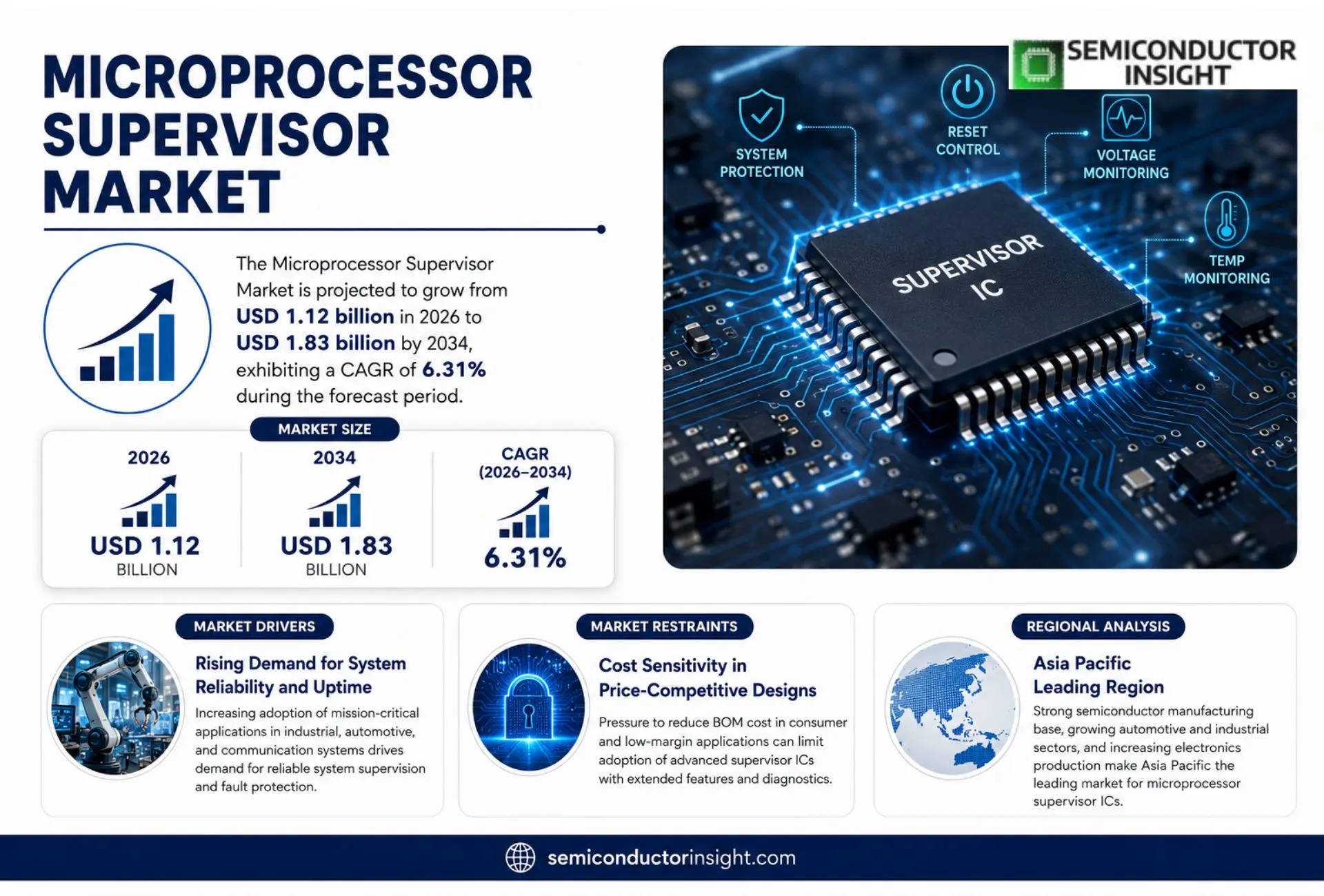
MARKET DRIVERS
Embedded Shift Toward Next-Gen Processors
Over the past two decades, the evolution of processors has moved from general computing to specialized, low‑power, high‑efficiency cores optimized for real‑time control and safety. The adoption of such cores in automotive, aerospace, and industrial automation industries has accelerated the need for robust supervisory layers that guarantee deterministic behavior, fault isolation, and secure boot mechanisms. Because short‑cycle reactions are essential for collision avoidance, autonomous navigation, and critical safety functions, manufacturers now rely on microprocessor supervisors that provide explicit safeguards against unpredictable software loops, buffer overflows, and hardware glitches. In this context, the Microprocessor Supervisor Market is expanding as clients demand higher assurance levels, tighter integration with Safety‑Related Part 5 interfaces, and streamlined compliance with ISO 26262, IEC 61508, and DO-178C standards. Firms that embed these supervisory functions directly on silicon are increasingly attractive, as they deliver lower latency, smaller form factor, and reduced dependency on external modules, allowing system architects to meet stringent size, weight, and power budgets.
Rapid Adoption in Safety‑Critical Domains
The turbulence created by rising expectations for safety and security in critical sectors is pushing the industry toward a more systematic approach to risk mitigation. Microprocessor supervisors are key to this transformation, offering isolation mechanisms, watchdog timers, and real‑time monitoring that can detect and mitigate anomalies before they evolve into system failures. In automotive electronics, where functional safety spans engine management, braking systems, and advanced driver‑assist systems, the need for such safety enhancements has become non‑negotiable. In aerospace, the margin for error is even smaller, and supervisory features that can identify sensor drift or misconfigured firmware are instrumental in ensuring mission integrity. Hospitals and defense infrastructures are also seeing rapid uptake, as medical devices and tactical systems must resist both accidental faults and malicious intrusions. Consequently, this demand spike fuels the Microprocessor Supervisor Market, compelling suppliers to innovate in hardware architecture, firmware stacks, and software support ecosystems.
➤ Key Insight: The convergence of safety regulations and the push for ultra‑reliable real‑time operations positions supervisory cores as indispensable building blocks in high‑integrity applications.
As manufacturers strive for single‑chip solutions that consolidate processor, peripheral, and supervisory logic, significant cost savings emerge through reduced board space, simplified design flows, and lowered time‑to‑market metrics. Additionally, the board‑level complexity that historically required separate watchdog or safety coprocessors is now being handled within the core itself, diminishing parasitic consumption and easing verification efforts. Companies that can demonstrate integrated, proven safety features will capture market share, especially as the manufacturing cost advantage grows with economies of scale. The microprocessor supervisor component is no longer a niche add‑on but a critical enabler that allows designers to deliver compliance‑ready, high‑performance systems on a single chip platform.
MARKET CHALLENGES
Supply Chain Fragmentation and Component Scarcity
One of the most immediate obstacles confronting the Microprocessor Supervisor Market is the persistent fragmentation across supplier ecosystems. High‑integrity supervisory logic is often locked inside locked‑down IP cores or tailored silicon foundries, and these limited‑edition offerings can become bottlenecks, especially during global chip shortages. When key vendors reduce output or redirect capacity toward other high‑margin product lines, customers face mounting delays or elevated pricing pressures. Furthermore, limited interoperability between different supervisory IP families hampers portfolio expansion and forces system designers to duplicate effort or carry multiple risk profiles in a single product. Establishing a robust and diversified supply network while preserving the stringent quality guarantees demanded by safety‑critical applications requires significant collaboration, which has proven slow to materialize across the industry.
Other Challenges
Minimal Toolchain Harmonization
The lack of unified verification and validation tools for distinct supervisory architectures creates a steep learning curve for development teams, leading to increased cost of entry and slower innovation cycles.
Regulatory Delays and Certification Complexity
While standards such as ISO 26262 are well defined, the certification process for new supervisory solutions can be protracted, involving exhaustive demonstrations of fault elimination, test coverage, and traceability. These hurdles prolong the path to market release and can fracture budgets, especially for smaller players seeking to offer aggressive price points while keeping safety margins intact.
MARKET RESTRAINTS
Cyber‑Security Vulnerabilities in Integrated Designs
Embedding supervisory logic reduces the point of failure but simultaneously increases the attack surface, especially when the supervisor and application cores share memory and bus interfaces. Legacy designs often omit hardware isolation, allowing malicious payloads to manipulate supervisory registers or bypass safety checks altogether. The absence of hardened cryptographic modules and secure key storage within highly integrated supervisors leaves these platforms prone to side‑channel analysis or firmware fakes. Consequently, aerospace, defense, and automotive firms retain a cautious stance, imposing stringent security vetting requirements that can slash development budgets and accountability windows. To address these constraints, firms must invest in advanced encryption engines, tamper‑evidence mechanisms, and formal security audits, thereby adding to cost and extending project timelines.
High R&D Expenditure for Continuous Compliance
Maintaining up‑to‑date safety‑and‑security features is not a one‑off endeavor; it demands sustained investment in firmware updates, hardware revisions, and compliance reviews. The cost associated with these maintenance activities can be prohibitive, particularly for small‑to‑mid‑size suppliers who operate under tighter margins. Frequent updates may require supply chain adjustments, compatibility testing across legacy support, and the re‑validation of safety cases, all of which consume scarce resources and limit the ability to pursue new product differentiation in divergent segments such as edge computing or IoT gateways.
MARKET OPPORTUNITIES
Industrial IoT Platforms Seeking Resilient Edge Processing
The surge in industrial Internet of Things deployments has created a fertile ground for microprocessor supervisors that can assure data integrity, protect against accidental corruption, and tolerate intermittent connectivity scenarios. Edge controllers in remote power plants, chemical plants, or mining operations often operate under harsh environmental conditions; a supervisory module that can detect overheating, clock glitches, or memory faults and trigger failsafe actions can significantly reduce maintenance costs and improve uptime. Vendors offering a plug‑and‑play supervisory layer that interfaces seamlessly with standard industrial communication stacks (e.g., OPC UA, EtherCAT, and Profinet) stand to capture a substantial share of this segment, especially as the demand for predictive maintenance and real‑time analytics continues to grow.
Automotive Semi‑Autonomous Systems and Beyond
With the automotive sector inching toward full autonomy, the complexity of electronic control units (ECUs) escalates dramatically. Supervisors that can offer layered watchdog functions, memory protection, and firmware integrity monitoring become essential components of an autonomous vehicle’s safety architecture. Moreover, the advent of vehicle‑to‑everything (V2X) communication, digital twins, and over‑the‑air (OTA) update pipelines introduces new attack vectors. Ensuring continuity of safety properties in the face of OTA uncertainties will require trusted runtime environments and hardware roots of trust that can be integrated into next‑generation processors. Microprocessor supervisor vendors that develop scalable, firmware‑independent safety cores will position themselves at the forefront of this rapidly evolving market, capturing opportunities in both OEM and Tier‑1 supplier chains.
Enterprise Data Centers and Cloud Security
While traditionally considered a niche, the rising volume of edge‑centric data centers has amplified the need for resilient processing cores capable of withstanding soft errors induced by radiation or supply voltage fluctuations. Supervisory logic embedded in silicon allows for post‑mortem analysis and automatic fault recovery, thereby enhancing data integrity and reducing downtime. In cloud computing environments where performance and uptime are key differentiators, manufacturers that can embed fault‑tolerant supervisors without compromising throughput or adding significant overhead will gain a competitive edge, especially in high‑redundancy, mission‑critical workloads that require sustained 24/7 availability.
Microprocessor Supervisor Market Trends
Digitalization of Supervisory Architecture
Digitalization of supervisory architecture has accelerated as manufacturers embed microprocessor‑based supervisors within multifunctional system‑on‑chip solutions. By combining firmware, high‑speed interconnects, and real‑time operating systems, these devices now command both diagnostic and safety logic with deterministic timing. The trend stems from escalating safety regulations in sectors such as industrial automation, medical devices, and renewable energy. For vendors, the transition to software‑controlled supervision unlocks rapid feature updates and cost‑effective scaling compared with legacy hardware‑only controllers. At the same time, integration with field‑programmable gate arrays and programmable real‑time processors decreases time‑to‑market for compliance‑heavy applications, enticing OEMs to adopt end‑to‑end microprocessor‑supervisor platforms. Moreover, the modular firmware architecture permits independent validation of safety functions, reducing certification cycles and enhancing traceability across product families. Consequently, sourcing suppliers on a multilayered component basis becomes a competitive advantage.
Other Trends
Rise of Edge‑Enabled Supervisory Modules
Edge‑enabled supervisory modules embed operating systems and secure communication stacks directly on the field device, lifting control away from central servers. The shift locks in reduced latency, fault isolation, and the ability to comply with time‑critical safety standards. The migration is driven by the convergence of low‑power silicon, energy‑efficient DSP cores, and embedded AI accelerators that can interpret sensor data on‑board. Manufacturers adopting this paradigm report sharper differentiation: customers in process control and battery management can certify systems without annual re‑inspection while supporting reconfiguration. Moreover, the modular nature of edge supervisors facilitate updates, reducing maintenance downtime and continuous improvement of safety logic. From a strategic perspective, it also enlarges the addressable market by allowing smaller players to enter niche markets with customized supervision sachets. The evolving ecosystem compels traditional OEMs to partner with silicon fabs, thereby redefining supply‑chain. Additionally, the modular firmware tiers create opportunities for third‑party vendors to provide safety extensions, further accelerating industry innovation cycles. Such openness builds resilience and increases vendor agility, providing iterative improvements for enterprises.
Emerging Demand in Autonomous Systems
Emerging Demand in Autonomous Systems. Especially in automotive, maritime and aviation sectors, now treat the microprocessor supervisor as a core competence. These applications require rapid decision cycles under unpredictable environments and must also adhere to stringent safety and cybersecurity requirements. Consequently, manufacturers integrate supervisors that combine deterministic kernels with counter‑measure controls for fault detection. The result is a dual emphasis on v‑specific certification and real‑world resilience. OEMs find that adopting a single supervisor platform across multiple vehicle platforms reduces integration lead times and ensures consistent safety baselines, while allowing rapid deployment of new features such as over‑the‑air updates or sensor‑fusion algorithms. Furthermore, regulatory bodies increasingly reference supervisor validation as a prerequisite for autonomous certification, thereby raising the barrier to entry for low‑budget competitors. For market participants, this trend signals a shift toward higher value services and a move away from commoditized hardware components.
COMPETITIVE LANDSCAPE
Key Industry Players
Market Overview and Key Dynamics: 2024-2031
Intel remains the pivot around which the microprocessor supervisor ecosystem revolves. The company’s strategic investment in silicon‑level safety features, coupled with aggressive acquisition of niche firms, has cemented its position as the market’s highest‑revenue provider. Its widespread OEM partnerships, particularly within automotive ECUs and industrial automation, create a virtuous cycle of reliability and aftermarket demand. Consequently, the supply chain has evolved into a two‑tier architecture: Tier 1 incumbents consolidate supply while Tier 2 challengers layer specialized functionalities onto the base silicon.
Within this environment, companies such as NVIDIA, AMD, ARM Holdings, and STMicroelectronics have carved out distinctive niches. NVIDIA’s integration of GPU‑based fault tolerance for AI inference workloads has attracted data‑center and edge‑AI customers, while AMD leverages its x86/x64 compatibility to penetrate high‑performance computing segments. ARM’s licensing model facilitates widespread deployment across consumer devices, and STMicroelectronics capitalises on its deep European manufacturing base to supply low‑power supervisory solutions for IoT and industrial sensors. These firms collectively mitigate market concentration by offering complementary strengths in power efficiency, scalability, and geographic reach.
List of Key Microprocessor Supervisor Companies Profiled
- Intel
- NVIDIA
- AMD
- ARM Holdings
- STMicroelectronics
- Qualcomm
- Texas Instruments
- Renesas Electronics
- Infineon Technologies
- ON Semiconductor
Segment Analysis:
| Segment Category | Sub-Segments | Key Insights |
| By Type |
|
Manual Reset description with qualitative insights only
|
| By Application |
|
Industrial Equipment description with qualitative insights only
|
| By End User |
|
OEM description with qualitative insights only
|
| By Market Stage |
|
Early Adoption description with qualitative insights only
|
| By Technology |
|
On-Package (Embedded) description with qualitative insights only
|
Regional Analysis: Microprocessor Supervisor Market
The penetration of supervisor microprocessors into tangible safety‑critical systems shows steady upward momentum, as manufacturers integrate embedded oversight to comply with tightening safety mandates. Emerging implementations in autonomous platforms underscore a shift toward microcontrollers with hierarchical supervisory features, hinting at more granular fault coverage and adaptive runtime protection.
A blend of seasoned suppliers and nimble start‑ups defines the competitive arena. Established firms typically showcase long‑term validation portfolios, while newer entrants pursue agile design cycles and cross‑platform compatibility, thereby creating a tiered but interconnected market structure.
Opportunities surface in sectors that demand low‑latency hazard detection, including industrial robotics, medical implants, and smart grid controls. Partnerships with cloud service providers can further elevate supervisory microprocessors by providing remote diagnostics and over‑the‑air updates for safety modules.
The primary hurdles involve stringent verification protocols, limited standard libraries for specific safety domains, and the cost implications of early certification stages. Navigating these obstacles requires a mix of technical rigor and cumulative experience across application domains.
Europe
Europe presents a market trajectory that intertwines compliance with proactive ingenuity. The region’s driving forces stem from the rigorous CE and ISO standards that govern safety in automotive and industrial automation. European manufacturers respond by embedding microprocessor supervisors within control units, especially in autonomous driving prototypes and commercial robotics. Moreover, the European Union’s emphasis on digital sovereignty has prompted investment in local semiconductor design studios, which furnish customized supervisory solutions catering to EU-specific grid systems. Consequently, the region is expected to attract a balance of high‑end and mid‑tier offerings, as firms accrue experience in system‑level verification. The market’s growth is therefore intertwined with policy directives that fix safety performance milestones, creating a predictable environment that encourages incremental improvements in supervisor reliability. As such, Europe’s evolution in the Microprocessor Supervisor Market reflects a cautious yet steady progression, largely anchored by internal policy alignment with global safety standards.
Asia-Pacific
Asia‑Pacific is distinguished by a rapid industrialization wave that creates a fertile arena for the Microprocessor Supervisor Market. While China and Japan maintain advanced component development capabilities, India and Southeast Asian nations exhibit an uptick in mid‑tier supervisory chip deployment within manufacturing automation and consumer electronics. The market’s dynamism is propelled by a strong emphasis on quality assurance frameworks that mimic rigorous Western standards, prompting domestic manufacturers to adopt specialized supervisory solutions. In addition, the region’s strategic focus on navigating supply‑chain risk has led to increased domestic chip production, thereby reducing reliance on external sources. OTA updates, data analytics, and cross‑device security protocols are integral to the Asia‑Pacific trajectory, attesting to a convergence of technology readiness and market demand in both high‑end automotive and consumer domains. This synergy cultivates an environment where early market entrants can test iterative firmware surveillance modules in a broad spectrum of device categories, hastening adoption cycles. Ultimately, Asia‑Pacific is poised to drive diverse application use cases that underscore the versatile nature of the Microprocessor Supervisor Market while building a resilient local ecosystem.
South America
South America illustrates a differentiated vertical of the Microprocessor Supervisor Market, where emerging industrial automation combined with infrastructure expansion provides a unique niche. Brazil’s growing smart‑city initiatives and Chile’s expanding renewable energy sector act as primary catalysts. Although historical supply‑chain depth has lagged, localized partnerships between national research bodies and multinational providers are forging a network of hybrid supervisory solutions. This emerging synergy benefits infrastructure projects requiring robust fault‑tolerance in harsh environments, particularly in energy storage and electric transit. Regional policy incentives for technology adoption foster buyer appetite, while education corridors cultivate a workforce skilled in firmware safety. As a result, South America’s market progression is tied to the pace of local industrial upgrades and government‑backed standardization efforts, which in turn shape the shape of supervisory application across the region.
Middle East & Africa
The Gulf and African markets collectively host a largely emerging capacity for the Microprocessor Supervisor Market. In the Middle East, burgeoning oil‑and‑gas facilities mandate concerted safety surveillance, creating avenues for embedded supervisory controllers in process control systems. African economies, meanwhile, capitalize on “greenfield” opportunities, embracing supervisory integrations in telecommunications and emerging 5G node infrastructure. Despite infrastructural constraints, the region leverages international collaboration and regional mandates for secure software practices. Early adoption is momentum‑driven by the need for resilient critical infrastructure, positioning the market for a slow but stable expansion. Regional policy frameworks guided by international standards and investment in local technical skills are instrumental in charting a comprehensive adoption path for supervisory microprocessors, ultimately culminating in a diversified yet cohesive market architecture.
Report Scope
This market research report provides a comprehensive analysis of the Microprocessor Supervisor Market , covering the forecast period 2026–2035. It offers detailed insights into market dynamics, technological advancements, competitive landscape, and key trends shaping the industry.
Key focus areas of the report include:
-
Market Overview: The report begins with an overview outlining its current market scenario, key growth indicators, and industry transformation drivers. It discusses macroeconomic factors, demand–supply balance, regulatory landscape, and the strategic role of semiconductors in powering advancements across industries such as automotive, telecommunications, consumer electronics, and industrial automation.
- Market Size & Forecast: Historical data and future projections for revenue, unit shipments, and market value across major regions and segments.
- Segmentation Analysis: Detailed breakdown by product type, technology, application, and end-user industry to identify high-growth segments and investment opportunities.
- Regional Insights: Insights into market performance across North America, Europe, Asia-Pacific, Latin America, and the Middle East & Africa, including country-level analysis where relevant.
- Competitive Landscape: Profiles of leading market participants, including their product offerings, R&D focus, manufacturing capacity, pricing strategies, and recent developments such as mergers, acquisitions, and partnerships.
- Technology Trends & Innovation: Assessment of emerging technologies, integration of AI/IoT, semiconductor design trends, fabrication techniques, and evolving industry standards.
- Market Drivers & Restraints: Evaluation of factors driving market growth along with challenges, supply chain constraints, regulatory issues, and market-entry barriers.
- Stakeholder Insights: Insights for component suppliers, OEMs, system integrators, investors, and policymakers regarding the evolving ecosystem and strategic opportunities.
Primary and secondary research methods are employed, including interviews with industry experts, data from verified sources, and real-time market intelligence to ensure the accuracy and reliability of the insights presented.
FREQUENTLY ASKED QUESTIONS:
What is the current market size of Microprocessor Supervisor Market?
-> The Microprocessor Supervisor Market was valued at USD million in 2026 and is expected to reach USD million by 2035.
What is the projected market size and CAGR for 2024‑2031?
-> Microprocessor Supervisor Market is projected to grow from USD million in 2024 to USD million in 2031, representing a compound annual growth rate (CAGR) of XX.X% over the forecast period.
What are the primary market segments by type?
-> The market is segmented into Manual Reset and Non‑Manual Reset supervisory ICs, each catering to different design requirements and reliability standards.
Which applications drive demand for Microprocessor Supervisors?
-> Key application areas include Industrial Equipment, Intelligent Instruments, and various Other high‑reliability electronic systems.
What are the main market drivers?
-> Drivers include rising adoption of safety‑critical electronics, growth in automotive electronics, and increasing regulatory requirements for system reliability.
What constraints could hinder market growth?
-> Restraints comprise high development costs, stringent certification processes, and supply‑chain disruptions for semiconductor components.
Who are the leading vendors in this market?
-> Prominent players include STMicroelectronics, Texas Instruments, Analog Devices, Renesas Electronics, ON Semiconductor, Diodes Inc., SGMICRO, and Union Semiconductor (Shanghai).
What research methodology was employed?
-> The study utilizes a combination of primary interviews, secondary data collection, and quantitative modeling, following a rigorous Research Methodology outlined in the report.
What is the base year for the analysis?
-> The analysis uses 2020 as the base year for historical data and trend assessment.
Which region is expected to lead the market?
-> Asia is projected to be the highest‑growth region, driven by strong semiconductor manufacturing capabilities and expanding end‑use applications.
Get Sample Report PDF for Exclusive Insights
Report Sample Includes
- Table of Contents
- List of Tables & Figures
- Charts, Research Methodology, and more...
 Download Sample Report PDF