AI Supercomputer Optical Interconnect Market Insights
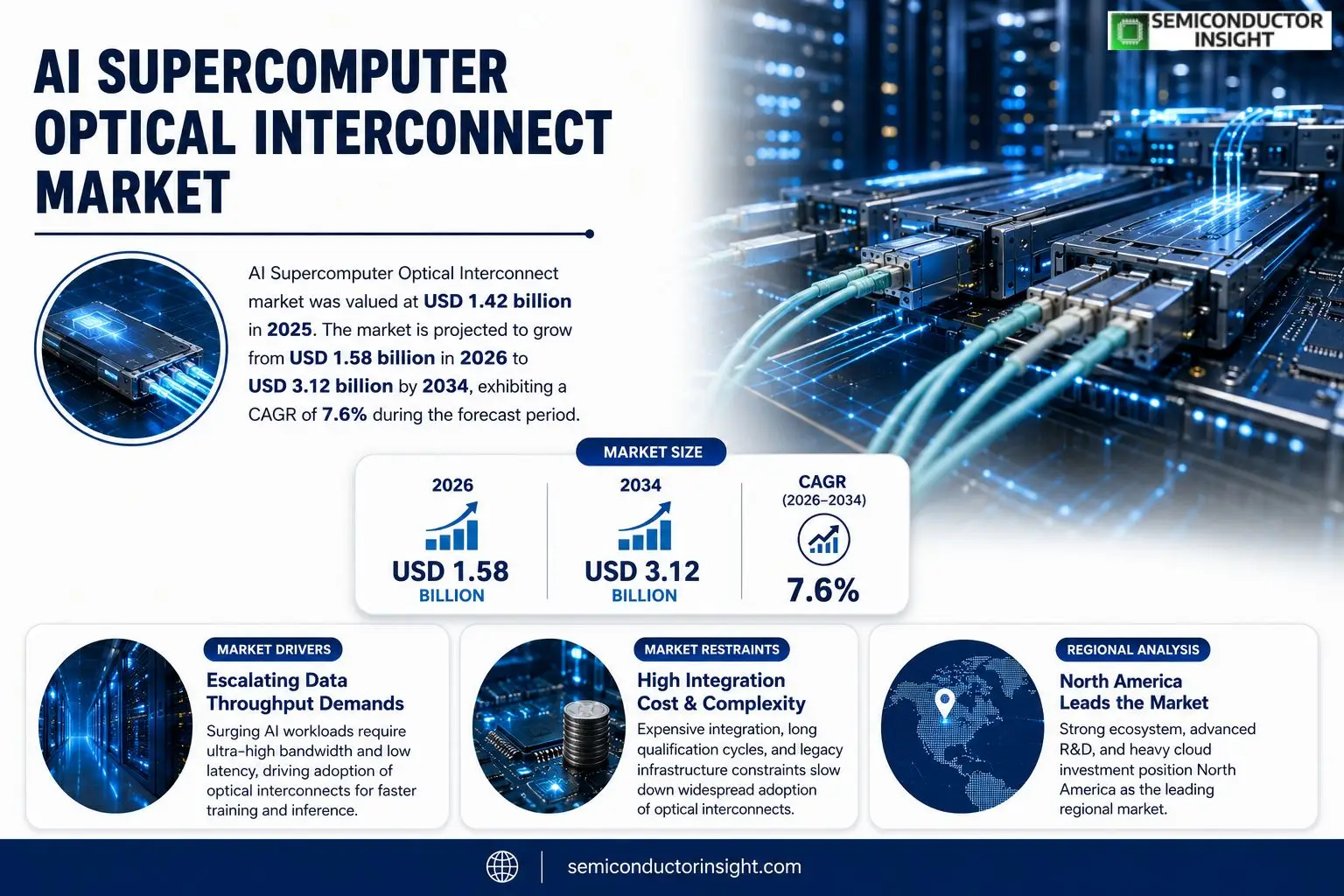
AI Supercomputer Optical Interconnect market size was valued at USD 1.42 billion in 2025. The market is projected to grow from USD 1.58 billion in 2026 to USD 3.12 billion by 2034, exhibiting a CAGR of 7.6% during the forecast period.
Optical interconnects for AI supercomputers consist of silicon‑photonic transceivers, wavelength‑division multiplexing modules and fiber‑optic cabling that enable terabit‑per‑second data exchange between GPUs, CPUs and memory pools. By converting electrical signals into light, these components lower latency and power draw compared with conventional copper linksan essential advantage when training massive neural networks.The upward trajectory stems from escalating capital spending on generative‑AI infrastructure, where manufacturers such as Nvidia, Intel and Ciena are scaling silicon‑photonic solutions to meet bandwidth demands exceeding 400 GB/s per node. Recent announcementsincluding Nvidia’s June 2024 rollout of a native photonic backplane for its DGX H100 systemsshow how ecosystem collaboration accelerates adoption. Suppliers like Lumentum and II‑VI broaden laser‑driver portfolios, reinforcing supply‑chain resilience as enterprises prioritize performance per watt.
MARKET DRIVERS
Escalating Data Throughput Demands
The rise of generative AI models, many exceeding hundreds of billions of parameters, compels supercomputer architects to seek interconnects that can move petabytes of data per second. Optical pathways deliver the low‑latency, high‑bandwidth channels required to keep training cycles within budgeted time frames, making them a decisive factor in platform selection.
Energy‑Efficiency Imperatives
Power consumption accounts for up to 40 % of total operating costs in large‑scale AI clusters. Optical interconnects, by virtue of reduced electrical resistance and minimal heat generation, cut energy use per terabit transferred by roughly 30 % compared with copper solutions. Operators therefore view optical upgrades as a direct route to lower total cost of ownership.
➤ “Switching to silicon‑photonic links can shave years off a data‑center’s depreciation schedule.”
Regulatory pressure on carbon footprints in major economies adds a compliance dimension. Enterprises that adopt energy‑savvy optical fabrics are better positioned to meet emerging emissions reporting standards while preserving competitive compute capacity.
MARKET CHALLENGES
Cost of Integration and Qualification
Despite performance benefits, the upfront expense of deploying optical modules in existing racks remains steep. Manufacturers must redesign motherboard layouts, and validation cycles lengthen as each photonic component undergoes reliability testing under extreme thermal loads. Budget‑constrained firms often defer these upgrades until the technology price curve flattens.
Other Challenges
Supply‑Chain Volatility
The specialized nature of silicon‑photonic wafers means that a single fab outage can delay multiple projects simultaneously, forcing customers to keep safety stock or seek alternate suppliers, which in turn raises procurement complexity.
MARKET RESTRAINTS
Technical Integration Barriers
Legacy supercomputing infrastructures rely heavily on established copper backplanes. Migrating to an optical mesh demands not only new transceiver hardware but also firmware updates, signal‑integrity re‑engineering, and staff retraining. The inertia of entrenched designs slows adoption, particularly in government‑funded research facilities where upgrade cycles are tightly regulated.Furthermore, the standards ecosystem for AI‑focused optical interconnects is still maturing. Divergent form factors among leading vendors create interoperability concerns, prompting some buyers to postpone purchases until a clear consensus emerges.
MARKET OPPORTUNITIES
Growth of Edge AI Deployments
As AI inference workloads migrate from centralized data halls to edge locationsautonomous vehicles, smart factories, and remote sensing stationsthe need for compact, high‑speed optical links expands. Miniaturized silicon‑photonic modules that can operate within tight thermal envelopes present a lucrative niche for vendors able to certify performance at the edge.
In parallel, the emergence of open‑source AI frameworks that standardize model formats encourages a more uniform demand for bandwidth across the ecosystem. Companies that bundle optical interconnects with turnkey AI supercomputer solutions can capture a larger share of the spend, leveraging bundled‑service pricing to differentiate themselves.
AI Supercomputer Optical Interconnect Market Trends
Scaling Bandwidth Through Silicon Photonics
Silicon‑photonic transceivers are reshaping the bandwidth architecture of AI Supercomputer Optical Interconnect Market. By moving the signal conversion point from copper traces to light‑carrying waveguides, designers can sustain terabit‑per‑second streams while trimming the physical footprint of inter‑node links. Recent product rollouts, such as Nvidia’s photonic backplane for DGX H100, demonstrate how integrated optics are moving beyond laboratory prototypes into rack‑scale deployments. The shift matters because AI training cycles now exceed petaflop‑hour thresholds, and any latency inflation directly translates into higher cloud‑service costs. Vendors that lock in silicon‑photonic designs today secure a performance edge that translates into more competitive pricing for hyperscale customers. Furthermore, wavelength‑division multiplexing modules enable multiple data channels over a single fiber, reducing cabling complexity and simplifying data‑center floor planning. This architectural efficiency drives procurement decisions across hyperscale operators and enterprise AI labs alike.
Other Trends
Power‑Efficiency Imperative
When AI workloads double the number of parameters, the associated electrical power draw escalates sharply. Optical interconnects mitigate this pressure by converting electrical signals to photons with far lower resistive loss, cutting per‑bit energy consumption. Suppliers such as Lumentum and II‑VI have broadened their laser‑driver portfolios to include low‑threshold, high‑efficiency devices, allowing system builders to meet stringent power‑per‑performance targets. For data‑center operators, the reduction in cooling demand translates into measurable OPEX savings, reinforcing the case for optical upgrades even in retrofit scenarios. As sustainability metrics become a procurement criterion, the power‑efficiency narrative adds a compelling layer to buying rationale.
Ecosystem Consolidation and Supply‑Chain Resilience
Recent announcements reveal a tightening of collaborations among silicon‑photonic foundries, network‑equipment manufacturers, and AI hardware vendors. The joint development of standardized form factors for optical modules accelerates time‑to‑market, while diversified sourcing strategiesexemplified by multiple laser‑driver providersshield AI Supercomputer Optical Interconnect Market from single‑point disruptions. This convergence reduces engineering overhead for end users and establishes a more predictable procurement pipeline. Companies that participate early in these ecosystem alliances can lock in preferred‑pricing arrangements and influence future specification roadmaps, positioning themselves to capitalize on the next wave of AI‑driven compute expansion.
COMPETITIVE LANDSCAPE
Key Industry Players
AI Supercomputer Optical Interconnect Market – Competitive Overview
Nvidia dominates the high‑end segment, pairing its GPU accelerators with proprietary silicon‑photonic backplanes that have become reference architecture for next‑generation AI clusters. Intel leverages its broad foundry capabilities to supply transceiver IP and custom silicon‑photonic foundry services, creating a parallel supply route that cushions customers against single‑source risk. Ciena’s expertise in wavelength‑division multiplexing (WDM) modules and carrier‑grade optics adds a layer of network‑level scalability, allowing hyperscale operators to stitch together dozens of nodes with terabit‑per‑second links. The triad’s vertical integrationhardware, software, and system designsets a high entry barrier, forcing newcomers to specialize in niche components or partner with an incumbent to access system‑level design wins.Beyond the tier‑one tier, a constellation of niche innovators is expanding the ecosystem. Lumentum and II‑VI invest heavily in laser‑driver assemblies that improve power‑efficiency margins for dense photonic stacks. Broadcom’s acquisition of a silicon‑photonic startup has broadened its portfolio to include low‑latency interconnect ASICs that sit between CPU and memory. Samsung and Fujitsu contribute advanced packaging techniques that enable heterogeneous integration of photonic and electronic dies. IBM’s research arm supplies custom‑fabricated waveguide platforms, while smaller players such as Acacia Communications, Xilinx (now part of AMD), and Infinera focus on high‑capacity WDM modules for rack‑scale deployment. The diversity of these firms reinforces supply chain resilience and pushes incremental performance improvements that collectively raise the market’s overall capability.
List of Key AI Supercomputer Optical Interconnect Companies Profiled
- Nvidia Corporation
- Intel Corporation
- Ciena Corporation
- Lumentum Holdings Inc.
- II‑VI Incorporated
- Broadcom Inc.
- Marvell Technology Group Ltd.
- NeoPhotonics Corp.
- Huawei Technologies Co., Ltd.
Segment Analysis:
| Segment Category | Sub-Segments | Key Insights |
| By Type |
|
Silicon‑Photonic Transceivers
|
| By Application |
|
Data Center Acceleration
|
| By End User |
|
Cloud Service Providers
|
| By Architecture |
|
Optical Switches
|
| By Deployment Model |
|
Hybrid Cloud Deployments
|
Regional Analysis: AI Supercomputer Optical Interconnect Market
North America
Leading cloud platforms are allocating capital to retro‑fit existing racks with co‑packaged photonic transceivers, recognizing that the marginal cost of bandwidth is falling faster than compute cycles. This shift enables tighter integration between AI accelerators and the optical fabric, trimming inter‑node communication delays that have become a bottleneck for large‑scale model training.
Universities in the United States and Canada are producing graduates fluent in both photonics and machine learning, feeding a talent pool that can bridge hardware design with AI algorithmic requirements. This interdisciplinary expertise accelerates the translation of research prototypes into commercial optical interconnect solutions.
Federal initiatives such as the National Quantum Initiative and strategic export‑control policies create a clear framework for advanced photonic research while safeguarding critical technologies, giving companies confidence to invest in long‑term development cycles.
Leading enterprises in sectors like autonomous driving and drug discovery have begun pilot projects that swap traditional copper back‑planes for dense optical fabrics, citing measurable reductions in training time and energy consumption as primary motivators.
Europe
European nations are leveraging strong public research funding to nurture photonic foundries capable of producing low‑loss waveguides at scale. Collaborative programs across the EU encourage cross‑border integration of AI supercomputer designs, allowing hardware vendors to tap into a shared pool of standards and validation tools. While the market remains fragmented compared with North America, the presence of several niche players focused on wavelength‑division multiplexing offers a complementary avenue for customers seeking bespoke solutions. Policy incentives that target carbon‑neutral data‑center operations are also nudging operators toward optical interconnects, as the energy savings align with broader sustainability commitments.
Asia‑Pacific
Asia‑Pacific exhibits a vigorous manufacturing base, especially in Taiwan, South Korea, and Japan, where silicon‑photonic fabs can deliver high‑volume components at competitive prices. Regional cloud providers are rapidly scaling their AI compute capacity, prompting a surge in demand for low‑latency optical links that can bridge geographically dispersed clusters. However, divergent regulatory approaches and varying levels of IP protection create a patchwork environment that can slow cross‑border collaboration. Companies that can navigate these nuances and partner with local system integrators are likely to capture the most compelling growth opportunities.
South America
In South America, the market is still emerging, driven largely by academic institutions experimenting with optical testbeds for AI research. Government programs aimed at digital transformation are beginning to earmark funds for high‑performance computing infrastructure, yet the scarcity of domestic photonic manufacturers forces reliance on imports. As regional universities develop expertise in co‑design of AI algorithms and optical hardware, a modest but steady demand for customized interconnect solutions is forming, particularly in sectors such as agritech and oil‑and‑gas analytics.
Middle East & Africa
The Middle East & Africa region is at an early stage of adoption, with a handful of sovereign wealth funds allocating capital toward AI research hubs that incorporate cutting‑edge optical networking. Local data‑center operators are experimenting with hybrid architectures that blend conventional fiber with emerging silicon‑photonic modules, aiming to future‑proof their facilities. Constraints around skilled labor and limited supply chains persist, but partnerships with North American and European vendors are gradually introducing the required technology base, hinting at a cautious but upward trajectory for AI Supercomputer Optical Interconnect Market in this geography.
Report Scope
This market research report provides a comprehensive analysis of the AI Supercomputer Optical Interconnect Market , covering the forecast period 2026–2034. It offers detailed insights into market dynamics, technological advancements, competitive landscape, and key trends shaping the industry.
Key focus areas of the report include:
- Market Overview: The report begins with an overview outlining its current market scenario, key growth indicators, and industry transformation drivers. It discusses macroeconomic factors, demand–supply balance, regulatory landscape, and the strategic role of semiconductors in powering advancements across industries such as automotive, telecommunications, consumer electronics, and industrial automation.
- Market Size & Forecast: Historical data and future projections for revenue, unit shipments, and market value across major regions and segments.
- Segmentation Analysis: Detailed breakdown by product type, technology, application, and end-user industry to identify high-growth segments and investment opportunities.
- Regional Insights: Insights into market performance across North America, Europe, Asia-Pacific, Latin America, and the Middle East & Africa, including country-level analysis where relevant.
- Competitive Landscape: Profiles of leading market participants, including their product offerings, R&D focus, manufacturing capacity, pricing strategies, and recent developments such as mergers, acquisitions, and partnerships.
- Technology Trends & Innovation: Assessment of emerging technologies, integration of AI/IoT, semiconductor design trends, fabrication techniques, and evolving industry standards.
- Market Drivers & Restraints: Evaluation of factors driving market growth along with challenges, supply chain constraints, regulatory issues, and market-entry barriers.
- Stakeholder Insights: Insights for component suppliers, OEMs, system integrators, investors, and policymakers regarding the evolving ecosystem and strategic opportunities.
Primary and secondary research methods are employed, including interviews with industry experts, data from verified sources, and real-time market intelligence to ensure the accuracy and reliability of the insights presented.
FREQUENTLY ASKED QUESTIONS:
What is the current market size of AI Supercomputer Optical Interconnect Market?
-> AI Supercomputer Optical Interconnect Market was valued at USD 1.42 billion in 2025 and is expected to reach USD 3.12 billion by 2034.
Which key companies operate in AI Supercomputer Optical Interconnect Market?
-> Key players include Nvidia, Intel, Ciena, Lumentum, and II‑VI, among others.
What are the key growth drivers?
-> Key growth drivers include increasing capital spending on generative‑AI infrastructure, escalating bandwidth requirements exceeding 400 GB/s per node, and the pursuit of lower latency and power consumption through silicon‑photonic solutions.
Which region dominates the market?
-> North America hosts the majority of leading AI supercomputer manufacturers and thus remains a dominant region, while Asia‑Pacific shows the fastest growth trajectory.
What are the emerging trends?
-> Emerging trends include native photonic backplanes, integration of wavelength‑division multiplexing for terabit‑scale interconnects, and expanded laser‑driver portfolios to enhance supply‑chain resilience.
Get Sample Report PDF for Exclusive Insights
Report Sample Includes
- Table of Contents
- List of Tables & Figures
- Charts, Research Methodology, and more...
 Download Sample Report PDF