Key Statistics
Key Takeaways
- Hardware contraction: Optical disk drive revenue is expected to contract materially between the 2025 base year and 2034 as standard PC attachments disappear. The forecast reflects fewer integrated drives in new computers, despite a continuing aftermarket for disc access, recovery and specialised duplication.
- DVD remains the installed-base workhorse: DVD mechanisms represent an estimated ~56% of 2025 drive value, compared with CD at ~16%, Blu-ray at ~22% and other specialised formats at ~6%. DVD retains a practical role in older desktop systems, equipment service and software distribution where offline compatibility still matters.
- Desktop buyers dominate: Desktop applications contribute an estimated ~61% of 2025 revenue, while laptops account for ~39%. Serviceable towers, laboratory workstations and institutional PCs retain legacy bays or external attachments, whereas lightweight notebooks typically omit a dedicated optical slot and use USB accessories only when required.
- Regional supply is concentrated: Asia-Pacific leads with an estimated ~39% of revenue, followed by North America at ~24% and Europe at ~21%. Japan and China remain important for product engineering, manufacturing and accessory distribution; supplier choice increasingly depends on firmware support and dependable replacement stock.
- Premium niches cushion volume decline: Blu-ray writers, archival mechanisms and recovery drives preserve higher-value purchases, although the broader product category faces persistent substitution by downloads, cloud storage and flash memory. Price adjustments announced by Japanese peripheral suppliers in 2026 demonstrate that component and freight costs can rise even as unit demand falls.
Optical Disk Drive Market Overview
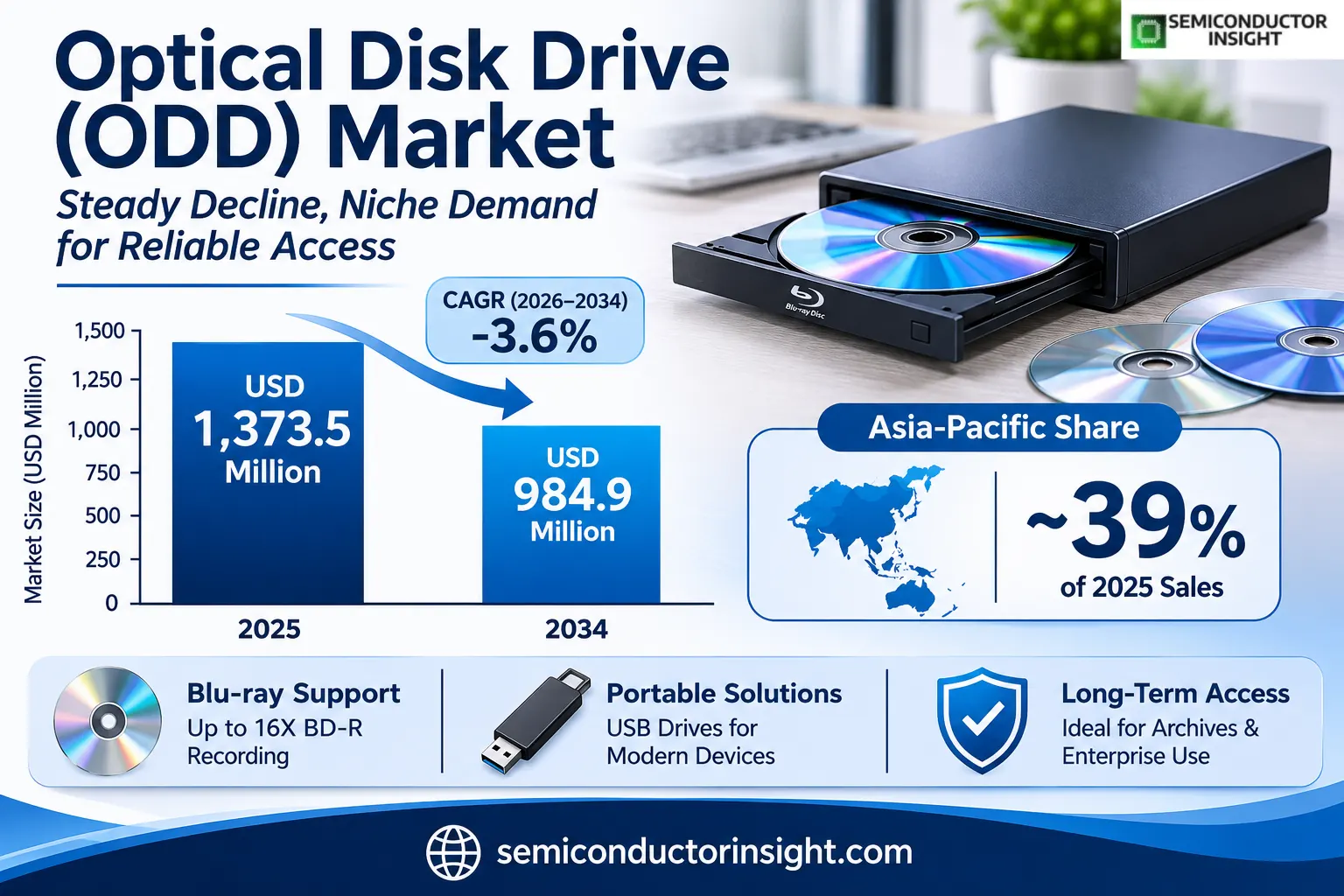
Optical disk drive market generated USD 1,373.5 million in 2025 and is expected to reach USD 984.9 million by 2034, with a CAGR of -3.6% across the 2026–2034 period. Asia-Pacific leads at an estimated ~39% of 2025 sales because optical pickup supply, device assembly, peripheral branding and replacement distribution remain concentrated in East Asian electronics ecosystems, even as new personal computers increasingly ship without optical drives.
An optical disk drive uses a laser pickup, spindle motor, tracking mechanism and decoding electronics to read or record data on CD, DVD and Blu-ray media. Computer-compatible internal mechanisms and external USB peripherals are included, as are specialist units purchased to preserve access to archived discs. Physical discs, complete computers, standalone home-cinema players and online storage subscriptions are outside the revenue boundary, even when sold through the same retailers or brands.
The 2025 value of USD 1,373.5 million sits below the earlier 2023 benchmark of USD 1,478.8 million, while the 2026 estimate is USD 1,323.6 million. The 2034 outlook of USD 984.9 million extends the decline implicit in the earlier USD 1,141.8 million 2030 endpoint. Installed systems still need optical access, but each replacement cycle removes another portion of the default computer drive attachment rate.
Portable USB drives are a practical response to disappearing laptop bays. ASUS offers a ZenDrive U9M with USB Type-C and Type-A connectivity, 8X DVD recording and 24X CD writing; Buffalo also markets slim USB DVD devices for computers that lack an internal mechanism. Such accessories maintain a smaller, more intentional customer base, with buyers selecting compatibility, bundled recording software and local support rather than treating a drive as a standard computer component.
Blu-ray equipment serves buyers with larger media collections, high-resolution content and longer-term disc retrieval needs. ASUS specifies 16X BD-R recording for its BW-16D1X-U external writer, while Verbatim markets USB-C Blu-ray hardware compatible with higher-capacity BDXL media. These specifications distinguish premium drives from basic DVD products, but the growing use of solid-state and network storage limits how much the high-end segment can offset falling mainstream optical volumes.
Commercial demand is increasingly connected to continuity rather than everyday content delivery. A public archive may need to retrieve discs recorded a decade earlier, an industrial service desk may need legacy installation media, and a small video producer may need a physical handover copy. These use cases sustain selective purchasing, while compatibility testing, firmware updates, software availability and genuine replacement mechanisms become more important than headline write speed alone.
Segment Analysis: By Type
The optical disk drive market comprises CD, DVD, BD and other specialised drives. DVD accounts for an estimated ~56% of 2025 value because it remains the most common practical compatibility format for computer peripherals, while BD holds ~22% through higher-priced writers and archiving use. CD-only devices represent ~16% and other specialist mechanisms ~6%; each group faces a different balance between installed-base maintenance and new-computer displacement.
| Type | Function | Market position |
|---|---|---|
| CD | CD mechanisms read or record conventional compact-disc formats used in older music collections, equipment installation media and legacy data retrieval. Low-cost CD-only drives have limited appeal where a single DVD unit can read most CD media, but replacement demand persists for systems with strict hardware qualification, tray dimensions or older host interfaces. The optical pickup, servo and firmware must remain compatible with aging discs. | An estimated ~16% of 2025 revenue, with a faster decline of about -5.8% CAGR. Institutions with inherited CD collections remain buyers, although replacement units face competition from versatile DVD drives and external adapters. Suppliers that can verify disc recognition and operating-system compatibility retain a modest service opportunity despite weak demand for new CD-specific hardware. |
| DVD | DVD optical drives combine broad CD compatibility with access to DVD software, training materials, videos and recovery images. External USB devices can be attached to a workstation when a disc is needed and stored when it is not, while serviceable desktops may retain a 5.25-inch drive bay. Many enterprise maintenance teams still specify reliable DVD reading rather than the newest disc-writing capability. | The largest type at an estimated ~56% share, declining around -3.9% annually. The category benefits from a broad installed base and lower replacement prices, but new notebooks and compact desktops rarely include optical bays. Distributor inventory and reliable bundled software influence purchases more strongly than increases in maximum recording speed. |
| BD | Blu-ray drives use shorter-wavelength optics to handle higher-capacity media and can support BD-R, BD-RE and BDXL formats depending on the mechanism and software. They serve media creators, home enthusiasts and users retaining large disc libraries. Premium external writers often include faster USB interfaces, additional power options and playback software requirements that basic DVD accessories do not address. | BD accounts for an estimated ~22% of value and has a comparatively milder -1.8% CAGR. Higher selling prices and specialist use support revenue, although the total buyer population remains limited. Customers scrutinise UHD playback compatibility, copy protection, supported media layers and firmware before purchasing an expensive external writer. |
| Others | Other optical-drive formats include specialty archival mechanisms, service replacements with uncommon mounting arrangements and units designed for controlled media workflows. Some archival drives are parts of larger systems but their separately sold drive hardware is included where identifiable. Proprietary readers and niche industrial units require longer qualification cycles and may remain operational well beyond a normal consumer-PC replacement interval. | A smaller estimated ~6% share with an outlook near -3.1% CAGR. Purchases are project-driven rather than broad retail replacements, and demand depends on the continued operation of specific media libraries and equipment fleets. Documentation, repairability and continuity of compatible media can matter more than unit price in these installations. |
Segment Analysis: By Application
Application demand divides between desktop computers and laptops. Desktops retain an estimated ~61% of 2025 optical-drive revenue because towers, office workstations and service benches can accommodate internal drives or keep external units nearby. Laptop-related purchases represent ~39%, primarily through portable USB accessories for users who need occasional disc access; both channels contract, with the laptop channel facing faster structural displacement.
| Application | Demand characteristics |
|---|---|
| Desktop | Desktop installations cover internal drives for serviceable towers and external writers used by office, laboratory, educational and industrial workstations. The desktop channel accounts for an estimated ~61% of value and declines near -3.3% a year. IT teams can replace a faulty mechanism without replacing a computer, and fixed work areas support repeated disc retrieval, software recovery and specialist burning tasks. Yet compact desktops and virtualised software distribution gradually reduce the number of installed mechanisms. |
| Laptop | Portable computers increasingly ship without optical slots, making an external USB drive a discretionary accessory rather than an integral component. Laptop applications represent an estimated ~39% of revenue and contract near -4.2% annually. Demand is concentrated among users who travel with legacy media, need occasional video transfers or support older institutional software, and buyers prioritise compact dimensions, bus power, cable compatibility and simple setup over continuous high-speed writing. |
Application choice increasingly depends on the location of the legacy task rather than on the device that originally produced the disc. A fixed maintenance bench may favour a durable desktop drive with predictable tray access, while a mobile technician values a lightweight USB unit. In both cases, the purchase decision is often postponed until a physical disc is encountered, which reduces inventory turnover and favours multi-format devices over single-purpose mechanisms.
Regional Analysis
Asia-Pacific holds the largest regional share at an estimated ~39% of 2025 revenue, followed by North America at ~24%, Europe at ~21%, Latin America at ~9% and the Middle East and Africa at ~7%. The five markets differ in their installed computer fleets, peripheral retail channels and specialist archive requirements, but all experience gradual substitution of disc-based workflows by downloadable, networked and solid-state alternatives.
How does optical disk drive demand differ across the five major regions?
Demand remains geographically broad despite concentration of component and finished-device production in Asia. North America and Europe contain substantial institutional and household disc collections that require occasional reading, while Latin American and Middle Eastern distributors supply replacement peripherals for older computer fleets. Suppliers generally compete through availability, software support and warranty service; an estimated ~39% Asian revenue weight does not imply that all units sold in other regions are locally manufactured.
| Region | Position | Growth outlook | Demand profile | What decides supplier selection |
|---|---|---|---|---|
| Asia-Pacific | Largest (~39%) | Gradual decline (~-3.1% CAGR) | Japan, China and Korea; peripheral design and distribution | Cross-format support, branded accessories, firmware continuity |
| North America | Second (~24%) | Declining (~-4.1% CAGR) | Desktop service, media libraries and recovery | USB compatibility, support documentation, channel stock |
| Europe | Third (~21%) | Declining (~-4.0% CAGR) | Archival collections and replacement drives | Standards, repairability, trusted retail channels |
| Latin America | Smaller (~9%) | Declining (~-3.3% CAGR) | Older desktops, education and IT service | Affordability, import availability, multi-format devices |
| Middle East & Africa | Specialist (~7%) | Declining (~-4.4% CAGR) | Institutional archives and installed PCs | Long-term supply, compatibility and local distributors |
Key Optical Disk Drive Manufacturers and Competitive Landscape
Competition spans branded peripheral suppliers, specialist optical-mechanism makers and legacy joint ventures whose names remain visible in older product histories. ASUS, Buffalo, Verbatim, I-O DATA, LG and Pioneer-related product lines appear in the commercial ecosystem, while historical names such as HLDS, PLDS and TSST require careful ownership and operating-status qualification. Buyers choose among formats, software support, warranty terms and dependable availability rather than assuming every brand manufactures its own optical pickup.
ASUS competes through external DVD and Blu-ray accessories with published speed, interface and media-compatibility specifications. Its ZenDrive U9M addresses occasional CD/DVD work on modern USB-equipped computers, whereas the BW-16D1X-U is positioned for users requiring faster Blu-ray writing. Verbatim sells slimline DVD and USB-C Blu-ray devices, while Buffalo emphasises compact form factors and compatibility for notebook users. These portfolios occupy distinct price and use-case bands despite serving the same declining hardware category.
Japanese peripheral specialist I-O DATA continues to adjust product combinations and availability. Its February 2026 introductions combined hardware with recording software for video preservation, while the later end of BRP-W1 production demonstrates how quickly a niche model can change status. Pioneer and LG are established optical-drive names, but individual models and manufacturing relationships must be checked before treating a historic brand presence as evidence of current production volume.
HLDS, PLDS and TSST are prominent in older industry lists and installed-base documentation, yet historical share figures cannot describe present market leadership without updated evidence. A 2019 supplier ranking is useful for understanding how computer optical-drive production was organised, not for asserting 2025 revenue shares. Current procurement should therefore distinguish a brand, a legal entity, an original design manufacturer and a distributor, particularly where parts remain in circulation after corporate restructuring.
Tier structure
| Tier | Companies | Basis of competition |
|---|---|---|
| Established branded suppliers | ASUS, I-O DATA, Buffalo, Verbatim, LG | Broad retail reach, documented USB and disc compatibility, consumer support and warranty coverage across multiple price levels. |
| Specialist and legacy ecosystem | Pioneer product lines; HLDS and PLDS heritage; historical TSST | Optical pickup expertise, service replacement continuity and specialist formats; legal and operating status must be checked by model. |
| Channel and contract manufacturing | Regional distributors, contract assemblers and service-parts suppliers | Availability, logistics, qualification, replacement stock and repair support for older desktop and notebook fleets. |
Key companies profiled
- ASUSTeK Computer
- I-O DATA DEVICE
- Buffalo
- Verbatim
- LG Electronics
- Pioneer
- Hitachi-LG Data Storage (historical HLDS ecosystem)
- Philips & Lite-On Digital Solutions (historical PLDS ecosystem)
- Toshiba Samsung Storage Technology (historical TSST ecosystem)
- Panasonic
- AOpen
- BTC Behavior Tech Computer
Optical Disk Drive Production Capacity Analysis
Optical-drive production depends on precision laser pickups, servo control, spindle motors, trays, plastic housings, controller firmware and host-interface electronics. Much of the manufacturing ecosystem is located in Asia, while brands and distributors serve customers internationally. The main capacity challenge is no longer simply adding assembly lines; it is maintaining viable supply of mature components and qualified replacement models while mainstream computer demand for internal optical bays contracts.
A conventional DVD drive requires an optical pickup assembly, tracking actuator, disc-loading mechanism, motor, signal-processing electronics and firmware that recognises supported media. Blu-ray designs add more demanding optical and compatibility requirements. Manufacturers must align components, test read/write performance and manage defects across multiple disc formats. Lower-volume production can become less economical when component suppliers prioritise newer electronics, even if physical assembly space remains available.
The market increasingly favours flexible peripheral assembly rather than fixed internal-drive configurations. External products add USB bridges, compact enclosures, cabling and sometimes bundled software, which lets brands offer different connection options without changing the optical mechanism itself. Supply-chain planning must account for long product lifecycles and short retail runs; the rapid discontinuation of a newly introduced 2026 model illustrates why a nominal product launch is not a reliable measure of sustained output.
Specialist archive equipment has a different service profile from consumer accessories. Optical mechanisms may need firmware, spare parts and tested host drivers long after the original system was installed. Sony maintains support resources for multiple Optical Disc Archive drives, showing the operational burden of long-term compatibility. Such maintenance supports a narrow professional market but should not be confused with high-volume manufacturing of new computer optical drives.
Optical Disk Drive Market Dynamics: Drivers, Restraints and Opportunities
The optical disk drive market is shaped by a small set of enduring positive use cases against stronger structural substitution. Physical archive retrieval, desktop service needs, Blu-ray enthusiast work and portable USB convenience preserve demand, but new laptop designs, streaming distribution, downloadable software and cost pressure reduce purchases. The combined contribution balance is negative throughout the forecast period, with specialist products slowing rather than reversing the overall contraction.
MARKET DRIVERS
Drivers Impact Analysis*
| Market Drivers | Impact Rank | CAGR Contribution (%) | 2026–2028 | 2029–2031 | 2032–2034 |
|---|---|---|---|---|---|
| Archive retrieval and records continuity | High | +0.80% | High | High | Medium |
| Serviceable desktop installed base | Medium-High | +0.60% | High | Medium | Medium |
| Blu-ray enthusiasts and media production | Medium | +0.40% | Medium | Medium | Low |
| Portable USB and Type-C accessories | Low-Medium | +0.30% | High | Medium | Low |
| Diagnostic recovery and offline installations | Low | +0.20% | Medium | Low | Low |
| Others (small-scale duplication and specialist replacements) | Low | +0.10% | Low | Low | Low |
Archive continuity creates replacement orders
Libraries, universities, businesses and private collectors retain recorded discs that cannot be read without functioning optical hardware. A failed reader can delay digitisation, audits or retrieval of historical files, so replacement demand persists even when new content is stored online. The Library of Congress publishes care guidance for optical media, underscoring the need to manage both the discs and the equipment used to access them. This requirement supports a smaller but resilient aftermarket.
Desktop service work preserves practical utility
Technicians maintaining older workstations, industrial controllers and office towers may still encounter installation DVDs, recovery discs or diagnostic media. A portable reader shared across several service benches is often sufficient, so the number of devices purchased remains lower than the number of systems supported. Nevertheless, compatibility with existing software and drive interfaces can make an optical accessory a cost-effective alternative to replacing a validated computer solely to recover one legacy disc.
Higher-specification Blu-ray devices support value
Specialist users continue to buy Blu-ray writers for physical video delivery, disc-library access and controlled offline handovers. ASUS lists 16X BD-R recording for a current external writer, and Verbatim offers hardware compatible with BDXL media. These capabilities can command higher selling prices than a basic DVD reader, although licensing, host compatibility and the cost of suitable discs limit the addressable customer population. The segment contributes value without restoring mass-market volume.
USB accessories make occasional access simpler
USB-connected optical drives can serve computers with no internal bay and can be stored between tasks. A compact peripheral may be shared by a family, school or IT department, preserving access to CDs and DVDs without permanent hardware in every machine. ASUS and Buffalo market such devices with modern USB interfaces and portable form factors. Convenience creates incremental purchases, but sharing also reduces the number of drives needed per computer fleet.
MARKET RESTRAINTS
Restraints Impact Analysis*
| Market Restraints | Impact Rank | CAGR Contribution (%) | 2026–2028 | 2029–2031 | 2032–2034 |
|---|---|---|---|---|---|
| Elimination of optical bays in new laptops | High | -2.30% | High | High | High |
| Streaming, downloads and networked distribution | Medium-High | -1.90% | High | High | High |
| Component costs and OEM consolidation | Medium | -1.10% | Medium | High | High |
| Others (flash media substitution and software compatibility) | Low | -0.70% | Medium | Medium | Medium |
Notebook design removes routine attachment demand
Modern laptops prioritise thin cases, larger batteries and fewer mechanical parts, leaving little room for a spinning-disc assembly. When a buyer no longer receives an optical drive as standard equipment, the accessory is purchased only after a disc-based task appears. One USB unit can serve several laptops, further weakening unit demand. This design shift is persistent and makes a return to earlier factory-installed optical-drive volumes unlikely.
Digital delivery displaces disc workflows
Software vendors increasingly distribute applications and updates through downloads, while video and music audiences rely on streaming subscriptions and local solid-state libraries. Cloud collaboration also replaces many physical file handovers. Optical media can still be useful for offline preservation, but those specialised tasks occur less frequently than the former routine installation and entertainment uses. The resulting decline affects both low-cost DVD drives and higher-priced Blu-ray readers, albeit at different rates.
Rising input costs squeeze mature hardware
Optical-drive producers still require precision mechanical components, semiconductor controllers, shipping capacity and after-sales support. I-O DATA attributed its July 2026 portable Blu-ray price changes partly to component, raw-material and freight increases, with announced adjustments of 43.3% to 67.6% for two models. Price increases can protect margin per unit while also discouraging discretionary replacement, especially when consumers can use online storage or transfer files to flash media instead.
Compatibility and support uncertainty deter buyers
Legacy disc formats may require playback software, copy-protection support, specific host drivers or firmware updates. A buyer who cannot confirm these requirements may postpone purchasing a drive, select a service provider or abandon a disc conversion task. Product discontinuations and software bundle changes compound the uncertainty. This is especially important for specialist Blu-ray and archival applications, where the value of the recorded material can far exceed the cost of the reader.
MARKET OPPORTUNITIES
Certified retrieval kits for archives
Suppliers can bundle tested optical readers, documented firmware, cables and compatible host software into retrieval kits for libraries and regulated organisations. A standardised kit reduces the risk that a one-off purchase fails when an old disc is encountered. Service agreements and periodic testing could create revenue beyond the basic mechanism, while the drive itself remains a modest component of the complete preservation workflow.
USB-C devices for mixed computer fleets
Many offices and households operate both older USB-A computers and newer USB-C notebooks. Peripheral makers can address this transition with versatile cables, bus-powered designs and clear compatibility information, avoiding the need for customers to keep separate readers. Reliable connection and recording-software support can justify a premium over unbranded devices, particularly for technicians who cannot afford a failed disc recovery during a service visit.
Specialist Blu-ray and physical-media creators
Video professionals, independent media producers and enthusiasts sometimes need a deliverable that remains usable without an internet connection. Blu-ray writers and reliable media-verification tools can serve these customers with more demanding requirements than everyday DVD playback. The opportunity is limited by the small customer base, but vendors that provide trustworthy format specifications, software guidance and consistent replacement stock can retain loyal buyers.
Long-life spare mechanisms for industrial systems
Some medical, laboratory and industrial computers are qualified with particular drive interfaces and cannot be changed casually. Suppliers able to document mechanical fit, firmware behaviour and replacement compatibility can serve this installed base even after mass consumer demand has declined. Inventory planning is critical because a spare mechanism may remain unsold for months, yet a single unavailable part can force expensive validation of an alternative system.
Optical Disk Drive Supply Chain Analysis
The optical-drive value chain links optical components and precision mechanics to controller electronics, mechanism assembly, peripheral integration, retail distribution and long-term maintenance. Economic value shifts toward compatibility assurance and channel service as commodity volumes decline. A brand may design the enclosure and software package while sourcing the optical mechanism from a specialist supplier, making ownership of a product label different from ownership of manufacturing capacity.
Optical and mechanical inputs. Laser assemblies and tracking actuators must read tiny marks reliably across different disc types, while motors and loading systems face wear after repeated use. The parts are mature but require precision, and shrinking volumes can make replacement sourcing difficult. Blu-ray mechanisms add optical and firmware complexity, which is one reason premium drives cost more than basic DVD peripherals even when both connect through the same USB port.
Electronics and firmware. Drive controllers handle error correction, media identification, writing strategies and communication with the host computer. External accessories add USB bridges and power management, and some applications depend on software or copy-protection licensing. Manufacturers therefore need a controlled firmware release process and clear compatibility documentation. A technically functioning laser mechanism may still be unsuitable if the operating system or required application cannot recognise it.
Branding and distribution. Retail brands package mechanisms with cables, enclosures and customer support, while regional distributors hold stock for intermittent replacement orders. Inventory can age quickly when a manufacturer retires a model or changes a software bundle. The July 2026 Japanese price revision shows how mature peripheral products remain exposed to input-cost inflation, even when overall industry volume is falling rather than growing.
Downstream service. Institutional archives and IT teams need to know whether a drive can read their actual discs, not merely whether it advertises a familiar logo. Service providers may test several media generations, document successful reads and maintain spare devices for future recovery. These practices support a narrow but durable aftermarket, although most new software and entertainment consumption has already moved away from physical optical distribution.
Recent Developments in the Optical Disk Drive Market
- 15 July 2026 Pricing
I-O DATA announced price revisions effective 3 August 2026 for ten products, including two portable Blu-ray drive models with published adjustments of 43.3% to 67.6%. The company cited higher semiconductor components, raw materials and freight expenses. The announcement illustrates pressure on mature optical hardware economics but does not establish an increase in drive shipments or market-wide revenue. Source - 15 June 2026 Support
Sony listed a Windows driver release for Optical Disc Archive hardware, documenting continued software maintenance for specialist disc-access equipment. Archive devices occupy a narrower professional category than ordinary computer DVD drives, but the support activity demonstrates how hardware usefulness depends on drivers and operating-system compatibility over time. Service continuity is an important consideration for institutions retaining physical optical collections. Source - 18 March 2026 Lifecycle
I-O DATA marked its BRP-W1 portable Blu-ray drive as discontinued after an earlier 2026 introduction. The company indicated that supply prioritisation for another recording model influenced the decision. This short product lifecycle is relevant to distributors and users who need dependable replacement stock, because a newly announced product cannot automatically be treated as an ongoing production line. Source - 4 February 2026 Product
I-O DATA introduced the BRP-R1 and DVRP-R1 as computer-connected Blu-ray and DVD recording products for copying selected television recordings from external storage. The devices target customers preserving physical programmes rather than the mass laptop market. Their specialised software functions help distinguish higher-value optical accessories from basic disc readers in a category where routine software delivery has moved online. Source - 4 February 2026 Product
I-O DATA also announced the BRP-W1 and DVRP-W1 portable drives with bundled recording software for video, audio and data discs. The launch demonstrates continued demand for occasional physical-media creation. Subsequent lifecycle changes show why manufacturers and distributors must monitor specific model availability rather than relying on launch announcements as evidence of long-term production commitments. Source - 14 January 2026 Pricing
I-O DATA implemented broader peripheral price revisions following its December 2025 announcement, citing sustained raw-material, energy and logistics cost pressures. Although the notice covered multiple storage categories, it provides context for the operating environment of mature computer accessories. It should not be used to infer optical-drive-specific revenue or market share without a separate product-level sales disclosure. Source
REPORT SCOPE & SEGMENTATION
| Attribute | Details |
|---|---|
| Study Period | 2023–2034 |
| Base Year | 2025 |
| Estimated Year | 2026 |
| Forecast Period | 2026–2034 |
| Historical Reference | 2023–2024 |
| Market Size 2025 | USD 1,373.5 million |
| Market Size 2026 | USD 1,323.6 million |
| Market Size 2034 | USD 984.9 million |
| Growth Rate | CAGR of -3.6% from 2026–2034 |
| Unit | Value (USD Million) |
| Segmentation | By Type, By Application, and By Region |
| By Type | CD · DVD · BD · Others |
| By Application | Desktop · Laptop |
| By Region | Regional coverage includes national demand, peripheral channels, installed-base replacement and specialist optical media use. Asia-PacificChina, Japan, South Korea, India, Australia and Southeast Asia North AmericaUnited States, Canada and Mexico EuropeGermany, United Kingdom, France, Italy and Rest of Europe Latin AmericaBrazil, Argentina, Chile and Rest of Latin America Middle East & AfricaUnited Arab Emirates, South Africa, Saudi Arabia and Rest of MEA |
| Key Companies Profiled | ASUSTeK Computer, I-O DATA DEVICE, Buffalo, Verbatim, LG Electronics, Pioneer, Panasonic, AOpen, BTC Behavior Tech Computer, historical HLDS, PLDS and TSST ecosystems |
| Customization Scope | Country and format breakouts, historical installed-base comparisons, replacement-channel assessment, product availability and buyer-specific optical-drive compatibility can be tailored to research requirements. |
Frequently Asked Questions
What is the global optical disk drive market size?
The market was valued at USD 1,373.5 million in 2025 and is expected to decline to USD 984.9 million by 2034, with a -3.6% annual rate. This covers standalone computer-compatible CD, DVD and Blu-ray drive hardware, including portable USB peripherals and specialist replacement mechanisms. The decline reflects fewer optical bays in new PCs and reduced use of discs for software and entertainment.
Which region has the largest optical disk drive market?
Asia-Pacific leads with an estimated ~39% share of 2025 revenue, supported by device assembly, product engineering, accessory distribution and domestic replacement needs. North America follows at about ~24%, while Europe represents roughly ~21%. Regional shares describe sales-market exposure rather than the location of every manufacturing plant, and all regions face pressure from downloads, streaming and flash-based storage.
Which optical disk drive type remains the largest?
DVD is the largest type at an estimated ~56% of 2025 value because its broad CD compatibility and low cost make it useful for older computers and service work. Blu-ray holds around ~22% through higher-priced writers, CD-only mechanisms around ~16%, and other specialist products near ~6%. These categories serve different media requirements and decline at different rates.
How do desktop and laptop applications compare?
Desktop applications account for an estimated ~61% of optical-drive revenue because serviceable towers, laboratories and institutional workstations still use internal or shared external readers. Laptops contribute about ~39%, largely through USB peripherals bought for occasional disc access. The laptop channel contracts faster as thin computers omit mechanical bays and one external reader can serve several machines.
Why are optical disk drives still purchased?
Buyers need optical drives to retrieve legacy archives, read installation or recovery discs, preserve video collections and create physical media for selected professional tasks. These requirements are episodic but can be critical when the information is otherwise inaccessible. External devices make occasional use practical, although many organisations increasingly migrate content to network storage and retain optical equipment only for compatibility.
Which companies offer optical drive products?
ASUS, Buffalo, Verbatim, I-O DATA and LG are visible in branded optical peripheral markets, with specialist and historical product lines associated with Pioneer and earlier manufacturing ventures. Product availability differs by region and model. Buyers should check current specifications and warranty terms rather than treating older market-share lists or discontinued corporate names as proof of present manufacturing leadership.
How fast is the optical disk drive market expected to change?
The market follows a projected -3.6% CAGR from 2026 through 2034, taking value from USD 1,323.6 million in 2026 toward a lower 2034 endpoint. DVD and CD hardware face stronger displacement than premium Blu-ray accessories, but even specialist products are affected by the migration of entertainment, software and file transfer to online channels.
What role do Blu-ray writers play?
Blu-ray writers address users who need high-capacity disc recording, physical video collections and selected offline archival workflows. Products may support faster BD-R recording, BDXL media and USB-C connectivity, depending on the model. Their higher selling prices support an estimated ~22% value share despite lower unit volumes than DVD devices, but software licensing and host compatibility remain important purchase conditions.
What are the main restraints on optical drive demand?
The biggest obstacles are the removal of optical bays from new laptops, widespread streaming and downloadable software, and component-cost pressure on mature mechanical hardware. Flash storage and cloud file sharing offer faster or simpler alternatives for many routine tasks. Specialist recovery and archive use slows the decline but does not restore the broad installed-equipment attachment rates of earlier PC generations.
What does this optical disk drive study include?
The study covers global optical-drive hardware revenue, with 2025 as the base year, 2026 as the estimate and 2034 as the forecast endpoint. It analyses CD, DVD, BD and other drive types, desktop and laptop applications, five world regions and relevant manufacturers and distributors. Coverage includes competitive positioning, production constraints, demand drivers, supply chains and recent product announcements.
Research Sources & Evidence Base

Get Sample Report PDF for Exclusive Insights
Report Sample Includes
- Table of Contents
- List of Tables & Figures
- Charts, Research Methodology, and more...
 Download Sample Report PDF