MARKET INSIGHTS
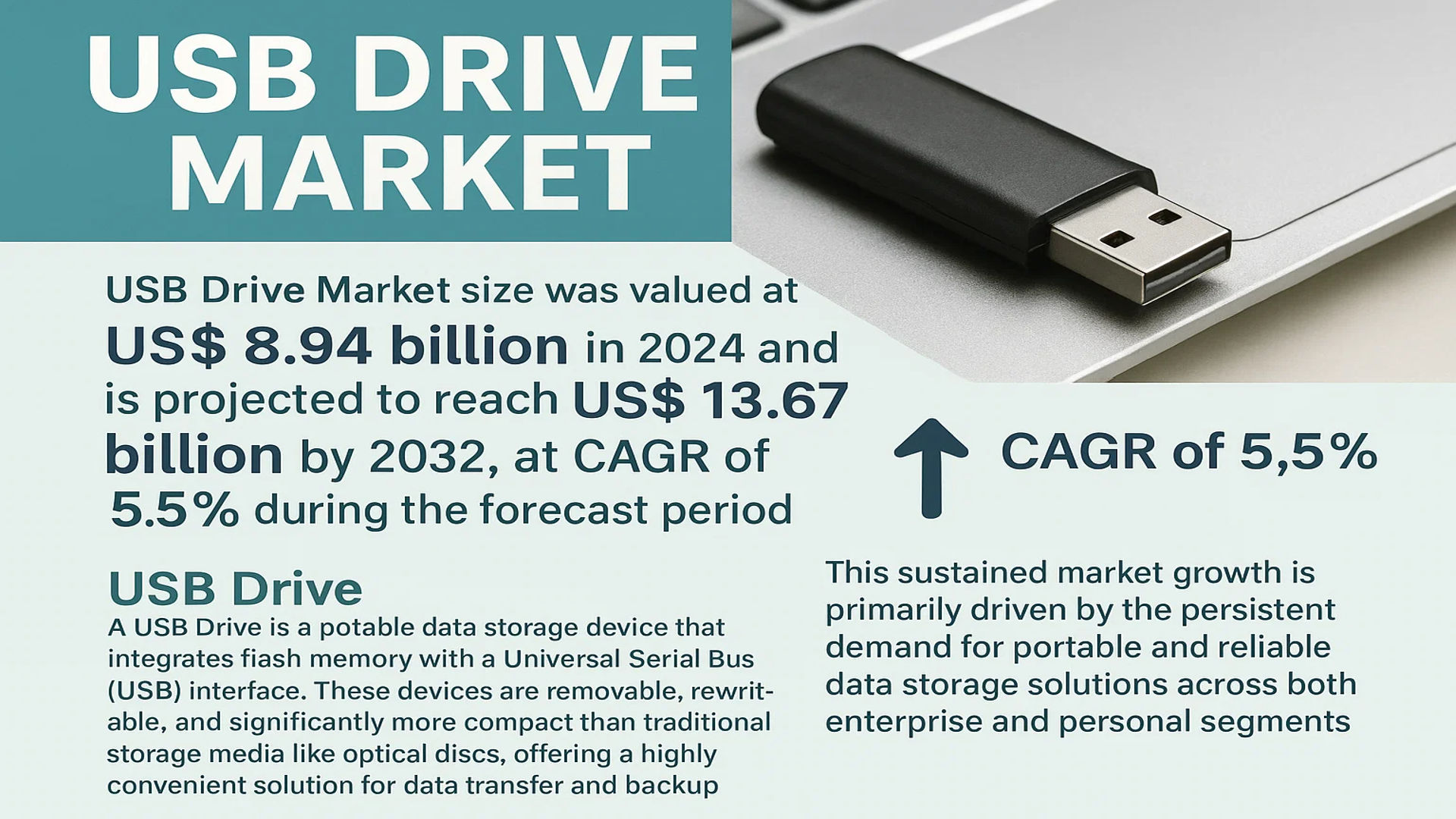
The global USB Drive Market size was valued at US$ 8.94 billion in 2024 and is projected to reach US$ 13.67 billion by 2032, at a CAGR of 5.5% during the forecast period 2025-2032.
A USB Drive is a portable data storage device that integrates flash memory with a Universal Serial Bus (USB) interface. These devices are removable, rewritable, and significantly more compact than traditional storage media like optical discs, offering a highly convenient solution for data transfer and backup across a multitude of devices.
This sustained market growth is primarily driven by the persistent demand for portable and reliable data storage solutions across both enterprise and personal segments. While cloud storage adoption rises, USB drives remain crucial for offline access, physical data transfer, and enhanced security. Furthermore, continuous advancements in storage capacity, with products now commonly available up to 2TB, and faster data transfer speeds, such as those enabled by the USB 3.2 standard, are key factors propelling market expansion. Leading players like Kingston, SanDisk, and Toshiba continue to innovate, focusing on durability, security features like hardware encryption, and design to maintain a competitive edge in the market.
MARKET DYNAMICS
MARKET DRIVERS
Rising Demand for Portable Data Storage Solutions to Accelerate Market Growth
The global USB drive market is experiencing robust growth driven by increasing demand for portable, high-capacity data storage solutions across multiple sectors. Enterprises and individual consumers require efficient ways to transfer, backup, and store critical data, with USB drives offering unparalleled convenience and compatibility. The market has witnessed significant capacity expansion, with drives now offering up to 2TB of storage while maintaining compact form factors. This evolution addresses the growing file sizes of modern applications, including 4K/8K video content, complex software packages, and extensive database files. The enterprise sector particularly relies on USB drives for secure data transfer between air-gapped systems, offline backups, and distribution of proprietary software. The education sector continues to utilize USB drives for distributing learning materials in regions with limited internet connectivity, further sustaining market demand.
Advancements in USB Technology Standards to Fuel Market Expansion
The transition from traditional USB-A to newer USB-C interfaces represents a significant driver for market refresh and upgrade cycles. USB-C’s reversible design, higher data transfer speeds, and power delivery capabilities have created substantial replacement demand. The adoption of USB 3.2 Gen 2 and USB4 standards has dramatically improved performance, with transfer speeds reaching up to 40Gbps compared to USB 2.0’s 480Mbps. This technological evolution enables professionals in creative industries, IT departments, and research institutions to work with large datasets more efficiently. Manufacturers have responded by introducing products with improved NAND flash technology, enhanced controller chips, and advanced error correction algorithms. The compatibility of USB-C with multiple devices including smartphones, tablets, and laptops has further expanded the addressable market, creating cross-platform usage scenarios that drive additional sales.
Growing Cybersecurity Concerns to Drive Demand for Secure USB Solutions
Increasing cybersecurity threats and data protection regulations have accelerated demand for hardware-encrypted USB drives. The market for secure USB drives is growing at approximately twice the rate of conventional drives as organizations seek to protect sensitive information from unauthorized access. These specialized drives incorporate advanced encryption standards including AES 256-bit encryption, biometric authentication, and tamper-resistant designs that automatically wipe data after multiple failed access attempts. Government agencies, financial institutions, and healthcare organizations are mandated to use encrypted storage devices for transporting confidential data, creating a sustained revenue stream for manufacturers. The implementation of regulations such as GDPR in Europe and similar data protection laws worldwide has compelled organizations to invest in secure data storage solutions, further driving adoption of enterprise-grade encrypted USB drives.
MARKET CHALLENGES
Increasing Competition from Cloud Storage Services to Challenge Market Growth
The USB drive market faces significant challenges from the rapid adoption of cloud storage solutions and wireless data transfer technologies. Cloud storage services offer advantages including automatic synchronization, remote accessibility, and virtually unlimited storage capacity without physical device management. The enterprise cloud storage market has grown substantially, with many organizations implementing cloud-first policies that reduce reliance on physical storage media. Wireless technologies including Wi-Fi Direct, Bluetooth transfer protocols, and 5G-enabled file sharing provide alternative methods for data transfer without physical media. The convenience of instantly sharing files through cloud links or direct wireless transfer has diminished the necessity for physical USB drives in many consumer and business scenarios, particularly for smaller file sizes and collaborative work environments.
Other Challenges
Counterfeit Products and Quality Issues
The market contends with widespread counterfeit products that undermine consumer confidence and brand reputation. Counterfeit USB drives often feature falsified capacity specifications, substandard components, and unreliable performance characteristics. These products not only cause data loss for unsuspecting consumers but also create price pressure on legitimate manufacturers who invest in quality components and rigorous testing procedures. The prevalence of counterfeit products is particularly high in online marketplaces and emerging markets, making it challenging for consumers to identify genuine products.
Physical Durability and Data Integrity Concerns
USB drives face inherent limitations regarding physical durability and long-term data integrity. The devices are susceptible to physical damage, loss, theft, and environmental factors that can compromise data storage. Unlike cloud services with built-in redundancy and enterprise-grade backup systems, USB drives represent single points of failure for critical data. The finite write cycles of NAND flash memory also limit the long-term reliability of these devices for archival purposes, creating concerns for users requiring guaranteed data preservation over extended periods.
MARKET RESTRAINTS
Declining Average Selling Prices to Restrain Revenue Growth
The USB drive market experiences continuous price erosion due to improvements in NAND flash manufacturing processes and intense competition among manufacturers. The average selling price per gigabyte has declined consistently, compressing profit margins despite increasing unit sales volumes. This price pressure is particularly pronounced in the consumer segment where product differentiation is limited and purchasing decisions are heavily influenced by price points. Manufacturers must continually innovate with new features, designs, and performance improvements to maintain pricing power, but these innovations often become standardized quickly across the industry. The cyclical nature of NAND flash memory pricing, influenced by global supply and demand dynamics, creates additional volatility in manufacturing costs and profitability, making long-term planning challenging for market participants.
Device Compatibility and Standardization Issues to Hinder Market Development
The transition between USB standards creates compatibility challenges that restrain market growth. While newer devices feature USB-C ports, the installed base of computers and other devices with traditional USB-A ports remains substantial. This creates a fragmented market where consumers must choose between compatibility with older devices or optimal performance with newer equipment. The variety of USB standards and confusing naming conventions (USB 3.0, USB 3.1 Gen 1, USB 3.2 Gen 2×2) creates consumer confusion and may delay purchasing decisions. The need for adapters and dongles to connect newer USB-C drives to legacy equipment adds cost and complexity, reducing the convenience factor that traditionally made USB drives attractive. This transition period between standards temporarily suppresses market growth as consumers await broader adoption of new standards before committing to purchases.
Limited Innovation in Core Technology to Constrain Market Expansion
The fundamental technology underlying USB drives has reached a maturity level that limits disruptive innovation. While capacities continue to increase and transfer speeds improve, the basic concept remains unchanged, reducing opportunities for groundbreaking features that could drive replacement cycles. The physical form factor constraints limit design innovation, and the interface standards are determined by industry consortia rather than individual manufacturers. This standardization, while beneficial for compatibility, restricts manufacturers’ ability to differentiate products through proprietary technological advancements. The market increasingly competes on incremental improvements rather than transformative innovations, making it challenging to stimulate accelerated upgrade cycles beyond natural capacity and performance requirements.
MARKET OPPORTUNITIES
Emerging Applications in Industrial and Automotive Sectors to Create New Growth Avenues
The USB drive market is discovering new opportunities in industrial, automotive, and specialized applications beyond traditional data storage. Industrial automation systems increasingly utilize USB drives for firmware updates, configuration backups, and data logging in environments where network connectivity is impractical or insecure. The automotive industry has integrated USB ports extensively for infotainment system updates, navigation map updates, and diagnostic data retrieval. These applications require drives with enhanced durability, extended temperature tolerance, and specialized form factors that command premium pricing. The reliability requirements in these sectors create opportunities for manufacturers to develop products with higher specifications and correspondingly better profit margins than consumer-grade devices.
Growing Demand for Customized and Branded USB Drives to Open New Revenue Streams
The corporate sector presents significant opportunities through customized and branded USB drives used for marketing, promotional campaigns, and corporate gifting. Companies increasingly utilize custom USB drives as physical marketing tools that combine practical utility with brand visibility. The ability to pre-load content, apply custom branding, and create unique form factors enables manufacturers to offer value-added services beyond standard production. The corporate market typically places larger volume orders with less price sensitivity than consumer channels, improving overall profitability. Educational institutions, event organizers, and professional conferences also represent substantial markets for bulk USB drive purchases containing presentation materials, research papers, or multimedia content for attendees.
Expansion in Emerging Markets to Provide Substantial Growth Potential
Emerging markets represent significant growth opportunities due to increasing digitalization, expanding middle-class populations, and limited internet infrastructure in many regions. Countries across Asia, Latin America, and Africa show strong demand for physical storage media as reliable alternatives to inconsistent internet connectivity. Educational institutions in these markets extensively utilize USB drives for distributing learning materials where digital infrastructure remains underdeveloped. The lower penetration of cloud services and limited broadband availability in many emerging markets creates sustained demand for physical storage solutions. Manufacturers can capitalize on these opportunities by developing products specifically tailored to price points and usage patterns in these regions, potentially leveraging older technology nodes to reduce manufacturing costs while maintaining reliability.
USB DRIVE MARKET TRENDS
Shift Towards High-Capacity and High-Speed USB Drives
The global USB drive market is witnessing a pronounced shift towards higher capacity and faster data transfer speeds, driven by increasing consumer and enterprise demand for efficient data storage solutions. While traditional lower-capacity drives (below 8GB) still hold a share, the market is increasingly dominated by 32GB and 64GB+ variants, which accounted for over 60% of total unit sales in 2024. This trend is further accelerated by the growing file sizes of media content, software applications, and professional data backups. The adoption of USB 3.2 and USB4 standards has significantly improved transfer rates, with some premium models offering speeds exceeding 1,000 MB/s. This evolution is critical as users increasingly rely on USB drives not just for file storage but also for running applications and operating systems directly from the drive.
Other Trends
Rising Demand in Enterprise and B2B Segments
While personal use remains significant, the enterprise segment is emerging as a major growth driver, projected to expand at a CAGR of approximately 6.2% from 2025 to 2032. Businesses are increasingly utilizing USB drives for secure data distribution, software deployment, and marketing collateral. The need for encrypted and hardware-secured drives has surged, particularly in sectors handling sensitive information like finance, healthcare, and legal services. Manufacturers are responding with advanced security features, including biometric authentication and hardware encryption that complies with standards like FIPS 140-2. This corporate adoption is not just about storage; it’s about secure, portable, and efficient data management solutions in an increasingly mobile and remote work environment.
Geographic Market Expansion and Competitive Dynamics
The Asia-Pacific region, particularly China, continues to be both a major manufacturing hub and the largest consumer market, accounting for nearly 45% of global USB drive sales in 2024. This dominance is supported by strong local brands like Netac, Aigo, and TECLAST, which collectively hold a significant market share alongside global leaders. However, the competitive landscape is intensifying. While Kingston and SanDisk maintain leadership in brand recognition and reliability, price competition is fierce, especially in the lower and mid-range segments. This has led to increased consolidation efforts and a strategic focus on differentiation through durability, warranty periods, and value-added software. Furthermore, markets in Southeast Asia and India are showing the highest growth rates, fueled by increasing digitalization and affordable data storage needs.
COMPETITIVE LANDSCAPE
Key Industry Players
Market Leaders Leverage Innovation and Global Distribution to Maintain Dominance
The global USB Drive market exhibits a semi-consolidated competitive structure, featuring a dynamic mix of multinational technology giants, specialized storage manufacturers, and emerging regional players. Kingston Technology Company stands as the unequivocal market leader, commanding a significant portion of global revenue share. This dominance is primarily attributed to its extensive product portfolio spanning all capacity segments, from affordable entry-level drives to high-performance, encrypted models for enterprise use. The company’s robust global supply chain and distribution network, coupled with strong brand recognition built over decades, have solidified its top position.
SanDisk, a subsidiary of Western Digital, and Toshiba also hold substantial market shares, leveraging their vertical integration as NAND flash memory producers. This control over a key raw material provides them with a distinct cost and supply chain advantage. Their growth is further fueled by continuous innovation in flash technology, allowing them to offer higher capacities and faster data transfer speeds, such as USB 3.2 and USB4 interfaces, which are increasingly demanded by both enterprise and personal users.
Additionally, these leading companies are aggressively pursuing growth through strategic initiatives. This includes geographical expansion into high-growth emerging markets, targeted mergers and acquisitions to absorb innovative technologies or market share, and consistent new product launches. For instance, the push towards drives with hardware encryption and cloud integration features is a direct response to growing enterprise security needs, a trend expected to significantly boost their market share over the coming years.
Meanwhile, other key players like ADATA and HP Inc. are strengthening their positions through significant investments in research and development focused on durability, design, and security features. They are also forming strategic partnerships with PC OEMs and retail distributors to enhance product placement and availability, ensuring their continued relevance in an increasingly competitive landscape.
List of Key USB Drive Companies Profiled
- Kingston Technology Company, Inc. (U.S.)
- Western Digital Corporation (SanDisk) (U.S.)
- Toshiba Corporation (Japan)
- Netac Technology Co., Ltd. (China)
- aigo (China)
- TECLAST (China)
- ADATA Technology Co., Ltd. (Taiwan)
- HP Inc. (U.S.)
Segment Analysis:
By Type
Above 64G Segment Dominates the Market Due to Escalating Demand for High-Capacity Portable Storage
The market is segmented based on storage capacity into:
- Below 8G
- 16G
- 32G
- Above 64G
- Subtypes: 64GB, 128GB, 256GB, 512GB, 1TB, and others
By Application
Enterprise Segment Leads Due to High Adoption for Data Transfer and Secure Storage Solutions
The market is segmented based on application into:
- Enterprise
- Subtypes: Corporate Data Storage, Secure Boot Drives, and Marketing Giveaways
- Personal
- Subtypes: File Backup, Media Storage, and Portable Operating Systems
By Interface
USB 3.0 Segment Holds Significant Share Owing to its Superior Data Transfer Speeds
The market is segmented based on interface type into:
- USB 2.0
- USB 3.0
- Subtypes: USB 3.0, USB 3.1 Gen 1, USB 3.2 Gen 1
- USB 3.1
- Subtypes: USB 3.1 Gen 2, USB 3.2 Gen 2
- USB Type-C
By Security Feature
Standard Drives Segment is Prevalent, Though Hardware-Encrypted Drives are Gaining Traction for Sensitive Data
The market is segmented based on security features into:
- Standard Drives
- Hardware-Encrypted Drives
- Subtypes: PIN-protected, Biometric (Fingerprint) enabled
- Software-Encrypted Drives
Regional Analysis: USB Drive Market
Asia-Pacific
The Asia-Pacific region is the undisputed leader in the global USB drive market, both in terms of production and consumption. This dominance is primarily driven by China, which functions as the world’s manufacturing hub for consumer electronics and flash memory components. The presence of major NAND flash memory producers and a dense ecosystem of assembly plants allows for significant economies of scale, making the region a cost-competitive source for global supply. Countries like India, Japan, and South Korea contribute substantially to regional demand, fueled by massive populations, rapid digitalization, and robust IT sectors. While cost-effective, lower-capacity drives remain popular among price-sensitive consumers, there is a clear and growing trend toward higher-capacity models (32GB and above) to accommodate larger file sizes, including 4K video and sophisticated software applications. The enterprise segment is particularly strong, with businesses requiring bulk purchases for data transfer, storage, and promotional purposes.
North America
Characterized by a mature and technologically advanced market, North America exhibits a strong demand for high-performance, high-capacity, and secure USB drives. The market is driven by stringent data security and privacy regulations, such as those in the healthcare (HIPAA) and financial (GLBA) sectors, which propel the adoption of hardware-encrypted drives. The enterprise application segment holds a significant share, with businesses prioritizing secure data mobility and backup solutions. Consumer demand, while still present, is increasingly challenged by the proliferation of cloud storage services and wireless transfer technologies. However, a niche market for premium, durable, and high-speed USB 3.2 and USB-C drives persists among professionals in creative and technical fields. The region is also a key hub for innovation, with leading brands headquartered here driving developments in transfer speeds and security features.
Europe
Similar to North America, the European market is well-developed and highly regulated, with a strong emphasis on product quality, data security, and environmental compliance. Regulations like the General Data Protection Regulation (GDPR) have a profound impact, making encrypted USB drives a standard requirement for enterprise and government use cases. Environmental directives, such as those governing RoHS and WEEE, influence product design and recycling programs. Demand is steady but is shifting away from basic models toward more sophisticated, secure, and environmentally conscious products. Western European nations, including Germany, France, and the U.K., represent the largest markets within the region, driven by their strong industrial and commercial sectors that require reliable physical data transfer solutions where cloud storage is deemed unsuitable for security or practicality reasons.
South America
The South American market presents a mixed landscape of opportunities and challenges. Economic volatility in key countries like Brazil and Argentina can impact consumer purchasing power and corporate IT budgets, often making cost the primary driver for purchases. This tends to favor the popularity of lower-to-mid-range capacity drives. However, the market is growing gradually, supported by increasing internet penetration, expanding small and medium-sized enterprises, and governmental efforts toward digitalization. The adoption of advanced, high-security drives is slower compared to more developed regions, but a baseline demand exists for reliable and affordable data storage and transfer solutions. The market potential is significant in the long term, contingent on greater economic stability and increased digital infrastructure investment.
Middle East & Africa
This is an emerging market with growth potential fragmented across the region. Wealthier Gulf Cooperation Council (GCC) nations, such as the UAE and Saudi Arabia, demonstrate stronger demand aligned with developed markets, featuring investments in smart city initiatives, large-scale commercial projects, and government sectors that require secure data handling. In contrast, other parts of the region face challenges related to economic development and IT infrastructure, which can limit market penetration. Overall, demand is primarily for affordable, entry-level drives that serve essential data mobility needs. As digital transformation efforts continue and economies develop, the demand for more advanced storage solutions is expected to rise, presenting a long-term growth opportunity for market players.
Report Scope
This market research report provides a comprehensive analysis of the global USB Drive market, covering the forecast period 2025–2032. It offers detailed insights into market dynamics, technological advancements, competitive landscape, and key trends shaping the industry.
Key focus areas of the report include:
- Market Size & Forecast: Historical data and future projections for revenue, unit shipments, and market value across major regions and segments.
- Segmentation Analysis: Detailed breakdown by product type, technology, application, and end-user industry to identify high-growth segments and investment opportunities.
- Regional Outlook: Insights into market performance across North America, Europe, Asia-Pacific, Latin America, and the Middle East & Africa, including country-level analysis where relevant.
- Competitive Landscape: Profiles of leading market participants, including their product offerings, R&D focus, manufacturing capacity, pricing strategies, and recent developments such as mergers, acquisitions, and partnerships.
- Technology Trends & Innovation: Assessment of emerging technologies, integration of AI/IoT, semiconductor design trends, fabrication techniques, and evolving industry standards.
- Market Drivers & Restraints: Evaluation of factors driving market growth along with challenges, supply chain constraints, regulatory issues, and market-entry barriers.
- Stakeholder Analysis: Insights for component suppliers, OEMs, system integrators, investors, and policymakers regarding the evolving ecosystem and strategic opportunities.
Primary and secondary research methods are employed, including interviews with industry experts, data from verified sources, and real-time market intelligence to ensure the accuracy and reliability of the insights presented.
FREQUENTLY ASKED QUESTIONS:
What is the current market size of Global USB Drive Market?
-> USB Drive Market size was valued at US$ 8.94 billion in 2024 and is projected to reach US$ 13.67 billion by 2032, at a CAGR of 5.5% during the forecast period 2025-2032.
Which key companies operate in Global USB Drive Market?
-> Key players include Kingston, SanDisk, Toshiba, Netac, aigo, TECLAST, ADATA, and HP, among others.
What are the key growth drivers?
-> Key growth drivers include rising demand for portable data storage, increasing digitalization, and growth in enterprise data management needs.
Which region dominates the market?
-> Asia-Pacific is the largest and fastest-growing region, driven by strong manufacturing presence and high consumer demand.
What are the emerging trends?
-> Emerging trends include higher capacity drives, USB Type-C adoption, hardware encryption, and ruggedized designs for industrial use.

Get Sample Report PDF for Exclusive Insights
Report Sample Includes
- Table of Contents
- List of Tables & Figures
- Charts, Research Methodology, and more...
 Download Sample Report PDF