
Key Statistics
Key Takeaways
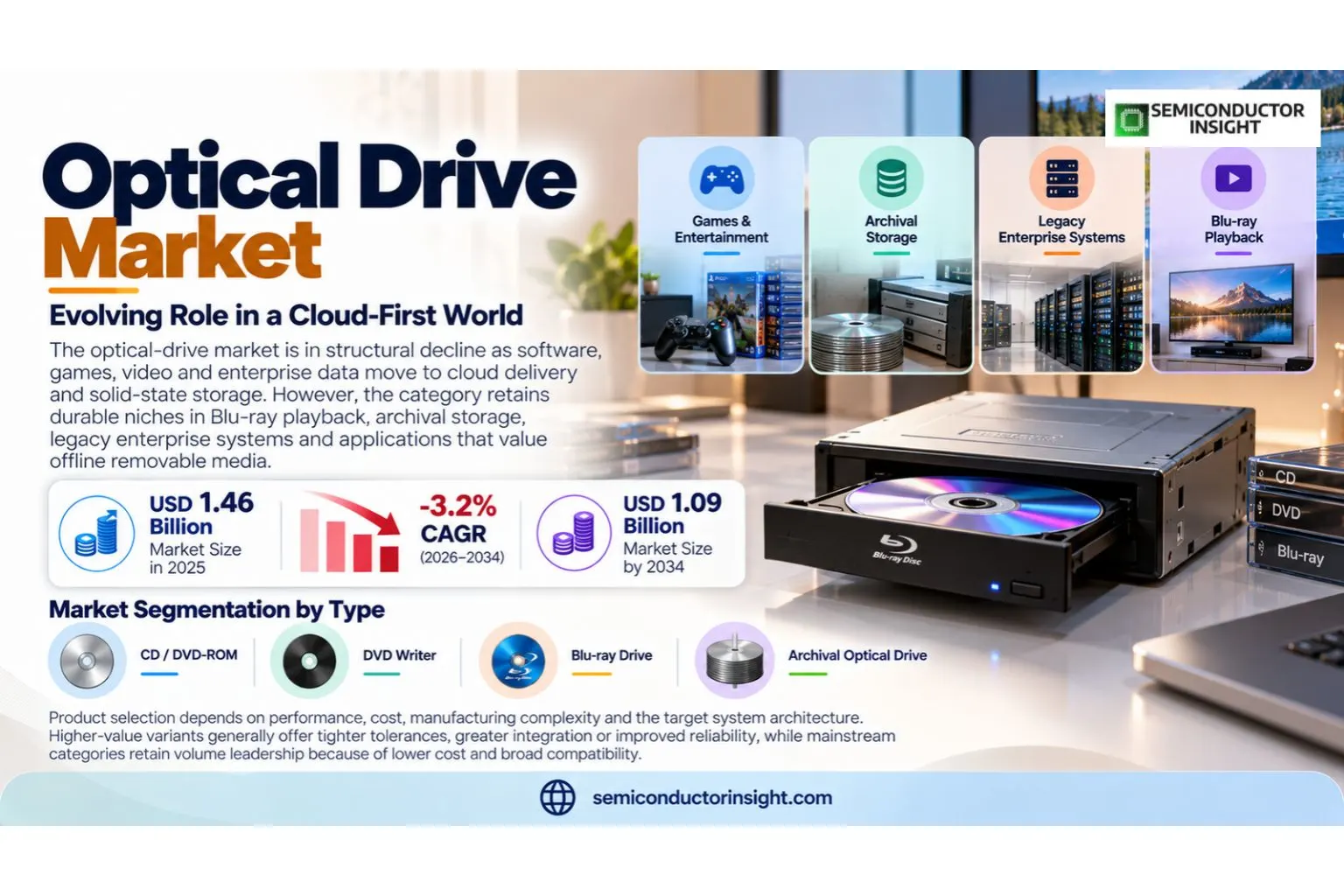
- Market size: The market is valued at USD 1.46 billion in 2025 and is projected to reach USD 1.09 billion by 2034, representing a -3.2% CAGR during 2026–2034.
- CD / DVD-ROM is a leading segment, reflecting established use across major applications.
- Asia Pacific leads the market, while Middle East & Africa provides the strongest growth profile.
- Desktop PCs is a major application, supported by rising performance and reliability requirements.
- external-drive migration, archival optical storage and premium Blu-ray niches is becoming a central competitive differentiator as customers seek higher performance and lower system-level cost.
Optical Drive Market Overview
Optical drive market is valued at USD 1.46 billion in 2025 and is projected to reach USD 1.09 billion by 2034, expanding at a -3.2% CAGR during 2026–2034. The 2026 market level is USD 1.42 billion. The optical-drive market is in structural decline as software, games, video and enterprise data move to cloud delivery and solid-state storage. However, the category retains durable niches in Blu-ray playback, archival storage, legacy enterprise systems and applications that value offline removable media.
External drives are gaining relative importance as internal PC bays disappear. Blu-ray and archival use cases also provide higher-value pockets than commodity DVD products, while consumer demand continues to shrink as streaming and digital distribution replace physical media. Commercial decisions in the Optical Drive market depend on qualification history, integration effort, operating reliability, lifecycle support and measurable system-level value.
Supplier strategy is increasingly focused on cost control, channel efficiency and niche applications rather than broad capacity expansion. The market rewards vendors that can support long product lifecycles and reliable compatibility with modern operating systems. Commercial decisions in the Optical Drive market depend on qualification history, integration effort, operating reliability, lifecycle support and measurable system-level value.
Segment Analysis: By Type
By type, the market is segmented into CD / DVD-ROM, DVD Writer, Blu-ray Drive, Archival Optical Drive. Product selection depends on performance, cost, manufacturing complexity and the target system architecture. Higher-value variants generally offer tighter tolerances, greater integration or improved reliability, while mainstream categories retain volume leadership because of lower cost and broad compatibility.
| Type | Commercial role |
|---|---|
| CD / DVD-ROM | CD / DVD-ROM addresses a distinct requirement set within the Optical Drive market, with purchasing decisions shaped by performance, qualification, integration and cost. |
| DVD Writer | DVD Writer addresses a distinct requirement set within the Optical Drive market, with purchasing decisions shaped by performance, qualification, integration and cost. |
| Blu-ray Drive | Blu-ray Drive addresses a distinct requirement set within the Optical Drive market, with purchasing decisions shaped by performance, qualification, integration and cost. |
| Archival Optical Drive | Archival Optical Drive addresses a distinct requirement set within the Optical Drive market, with purchasing decisions shaped by performance, qualification, integration and cost. |
Additional Segmentation: By Form Factor
Form Factor segmentation highlights important technical and commercial differences inside the Optical Drive market. These categories affect pricing, qualification, process requirements and customer fit, making them useful for evaluating where value growth differs from simple unit growth. Commercial decisions in the Optical Drive market depend on qualification history, integration effort, operating reliability, lifecycle support and measurable system-level value.
| Form Factor | Demand characteristics |
|---|---|
| Internal Drive | Embedded drives used in desktops, workstations and legacy systems. |
| External Drive | USB-connected removable drives for PCs and mobile workstations. |
| Slim Drive | Compact form factor used in selected laptops and embedded systems. |
Segment Analysis: By Application
By application, the market covers Desktop PCs, Laptops, Gaming & Entertainment, Automotive, Archival Storage, Others. Demand varies by reliability, performance, budget and product lifecycle. Premium applications usually require stricter qualification and long-term supply support, while higher-volume applications place more emphasis on cost, manufacturing scale and rapid technology migration. Commercial decisions in the Optical Drive market depend on qualification history, integration effort, operating reliability, lifecycle support and measurable system-level value.
| Application | Demand characteristics |
|---|---|
| Desktop PCs | Desktop PCs is a material demand segment where reliability, cost and system performance influence purchasing decisions. |
| Laptops | Laptops is a material demand segment where reliability, cost and system performance influence purchasing decisions. |
| Gaming & Entertainment | Gaming & Entertainment is a material demand segment where reliability, cost and system performance influence purchasing decisions. |
| Automotive | Automotive is a material demand segment where reliability, cost and system performance influence purchasing decisions. |
| Archival Storage | Archival Storage is a material demand segment where reliability, cost and system performance influence purchasing decisions. |
| Others | Others is a material demand segment where reliability, cost and system performance influence purchasing decisions. |
Additional Segmentation: By End User
End User segmentation clarifies how system architecture and customer requirements reshape product selection. Growth is strongest where the technology delivers a clear performance, cost, reliability or integration advantage relative to incumbent solutions. Commercial decisions in the Optical Drive market depend on qualification history, integration effort, operating reliability, lifecycle support and measurable system-level value.
| End User | Commercial role |
|---|---|
| Consumer | Home media playback, software access and personal archives. |
| Enterprise | Legacy systems, software distribution and document retention. |
| Media & Entertainment | Blu-ray production and high-quality physical media. |
| Automotive | Selected in-vehicle entertainment and legacy systems. |
| Government / Archival | Long-term offline storage and controlled data retention. |
Regional Analysis
Asia Pacific remains the largest region because China and Japan combine manufacturing with a substantial installed base. The Middle East & Africa can show pockets of faster demand growth from a smaller base where PC penetration and offline media usage remain relevant. Commercial decisions in the Optical Drive market depend on qualification history, integration effort, operating reliability, lifecycle support and measurable system-level value.
Why does regional demand differ across the Optical Drive market?
Regional performance depends on PC replacement, physical-media demand, broadband access and legacy-system retention. Developed markets decline faster in mainstream use but preserve archival and Blu-ray niches, while emerging markets may retain removable optical media longer. Commercial decisions in the Optical Drive market depend on qualification history, integration effort, operating reliability, lifecycle support and measurable system-level value.
How does Asia Pacific participate in the Optical Drive market?
Asia Pacific demand is anchored by manufacturing scale, electronics production and growing investment in advanced infrastructure. China, Japan, South Korea, Taiwan and India contribute different mixes of production, end-market demand and technical capability, making the region central to both volume growth and supply-chain development. Commercial decisions in the Optical Drive market depend on qualification history, integration effort, operating reliability, lifecycle support and measurable system-level value.
How does North America participate in the Optical Drive market?
North America remains a high-value market with strong technology development, enterprise spending and specialized industrial demand. The United States is the principal contributor, supported by leading technology companies, research institutions and high-value end markets that adopt premium solutions early. Commercial decisions in the Optical Drive market depend on qualification history, integration effort, operating reliability, lifecycle support and measurable system-level value.
How does Europe participate in the Optical Drive market?
Europe combines advanced manufacturing, healthcare, aerospace, automotive and research demand. Germany, France, the United Kingdom, Italy and other markets emphasize reliability, energy efficiency and regulatory compliance, supporting demand for technically differentiated products with strong lifecycle support. Commercial decisions in the Optical Drive market depend on qualification history, integration effort, operating reliability, lifecycle support and measurable system-level value.
How does South America participate in the Optical Drive market?
South America is a smaller but developing market led by Brazil and selected industrial economies. Demand is concentrated in infrastructure, healthcare, electronics, research and industrial modernization, with import dependence making distributor support, service coverage and pricing important commercial factors. Commercial decisions in the Optical Drive market depend on qualification history, integration effort, operating reliability, lifecycle support and measurable system-level value.
How does Middle East & Africa participate in the Optical Drive market?
Middle East & Africa remains an emerging market where demand is concentrated in infrastructure, healthcare, energy, defense and research projects. Gulf countries account for much of the premium investment, while wider adoption depends on local technical capability, procurement cycles and access to qualified suppliers. Commercial decisions in the Optical Drive market depend on qualification history, integration effort, operating reliability, lifecycle support and measurable system-level value.
Competitive Landscape
The competitive landscape includes HLDS, PLDS, Pioneer, ASUS, Lite-On, LG Electronics, Panasonic and specialty archival-storage suppliers. Market position is shaped by technical performance, qualification depth, customer support, manufacturing scale and the ability to support product transitions without disrupting customer operations. Commercial decisions in the Optical Drive market depend on qualification history, integration effort, operating reliability, lifecycle support and measurable system-level value.
Competition is increasingly centered on external-drive migration, archival optical storage and premium Blu-ray niches. Larger suppliers benefit from global engineering resources and purchasing scale, while specialized vendors can defend attractive niches through process expertise, customization and faster technical support. Commercial decisions in the Optical Drive market depend on qualification history, integration effort, operating reliability, lifecycle support and measurable system-level value.
| Competitive dimension | What matters |
|---|---|
| Technology | Performance, reliability and roadmap credibility. |
| Qualification | Customer validation, compliance and field history. |
| Supply | Capacity, lead time and regional resilience. |
| Commercial support | Application engineering, service and lifecycle support. |
Production Capacity Analysis
Capacity strategy in the Optical Drive market is closely linked to demand visibility, qualification cycles and customer concentration. Suppliers add capacity carefully because advanced production often requires specialized equipment, process know-how and extended validation before new lines can serve demanding applications. Commercial decisions in the Optical Drive market depend on qualification history, integration effort, operating reliability, lifecycle support and measurable system-level value.
Regional capacity decisions increasingly balance cost with resilience. Customers are asking suppliers to diversify critical steps, maintain qualified backup capacity and support shorter lead times. That trend favors manufacturers able to combine scale with consistent process control and regional technical support. Commercial decisions in the Optical Drive market depend on qualification history, integration effort, operating reliability, lifecycle support and measurable system-level value.
Market Dynamics
The Optical Drive market is shaped by simultaneous changes in end-market demand, product architecture, manufacturing economics and qualification requirements. Technology improvements create new use cases, but commercialization depends on whether performance gains translate into measurable system value. Commercial decisions in the Optical Drive market depend on qualification history, integration effort, operating reliability, lifecycle support and measurable system-level value.
Supply-chain conditions also influence purchasing behavior. Customers increasingly evaluate continuity, regional sourcing and lifecycle support alongside unit price. This shifts competition toward suppliers that can deliver stable quality and technical service through multiple product generations. Commercial decisions in the Optical Drive market depend on qualification history, integration effort, operating reliability, lifecycle support and measurable system-level value.
Market Drivers
Residual demand is supported by Blu-ray, archival storage, legacy enterprise systems and users requiring offline removable media. External drives also benefit from laptops and desktops that no longer include built-in optical hardware. Commercial decisions in the Optical Drive market depend on qualification history, integration effort, operating reliability, lifecycle support and measurable system-level value.
| Driver | CAGR impact |
|---|---|
| Technology upgrade cycle | +1.8 percentage points |
| End-market expansion | +1.3 percentage points |
| Higher content per system | +0.9 percentage points |
Market Restraints
Streaming, cloud software delivery, USB storage and solid-state drives continue to reduce mainstream optical-drive demand. Falling PC attachment rates and shrinking physical-media sales pressure volumes and average selling prices. Commercial decisions in the Optical Drive market depend on qualification history, integration effort, operating reliability, lifecycle support and measurable system-level value.
| Restraint | CAGR impact |
|---|---|
| Qualification and replacement cost | -0.8 percentage points |
| Price pressure | -0.6 percentage points |
| Supply or integration complexity | -0.5 percentage points |
Market Opportunities
Opportunities remain in archival storage, collector-grade Blu-ray, government retention and specialized offline systems. Vendors can also target compact external drives and professional workflows that value media longevity and air-gapped storage. Commercial decisions in the Optical Drive market depend on qualification history, integration effort, operating reliability, lifecycle support and measurable system-level value.
| Opportunity | Commercial significance |
|---|---|
| external-drive migration, archival optical storage and premium Blu-ray niches | Supports premium product mix and new design wins. |
| Regional capacity | Improves lead times and customer resilience. |
| Application engineering | Raises switching costs and deepens customer relationships. |
Supply Chain Analysis
The Optical Drive supply chain spans upstream materials and components, specialized manufacturing, qualification and integration, distribution or direct sales, and end-use deployment. Value is not distributed evenly: the highest margins generally accrue where process know-how, IP, qualification or application engineering create defensible differentiation. Commercial decisions in the Optical Drive market depend on qualification history, integration effort, operating reliability, lifecycle support and measurable system-level value.
| Stage | Role |
|---|---|
| Upstream inputs | Materials, components, software or specialized process equipment. |
| Manufacturing | Core fabrication, assembly and process control. |
| Qualification & integration | Validation, reliability testing and customer-specific adaptation. |
| End-market deployment | System integration, service and lifecycle support. |
Supply continuity has become strategically important because qualified alternatives may require lengthy validation. Buyers therefore monitor second-source readiness, geographic concentration and supplier financial stability, especially where a single component can delay a high-value system. Commercial decisions in the Optical Drive market depend on qualification history, integration effort, operating reliability, lifecycle support and measurable system-level value.
Recent Developments in the Optical Drive Market
Report Scope & Segmentation
This analysis covers the Optical Drive market from a 2025 base year through the 2026–2034 forecast period. It evaluates demand by product type, application and two additional segmentation axes, with regional coverage spanning Asia Pacific, North America, Europe, South America, and the Middle East & Africa. Commercial decisions in the Optical Drive market depend on qualification history, integration effort, operating reliability, lifecycle support and measurable system-level value.
| Scope item | Coverage |
|---|---|
| Base year | 2025 |
| Estimated year | 2026 |
| Forecast period | 2026–2034 |
| By Type | CD / DVD-ROM, DVD Writer, Blu-ray Drive, Archival Optical Drive |
| By Application | Desktop PCs, Laptops, Gaming & Entertainment, Automotive, Archival Storage, Others |
| By Form Factor | Internal Drive, External Drive, Slim Drive |
| By End User | Consumer, Enterprise, Media & Entertainment, Automotive, Government / Archival |
| Key participants | HLDS, PLDS, Pioneer, ASUS, Lite-On, LG Electronics, Panasonic and specialty archival-storage suppliers |
Frequently Asked Questions
What is the Optical Drive market size in 2025?
The market is valued at USD 1.46 billion in 2025.
What is the market forecast for 2034?
The market is projected to reach USD 1.09 billion by 2034, with a -3.2% CAGR during 2026–2034.
Which region leads the market?
Asia Pacific leads current market value, while Middle East & Africa has the strongest growth profile.
Which type is most important?
CD / DVD-ROM is a leading category, although mix varies by application and performance requirement.
Which applications matter most?
Desktop PCs is a major demand segment, alongside Laptops, Gaming & Entertainment.
What technology trend matters most?
external-drive migration, archival optical storage and premium Blu-ray niches is a central technology and commercialization trend.
Who are the major suppliers?
Major participants include HLDS, PLDS, Pioneer, ASUS, Lite-On, LG Electronics, Panasonic and specialty archival-storage suppliers.
What drives market growth?
Residual demand is supported by Blu-ray, archival storage, legacy enterprise systems and users requiring offline removable media. External drives also benefit from laptops and desktops that no longer include built-in opt
What limits growth?
Streaming, cloud software delivery, USB storage and solid-state drives continue to reduce mainstream optical-drive demand. Falling PC attachment rates and shrinking physical-media sales pressure volumes and average selli
What will shape the market through 2034?
Technology roadmaps, qualification, supply continuity and external-drive migration, archival optical storage and premium Blu-ray niches will shape competitive outcomes.
Research Sources & Evidence Base
View selected external research sources
- ASUS — Optical Drives & Storage: Current consumer and external optical-drive context. Open source
- Sony — Optical Disc Archive: Professional archival optical-storage context. Open source

Get Sample Report PDF for Exclusive Insights
Report Sample Includes
- Table of Contents
- List of Tables & Figures
- Charts, Research Methodology, and more...
 Download Sample Report PDF




Be the first to review “Optical Drive Market Size, Share & Industry Analysis, By Type (CD/DVD-ROM, DVD Writer, Blu-ray Drive, Archival Optical Drive), By Application (Desktop PCs, Laptops, Gaming & Entertainment, Automotive, Archival Storage, Others), By Form Factor (Internal Drive, External Drive, Slim Drive), By End User (Consumer, Enterprise, Media & Entertainment, Automotive, Government/Archival), and Regional Forecast, 2026-2034”