8-bit Automotive Microcontrollers (MCU) Market Insights
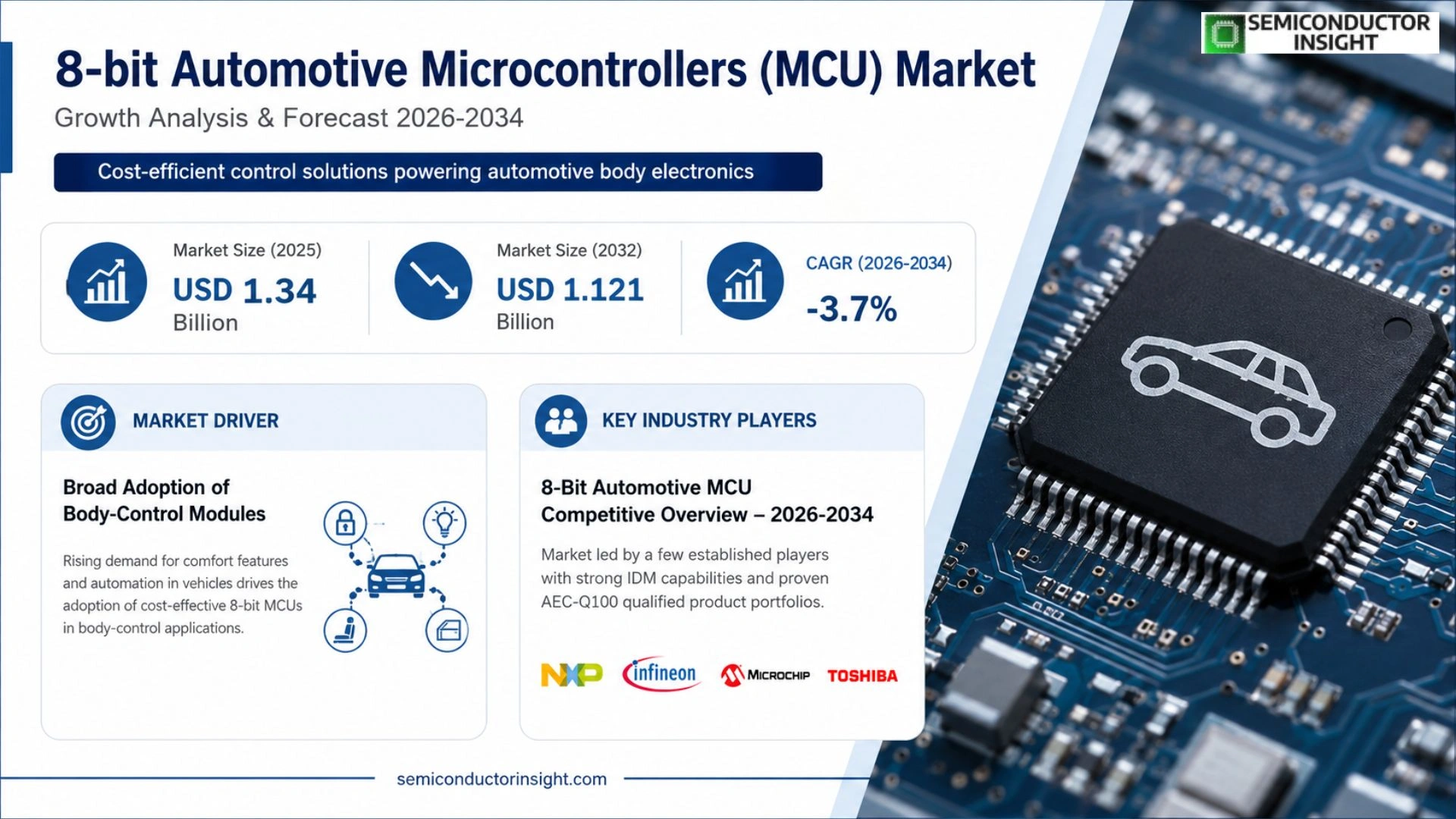
8-bit Automotive Microcontrollers (MCU) market size was valued at USD 1.34 billion in 2025. The market is projected to decline to USD 1.121 billion by 2032, exhibiting a CAGR of –3.7% during the forecast period.
An 8‑bit automotive microcontroller (MCU) is an eight‑bit computing core chip engineered for vehicle electronics. It integrates a CPU, ROM/RAM/Flash memory, I/O interfaces and peripherals such as ADCs, PWM generators and timers, delivering low power consumption, modest cost and high reliability through a streamlined instruction set. Its primary role is real‑time sensor data processing and actuator control across body‑control modules, powertrain functions and driver‑assistance features.
The market dynamics are shaped by several forces. Global sales of these MCUs are expected to reach roughly 4.6 billion units in 2025 with an average selling price of about USD 319 per thousand units, underscoring their cost advantage for entry‑level electric‑vehicle applications such as battery‑management systems. Growing demand for smart cockpits and higher levels of autonomous driving pushes OEMs toward integrating dozens of MCUs per vehicle; Level 3 autonomy may require up to thirty MCUs compared with traditional gasoline models. Simultaneously, localization policies in key regions encourage domestic suppliers,companies like ChipON Microelectronics and BYD Semiconductor,to obtain AEC‑Q100 certification, thereby reducing reliance on long‑standing foreign incumbents such as Infineon Technologies, NXP Semiconductors and Renesas Electronics.
MARKET DRIVERS
Broad Adoption of Body‑Control Modules
The proliferation of comfort‑oriented features,ambient lighting, power seat adjustment, and door‑lock automation,has nudged OEMs toward cost‑effective control logic. 8-bit Automotive Microcontrollers (MCU) Market players benefit from the modest silicon footprint required for these tasks, allowing designers to consolidate multiple functions into a single device while keeping bill‑of‑materials low.
Stringent Power‑Management Requirements
Vehicle electrification mandates that auxiliary systems consume minimal power to preserve overall efficiency. The inherent low‑power consumption of 8‑bit MCU architectures aligns tightly with this need, prompting tier‑one suppliers to specify these parts across a range of ancillary circuits. The resulting design simplicity translates into faster time‑to‑market for new vehicle models.
➤ Design teams repeatedly cite the predictable performance envelope of 8‑bit MCUs as a decisive factor when allocating silicon budget for peripheral control.
Beyond energy considerations, the mature software ecosystem surrounding classic 8‑bit cores reduces development risk. Legacy code libraries, proven debugging tools, and a deep talent pool allow manufacturers to accelerate validation cycles, thereby protecting launch schedules against unexpected delays.
MARKET CHALLENGES
Cost Sensitivity in High‑Volume Commodities
While 8‑bit MCUs are inherently inexpensive, the relentless pressure to shave fractions of a cent from unit cost forces suppliers into razor‑thin margins. Any price increment,whether from raw‑material spikes or added safety features,can quickly erode competitiveness, especially for components embedded in safety‑critical subsystems where volume scales into the hundreds of millions.
Other Challenges
Supply Chain Volatility
Global semiconductor shortages have underscored the fragility of just‑in‑time logistics. Even mature 8‑bit product families are susceptible to fab capacity constraints, leading to longer lead times and potential production bottlenecks for automotive assemblers.
MARKET RESTRAINTS
Escalating Safety and Functional‑Safety Standards
ISO 26262 and emerging functional‑safety mandates demand rigorous verification for every electronic component. Achieving compliance with higher ASIL levels often necessitates additional redundancy, diagnostic firmware, or even migration to more capable 32‑bit platforms, thereby limiting the applicability of traditional 8‑bit parts in safety‑critical pathways.
Automakers are also tightening acceptance criteria for electromagnetic compatibility (EMC) and temperature resilience. Meeting these stricter thresholds can require redesigns that offset the cost advantage historically associated with 8‑bit MCUs.
MARKET OPPORTUNITIES
Growth of Connected‑Vehicle Subsystems
As telematics and over‑the‑air updates become standard, a new class of low‑power gateway nodes is emerging. These nodes need modest processing power to handle CAN‑FD or LIN traffic while staying within strict power envelopes,an ideal niche for 8‑bit MCUs augmented with secure boot and lightweight encryption modules.
Furthermore, the shift toward modular vehicle architectures opens avenues for manufacturers to deploy standardized 8‑bit controllers across multiple platforms, achieving economies of scale without sacrificing functional adequacy. Companies that invest early in customizable peripheral sets stand to capture a sizable share of the upcoming wave of vehicle‑to‑infrastructure (V2I) interfaces.
Finally, emerging markets are witnessing a resurgence of low‑cost vehicle platforms aimed at first‑time buyers. Price‑sensitive segments such as compact cars and entry‑level commercial vans prioritize durability over raw processing horsepower, creating a fertile environment for 8-bit Automotive Microcontrollers (MCU) Market to expand its footprint.
8-bit Automotive Microcontrollers (MCU) Market Trends
Electrification and Advanced Driver Assistance Amplify MCU Demand
The shift toward electric powertrains and higher levels of vehicle automation has forced manufacturers to embed far more control nodes than in conventional models. A Level‑3 autonomous system, for example, can require two‑dozen to three‑dozen MCUs, a multiple of the count needed in a gasoline‑engine platform. This surge in sensor and actuator integration directly lifts unit shipments, which have already topped 4.6 billion units in 2025, while the average selling price remains near $319 per thousand units. The resulting economies of scale keep the cost advantage of 8‑bit designs intact, making them the preferred choice for entry‑level electric vehicles and body‑control functions such as window lifts, lighting, and climate regulation.
Other Trends
Domestic Localization and Supply‑Chain Resilience
Geopolitical tension and recurring chip shortages have prompted automakers and Tier 1 suppliers to prioritize locally sourced silicon. Over 90 % of automotive‑grade MCUs have historically been imported, but recent policy incentives,tax breaks, R&D subsidies, and expedited certification pathways for AEC‑Q100 and ISO 26262,have enabled firms like ChipON and BYD Semiconductor to reach volume production. The outcome is a gradual erosion of the foreign monopoly, which not only secures supply continuity but also creates new pricing pressure for legacy exporters. For buyers, the shift translates into shorter lead times and a clearer path to meet regional content mandates.
Safety Standards and Low‑Power Architecture Drive Product Evolution
Automotive electronics must survive temperature extremes from –40 °C to 150 °C and remain functional for more than 15 years. To satisfy these reliability targets, 8‑bit MCU vendors have refined internal oscillators, added hardware CRC checks, and adopted dynamic voltage regulation schemes that cut static power draw. The integration of RISC‑V cores further trims development expenses while preserving the deterministic instruction set required for functional safety. Gross margins stay healthy at 40‑50 %, reflecting the premium placed on proven, low‑cost controllers. OEMs that align their platform design with these low‑power, safety‑centric parts can reduce overall vehicle energy consumption and defer expensive redesigns as emission regulations tighten.
COMPETITIVE LANDSCAPE
Key Industry Players
8‑Bit Automotive MCU Competitive Overview – 2025‑2032
8‑bit automotive MCU arena remains concentrated around a handful of legacy silicon giants that leverage IDM capabilities and long‑standing AEC‑Q100 qualification pipelines. Infineon Technologies, NXP Semiconductors and Renesas Electronics dominate the high‑volume segments used in body‑control modules, power‑train actuators and tire‑pressure monitoring units. Their entrenched relationships with Tier‑1 suppliers give them leverage over pricing and roadmap alignment, which translates into gross margins that hover near the upper‑half of the industry range. However, the modest decline in unit price,driven by cost‑sensitive electric‑vehicle entry models,has pressured these incumbents to rationalize product portfolios, accelerate low‑power RISC‑V migrations, and pursue joint ventures that secure supply continuity amid global wafer shortages.
Beyond the traditional quartet, a growing cohort of regionally focused manufacturers is carving out market share in niche applications and domestically targeted programs. ChipON Microelectronics and BYD Semiconductor have achieved AEC‑Q100 compliance for body‑electronics and smart‑cockpit functions, positioning themselves as preferred suppliers for Chinese OEMs seeking to reduce import exposure. GigaDevice Semiconductor, Silicon Laboratories and Microchip Technology complement the landscape with specialist offerings such as high‑precision ADCs and automotive‑grade CRC‑enabled cores, often delivered through fabless‑foundry partnerships that lower entry barriers. Smaller players like Toshiba, Analog Devices and ON Semiconductor maintain relevance by supplying peripheral ASICs and mixed‑signal front‑ends that augment the core MCU, while their ability to bundle design‑in‑services offers a competitive edge in fast‑track development cycles.
List of Key 8‑Bit Automotive Microcontrollers Companies Profiled
- Infineon Technologies
- NXP Semiconductors
- Renesas Electronics
- Microchip Technology
- STMicroelectronics
- Texas Instruments
- Analog Devices
- Silicon Laboratories
- Toshiba
- GigaDevice Semiconductor
- ChipON Microelectronics
- BYD Semiconductor
- ON Semiconductor
Segment Analysis:
| Segment Category | Sub-Segments | Key Insights |
| By Type |
|
Basic Control Type remains the dominant choice for entry‑level vehicle body functions because of its cost efficiency and proven reliability.
|
| By Application |
|
Body Electronics leads the application landscape as automakers expand smart‑cockpit features.
|
| By End User |
|
Tier‑1 Suppliers are the primary drivers of adoption due to their role in integrating MCUs into vehicle modules.
|
| By Technology |
|
RISC‑V Open‑Source Core is gaining traction for its flexibility and cost advantage.
|
| By Functional Category |
|
Safety‑Critical MCU is emerging as a focal point for functional‑safety compliance.
|
Regional Analysis: 8-bit Automotive Microcontrollers (MCU) Market
North America
The United States aftermarket furnishes a robust stream of replacement units, driven by a fleet of aging light‑duty trucks and SUVs. Distributors report that service workshops favor 8‑bit MCUs for quick diagnostics, preserving part availability well beyond the original equipment life cycle.
North American safety mandates encourage manufacturers to retain proven silicon footprints. The emphasis on functional safety compliance means that redesign cycles for 8‑bit MCUs are infrequent, reinforcing a predictable demand pattern.
Proximity to major fab facilities and a dense network of contract manufacturers enable rapid response to volume spikes. This logistical advantage cushions the market against global shortages that affect higher‑end microcontroller segments.
A mature ecosystem of development tools and reference designs simplifies integration for OEMs. This reduces engineering overhead, allowing small‑tier suppliers to compete for niche contracts within the North American landscape.
Europe
European automotive manufacturers balance cost discipline with stringent emissions regulations. While many flagship models adopt advanced 32‑bit architectures for power management, a substantial segment of compact and commercial vehicles still employs 8‑bit MCUs for functions such as dashboard illumination and door‑lock control. The region’s strong emphasis on modular vehicle platforms encourages reuse of existing 8‑bit code bases, limiting the incentive to redesign at higher complexity. Additionally, a well‑established network of tier‑1 suppliers provides localized support, ensuring that firmware updates align with EU‑wide safety directives. Consequently, Europe sustains a steady demand curve that complements its broader digital‑engine transition strategy.
Asia‑Pacific
The Asia‑Pacific arena exhibits a dichotomy: high‑volume emerging‑market carmakers lean heavily on 8‑bit MCUs to keep unit costs minimal, whereas premium manufacturers in Japan and South Korea gravitate toward more sophisticated silicon. The region’s expansive supply chain, anchored by wafer fabs in Taiwan and South Korea, enables rapid prototyping and price competitiveness. Local OEMs often design vehicles with long production runs, reinforcing the relevance of legacy 8‑bit solutions for body‑control modules and sensor interfaces. Moreover, government incentives aimed at expanding vehicle fleets in developing economies accentuate the appeal of low‑cost microcontroller options.
South America
In South America, market dynamics are shaped by a high proportion of imported used vehicles, which extends the service life of older models equipped with 8‑bit MCUs. Regional distributors report that parts scarcity for newer 32‑bit devices drives workshops toward more readily available 8‑bit components. Economic volatility also curtails large‑scale redesign investments, prompting manufacturers to focus on incremental improvements to existing 8‑bit architectures. This pragmatic approach sustains a modest yet dependable market segment within the broader continental automotive landscape.
Middle East & Africa
The Middle East & Africa region reflects a blend of luxury vehicle imports and a growing fleet of cost‑sensitive commercial trucks. In many African markets, long‑standing vehicle platforms dominate, and repair networks prioritize components that are easy to source and service. 8‑bit MCUs meet these criteria, especially for auxiliary functions like climate‑control modules and lighting systems. In the Gulf Cooperation Council, high disposable income fuels demand for aftermarket upgrades, yet the underlying hardware frequently remains rooted in 8‑bit technology due to its proven reliability and cost advantage. This creates a niche where legacy microcontroller usage persists alongside gradual adoption of newer architectures.
Report Scope
This market research report provides a comprehensive analysis of the 8-bit Automotive Microcontrollers (MCU) Market , covering the forecast period 2026–2034. It offers detailed insights into market dynamics, technological advancements, competitive landscape, and key trends shaping the industry.
Key focus areas of the report include:
- Market Overview: The report begins with an overview outlining its current market scenario, key growth indicators, and industry transformation drivers. It discusses macroeconomic factors, demand–supply balance, regulatory landscape, and the strategic role of semiconductors in powering advancements across industries such as automotive, telecommunications, consumer electronics, and industrial automation.
- Market Size & Forecast: Historical data and future projections for revenue, unit shipments, and market value across major regions and segments.
- Segmentation Analysis: Detailed breakdown by product type, technology, application, and end-user industry to identify high-growth segments and investment opportunities.
- Regional Insights: Insights into market performance across North America, Europe, Asia-Pacific, Latin America, and the Middle East & Africa, including country-level analysis where relevant.
- Competitive Landscape: Profiles of leading market participants, including their product offerings, R&D focus, manufacturing capacity, pricing strategies, and recent developments such as mergers, acquisitions, and partnerships.
- Technology Trends & Innovation: Assessment of emerging technologies, integration of AI/IoT, semiconductor design trends, fabrication techniques, and evolving industry standards.
- Market Drivers & Restraints: Evaluation of factors driving market growth along with challenges, supply chain constraints, regulatory issues, and market-entry barriers.
- Stakeholder Insights: Insights for component suppliers, OEMs, system integrators, investors, and policymakers regarding the evolving ecosystem and strategic opportunities.
Primary and secondary research methods are employed, including interviews with industry experts, data from verified sources, and real-time market intelligence to ensure the accuracy and reliability of the insights presented.
FREQUENTLY ASKED QUESTIONS:
What is the current market size of 8-bit Automotive Microcontrollers (MCU) Market?
-> 8-bit Automotive Microcontrollers (MCU) market is projected to decline to USD 1.121 billion by 2032, exhibiting a CAGR of –3.7%
Which key companies operate in 8-bit Automotive Microcontrollers (MCU) Market?
-> Key players include Infineon Technologies, NXP Semiconductors, Renesas Electronics, Microchip Technology, STMicroelectronics, Texas Instruments, Analog Devices, Silicon Laboratories, Toshiba, Giga Device Semiconductor, among others.
What are the key growth drivers?
-> Key growth drivers include accelerated demand upgrades driven by automotive intelligence and electrification, domestic substitution policies enhancing supply‑chain security, and functional‑safety plus low‑power requirements prompting technological iteration.
Which region dominates the market?
-> Asia dominates the market, supported by strong production capacity and adoption in China, Japan, South Korea and other Asian economies.
What are the emerging trends?
-> Emerging trends include adoption of RISC‑V open‑source architectures, increased integration of 8‑bit MCUs in electric‑vehicle battery‑management systems, and a focus on ultra‑low‑power designs for connected and autonomous vehicle applications.
Get Sample Report PDF for Exclusive Insights
Report Sample Includes
- Table of Contents
- List of Tables & Figures
- Charts, Research Methodology, and more...
 Download Sample Report PDF