Heterogeneous Integration (HI) Platform Market Insights
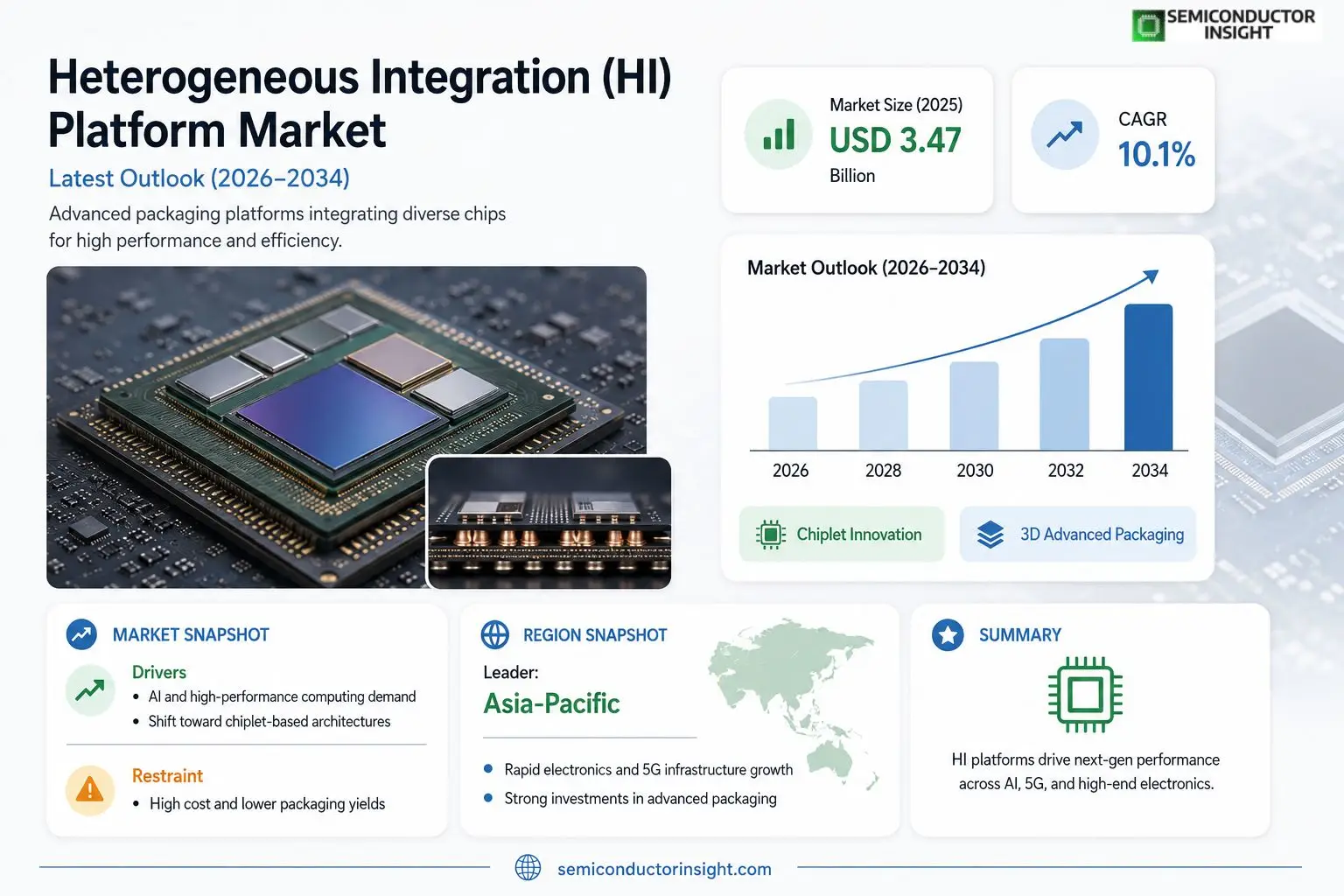
Global Heterogeneous Integration (HI) Platform market size was valued at USD 3.47 billion in 2025. The market is projected to grow from USD 3.82 billion in 2026 to USD 8.15 billion by 2034, exhibiting a CAGR of 10.1% during the forecast period.
Heterogeneous Integration (HI) platforms represent advanced semiconductor packaging solutions designed to combine multiple dies, chips, or components with diverse functionalities into a single package. These platforms enable seamless integration of disparate technologies,such as logic, memory, sensors, and RF devices,onto a common substrate, enhancing performance, power efficiency, and form factor optimization. Key components include interposers (silicon, organic, or glass), fan-out wafer-level packaging (FOWLP), system-in-package (SiP), and chiplet-based architectures, which collectively address the growing demand for high-performance computing, AI acceleration, and miniaturized electronic systems.
The rapid expansion of Heterogeneous Integration (HI) Platform Market is driven by escalating requirements for high-bandwidth memory interfaces, AI-driven workloads in data centers, and the proliferation of 5G infrastructure. Furthermore, the shift toward chiplet-based designs,exemplified by initiatives like Intel’s EMIB and AMD’s Infinity Fabric,is accelerating adoption across consumer electronics, automotive electronics, and cloud computing sectors. Strategic collaborations among industry leaders are also shaping market dynamics; for instance, in March 2024, TSMC announced its 3D Fabric technology, enabling advanced chip stacking for AI applications. Prominent players such as Intel Corporation, Taiwan Semiconductor Manufacturing Company (TSMC), Samsung Electronics Co., Ltd., ASE Technology Holding Co., Ltd., and Amkor Technology continue to invest heavily in R&D to enhance thermal management and interconnect density within HI platforms.
MARKET DRIVERS
Accelerated Moore’s Law Evolution
As traditional scaling methodologies face diminishing returns, Heterogeneous Integration (HI) Platform Market is pivoting towards 3D packaging and System-in-Package (SiP) solutions. The demand for smaller form factors without compromising performance is driving semiconductor manufacturers to adopt advanced integration architectures that consolidate diverse logic, memory, and RF components onto a single substrate.
Artificial Intelligence and High-Performance Computing
The exponential growth of AI workloads necessitates processors capable of handling massive parallel data streams. In Heterogeneous Integration (HI) Platform Market, the ability to combine high-compute logic with specialized memory controllers in a unified stack is a critical driver. This synergy reduces latency and power consumption, essential for training large-scale neural networks and real-time inference engines.
➤ The convergence of specialized accelerators with general-purpose CPUs is fundamentally reshaping computing architectures.
Ultimately, the push for energy-efficient data centers and edge devices is propelling the adoption of advanced interconnect technologies, including silicon interposers and embedded die solutions.
MARKET CHALLENGES
Design and Verification Complexity
Developing heterogeneous systems requires co-designing components that utilize different fabrication processes, materials, and design languages simultaneously. This complexity significantly increases the time-to-market for new products and introduces significant hurdles in ensuring system-level interoperability and signal integrity across disparate technology nodes.
Other Challenges
Significant Thermal Management Requirements
The dense packing of logic and memory layers in Heterogeneous Integration (HI) Platform Market solutions creates localized hotspots.
Legacy Ecosystem Incompatibility
Existing supply chains and design tools are often ill-equipped to handle the nuances of multi-chip module (MCM) designs.
MARKET RESTRAINTS
High Capital Expenditure and Yield Costs
The shift toward complex integration techniques often demands expensive equipment and specialized cleanroom facilities. Additionally, the yield rates for complex packaging stacks are typically lower than traditional monolithic methods, driving up the overall manufacturing costs and potentially limiting ROI for smaller semiconductor foundries operating within Heterogeneous Integration (HI) Platform Market.
MARKET OPPORTUNITIES
Automotive and 5G Infrastructure Expansion
The rapidly evolving automotive sector requires High-Reliability (Hi-Rel) chips capable of withstanding harsh environments, driving demand for robust heterogeneous integration solutions. Similarly, the rollout of 5G networks necessitates advanced RF and analog components integrated efficiently with digital control planes, offering significant growth vectors for Heterogeneous Integration (HI) Platform Market.
Heterogeneous Integration (HI) Platform Market Trends
Primary Trend Heading Here
Global Heterogeneous Integration (HI) Platform market is experiencing significant growth, driven by increasing demands for advanced semiconductor packaging solutions. These platforms are crucial for combining diverse functionalities into single packages, leading to enhanced performance and efficiency. Heterogeneous Integration (HI) Platform Market was valued at USD 3.47 billion in 2025. Heterogeneous Integration (HI) Platform Market is projected to reach USD 8.15 billion by 2034, demonstrating a robust growth trajectory.
Other Trends
Chiplet-Based Designs
The adoption of chiplet-based architectures is a key trend reshaping Heterogeneous Integration (HI) Platform Market. Companies like Intel and AMD are pioneering these designs, which involve breaking down complex chips into smaller, specialized modules. This approach allows for greater design flexibility, improved yield, and faster time-to-market. Strategic initiatives, such as TSMC’s 3D Fabric technology, are further accelerating the development and deployment of advanced chip stacking solutions.
Advanced Packaging Technologies
The relentless pursuit of higher performance and miniaturization is fueling innovation in packaging technologies within Heterogeneous Integration (HI) Platform Market. Key technologies like interposers, fan-out wafer-level packaging (FOWLP), and system-in-package (SiP) are gaining traction. These technologies enable higher interconnect density and improved thermal management, which are essential for supporting increasingly complex electronic systems and AI workloads.
Demand from Data Centers and AI Accelerators
The burgeoning data center market and the demand for AI acceleration are significant drivers for Heterogeneous Integration (HI) Platform Market. High-bandwidth memory interfaces and the need for efficient processing power are pushing the boundaries of packaging technology. The ability to integrate diverse components onto a single platform is critical for meeting the performance requirements of modern data center applications and AI workloads.
Collaboration and Investment
Strategic collaborations and substantial investments are shaping the landscape of Heterogeneous Integration (HI) Platform Market. Major players across the semiconductor ecosystem are actively investing in R&D to develop advanced packaging solutions and expand their capabilities. These collaborations are fostering innovation and accelerating the adoption of Heterogeneous Integration (HI) Platform technologies across various industries.
COMPETITIVE LANDSCAPE
Key Industry Players
Key Industry Players in Heterogeneous Integration (HI) Platform Market
Heterogeneous Integration (HI) Platform Market is characterized by intense competition among established semiconductor manufacturers, leading packaging companies, and innovative technology providers. Several key players are investing significantly in research and development to advance the capabilities of HI platforms, focusing on enhanced interconnect density, thermal management, and support for diverse chiplets and functionalities. The market’s growth is fueled by the increasing demand for high-performance computing, AI acceleration, and miniaturized electronic systems, driving innovation in packaging technologies like interposers, FOWLP, and SiP. Strategic partnerships and technology collaborations are also playing a crucial role in shaping the competitive landscape.
The competitive intensity is further amplified by the emergence of new entrants and the expansion of existing players into adjacent areas of the semiconductor ecosystem. Companies are focusing on offering comprehensive solutions encompassing design, manufacturing, and testing services to cater to the evolving needs of the HI market. The adoption of chiplet-based designs by major players like Intel and AMD is also impacting the demand for advanced HI platforms, pushing companies to develop more versatile and scalable solutions. This dynamic environment necessitates continuous innovation and strategic positioning to maintain a competitive edge in this rapidly evolving market.
List of Key Heterogeneous Integration (HI) Companies Profiled
- Intel Corporation
- Taiwan Semiconductor Manufacturing Company (TSMC)
- Samsung Electronics Co., Ltd.
- ASE Technology Holding Co., Ltd.
- Amkor Technology
- UTAC Technology Co., Ltd.
- GlobalWafers
- Silicon Motion Technology Corp.
- DICS, Inc.
- Sheild Technology Inc.
- XTO Advanced Packaging, Inc.
- Epeda AG
- Ginkgo FlashMemory Inc.
- Jako Advanced Packaging Co., Ltd.
- Nanolex Technology Corp.
Segment Analysis:
| Segment Category | Sub-Segments | Key Insights |
| By Type |
|
Leading Segment continues to benefit from its established manufacturing processes and cost-effectiveness, making it a popular choice for a wide range of applications. The demand for silicon interposers is particularly strong in consumer electronics due to their mature technology and scalability. |
| By Application |
|
Leading Segment in AI workloads is experiencing rapid growth due to its ability to accelerate deep learning and other computationally intensive tasks. This segment is driving innovation in chiplet-based designs and advanced packaging technologies. |
| By End User |
|
Leading Segment in automotive electronics is focused on enhancing the performance and reliability of electronic control units (ECUs) for advanced driver-assistance systems (ADAS) and autonomous driving. The need for robust and compact HI platforms is a key driver. |
| By Integration Level |
|
Leading Segment utilizing chiplet integration is gaining traction for its flexibility in combining different functionalities and scaling performance. This approach is particularly beneficial in high-end computing and AI applications. |
| By Technology |
|
Leading Segment employing silicon-on-silicon technology is focusing on achieving higher integration density and improved performance. This technology is enabling the creation of complex, high-bandwidth packages for demanding applications. |
Regional Analysis: North America
United States
The adoption of advanced packaging, including 2.5D and 3D integration, is a key driver in the US HI market, enabling higher integration density and improved performance.
The burgeoning artificial intelligence (AI) and high-performance computing (HPC) sectors in the US are significant consumers of HI platforms, demanding solutions that can deliver exceptional processing power and efficiency.
Government initiatives and substantial R&D investments in the US are fostering innovation and accelerating the development of advanced HI technologies.
The increasing focus on chiplet designs and the promotion of open standards are driving innovation in HI platforms, enabling greater design flexibility and modularity.
Europe
Europe is experiencing a growing interest in Heterogeneous Integration (HI) Platform Market, with several countries investing in advanced semiconductor manufacturing capabilities. The region’s strengths lie in its strong foundational research, particularly in areas like microelectronics and materials science. Key applications for HI in Europe include automotive electronics, industrial automation, and medical devices. Business strategies in Europe often involve collaborations between academic institutions, research centers, and industrial players to foster innovation and address specific regional needs. The emphasis is on developing energy-efficient and robust HI solutions for a wide range of applications. While the pace of adoption may trail behind the US, the European market is poised for significant growth in the coming years, driven by government initiatives and the increasing demand for advanced electronic systems. Heterogeneous Integration (HI) Platform Market presents opportunities for European companies to leverage their expertise in system integration and design to compete globally.
Asia-Pacific
The Asia-Pacific region is emerging as a dominant force in Heterogeneous Integration (HI) Platform Market, driven by rapid economic growth, a large and rapidly expanding electronics industry, and significant government investments in semiconductor technology. Countries like China, Japan, South Korea, and Taiwan are at the forefront of HI development and adoption. The region’s primary applications include consumer electronics, telecommunications infrastructure, and automotive electronics. Business strategies in Asia-Pacific often involve establishing local manufacturing capabilities, fostering partnerships with domestic companies, and adapting HI solutions to meet the specific needs of regional markets. The emphasis is on cost-effectiveness, scalability, and integration with existing manufacturing processes. The Asia-Pacific region’s substantial market size and supportive government policies position it as a key growth engine for Heterogeneous Integration (HI) Platform Market. The potential for innovation and market penetration is significant, with opportunities for both established and emerging players.
South America
Heterogeneous Integration (HI) Platform Market in South America is at an earlier stage of development compared to North America, Europe, and Asia-Pacific. However, the region is witnessing increasing interest due to the growth of its electronics manufacturing sector and the rising demand for advanced electronic devices. Key applications in South America include telecommunications, industrial automation, and automotive. Business strategies in South America typically involve adapting existing HI solutions to meet the specific needs and cost sensitivities of the regional market. The focus is on providing value-added services, such as design support and technical assistance. While the market size is currently smaller, South America presents long-term growth potential as its electronics industry continues to expand. The adoption of Heterogeneous Integration (HI) Platform Market solutions is expected to accelerate in the coming years, driven by increasing investment in technology and a growing skilled workforce.
Middle East & Africa
Heterogeneous Integration (HI) Platform Market in the Middle East & Africa is a nascent market with significant growth potential. The region’s increasing focus on technological advancement, infrastructure development, and diversification of economies is driving demand for advanced electronic systems. Key applications include telecommunications infrastructure, defense electronics, and industrial automation. Business strategies in the Middle East & Africa often involve partnerships with international technology providers and a focus on providing tailored solutions to meet the specific needs of the region. The emphasis is on reliability, security, and cost-effectiveness. While the market size is currently limited, the long-term growth prospects for Heterogeneous Integration (HI) Platform Market in the Middle East & Africa are substantial, driven by government investments in technology and infrastructure projects.
Report Scope
This market research report provides a comprehensive analysis of the Heterogeneous Integration (HI) Platform Market , covering the forecast period 2026–2034. It offers detailed insights into market dynamics, technological advancements, competitive landscape, and key trends shaping the industry.
Key focus areas of the report include:
- Market Overview: The report begins with an overview outlining its current market scenario, key growth indicators, and industry transformation drivers. It discusses macroeconomic factors, demand–supply balance, regulatory landscape, and the strategic role of semiconductors in powering advancements across industries such as automotive, telecommunications, consumer electronics, and industrial automation.
- Market Size & Forecast: Historical data and future projections for revenue, unit shipments, and market value across major regions and segments.
- Segmentation Analysis: Detailed breakdown by product type, technology, application, and end-user industry to identify high-growth segments and investment opportunities.
- Regional Insights: Insights into market performance across North America, Europe, Asia-Pacific, Latin America, and the Middle East & Africa, including country-level analysis where relevant.
- Competitive Landscape: Profiles of leading market participants, including their product offerings, R&D focus, manufacturing capacity, pricing strategies, and recent developments such as mergers, acquisitions, and partnerships.
- Technology Trends & Innovation: Assessment of emerging technologies, integration of AI/IoT, semiconductor design trends, fabrication techniques, and evolving industry standards.
- Market Drivers & Restraints: Evaluation of factors driving market growth along with challenges, supply chain constraints, regulatory issues, and market-entry barriers.
- Stakeholder Insights: Insights for component suppliers, OEMs, system integrators, investors, and policymakers regarding the evolving ecosystem and strategic opportunities.
Primary and secondary research methods are employed, including interviews with industry experts, data from verified sources, and real-time market intelligence to ensure the accuracy and reliability of the insights presented.
FREQUENTLY ASKED QUESTIONS:
What is the current market size of Heterogeneous Integration (HI) Platform Market?
-> Heterogeneous Integration (HI) Platform Market was valued at USD 3.47 billion in 2025 and is expected to reach USD 8.15 billion by 2034, reflecting a CAGR of 10.1% over the forecast period.
Which key companies operate in Heterogeneous Integration (HI) Platform Market?
-> Key players include Intel Corporation, Taiwan Semiconductor Manufacturing Company (TSMC), Samsung Electronics Co., Ltd., ASE Technology Holding Co., Ltd., and Amkor Technology, among others.
What are the key growth drivers?
-> Key growth drivers include high‑bandwidth memory interface demand, AI‑driven workloads in data centers, rapid 5G infrastructure rollout, and the shift toward chiplet‑based designs.
Which region dominates the market?
-> Asia‑Pacific is the fastest‑growing region, while North America remains a dominant market for heterogeneous integration platforms.
What are the emerging trends?
-> Emerging trends include chiplet‑based architectures, 3D stacking technologies such as TSMC’s 3D Fabric, advanced interposer materials, and AI/ML‑enabled packaging solutions.

Get Sample Report PDF for Exclusive Insights
Report Sample Includes
- Table of Contents
- List of Tables & Figures
- Charts, Research Methodology, and more...
 Download Sample Report PDF