GPS / GNSS (Multi-constellation) Receiver IC Market Insights
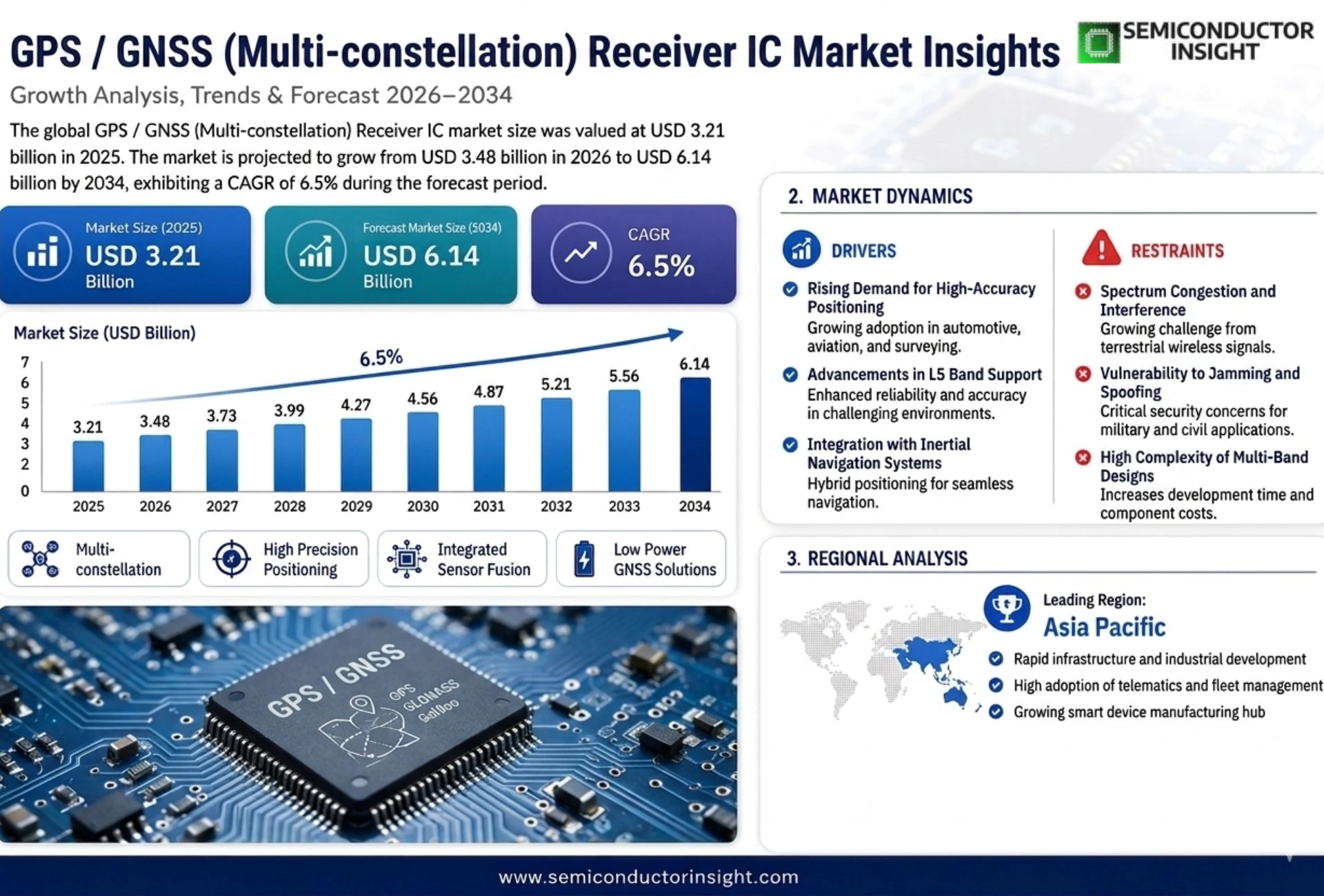
GPS / GNSS (Multi-constellation) Receiver IC Market size was valued at USD 3.21 billion in 2025. The market is projected to grow from USD 3.48 billion in 2026 to USD 6.14 billion by 2034, exhibiting a CAGR of 6.5% during the forecast period.
GPS / GNSS multi-constellation receiver ICs are semiconductor devices engineered to simultaneously receive and process signals from multiple global navigation satellite systems, including the U.S. GPS, Russia’s GLONASS, Europe’s Galileo, and China’s BeiDou. By leveraging signals from more than one constellation, these integrated circuits deliver superior positioning accuracy, enhanced signal availability in challenging environments, and improved reliability , qualities that are increasingly critical across automotive, consumer electronics, precision agriculture, defense, and industrial IoT applications.
The market is witnessing robust expansion driven by the surging adoption of connected and autonomous vehicles, the proliferation of smart devices requiring precise location services, and growing investments in infrastructure digitization worldwide. Furthermore, the rising deployment of Industry 4.0 technologies and asset tracking solutions continues to amplify demand for high-performance GNSS receiver ICs. Key players actively shaping the competitive landscape include u-blox AG, Qualcomm Technologies, Inc., Broadcom Inc., STMicroelectronics, and MediaTek Inc., each offering differentiated multi-constellation receiver IC portfolios catering to diverse end-use sectors.
MARKET DRIVERS
Surging Demand for Precision Positioning Across Automotive and Consumer Electronics Sectors
GPS / GNSS (Multi-constellation) Receiver IC Market is experiencing robust expansion, driven primarily by the accelerating adoption of advanced positioning technologies across automotive, consumer electronics, and industrial verticals. Modern vehicles increasingly rely on multi-constellation GNSS receiver ICs that simultaneously process signals from GPS (United States), GLONASS (Russia), Galileo (European Union), and BeiDou (China) satellite systems, enabling centimeter-level accuracy that single-constellation solutions cannot deliver. The automotive sector’s shift toward advanced driver-assistance systems (ADAS) and autonomous navigation platforms has elevated the performance benchmarks demanded of GNSS chipsets, compelling semiconductor manufacturers to invest substantially in multi-frequency, multi-constellation receiver architectures.
Proliferation of Smart Infrastructure and Industry 4.0 Applications Fueling Adoption
Beyond automotive, the rapid deployment of smart city infrastructure, precision agriculture systems, unmanned aerial vehicles (UAVs), and industrial IoT platforms is generating sustained demand for high-sensitivity multi-constellation GNSS receiver ICs. Precision agriculture applications, for example, require sub-decimeter positioning accuracy to enable autonomous machinery and variable-rate application systems, making multi-constellation support an operational necessity rather than a premium feature. The integration of GNSS receiver ICs into wearable devices, asset trackers, and logistics management platforms further broadens the addressable market, as enterprises prioritize real-time geolocation intelligence for operational efficiency.
➤ The concurrent deployment of LEO (Low Earth Orbit) satellite constellations alongside traditional GNSS infrastructure is expanding signal availability in dense urban environments and high-interference zones, strengthening the value proposition of multi-constellation receiver IC solutions capable of aggregating diverse orbital signal sources.
Regulatory mandates across key markets are also acting as structural growth catalysts for GPS / GNSS (Multi-constellation) Receiver IC Market. In the European Union, eCall emergency communication requirements for new vehicles mandate embedded GNSS functionality, while evolving aviation standards from bodies such as ICAO increasingly specify multi-constellation receiver compliance for enhanced safety of life positioning. These regulatory frameworks create a durable, non-cyclical demand floor that provides semiconductor vendors with long-term design win visibility and supports sustained capital investment in next-generation receiver IC development.
MARKET CHALLENGES
Signal Interference and Multipath Propagation Remain Core Technical Impediments
Despite the technological momentum withGPS / GNSS (Multi-constellation) Receiver IC Market, signal integrity challenges continue to constrain performance in complex deployment environments. Urban canyon effects, wherein dense building clusters reflect and attenuate satellite signals, introduce multipath propagation errors that degrade positioning accuracy even in advanced multi-constellation receiver designs. GNSS receiver IC developers must implement sophisticated signal processing algorithms, including multipath mitigation filters and interference cancellation circuits, that add design complexity, increase power consumption, and elevate bill-of-materials costs , presenting a persistent engineering challenge that limits achievable performance particularly for low-power IoT-grade chipsets.
Other Challenges
Radio Frequency Interference and Spectrum Congestion
The proliferation of wireless communication technologies operating in adjacent frequency bands poses a growing radio frequency interference risk to GNSS receiver IC performance. 5G network deployments, particularly those utilizing frequency bands proximate to L-band GNSS signals, have raised documented concerns regarding desensitization of receiver front-ends, requiring additional filtering stages and increasing chipset complexity. Manufacturers operating GPS / GNSS (Multi-constellation) Receiver IC Market face the dual challenge of maintaining high receiver sensitivity while incorporating robust interference rejection capabilities, a balance that demands advanced RF semiconductor process nodes and increases overall development expenditure.
Design Complexity and Time-to-Market Pressures
Supporting simultaneous signal processing across multiple constellations and frequencies demands substantially greater silicon area, baseband processing capability, and firmware sophistication compared to legacy single-constellation designs. This complexity elevates non-recurring engineering costs and extends product development cycles, creating time-to-market risks particularly for smaller fabless semiconductor vendors competing against established players with mature multi-constellation IP portfolios. Supply chain constraints affecting advanced CMOS process node availability further compound these pressures, as leading-edge GNSS receiver IC designs increasingly migrate to sub-28nm fabrication processes to meet power and performance targets.
MARKET RESTRAINTS
Intense Price Erosion and Commoditization Pressures Compressing Vendor Margins
A principal restraint moderating revenue growth withGPS / GNSS (Multi-constellation) Receiver IC Market is the pronounced average selling price erosion driven by intensifying competition among established semiconductor vendors and the emergence of well-capitalized Chinese fabless chipset developers. As multi-constellation GNSS functionality has progressively migrated from premium to mainstream market segments, competitive dynamics have accelerated commoditization, compelling vendors to pursue aggressive pricing strategies that erode gross margins. This pricing environment constrains R&D reinvestment capacity, particularly for mid-tier participants lacking the scale economies of market leaders, and may slow the pace of innovation in power efficiency and accuracy enhancement technologies.
Power Consumption Constraints Limiting Adoption in Battery-Dependent Device Categories
The inherently higher power consumption associated with simultaneous multi-constellation signal acquisition and tracking presents a meaningful adoption barrier within the wearable technology and compact IoT sensor markets, where battery longevity is a primary design constraint. While leading receiver IC vendors have made demonstrable progress in duty-cycling architectures and low-power acquisition modes, the fundamental trade-off between constellation coverage breadth and energy efficiency remains a limiting factor. Device OEMs targeting extended battery life specifications frequently opt for single-constellation or reduced-frequency receiver configurations, restricting the penetration of full multi-constellation GNSS receiver IC solutions in volume-driven, power-sensitive market segments and tempering overall addressable market expansion rates.
MARKET OPPORTUNITIES
High-Accuracy Dual-Frequency Multi-Constellation Receivers Unlocking New Vertical Markets
The commercial availability of cost-optimized dual-frequency (L1/L5) multi-constellation GNSS receiver ICs represents a transformative opportunity for GPS / GNSS (Multi-constellation) Receiver IC Market, as dual-frequency signal processing enables ionospheric error correction that significantly enhances positioning accuracy without dependence on augmentation network infrastructure. This capability is opening previously inaccessible markets including mass-market surveying instruments, precision drone delivery systems, and consumer-grade high-accuracy navigation applications. The progressive reduction in dual-frequency receiver IC pricing, as volume manufacturing scales and process yields improve, is expected to substantially expand the total addressable market by enabling accuracy levels previously achievable only with professional-grade equipment.
Integration of GNSS with Complementary Sensor Fusion Technologies Expanding System Value
A compelling strategic opportunity withGPS / GNSS (Multi-constellation) Receiver IC Market lies in the integration of multi-constellation GNSS receiver functionality with inertial measurement units (IMUs), barometric pressure sensors, and dead reckoning processors within unified system-on-chip (SoC) architectures. Such sensor-fused positioning solutions address the fundamental limitation of standalone GNSS in signal-denied environments , tunnels, indoor spaces, and dense urban canyons , by maintaining continuous position estimates through complementary sensor modalities. Automotive-grade integrated positioning SoCs incorporating multi-constellation GNSS alongside six-axis IMU and wheel odometry interfaces represent a high-value product category with strong design win momentum, as vehicle OEMs and Tier-1 suppliers seek to consolidate positioning system bill-of-materials while elevating performance for ADAS and connected vehicle applications.
Emerging Economies and 5G-Enabled Location Services Presenting Untapped Growth Avenues
Rapid smartphone penetration and expanding 4G/5G network infrastructure across emerging economies in Southeast Asia, South Asia, and Sub-Saharan Africa are creating substantial incremental demand for multi-constellation GNSS receiver ICs embedded in mid-range mobile devices, two-wheel electric vehicles, and fleet management terminals. Simultaneously, the maturation of 5G network-assisted positioning technologies , including observed time difference of arrival (OTDOA) and network-assisted GNSS , is expanding the application scope of GNSS receiver ICs in hybrid positioning solutions that leverage both satellite and cellular infrastructure. Vendors capable of delivering highly integrated, cost-competitive multi-constellation receiver IC solutions tailored to the price sensitivities and environmental conditions of emerging market deployments are strategically positioned to capture disproportionate share of this accelerating demand.
GPS / GNSS (Multi-constellation) Receiver IC Market Trends
Rising Adoption of Autonomous and Connected Vehicles Accelerating Demand
GPS / GNSS (Multi-constellation) Receiver IC Market is experiencing a significant upswing driven by the rapid proliferation of connected and autonomous vehicles globally. Modern automotive platforms increasingly require precise, real-time positioning data to support advanced driver-assistance systems (ADAS), lane-keeping assistance, and fully autonomous navigation. Multi-constellation receiver ICs, capable of simultaneously processing signals from GPS, GLONASS, Galileo, and BeiDou, offer the redundancy and accuracy that automotive-grade applications demand. As automakers integrate higher levels of vehicle autonomy into production models, the dependency on robust GNSS receiver IC solutions continues to intensify across both passenger and commercial vehicle segments.
Other Trends
Expansion of Smart Consumer Electronics and IoT Devices
The proliferation of smartphones, wearables, and connected IoT devices is a prominent trend shaping GPS / GNSS (Multi-constellation) Receiver IC Market. Consumers increasingly expect seamless, accurate location services embedded in everyday devices. IoT deployments in logistics, asset tracking, and smart city infrastructure are further elevating the requirement for compact, power-efficient multi-constellation receiver ICs that can deliver reliable positioning even in dense urban environments with obstructed signal conditions.
Growth in Precision Agriculture Applications
Precision agriculture represents a fast-growing end-use segment for GPS / GNSS (Multi-constellation) Receiver IC Market. Farmers and agribusinesses are deploying GNSS-enabled equipment for automated guidance, field mapping, variable-rate application, and yield monitoring. Multi-constellation receiver ICs provide the sub-meter and centimeter-level accuracy that modern agricultural machinery requires, improving operational efficiency and reducing input costs. This trend is particularly prominent across North America, Europe, and Asia-Pacific, where agricultural modernization programs are actively subsidized.
Integration with Industry 4.0 and Digital Infrastructure
Growing investments in Industry 4.0 technologies are reinforcing demand withGPS / GNSS (Multi-constellation) Receiver IC Market. Industrial automation platforms, robotics, and digital twin implementations increasingly rely on precise geospatial data for real-time operational coordination. Infrastructure digitization initiatives across utilities, construction, and transportation sectors are expanding the addressable opportunity for high-performance GNSS receiver ICs designed to operate reliably in complex industrial environments.
Competitive Innovation Among Leading Semiconductor Providers
The competitive landscape of GPS / GNSS (Multi-constellation) Receiver IC Market is characterized by continuous product innovation. Key players including u-blox AG, Qualcomm Technologies, Inc., Broadcom Inc., STMicroelectronics, and MediaTek Inc. are actively advancing their multi-constellation receiver IC portfolios to address evolving accuracy, power consumption, and miniaturization requirements. Differentiated offerings targeting automotive, industrial, and consumer segments are intensifying competition, prompting accelerated R&D investment and strategic partnerships across the semiconductor ecosystem.
COMPETITIVE LANDSCAPE
Key Industry Players
GPS / GNSS (Multi-constellation) Receiver IC Market: Competitive Dynamics and Leading Innovators
GPS / GNSS (Multi-constellation) Receiver IC Market is characterized by intense competition among established semiconductor giants and specialized positioning technology providers. u-blox AG stands as a prominent force in the market, renowned for its highly integrated multi-constellation receiver IC modules widely adopted across automotive telematics, industrial IoT, and precision agriculture applications. Qualcomm Technologies, Inc. and Broadcom Inc. leverage their extensive semiconductor ecosystems to deliver high-performance GNSS receiver solutions embedded within system-on-chip (SoC) platforms, enabling seamless integration into smartphones, wearables, and connected vehicles. STMicroelectronics and MediaTek Inc. further intensify competition by offering cost-optimized, power-efficient multi-constellation receiver ICs targeting consumer electronics and mass-market IoT deployments. The competitive landscape is shaped by continuous R&D investments aimed at enhancing signal processing capabilities, reducing power consumption, and achieving centimeter-level accuracy by simultaneously processing signals from GPS, GLONASS, Galileo, and BeiDou constellations.
Beyond the tier-one players, a robust cohort of specialized and regional manufacturers is reinforcing market competitiveness. Septentrio NV has carved out a strong position in the high-precision GNSS segment, serving survey, agriculture, and autonomous systems markets with its advanced multi-constellation receiver chipsets. Trimble Inc. and Hexagon AB bring deep domain expertise in precision positioning, catering to professional-grade applications in construction, geospatial, and machine control sectors. Furuno Electric Co., Ltd. and FURUNO maintain a notable presence particularly in marine and industrial navigation segments. Unicore Communications and SiGe Semiconductor are recognized for their differentiated GNSS IC offerings targeting emerging markets and specialized use cases. As the market expands toward USD 6.14 billion by 2034 at a CAGR of 6.5%, competitive strategies increasingly revolve around multi-band support, anti-spoofing capabilities, and deep integration with cellular and sensor fusion platforms.
List of Key GPS / GNSS (Multi-constellation) Receiver IC Companies Profiled
- u-blox AG
- Qualcomm Technologies, Inc.
- Broadcom Inc.
- STMicroelectronics
- MediaTek Inc.
- Septentrio NV
- Trimble Inc.
- Hexagon AB
- Furuno Electric Co., Ltd.
- Unicore Communications
- Telit Communications
- Skyworks Solutions, Inc.
- NovAtel Inc. (Hexagon)
- Swift Navigation
- Allystar Technology
Segment Analysis:
| Segment Category | Sub-Segments | Key Insights |
| By Type |
|
Multi-Band Multi-Constellation Receiver IC stands as the dominant and fastest-evolving type segment, driven by its exceptional ability to simultaneously process signals across multiple frequency bands and satellite systems including GPS, GLONASS, Galileo, and BeiDou.
|
| By Application |
|
Automotive & Transportation represents the leading application segment, propelled by the accelerating global transition toward connected, electrified, and autonomous mobility solutions that demand centimeter-level positioning accuracy and uninterrupted satellite signal availability.
|
| By End User |
|
Original Equipment Manufacturers (OEMs) constitute the dominant end-user category, as they embed multi-constellation GNSS receiver ICs across a broad spectrum of finished products ranging from smartphones and wearables to automotive navigation systems and industrial machinery.
|
| By Constellation Support |
|
Quad-Constellation Receiver ICs are rapidly emerging as the preferred configuration across high-value application domains, reflecting the industry’s broader shift toward maximum satellite availability and positioning resilience.
|
| By Integration Level |
|
GNSS Integrated within SoC / Application Processor is establishing itself as the leading integration paradigm, as system designers across automotive, mobile, and IoT segments prioritize platform consolidation to reduce bill-of-materials complexity and board space footprint.
|
Regional Analysis: GPS / GNSS (Multi-constellation) Receiver IC Market
Asia-Pacific
Asia-Pacific hosts some of the world’s most advanced semiconductor fabrication facilities, providing a significant competitive advantage in the GPS / GNSS multi-constellation receiver IC market. Taiwan, South Korea, and Japan contribute cutting-edge foundry capabilities that enable the production of highly miniaturized, power-efficient GNSS chipsets. This manufacturing depth supports faster design iteration cycles and cost-competitive production at scale, reinforcing the region’s supply chain dominance.
National satellite navigation programs across Asia-Pacific , including China’s BeiDou, India’s NavIC, and Japan’s QZSS , are creating strong domestic demand for compatible multi-constellation receiver ICs. These government-led initiatives encourage local chipset development, reduce import dependency, and stimulate a vibrant ecosystem of system integrators and device manufacturers who require certified, region-optimized GNSS receiver solutions.
The rapid proliferation of connected vehicles and smart consumer devices across Asia-Pacific is a primary demand engine for GPS / GNSS multi-constellation receiver ICs. Automotive telematics, advanced driver assistance systems, and next-generation smartphones require high-accuracy, low-power GNSS chipsets capable of tracking multiple constellations simultaneously, making the region a central battleground for leading IC vendors competing on performance and integration.
Asia-Pacific’s aggressive smart city rollouts and industrial IoT deployments are broadening the addressable market for GPS / GNSS multi-constellation receiver ICs beyond traditional navigation. Fleet management, precision logistics, drone delivery ecosystems, and intelligent utility monitoring all rely on accurate positioning technology. The region’s pace of digital infrastructure development is expected to sustain strong incremental demand for advanced GNSS receiver IC solutions through 2034.
North America
North America represents a highly mature yet continuously evolving landscape for the GPS / GNSS multi-constellation receiver IC market. The United States, as the originator of the GPS constellation, maintains a deeply embedded positioning technology culture across defense, aerospace, automotive, and commercial sectors. The growing adoption of multi-constellation receiver architectures , combining GPS with GLONASS, Galileo, and BeiDou signals , reflects the industry’s push for enhanced accuracy and resilience. Domestic demand is substantially shaped by autonomous vehicle development programs, precision agriculture operations across vast farmland, and the expanding unmanned aerial systems sector. Federal investment in positioning, navigation, and timing infrastructure continues to reinforce the technology’s strategic importance. Canada contributes complementary demand, particularly in resource extraction industries where reliable geolocation is operationally critical. The presence of major fabless semiconductor companies and system-on-chip designers in Silicon Valley further cements North America’s role as a technology innovation hub within the global GPS / GNSS receiver IC market.
Europe
Europe occupies a strategically significant position in the GPS / GNSS multi-constellation receiver IC market, underpinned by the continent’s ownership of the Galileo satellite navigation system, which provides European industry with an independent, high-accuracy positioning infrastructure. This regional asset has stimulated a specialized ecosystem of GNSS chipset developers, particularly in Germany, France, the Netherlands, and Sweden. Automotive remains the dominant application vertical, with European original equipment manufacturers embedding multi-constellation receiver ICs across connected and autonomous vehicle platforms as standard features. Stringent European Union regulations around road safety, emissions monitoring, and logistics traceability are further accelerating GNSS integration. The aerospace and precision surveying sectors also represent consistent demand sources. Europe’s emphasis on technological sovereignty and data privacy is prompting increased investment in Galileo-compatible chipset development, giving regional IC vendors a competitive differentiation lever that resonates strongly with compliance-focused industrial and government customers.
South America
South America presents an emerging growth opportunity within the GPS / GNSS multi-constellation receiver IC market, characterized by rising adoption across agriculture, mining, and logistics , sectors that are foundational to the region’s economies. Brazil leads regional demand, with precision agriculture applications representing a particularly compelling use case given the country’s vast agricultural output and the operational efficiency gains achievable through accurate geolocation technology. The expansion of ride-sharing platforms, last-mile delivery networks, and fleet telematics across major urban centers in Brazil, Argentina, and Colombia is also driving incremental uptake of GNSS receiver ICs. Infrastructure development projects supported by regional and international investment programs are incorporating positioning technology for construction monitoring and asset tracking. While the market remains dependent on imported chipset solutions, growing technology awareness among domestic system integrators is gradually improving adoption rates and creating a foundation for sustained multi-constellation GNSS market development through the forecast period.
Middle East & Africa
The Middle East and Africa region is at an early but promising stage of development within the GPS / GNSS multi-constellation receiver IC market. Gulf Cooperation Council countries, led by the United Arab Emirates and Saudi Arabia, are the primary demand centers, driven by ambitious smart city projects, intelligent transportation initiatives, and defense modernization programs that require sophisticated positioning technology. National vision plans across the Gulf emphasize digital infrastructure as a pillar of economic diversification, creating procurement opportunities for GNSS receiver IC vendors. In Africa, infrastructure constraints have historically limited adoption; however, expanding mobile connectivity and the growth of agricultural technology platforms are beginning to unlock demand for affordable, low-power GNSS chipsets. The region’s reliance on multi-constellation receiver architectures is expected to grow as GPS, Galileo, and BeiDou signals become increasingly accessible, offering improved positioning reliability across geographically diverse and sometimes challenging RF environments throughout the continent.
Report Scope
This market research report provides a comprehensive analysis of the GPS / GNSS (Multi-constellation) Receiver IC Market , covering the forecast period 2026–2034. It offers detailed insights into market dynamics, technological advancements, competitive landscape, and key trends shaping the industry.
Key focus areas of the report include:
- Market Overview: The report begins with an overview outlining its current market scenario, key growth indicators, and industry transformation drivers. It discusses macroeconomic factors, demand–supply balance, regulatory landscape, and the strategic role of semiconductors in powering advancements across industries such as automotive, telecommunications, consumer electronics, and industrial automation.
- Market Size & Forecast: Historical data and future projections for revenue, unit shipments, and market value across major regions and segments.
- Segmentation Analysis: Detailed breakdown by product type, technology, application, and end-user industry to identify high-growth segments and investment opportunities.
- Regional Insights: Insights into market performance across North America, Europe, Asia-Pacific, Latin America, and the Middle East & Africa, including country-level analysis where relevant.
- Competitive Landscape: Profiles of leading market participants, including their product offerings, R&D focus, manufacturing capacity, pricing strategies, and recent developments such as mergers, acquisitions, and partnerships.
- Technology Trends & Innovation: Assessment of emerging technologies, integration of AI/IoT, semiconductor design trends, fabrication techniques, and evolving industry standards.
- Market Drivers & Restraints: Evaluation of factors driving market growth along with challenges, supply chain constraints, regulatory issues, and market-entry barriers.
- Stakeholder Insights: Insights for component suppliers, OEMs, system integrators, investors, and policymakers regarding the evolving ecosystem and strategic opportunities.
Primary and secondary research methods are employed, including interviews with industry experts, data from verified sources, and real-time market intelligence to ensure the accuracy and reliability of the insights presented.
FREQUENTLY ASKED QUESTIONS:
What is the current market size of GPS / GNSS (Multi-constellation) Receiver IC Market?
-> GPS / GNSS (Multi-constellation) Receiver IC Market was valued at USD 3.21 billion in 2025 and is expected to reach USD 6.14 billion by 2034, growing at a CAGR of 6.5% during the forecast period.
Which key companies operate GPS / GNSS (Multi-constellation) Receiver IC Market?
-> Key players include u-blox AG, Qualcomm Technologies, Inc., Broadcom Inc., STMicroelectronics, and MediaTek Inc., among others.
What are the key growth drivers?
-> Key growth drivers include surging adoption of connected and autonomous vehicles, proliferation of smart devices requiring precise location services, growing investments in infrastructure digitization, and rising deployment of Industry 4.0 technologies and asset tracking solutions.
Which region dominates the market?
-> Asia-Pacific is the fastest-growing region, while North America remains a significant market, driven by strong demand across automotive, defense, and industrial IoT applications.
What are the emerging trends?
-> Emerging trends include multi-constellation signal processing, integration of GNSS with AI and IoT platforms, precision agriculture applications, autonomous vehicle navigation, and advanced semiconductor design for improved positioning accuracy in challenging environments.

Get Sample Report PDF for Exclusive Insights
Report Sample Includes
- Table of Contents
- List of Tables & Figures
- Charts, Research Methodology, and more...
 Download Sample Report PDF