FlexRay Controller & Transceiver Market Insights
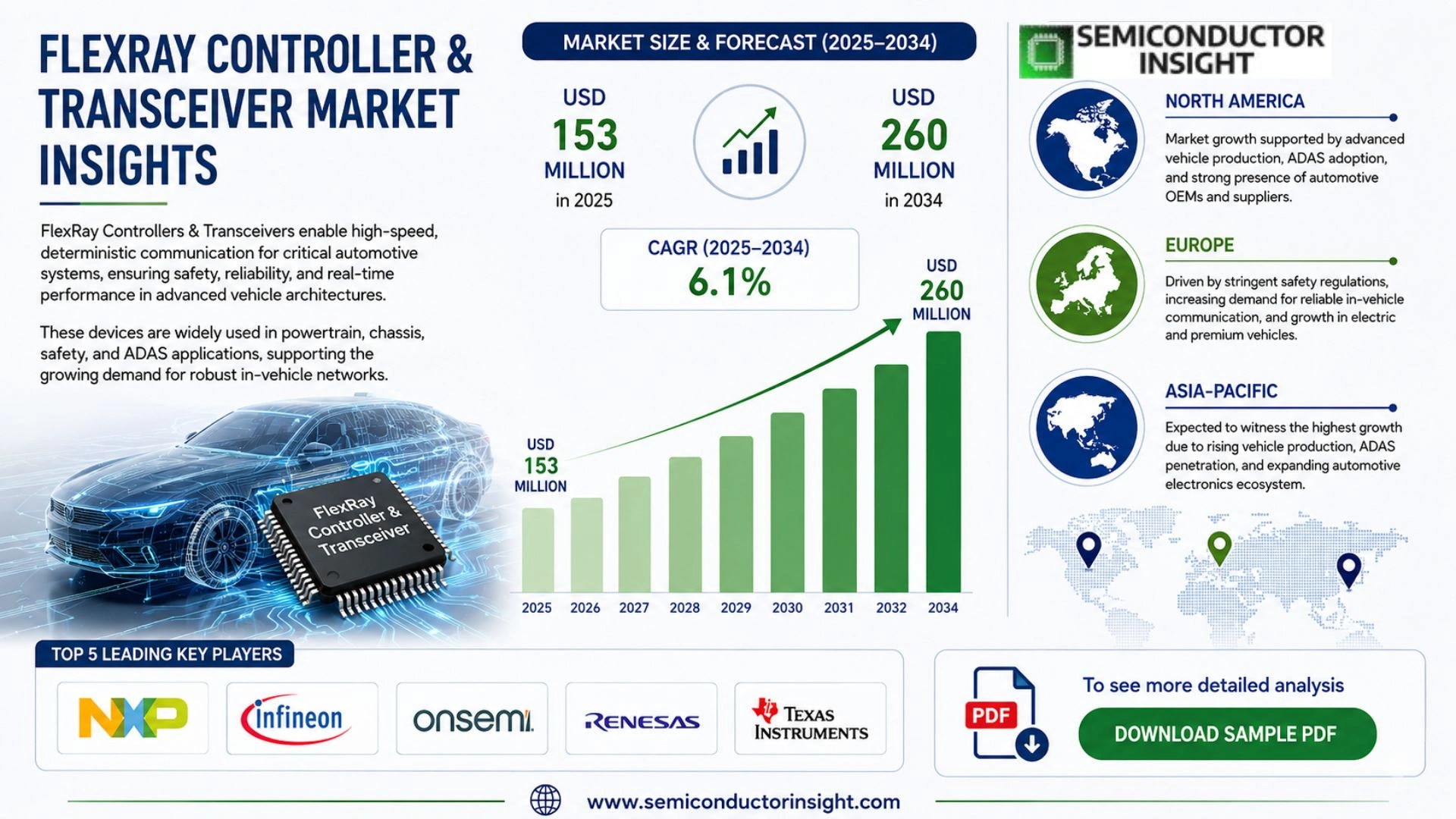
FlexRay Controller & Transceiver Market size was valued at USD 153 million in 2025. The market is projected to grow from USD 153 million in 2025 to USD 260 million by 2034, exhibiting a CAGR of 6.1% during the forecast period.
FlexRay controllers and transceivers are specialized components designed for high-speed, deterministic communication in automotive networks. These devices enable reliable data exchange between electronic control units (ECUs) in vehicles, supporting advanced applications that require precise timing and fault tolerance. FlexRay technology operates at data rates up to 10 Mbit/s per channel and features redundant channels for enhanced reliability, making it suitable for safety-critical systems such as chassis control, advanced driver-assistance systems (ADAS), and powertrain management.
The market is experiencing steady growth due to several factors, including the rising complexity of vehicle electronics, increasing demand for high-bandwidth communication protocols, and the ongoing evolution of automotive safety and comfort features. Furthermore, the integration of FlexRay in premium vehicles and specific industrial applications continues to drive adoption. However, the shift toward Ethernet-based solutions in newer architectures presents both opportunities and challenges for traditional FlexRay implementations. Initiatives by key players in the market are also expected to fuel growth. For instance, companies continue to enhance transceiver designs for better EMC performance and lower power consumption. NXP Semiconductors, Infineon Technologies, and Texas Instruments are some of the key players that operate in the market with a wide range of portfolios.
MARKET DRIVERS
Rising Demand for High-Speed Deterministic Communication
FlexRay Controller & Transceiver Market is primarily driven by the increasing need for reliable, high-speed communication protocols in modern vehicles. FlexRay offers deterministic data transmission at up to 10 Mbps with fault-tolerant capabilities, making it ideal for safety-critical applications such as advanced driver-assistance systems (ADAS), chassis control, and powertrain management.
Growth in ADAS and Vehicle Electrification
Expansion of electric vehicles and integration of sophisticated electronic control units (ECUs) have accelerated adoption. FlexRay transceivers support the robust networking required for real-time control in hybrid and electric platforms, where precise timing is essential for performance and safety.
➤ The protocol’s dual-channel redundancy and time-triggered architecture provide superior reliability compared to CAN or LIN in high-performance automotive environments.
Leading semiconductor manufacturers continue to innovate in integrated controller-transceiver solutions to meet OEM requirements for next-generation vehicle architectures.
MARKET CHALLENGES
Competition from Emerging Protocols
FlexRay Controller & Transceiver Market faces significant competition from automotive Ethernet, which offers higher bandwidth and is increasingly favored for domain controller architectures and software-defined vehicles. This shift challenges FlexRay’s position in new platform designs.
Other Challenges
Integration Complexity
Incorporating FlexRay into mixed-protocol vehicle networks requires specialized expertise and adds design complexity, particularly when interfacing with legacy CAN/LIN systems.
High Development Costs
The specialized nature of FlexRay components results in elevated costs for controllers and transceivers compared to more commoditized alternatives, limiting adoption in cost-sensitive vehicle segments.
MARKET RESTRAINTS
High Implementation Costs and Niche Application Scope
FlexRay solutions command premium pricing due to their advanced features, which restrains widespread adoption beyond premium and safety-focused vehicle segments. The overall FlexRay Controller & Transceiver Market growth is moderated by these cost factors relative to alternative protocols. The technology’s complexity in implementation and limited ecosystem compared to Ethernet further constrains expansion in mass-market vehicles.
MARKET OPPORTUNITIES
Expansion in Autonomous and Connected Vehicle Applications
Ongoing development of autonomous driving technologies presents substantial opportunities for FlexRay Controller & Transceiver Market. The protocol’s deterministic performance remains valuable for safety-critical redundant systems even as Ethernet gains ground in data-intensive domains.
Opportunities also exist in aftermarket upgrades and specific industrial applications requiring high-reliability communication, alongside continued use in legacy platforms transitioning through hybrid networking strategies.
Trends
Increasing Demand for Deterministic Communication in Automotive Networks
FlexRay Controller & Transceiver Market continues to evolve as automakers prioritize high-speed and reliable data exchange between electronic control units. FlexRay technology stands out for its ability to deliver deterministic communication essential for real-time applications. These components support data rates up to 10 Mbit/s per channel while incorporating redundant channels that enhance system reliability and fault tolerance. Such features make FlexRay controllers and transceivers particularly valuable in complex vehicle architectures where timing precision cannot be compromised.
Other Trends
Growing Integration in Safety-Critical Applications
Adoption of FlexRay controllers and transceivers is expanding in key safety-critical systems including chassis control, advanced driver-assistance systems, and powertrain management. The rising complexity of vehicle electronics drives this trend as manufacturers seek communication protocols capable of handling increasing bandwidth requirements. FlexRay solutions enable precise coordination between multiple ECUs, supporting the development of more sophisticated safety and comfort features in modern vehicles. Premium vehicle segments continue to lead integration efforts while certain industrial applications also leverage these robust networking capabilities.
Challenges from Emerging Network Technologies
The automotive industry’s gradual shift toward Ethernet-based solutions introduces both opportunities and challenges for FlexRay Controller & Transceiver Market. While newer architectures explore alternative protocols, FlexRay maintains strong relevance in applications requiring strict determinism and redundancy. Market participants are responding by optimizing existing designs to ensure compatibility within hybrid networking environments that combine multiple communication standards.
Focus on Performance Enhancements by Leading Manufacturers
Key industry players are actively advancing transceiver technologies to improve electromagnetic compatibility and reduce power consumption. These developments help address evolving requirements for efficiency and reliability in next-generation vehicles. Companies with established portfolios continue to refine FlexRay controller and transceiver offerings, ensuring they meet the stringent demands of automotive environments. The combination of technical improvements and sustained demand for proven deterministic solutions supports ongoing relevance of FlexRay technology across targeted market segments.
COMPETITIVE LANDSCAPE
Key Industry Players
FlexRay Controller & Transceiver Market Competitive Landscape Analysis
FlexRay Controller & Transceiver Market features a concentrated competitive structure dominated by established semiconductor leaders with strong automotive expertise. NXP Semiconductors stands out as a leading player, leveraging its pioneering role in FlexRay development to offer highly robust transceivers and communication controllers optimized for safety-critical applications. The market is characterized by high barriers to entry due to stringent automotive qualification standards, the need for deterministic performance, and extensive validation requirements with OEMs.
Other significant players include Infineon Technologies and Texas Instruments, which maintain competitive positions through advanced product portfolios emphasizing EMC performance, low power consumption, and integration capabilities. Niche contributors such as STMicroelectronics, Renesas Electronics, and Melexis further enhance market dynamics by addressing specialized requirements in premium vehicle segments and industrial applications.
List of Key FlexRay Controller & Transceiver Companies Profiled
- NXP Semiconductors
- Infineon Technologies
- Texas Instruments
- STMicroelectronics
- Renesas Electronics Corporation
- Analog Devices, Inc.
- ON Semiconductor
- Melexis
- Microchip Technology
- Broadcom Inc.
- ROHM Semiconductor
- Silicon Laboratories
- Maxim Integrated
Segment Analysis:
| Segment Category | Sub-Segments | Key Insights |
| By Type |
|
Integrated Controller-Transceiver Modules represent the most advanced offering in the market, combining processing logic with physical layer interfaces in a single compact package. This design significantly reduces board space requirements and simplifies ECU architecture while maintaining deterministic communication performance. Key benefits include improved signal integrity through optimized internal connections and enhanced fault tolerance mechanisms that leverage redundant channel capabilities. Manufacturers favor these solutions for next-generation vehicle platforms where electronic content density continues to rise, allowing seamless support for safety-critical functions without compromising timing precision. |
| By Application |
|
Advanced Driver Assistance Systems (ADAS) emerge as the leading application segment due to the protocol’s exceptional reliability and precise synchronization features essential for real-time sensor fusion and actuator coordination. FlexRay enables high-bandwidth data exchange necessary for complex decision-making algorithms in safety systems. Its deterministic behavior ensures consistent performance under varying operational conditions, which is critical for maintaining system integrity during emergency maneuvers. Integration with other network protocols further enhances overall vehicle intelligence, supporting features like adaptive cruise control and lane-keeping assistance through robust communication backbone. |
| By End User |
|
Automotive OEMs constitute the primary end user group, leveraging FlexRay technology to enhance electronic architecture reliability in premium and high-performance vehicle lines. These manufacturers prioritize the protocol for applications demanding fault-tolerant communication, enabling sophisticated control strategies across multiple domains. The technology supports seamless scalability as vehicle systems grow more interconnected, facilitating future-proof designs that accommodate evolving safety and comfort requirements. OEMs benefit from reduced development complexity when implementing time-triggered networks that guarantee message delivery within strict temporal boundaries. |
| By Vehicle Type |
|
Luxury and Premium Vehicles lead adoption owing to their focus on cutting-edge electronic features requiring high-speed, deterministic networking. FlexRay controllers and transceivers deliver the necessary performance for integrated chassis management and advanced safety suites that distinguish flagship models. These vehicles incorporate multiple redundant systems where timing precision directly impacts brand reputation for innovation and safety. The technology enables sophisticated driver experience enhancements while maintaining operational stability across diverse driving scenarios, making it ideal for platforms with extensive sensor arrays and complex control hierarchies. |
| By Integration Level |
|
System-on-Chip Solutions are gaining prominence as they consolidate multiple functions into unified silicon platforms, optimizing power efficiency and thermal performance in space-constrained automotive environments. This approach minimizes interconnection points that could introduce latency or failure risks, while supporting enhanced diagnostic capabilities for network health monitoring. Developers appreciate the streamlined validation processes and improved electromagnetic compatibility characteristics inherent in highly integrated designs. Such solutions facilitate easier migration toward zonal architectures where communication nodes must handle diverse data streams with unwavering reliability and synchronization. |
Regional Analysis: FlexRay Controller & Transceiver Market
Europe
Europe benefits from concentrated expertise in high-performance vehicle systems where FlexRay Controller & Transceiver solutions deliver the deterministic communication essential for safety and performance. Collaborative projects between automakers and technology providers drive ongoing enhancements in bandwidth utilization and latency reduction.
Strict functional safety and cybersecurity frameworks in Europe create strong demand for robust FlexRay transceivers capable of meeting ISO 26262 requirements. This environment encourages manufacturers to develop highly reliable components optimized for harsh automotive conditions.
The region’s well-established automotive supply networks enable efficient scaling of FlexRay Controller & Transceiver production. Close proximity between design centers, foundries, and assembly facilities accelerates development cycles and quality assurance processes.
Significant investment in research supports evolution of FlexRay technology alongside hybrid networking approaches, ensuring European manufacturers maintain competitive edges in premium vehicle segments through superior communication reliability.
North America
North America exhibits steady momentum FlexRay Controller & Transceiver Market, particularly through its focus on integrating advanced electronics in light trucks, SUVs, and commercial vehicles. Major automakers in the United States emphasize durability and performance enhancements where FlexRay technology supports critical control systems. The region benefits from strong technology partnerships between semiconductor firms and vehicle producers, driving customization of controllers for specific powertrain and safety applications. Innovation hubs in key states continue exploring hybrid networking solutions that incorporate FlexRay for high-reliability functions while transitioning toward newer protocols.
Asia-Pacific
Asia-Pacific demonstrates dynamic growth potential FlexRay Controller & Transceiver Market fueled by expanding automotive manufacturing capabilities across Japan, South Korea, and China. The region excels in high-volume production of electronic control units, with FlexRay solutions finding applications in advanced safety and comfort features. Japanese manufacturers leverage precision engineering to optimize transceiver performance, while Chinese suppliers rapidly develop cost-effective alternatives. Increasing focus on premium and electric vehicles creates new opportunities for sophisticated communication networks where FlexRay delivers dependable real-time data transfer essential for vehicle stability and driver assistance systems.
South America
South America represents an emerging landscape for FlexRay Controller & Transceiver Market, with Brazil and Argentina showing gradual adoption tied to growing local automotive assembly operations. The region focuses on adapting established vehicle platforms to incorporate reliable networking technologies suitable for challenging operating environments. Local manufacturers explore FlexRay implementations for commercial and agricultural vehicles where robust communication enhances operational efficiency. Economic development and infrastructure improvements support rising demand for vehicles equipped with advanced electronic systems, positioning the region for future expansion in specialized FlexRay applications.
Middle East & Africa
The Middle East & Africa region shows selective uptake FlexRay Controller & Transceiver Market, primarily linked to luxury vehicle imports and growing local assembly initiatives. Countries with expanding automotive sectors prioritize technologies that ensure reliability under extreme climatic conditions. FlexRay solutions appeal to applications requiring fault-tolerant communication in high-end vehicles and specialized transport. Infrastructure development projects and rising consumer interest in premium features create pathways for increased integration of advanced controllers and transceivers, though the market remains in developmental stages compared to more established regions.
Report Scope
This market research report provides a comprehensive analysis of the FlexRay Controller & Transceiver Market , covering the forecast period 2026–2034. It offers detailed insights into market dynamics, technological advancements, competitive landscape, and key trends shaping the industry.
Key focus areas of the report include:
- Market Overview: The report begins with an overview outlining its current market scenario, key growth indicators, and industry transformation drivers. It discusses macroeconomic factors, demand–supply balance, regulatory landscape, and the strategic role of semiconductors in powering advancements across industries such as automotive, telecommunications, consumer electronics, and industrial automation.
- Market Size & Forecast: Historical data and future projections for revenue, unit shipments, and market value across major regions and segments.
- Segmentation Analysis: Detailed breakdown by product type, technology, application, and end-user industry to identify high-growth segments and investment opportunities.
- Regional Insights: Insights into market performance across North America, Europe, Asia-Pacific, Latin America, and the Middle East & Africa, including country-level analysis where relevant.
- Competitive Landscape: Profiles of leading market participants, including their product offerings, R&D focus, manufacturing capacity, pricing strategies, and recent developments such as mergers, acquisitions, and partnerships.
- Technology Trends & Innovation: Assessment of emerging technologies, integration of AI/IoT, semiconductor design trends, fabrication techniques, and evolving industry standards.
- Market Drivers & Restraints: Evaluation of factors driving market growth along with challenges, supply chain constraints, regulatory issues, and market-entry barriers.
- Stakeholder Insights: Insights for component suppliers, OEMs, system integrators, investors, and policymakers regarding the evolving ecosystem and strategic opportunities.
Primary and secondary research methods are employed, including interviews with industry experts, data from verified sources, and real-time market intelligence to ensure the accuracy and reliability of the insights presented.
FREQUENTLY ASKED QUESTIONS:
What is the current market size of FlexRay Controller & Transceiver Market?
-> FlexRay Controller & Transceiver Market was valued at USD 153 million in 2025 and is expected to reach USD 260 million by 2034.
Which key companies operate FlexRay Controller & Transceiver Market?
-> Key players include NXP Semiconductors, Infineon Technologies, and Texas Instruments, among others.
What are the key growth drivers?
-> Key growth drivers include rising complexity of vehicle electronics, increasing demand for high-bandwidth communication protocols, and the ongoing evolution of automotive safety and comfort features.
Which region dominates the market?
-> Asia-Pacific is the fastest-growing region, while Europe remains a dominant market.
What are the emerging trends?
-> Emerging trends include enhanced transceiver designs for better EMC performance and lower power consumption, integration in premium vehicles, and adaptation alongside Ethernet-based solutions.

Get Sample Report PDF for Exclusive Insights
Report Sample Includes
- Table of Contents
- List of Tables & Figures
- Charts, Research Methodology, and more...
 Download Sample Report PDF