Flexible Printed Circuit Boards (FPCs) for Electric Vehicles Market Insights
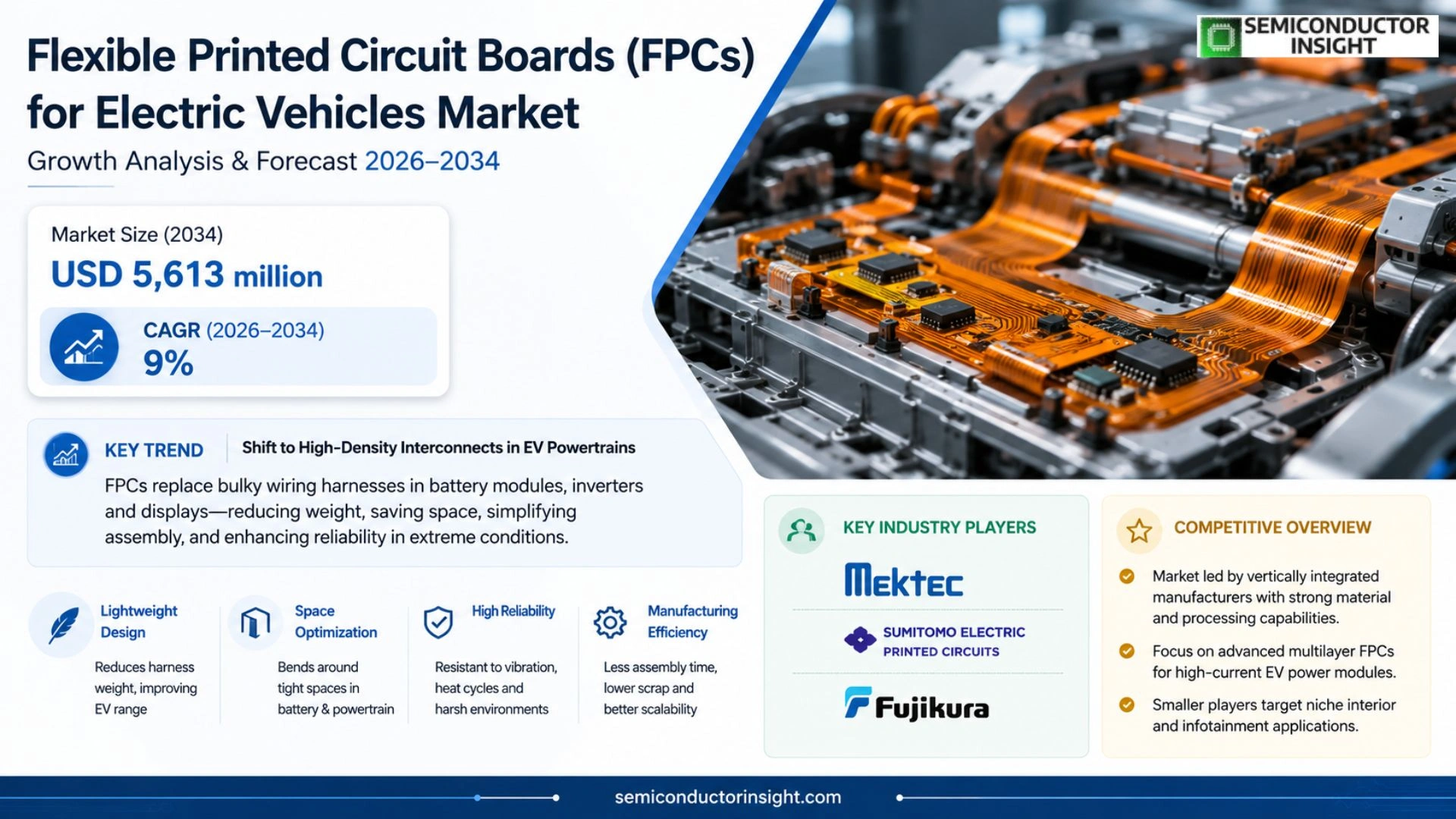
Global Flexible Printed Circuit Boards (FPCs) for Electric Vehicles market size was valued at USD 2,585 million in 2025 and is projected to reach USD 5,613 million by 2034, exhibiting a CAGR of approximately 9 % during the forecast period.
Flexible Printed Circuit Boards (FPCs) for Electric Vehicles are polyimide‑ or PET‑based flexible circuit boards employed in EV battery systems, power electronics and in‑vehicle electronics. They replace traditional wiring harnesses and some rigid PCBs in high‑density, space‑constrained, vibration‑intensive environments such as battery modules, BMS, inverters, charging systems, sensors, lighting and infotainment. Their lightweight construction, high reliability, design flexibility and simplified assembly meet automotive‑grade standards for high‑voltage isolation, heat resistance, vibration endurance, humidity tolerance and long service life.
The market accelerates because BEV penetration rises sharply while vehicle electronic content per unit climbs steadily. Weight‑reduction targets for wiring harnesses push OEMs toward FPC adoption across battery‑module measurement lines, power‑electronics control units, camera/radar modules, intelligent lighting and large‑format displays. Tier‑1 suppliers such as Bosch, Continental, ZF and Denso partner with OEMs like Volkswagen Group, Toyota, Tesla and BYD to integrate FPC solutions; meanwhile manufacturers including Mektec Corporation, Sumitomo Electric Printed Circuits and Fujikura expand capacity to satisfy growing demand.
MARKET DRIVERS
Electrification Momentum Accelerates FPC Adoption
The surge in electric‑vehicle registrations, which topped 12 million units worldwide in 2023, compels manufacturers to trim vehicle weight without sacrificing reliability. Flexible Printed Circuit Boards (FPCs) for Electric Vehicles Market address this need by replacing bulky harnesses with thin, bendable interconnects that shave off kilograms of mass, directly boosting driving range.
Miniaturization of Power‑train Electronics
High‑density power‑train modules now embed converters, sensors, and control units within confined spaces. FPC technology offers multilayer routing on a single substrate, enabling designers to stack functionality and reduce board count. This architectural efficiency translates into lower assembly time and fewer failure points.
➤ OEMs that integrate FPCs report up to a 15 % reduction in wiring‑bundle weight, directly improving vehicle efficiency.
Regulatory pressure for stricter emissions standards also nudges the industry toward lightweight, high‑efficiency solutions. FPCs, with their superior thermal management and ability to accommodate high‑current paths, become a practical response to both compliance and performance targets.
MARKET CHALLENGES
Supply‑Chain Fragility Limits Scale‑up
The raw‑material base for polyimide films, a core component of FPCs, remains concentrated in a handful of regions. Any disruption,such as geopolitical tensions or pandemic‑related factory shutdowns,ripple through the supply chain, inflating material costs and stretching lead times for EV makers.
Other Challenges
Design Complexity
Design engineers must reconcile high‑frequency signal integrity with the mechanical flex requirements of automotive applications. The need for specialized simulation tools and skilled personnel raises development overhead, especially for smaller OEMs seeking to adopt FPCs quickly.
MARKET RESTRAINTS
Cost Premium Compared With Rigid Substrates
Although FPCs deliver weight and space advantages, their unit cost remains higher than conventional rigid PCBs due to additional processing steps and tighter tolerances. For cost‑sensitive vehicle segments, this premium can deter widespread substitution, especially when margin pressures are acute.
MARKET OPPORTUNITIES
Emerging High‑Voltage Architectures
Next‑generation EV platforms are exploring 800‑V architectures to accelerate charging rates. Such high‑voltage designs demand interconnects that can handle increased electrical stress while maintaining flexibility. FPCs engineered with advanced dielectric materials are positioned to meet these specifications, opening a niche where premium pricing is justified by performance gains.
Flexible Printed Circuit Boards (FPCs) for Electric Vehicles Market Trends
Shift to High‑Density Interconnects in EV Powertrains
The migration from conventional wiring harnesses to flexible printed circuit boards is reshaping the architecture of electric‑vehicle powertrains. Because EVs now host a larger share of power‑electronics modules, battery‑management sensors and infotainment displays, designers face tighter packaging constraints and a premium on weight savings. Flexible boards, fabricated on polyimide or PET substrates, can be routed around curved surfaces inside battery modules, inverter casings and instrument panels, eliminating bulky cable bundles. The resulting reduction in harness mass directly improves vehicle range, while the simplified assembly line lowers labour hours and scrap rates. Moreover, the inherent vibration resistance of flexible circuits enhances long‑term reliability in the high‑frequency thermal cycles typical of automotive environments. As manufacturers pursue higher electric‑driven vehicle penetration, the need for such high‑density interconnect solutions becomes a decisive engineering consideration.
Other Trends
Material Innovations Enable Automotive‑Grade Reliability
Recent advances in raw‑material grading are elevating the automotive suitability of flexible boards. High‑temperature polyimide films supplied by firms such as DuPont and Kaneka now sustain continuous operation above 260 °C, meeting stringent HV isolation standards required in battery‑module applications. Simultaneously, the introduction of low‑outgassing coverlay adhesives further mitigates humidity‑induced delamination, a critical factor for long‑life vehicle warranties. These material upgrades allow designers to consolidate multiple functions,power distribution, data transmission and sensor interfacing,onto a single flexible substrate, cutting down the bill of materials and simplifying verification cycles. Consequently, suppliers that can guarantee consistent film tensile strength and copper adhesion are increasingly viewed as strategic partners rather than mere component vendors.
Supply‑Chain Consolidation Around Tier‑1 Suppliers
Parallel to the technical shift, the supply chain is consolidating around a core set of Tier‑1 automotive electronics groups and a handful of high‑volume FPC producers. Companies such as Bosch, Continental and ZF are now specifying board designs directly in their system architecture, which forces FPC manufacturers to align production schedules with vehicle model launches. In Asia, capacity expansions by firms like Suzhou Dongshan Precision and Flexium have lifted total square‑meter output beyond the 17,000 K Sqm mark, creating a surplus that pressures pricing but also enables rapid prototyping for new vehicle generations. This concentration generates two practical outcomes: first, smaller niche players face heightened entry barriers unless they differentiate through specialty substrates or ultra‑thin formats; second, long‑term contracts between OEMs and the dominant FPC makers provide a predictable revenue stream that supports continued R&D investment in high‑frequency and high‑current designs. Market participants that secure early collaborations with Tier‑1 customers are therefore positioned to capture a larger share of upcoming vehicle platforms.
COMPETITIVE LANDSCAPE
Key Industry Players
Flexible Printed Circuit Boards (FPCs) for Electric Vehicles – Competitive Overview
The FPC segment for electric vehicles is dominated by a handful of vertically integrated manufacturers that control both polymer film supply and high‑precision copper‑foil processing. Mektec Corporation, a legacy player in polyimide substrates, leverages its deep relationship with automotive Tier‑1s to secure long‑term volume contracts for battery‑module interconnects. Sumitomo Electric Printed Circuits and Fujikura complement this dominance with advanced multilayer capabilities, enabling high‑current pathways that meet the stringent thermal and vibration standards of power‑train modules. Their scale translates into competitive pricing, which forces smaller suppliers to focus on niche applications such as interior lighting or infotainment flexes, where design flexibility outweighs cost considerations. This bifurcated structure creates a clear hierarchy: a core of full‑service giants, a secondary tier of specialized producers, and a fringe of regional firms that survive on localized OEM partnerships.
Beyond the core, a diverse set of companies has emerged to address specific material or geometry challenges. Suzhou Dongshan Precision, AT&S, and Avary have invested heavily in high‑temperature PI and high‑frequency stack‑up technologies, positioning themselves for the next wave of ADAS radar and camera flexes. Kinwong Electronic and Shennan Circuits focus on thin‑profile coverlay solutions that enable curved cockpit displays, while ZDT and Flexium specialize in high‑speed signal routing for vehicle‑to‑infrastructure communication. Victory Giant Technology, SI FLEX, Bhflex, Interflex, ICHIA, Career Technology, and AKM round out the ecosystem, each carving out market share through proprietary adhesive chemistries or low‑volume custom production that larger players cannot justify.
List of Key Flexible Printed Circuit Boards (FPCs) for Electric Vehicles Companies Profiled
- Mektec Corporation, Sumitomo Electric Printed Circuits, Fujikura, Suzhou Dongshan Precision, AT&S, Avary
- Kinwong Electronic, Shennan Circuits, Flexium, Victory Giant Technology
- SI FLEX, Bhflex, Interflex, ICHIA, Career Technology, AKM, ZDT, SI FLEX, Bhflex, Interflex
Segment Analysis:
| Segment Category | Sub-Segments | Key Insights |
| By Type |
|
Multi-layer Circuit
|
| By Application |
|
Intelligent Cockpit
|
| By End User |
|
Tier‑1 automotive electronics manufacturers
|
| By Material System |
|
Polyimide‑based FPC
|
| By Electrical Performance |
|
High‑current FPC
|
Regional Analysis: Flexible Printed Circuit Boards (FPCs) for Electric Vehicles Market
Europe
EU emission standards and the forthcoming Euro 7 package force automakers to pursue lighter wiring solutions. FPCs, with their reduced mass and streamlined routing, become the logical response to meet mandated efficiency thresholds without compromising system reliability.
Proximity of circuit‑board fabricators to major chassis plants enables just‑in‑time deliveries. Collaborative platforms between German OEMs and Dutch FPC producers accelerate iterations, allowing rapid alignment with evolving vehicle architectures.
European engineering teams are pioneering multilayer, high‑frequency FPCs for sensor fusion and autonomous‑driving modules. The emphasis on compact, bendable interconnects supports the trend toward fully integrated cockpit designs.
A blend of legacy manufacturers and emerging start‑ups fosters fierce competition on price, material quality and turnaround time, compelling the region to stay ahead of global rivals in both technology and cost efficiency.
North America
The United States leverages its deep automotive engineering talent pool to integrate FPCs into high‑performance electric drivetrains. Federal tax incentives for EV purchases amplify demand, prompting Tier‑1 suppliers to invest in flexible‑circuit capabilities that support fast‑charging infrastructure. Meanwhile, Canadian firms contribute advanced material research, especially in thermally resilient polymers, enhancing durability under extreme climate conditions. The interplay of policy support, R&D investment and a sprawling supplier base creates a fertile environment for innovative FPC applications across luxury and mass‑market EVs.
Asia‑Pacific
In Asia‑Pacific, China’s rapid EV rollout and Japan’s precision electronics culture produce a unique demand dynamic for flexible circuits. Chinese automakers prioritize cost‑effective FPCs to achieve aggressive pricing targets, while Japanese manufacturers focus on high‑frequency, miniaturized variants for autonomous systems. The region’s expansive manufacturing footprint and abundant raw‑material sources lower entry barriers, yet quality variability remains a differentiation point for firms that can assure automotive‑grade reliability.
South America
South America’s market is still nascent, but Brazil’s emerging EV incentives and local content regulations are nudging OEMs toward flexible interconnect solutions. Infrastructure constraints push designers to favor compact FPCs that simplify wiring harnesses and reduce vehicle weight, which is critical for extending range on limited charging networks. Regional partnerships between automotive assemblers and niche PCB firms are beginning to bridge the technology gap, signaling a gradual but steady uptake.
Middle East & Africa
The Middle East & Africa region exhibits a mixed outlook. While the Gulf’s wealth enables premium EV projects that demand high‑end FPCs for luxury interiors, broader African markets confront limited charging infrastructure and price sensitivity. Consequently, suppliers focus on ruggedized flexible circuits that can tolerate high ambient temperatures and dust exposure. Collaborative ventures with local distributors aim to establish a foothold, positioning the region for incremental growth as EV adoption accelerates.
Report Scope
This market research report provides a comprehensive analysis of the Flexible Printed Circuit Boards (FPCs) for Electric Vehicles Market , covering the forecast period 2026–2034. It offers detailed insights into market dynamics, technological advancements, competitive landscape, and key trends shaping the industry.
Key focus areas of the report include:
- Market Overview: The report begins with an overview outlining its current market scenario, key growth indicators, and industry transformation drivers. It discusses macroeconomic factors, demand–supply balance, regulatory landscape, and the strategic role of semiconductors in powering advancements across industries such as automotive, telecommunications, consumer electronics, and industrial automation.
- Market Size & Forecast: Historical data and future projections for revenue, unit shipments, and market value across major regions and segments.
- Segmentation Analysis: Detailed breakdown by product type, technology, application, and end-user industry to identify high-growth segments and investment opportunities.
- Regional Insights: Insights into market performance across North America, Europe, Asia-Pacific, Latin America, and the Middle East & Africa, including country-level analysis where relevant.
- Competitive Landscape: Profiles of leading market participants, including their product offerings, R&D focus, manufacturing capacity, pricing strategies, and recent developments such as mergers, acquisitions, and partnerships.
- Technology Trends & Innovation: Assessment of emerging technologies, integration of AI/IoT, semiconductor design trends, fabrication techniques, and evolving industry standards.
- Market Drivers & Restraints: Evaluation of factors driving market growth along with challenges, supply chain constraints, regulatory issues, and market-entry barriers.
- Stakeholder Insights: Insights for component suppliers, OEMs, system integrators, investors, and policymakers regarding the evolving ecosystem and strategic opportunities.
Primary and secondary research methods are employed, including interviews with industry experts, data from verified sources, and real-time market intelligence to ensure the accuracy and reliability of the insights presented.
FREQUENTLY ASKED QUESTIONS:
What is the current market size of Flexible Printed Circuit Boards (FPCs) for Electric Vehicles Market?
-> Flexible Printed Circuit Boards (FPCs) for Electric Vehicles Market was valued at USD 2585 million in 2025 and is expected to reach USD 4707 million by 2032.
Which key companies operate in Flexible Printed Circuit Boards (FPCs) for Electric Vehicles Market?
-> Key players include Mektec Corporation, Sumitomo Electric Printed Circuits, Fujikura, Suzhou Dongshan Precision, AT&S, Avary, Kinwong Electronic, Shennan Circuits, ZDT, Flexium, Victory Giant Technology, SI FLEX, Bhflex, Interflex, ICHIA, Career Technology, AKM.
What are the key growth drivers?
-> Key growth drivers include rising BEV penetration, increasing electronic content per vehicle, wiring‑harness weight reduction, higher BMS sensing points, expanding ADAS sensor density, and demand for lightweight, reliable, high‑flexibility interconnects.
Which region dominates the market?
-> Asia leads the market, driven by strong EV adoption in China, Japan, and South Korea, while Europe and North America follow.
What are the emerging trends?
-> Emerging trends include the shift from consumer‑electronics derivatives to strategic interconnect platforms, increasing use in battery‑module/BMS measurement lines, power‑electronics control units, automotive camera and radar modules, intelligent lighting, infotainment, and large‑format displays.

Get Sample Report PDF for Exclusive Insights
Report Sample Includes
- Table of Contents
- List of Tables & Figures
- Charts, Research Methodology, and more...
 Download Sample Report PDF