Fingerprint Sensor (Optical, Ultrasonic, Capacitive) Market Insights
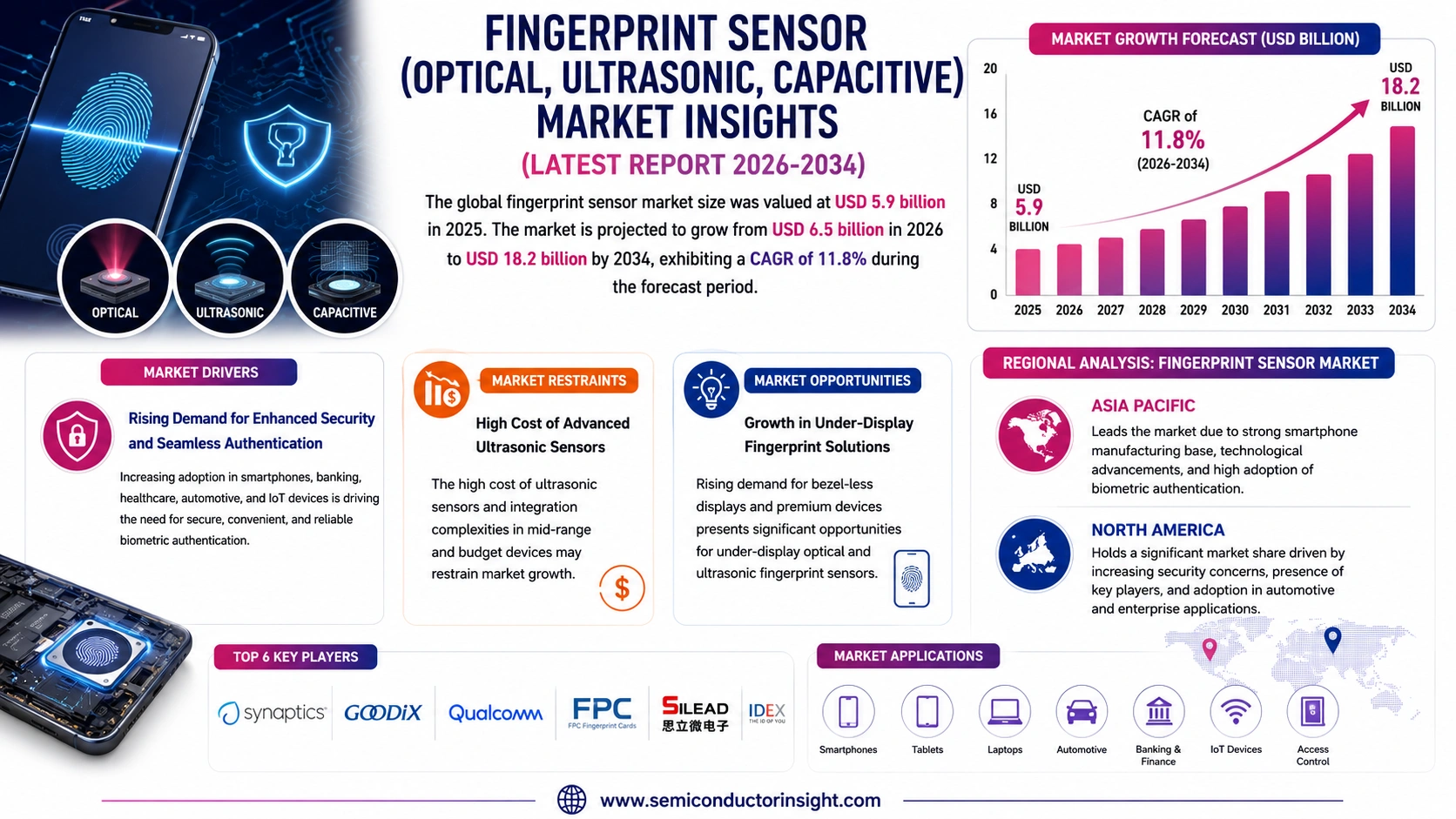
Global Fingerprint Sensor (Optical, Ultrasonic, Capacitive) Market size was valued at USD 5.9 billion in 2025. The market is projected to grow from USD 6.5 billion in 2026 to USD 18.2 billion by 2034, exhibiting a CAGR of 11.8% during the forecast period.
Fingerprint sensors are biometric devices that capture the unique patterns of ridges and valleys on a human finger to enable secure identification and authentication. These sensors come in three primary types: optical sensors that use light to capture fingerprint images, capacitive sensors that detect electrical variations caused by the finger’s ridges and valleys, and ultrasonic sensors that employ high-frequency sound waves to create detailed 3D maps of the fingerprint.
The market is experiencing robust growth due to several factors, including the rising integration of biometric authentication in consumer electronics such as smartphones and laptops, increasing emphasis on security in mobile payments and access control systems, and growing adoption across government, healthcare, and automotive sectors. Advancements in under-display sensor technologies have further accelerated demand, particularly for sleek device designs without compromising accuracy or security. Initiatives by key players continue to drive innovation and market expansion. For instance, in 2025, companies like Goodix and Qualcomm advanced ultrasonic sensor capabilities for improved performance under challenging conditions such as moisture or contaminants. Shenzhen Goodix Technology Co. Ltd., Fingerprint Cards AB, Synaptics Incorporated, Qualcomm Technologies Inc., and Egis Technology Inc. are some of the key players that operate in the market with a wide range of portfolios.
MARKET DRIVERS
Rising Demand for Biometric Authentication in Consumer Electronics
Fingerprint Sensor (Optical, Ultrasonic, Capacitive) Market is experiencing robust growth driven by the widespread integration of biometric authentication in smartphones, tablets, and laptops. Capacitive sensors continue to hold significant market share due to their reliability, low power consumption, and cost-effectiveness in mass-market devices. Optical sensors benefit from advancements in under-display technology, offering seamless integration in modern bezel-less designs.
Advancements in Sensor Technologies and IoT Integration
Technological improvements have enhanced the performance of ultrasonic sensors, which provide superior accuracy through glass or metal surfaces and better spoof resistance. These advancements support broader adoption across IoT devices, smart home security systems, and wearables. The increasing need for secure, contactless authentication in various applications further accelerates demand for these fingerprint sensor technologies.
➤ Growing security concerns and the shift from traditional passwords to biometrics are key factors propelling Fingerprint Sensor (Optical, Ultrasonic, Capacitive) Market forward.
Expansion into automotive applications for vehicle access, driver personalization, and in-car payments, along with government initiatives for secure identification, provides additional momentum to market growth.
MARKET CHALLENGES
Performance Limitations in Real-World Conditions
Environmental factors such as wet, dirty, or damaged fingers can impact the accuracy and reliability of fingerprint sensors, particularly capacitive types. Optical sensors may struggle in varying lighting conditions, while integration challenges persist in ensuring consistent performance across diverse user scenarios and device types.
Other Challenges
Competition from Alternative Biometrics
Facial recognition and other biometric methods offer contactless convenience, posing competition to fingerprint sensors in certain consumer and security applications.
Spoofing and Security Vulnerabilities
Despite improvements, the risk of spoofing attacks using artificial fingerprints remains a notable challenge, requiring ongoing advancements in liveness detection technologies for Optical, Ultrasonic, and Capacitive sensors.
MARKET RESTRAINTS
High Implementation Costs and Privacy Concerns
Deployment of advanced fingerprint sensor technologies, especially ultrasonic variants, involves higher production and integration costs, limiting adoption in budget devices and emerging markets. Privacy issues related to the storage and potential breaches of biometric data continue to create hesitation among consumers and regulators.
The need for robust data protection measures and compliance with stringent regulations adds complexity and cost, restraining faster market penetration for Fingerprint Sensor (Optical, Ultrasonic, Capacitive) solutions across various sectors.
MARKET OPPORTUNITIES
Expansion in IoT, Automotive, and Emerging Applications
The proliferation of IoT devices and smart ecosystems creates substantial opportunities for compact, low-power fingerprint sensors. Ultrasonic and optical technologies are particularly well-positioned for integration in secure access systems, wearables, and connected home devices, driving innovation Fingerprint Sensor (Optical, Ultrasonic, Capacitive) Market.
Growth in automotive biometrics for enhanced vehicle security and personalized user experiences, along with increasing adoption in banking, healthcare, and government sectors for secure transactions and identification, presents significant expansion potential.
Trends
Rising Integration of Biometric Authentication in Consumer Electronics
Fingerprint Sensor (Optical, Ultrasonic, Capacitive) Market continues to expand as manufacturers prioritize seamless and secure user authentication in smartphones, laptops, and tablets. Optical sensors remain popular for their cost-effectiveness and reliable image capture using light reflection, while capacitive sensors excel in detecting electrical changes from fingerprint ridges for fast response times. Ultrasonic sensors are gaining traction by generating detailed 3D maps through sound waves, offering superior performance in varied conditions.
Other Trends
Growing Adoption Across Multiple Industry Verticals
Security demands are driving broader implementation of fingerprint sensor technologies in government identification systems, healthcare access controls, and automotive applications. These sensors enable precise verification while supporting modern design requirements, particularly with under-display integration that maintains device aesthetics without sacrificing accuracy or security levels.
Technological Advancements in Sensor Performance
Innovation remains a core driver Fingerprint Sensor (Optical, Ultrasonic, Capacitive) Market, with leading companies enhancing capabilities for challenging environments. Ultrasonic sensor improvements now better handle moisture, contaminants, and varying pressure levels, expanding usability in real-world scenarios. Optical and capacitive variants continue to evolve with higher resolution and faster processing to meet expectations for quick, reliable authentication in mobile payments and sensitive data access. Key players including Shenzhen Goodix Technology Co. Ltd., Fingerprint Cards AB, Synaptics Incorporated, Qualcomm Technologies Inc., and Egis Technology Inc. are actively developing diverse portfolios that address specific performance needs across device categories. This competitive focus on refinement ensures Fingerprint Sensor (Optical, Ultrasonic, Capacitive) Market sustains momentum through continuous technological progress and application expansion.
COMPETITIVE LANDSCAPE
Key Industry Players
Dynamic Competition Fingerprint Sensor (Optical, Ultrasonic, Capacitive) Market
The fingerprint sensor market is led by a mix of established semiconductor giants and specialized biometric firms, with Shenzhen Goodix Technology Co., Ltd., Synaptics Incorporated, and Fingerprint Cards AB (Fingerprints) commanding significant shares through their diverse portfolios spanning capacitive, optical, and ultrasonic technologies. The competitive structure features high concentration among top players who supply major smartphone OEMs, while innovation in under-display and in-display solutions drives differentiation, particularly in accuracy, power efficiency, and integration with sleek device designs.
Other notable players include Qualcomm Technologies Inc. for ultrasonic advancements, Egis Technology Inc. for robust solutions, and emerging specialists focusing on niche applications in automotive, healthcare, and access control. Companies are actively pursuing strategic partnerships, R&D investments, and technology acquisitions to expand their technological edge and global footprint amid rising demand for secure biometric authentication.
List of Key Fingerprint Sensor Companies Profiled
- Shenzhen Goodix Technology Co., Ltd.
- Synaptics Incorporated
- Fingerprint Cards AB (Fingerprints)
- Qualcomm Technologies, Inc.
- Egis Technology Inc.
- IDEX Biometrics ASA
- NEXT Biometrics Group ASA
- Novatek Microelectronics Corp.
- CrucialTec Co., Ltd.
- Q Technology (Group) Company Limited
- ELAN Microelectronics Corp.
- IDEMIA
- Thales Group
- Suprema Inc.
- Sonavation Inc.
Segment Analysis:
| Segment Category | Sub-Segments | Key Insights |
| By Type |
|
Capacitive Sensors dominate due to their mature technology and seamless integration into slim consumer devices. They offer reliable performance in everyday conditions with fast response times.
Key qualitative insights:
|
| By Application |
|
Smartphones and Tablets represent the primary application area as biometric security becomes standard in personal communication devices.
Key qualitative insights:
|
| By End User |
|
Consumer Electronics lead adoption as users prioritize convenient and secure personal device access.
Key qualitative insights:
|
| By Form Factor |
|
In-Display Sensors gain prominence for delivering premium user experiences in flagship devices.
Key qualitative insights:
|
| By Integration Level |
|
Embedded Solutions excel by offering manufacturers streamlined production and optimized performance.
Key qualitative insights:
|
Regional Analysis: Fingerprint Sensor (Optical, Ultrasonic, Capacitive) Market
Asia-Pacific
Asia-Pacific benefits from vertically integrated production facilities that optimize costs and quality for all three sensor types. Capacitive sensors dominate mid-range devices due to their balance of performance and affordability, while ultrasonic variants gain traction in flagship models requiring advanced security features. This manufacturing strength allows regional players to respond swiftly to global demand shifts.
Technology clusters in Seoul, Shenzhen, and Tokyo drive research into next-generation fingerprint sensing that combines optical clarity with ultrasonic depth perception. Partnerships between universities and corporations accelerate breakthroughs in under-display integration, enhancing user experience while maintaining high security standards across consumer electronics.
High smartphone penetration and growing awareness of biometric convenience propel widespread use of fingerprint sensors throughout the region. Urban consumers particularly value the speed and reliability of capacitive and ultrasonic solutions for daily digital transactions and device unlocking in fast-paced environments.
Supportive regulatory frameworks for digital identity and data protection encourage broader implementation of fingerprint technologies. Initiatives promoting secure mobile payments and e-governance create sustained opportunities for optical, ultrasonic, and capacitive sensors in both consumer and institutional applications.
North America
North America maintains a strong position Fingerprint Sensor (Optical, Ultrasonic, Capacitive) Market through focus on premium innovation and enterprise security solutions. The United States leads in developing high-end ultrasonic sensors prized for their accuracy in challenging conditions. Tech companies prioritize seamless integration with advanced operating systems and emphasize privacy features that align with stringent data protection expectations. Demand extends beyond consumer devices into automotive and healthcare sectors where reliable biometric authentication enhances user safety and operational efficiency. The region’s robust R&D ecosystem supports continuous improvement in sensor durability and multi-modal biometric approaches.
Europe
Europe emphasizes security standards and sustainable technology Fingerprint Sensor (Optical, Ultrasonic, Capacitive) Market. Countries such as Germany, the UK, and France drive adoption through strict regulatory compliance and focus on data sovereignty. Capacitive sensors remain popular for their proven reliability in everyday consumer electronics, while optical variants see increased interest in specialized industrial applications. The automotive sector shows particular promise as vehicle manufacturers integrate advanced biometric systems for personalized user experiences and enhanced security features. Collaborative research initiatives across the continent accelerate development of privacy-centric sensor solutions.
South America
South America represents an emerging landscape for Fingerprint Sensor (Optical, Ultrasonic, Capacitive) Market with growing digital inclusion efforts. Brazil and Argentina witness expanding smartphone markets where cost-effective capacitive sensors facilitate broader access to secure authentication. Government programs promoting financial technology and digital identities create new opportunities for fingerprint-based solutions. Local distributors partner with global manufacturers to adapt sensor technologies to regional environmental conditions and user preferences. While infrastructure challenges persist, steady urbanization supports increased demand for convenient biometric features across mobile devices and payment systems.
Middle East & Africa
The Middle East and Africa exhibit dynamic potential Fingerprint Sensor (Optical, Ultrasonic, Capacitive) Market fueled by smart city initiatives and expanding mobile connectivity. Gulf countries invest heavily in advanced security infrastructure where ultrasonic and optical sensors provide robust identification capabilities. In Africa, rising mobile money adoption encourages integration of reliable fingerprint technologies for secure transactions. The region’s diverse climatic conditions challenge sensor performance, prompting manufacturers to develop resilient solutions. Strategic partnerships between governments and technology providers accelerate deployment of biometric systems in both consumer markets and public sector applications.
Report Scope
This market research report provides a comprehensive analysis of the Fingerprint Sensor (Optical, Ultrasonic, Capacitive) Market , covering the forecast period 2026–2034. It offers detailed insights into market dynamics, technological advancements, competitive landscape, and key trends shaping the industry.
Key focus areas of the report include:
- Market Overview: The report begins with an overview outlining its current market scenario, key growth indicators, and industry transformation drivers. It discusses macroeconomic factors, demand–supply balance, regulatory landscape, and the strategic role of semiconductors in powering advancements across industries such as automotive, telecommunications, consumer electronics, and industrial automation.
- Market Size & Forecast: Historical data and future projections for revenue, unit shipments, and market value across major regions and segments.
- Segmentation Analysis: Detailed breakdown by product type, technology, application, and end-user industry to identify high-growth segments and investment opportunities.
- Regional Insights: Insights into market performance across North America, Europe, Asia-Pacific, Latin America, and the Middle East & Africa, including country-level analysis where relevant.
- Competitive Landscape: Profiles of leading market participants, including their product offerings, R&D focus, manufacturing capacity, pricing strategies, and recent developments such as mergers, acquisitions, and partnerships.
- Technology Trends & Innovation: Assessment of emerging technologies, integration of AI/IoT, semiconductor design trends, fabrication techniques, and evolving industry standards.
- Market Drivers & Restraints: Evaluation of factors driving market growth along with challenges, supply chain constraints, regulatory issues, and market-entry barriers.
- Stakeholder Insights: Insights for component suppliers, OEMs, system integrators, investors, and policymakers regarding the evolving ecosystem and strategic opportunities.
Primary and secondary research methods are employed, including interviews with industry experts, data from verified sources, and real-time market intelligence to ensure the accuracy and reliability of the insights presented.
FREQUENTLY ASKED QUESTIONS:
What is the current market size of Fingerprint Sensor (Optical, Ultrasonic, Capacitive) Market?
-> Fingerprint Sensor (Optical, Ultrasonic, Capacitive) Market was valued at USD 5.9 billion in 2025 and is expected to reach USD 18.2 billion by 2034.
Which key companies operate Fingerprint Sensor (Optical, Ultrasonic, Capacitive) Market?
-> Key players include Shenzhen Goodix Technology Co. Ltd., Fingerprint Cards AB, Synaptics Incorporated, Qualcomm Technologies Inc., and Egis Technology Inc., among others.
What are the key growth drivers?
-> Key growth drivers include rising integration of biometric authentication in consumer electronics such as smartphones and laptops, increasing emphasis on security in mobile payments and access control systems, and growing adoption across government, healthcare, and automotive sectors.
Which region dominates the market?
-> Asia-Pacific is the fastest-growing region, while North America remains a dominant market.
What are the emerging trends?
-> Emerging trends include advancements in under-display sensor technologies and improved ultrasonic sensor capabilities for challenging conditions such as moisture or contaminants.

Get Sample Report PDF for Exclusive Insights
Report Sample Includes
- Table of Contents
- List of Tables & Figures
- Charts, Research Methodology, and more...
 Download Sample Report PDF