AI-Enhanced Supply Chain Forecasting for Semiconductors Market Insights
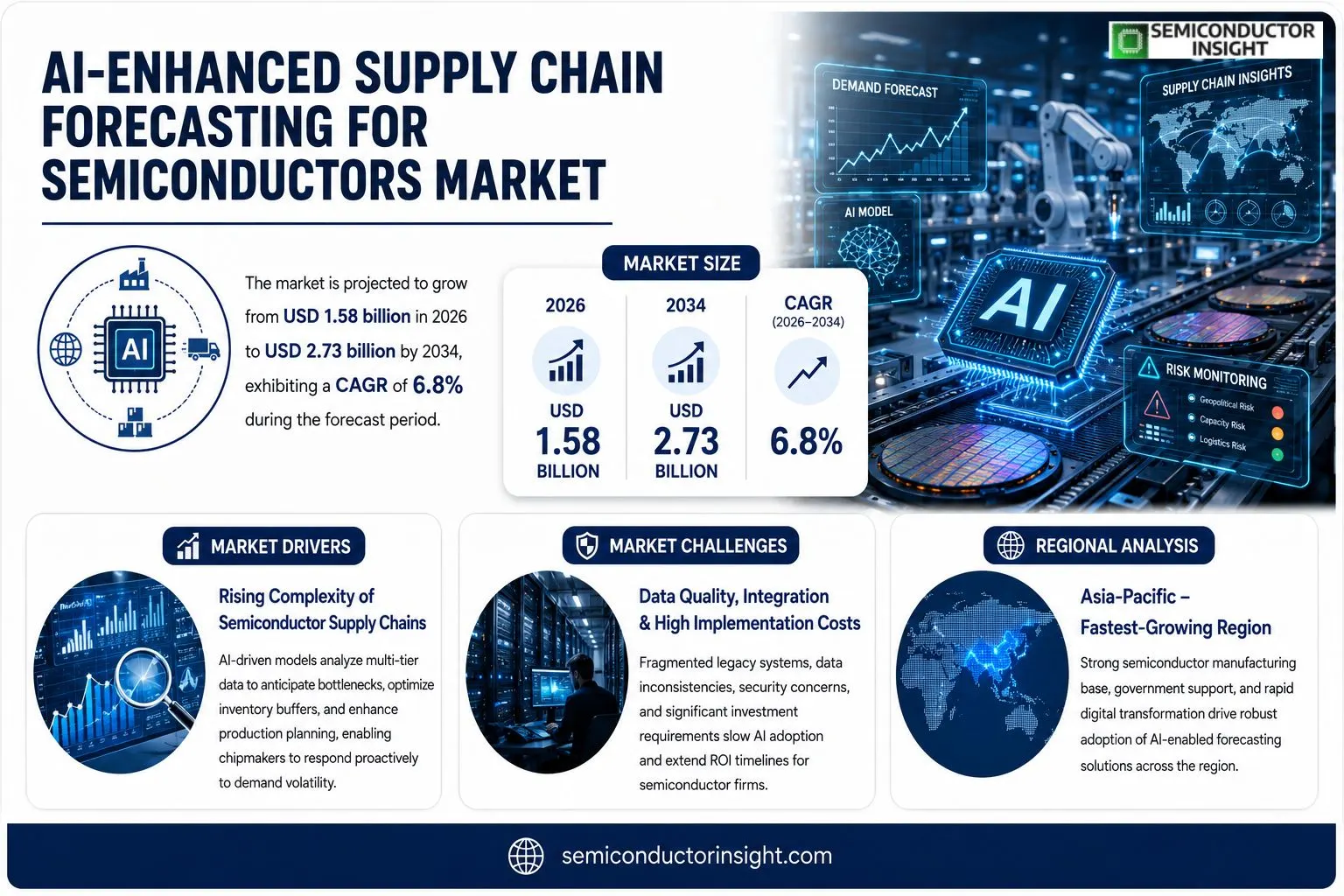
AI-Enhanced Supply Chain Forecasting for Semiconductors market size was valued at USD 1.45 billion in 2025. The market is projected to grow from USD 1.58 billion in 2026 to USD 2.73 billion by 2034, exhibiting a CAGR of 6.8% during the forecast period.
AI‑enhanced supply chain forecasting leverages machine‑learning models, predictive analytics, and real‑time data integration to anticipate demand swings, production bottlenecks, and logistics constraints across semiconductor manufacturing ecosystems. By ingesting wafer‑level yield metrics, component lead‑time trends, and geopolitical risk signals, these solutions generate actionable insights that refine inventory positioning and capacity planning.The market is experiencing rapid growth due to several factors, including heightened investment in advanced analytics by chipmakers, rising complexity of multi‑node fab networks, and increasing pressure on time‑to‑market driven by emerging applications such as AI accelerators and automotive electronics. Furthermore, collaborations between semiconductor OEMs and cloud‑based AI platform providers are accelerating adoption, while major players such as Intel Capital, TSMC’s Advanced Analytics Division, and IBM Research are expanding their solution portfolios.
MARKET DRIVERS
Rising Complexity of Semiconductor Supply Chains
The semiconductor sector now spans dozens of tiers, from raw silicon wafer processing to final chip assembly. Variability in lead‑times, frequent capacity crunches, and geopolitical frictions have made traditional forecasting methods unreliable. AI‑driven models, trained on high‑frequency production data, offer the granularity needed to anticipate bottlenecks before they materialize, allowing manufacturers to buffer inventory strategically.
Accelerating Adoption of Advanced Analytics
Enterprises are investing heavily in cloud‑based AI platforms that can ingest terabytes of sensor, ERP, and market data in near real‑time. Predictive accuracy gains of 15‑20 % reported by early adopters have translated into measurable cost savings on logistics and production scheduling, prompting C‑suite executives to champion AI projects across the supply chain.
➤ “AI‑enhanced forecasting is shifting the margin upside for chipmakers, turning what was once a reactive function into a proactive competitive weapon.”
For AI-Enhanced Supply Chain Forecasting for Semiconductors Market, the convergence of data richness and algorithmic sophistication creates a feedback loop: better forecasts reduce waste, which in turn generates cleaner data for the next cycle of model refinement. Companies that embed this capability now are positioning themselves to capture premium market share as the industry rebounds from recent disruptions.
MARKET CHALLENGES
Data Quality and Integration Hurdles
Despite abundant data streams, many semiconductor firms still rely on legacy MES systems that produce fragmented, low‑resolution records. Inconsistent timestamps, missing attributes, and siloed databases impede the training of robust AI algorithms, forcing firms to allocate sizable resources to data cleansing before any forecasting benefit can be realised.
Other Challenges
Regulatory & Security Concerns
The strategic importance of chip production makes supply‑chain data a target for espionage. Compliance with export‑control regimes and the need to safeguard proprietary process parameters add layers of complexity to any AI deployment, often slowing rollout timelines.
MARKET RESTRAINTS
High Implementation Costs
Deploying an enterprise‑grade AI forecasting solution typically requires multi‑million‑dollar investments in infrastructure, software licensing, and specialist talent. For midsize fab operators, the payback horizon can exceed three years, making the business case difficult to justify without clear, upfront ROI modeling.
Talent Shortage
Effective model development demands data scientists who understand both machine learning and semiconductor manufacturing nuances. The current talent pool is limited, driving up remuneration and extending project durations, which in turn dampens enthusiasm for large‑scale AI adoption.
MARKET OPPORTUNITIES
Edge Computing Integration
Embedding AI inference engines directly on production equipment enables real‑time demand signals to adjust routing and batch sizing on the shop floor. Early pilots in leading fabs have demonstrated up to 12 % reductions in cycle time, signaling a lucrative avenue for vendors offering edge‑optimized forecasting modules.
Collaborative Ecosystems
Partnerships between semiconductor manufacturers, AI start‑ups, and logistics providers are creating shared data marketplaces. By pooling anonymized demand and capacity data, participants can train richer models that capture macro‑trend influences, unlocking new revenue streams through forecasting‑as‑a‑service offerings.
AI-Enhanced Supply Chain Forecasting for Semiconductors Market Trends
Elevated Predictive Accuracy Fuels Operational Shifts
The semiconductor sector recorded a valuation of $1.45 billion in 2025. One year later the figure rose to $1.58 billion, and the trajectory points toward $2.73 billion by 2034, implying an average annual increase close to 6.8 percent. This upward movement stems from the capacity of AI‑enhanced supply chain forecasting to assimilate wafer‑level yield data, component lead‑time variations, and geopolitical risk indicators into a coherent demand signal. Manufacturers that replace manual heuristics with these models report tighter inventory buffersoften trimming excess stock by 12‑15 percentwhile preserving service levels for high‑mix, low‑volume products. The ability to anticipate bottlenecks before they crystallize enables fab operators to re‑schedule capacity, thereby shaving weeks off time‑to‑market for AI accelerators and automotive chips. Consequently, capital allocation shifts toward analytics platforms rather than incremental fab expansion, reshaping investment priorities across the ecosystem.
Other Trends
Integration with Fab Automation Systems
Recent deployments link predictive engines directly to equipment control loops, allowing real‑time adjustments to wafer throughput based on short‑term forecast deviations. Early adopters note a reduction of line idle time by roughly 8 percent, a gain that translates into measurable cost avoidance on a per‑wafer basis. The convergence of AI insights with robotic process automation also mitigates human‑error exposure, a factor that gains prominence as fab nodes become increasingly intricate. Companies are therefore evaluating bundled solutions that combine forecasting, scheduling, and execution, a strategy that promises a more seamless flow from data ingestion to machine action.
Collaborative AI Platforms Expand Ecosystem Reach
Strategic alliances between chipmakers and cloud‑native AI providers are accelerating solution diffusion beyond the traditional OEM sphere. Joint ventures now offer shared repositories of anonymized yield data, enriching model training sets and elevating forecast robustness across the supply chain. This collaborative posture creates a feedback loop: improved forecasts increase confidence in cross‑supplier planning, which in turn supplies richer data for the next modeling cycle. For vendors, the implication is a move away from siloed product bundles toward subscription‑based platforms that generate recurring revenue while fostering lock‑in through continual data exchange.
COMPETITIVE LANDSCAPE
Key Industry Players
AI‑Enhanced Supply‑Chain Forecasting for Semiconductors – Competitive Overview
Intel Capital remains the dominant force in the segment, leveraging its deep ties with Intel’s wafer‑fab operations to embed predictive‑analytics engines directly into capacity‑planning tools. This integration produces a feedback loop where yield data, lithography throughput, and component lead‑time fluctuations are continuously refined, giving Intel‑backed customers a clear advantage in handling demand volatility. TSMC’s Advanced Analytics Division follows a similar trajectory, offering a cloud‑native forecasting platform that taps into the foundry’s massive data lake, thereby standardising inventory decisions across its multi‑node ecosystem. IBM Research complements these efforts with a suite of machine‑learning models that incorporate geopolitical risk indices, creating a more resilient planning horizon for chip manufacturers that operate across divergent regulatory environments.Beyond the marquee players, a cohort of niche innovators is shaping specialised aspects of the marketplace. Samsung Electronics and Qualcomm have each introduced AI‑driven modules that focus on component‑level lead‑time prediction, targeting high‑mix, low‑volume product lines in automotive and edge‑AI applications. AMD and NVIDIA are extending their GPU‑accelerated analytics to real‑time bottleneck detection, while GlobalFoundries emphasizes open‑source forecasting APIs that allow third‑party SaaS providers to embed semiconductor‑specific analytics into broader supply‑chain suites. Smaller but technically agile firms such as Cadence Design Systems, Synopsys, and Applied Materials contribute domain‑specific models that translate wafer‑yield anomalies into actionable inventory adjustments, reinforcing the ecosystem’s overall analytical depth.
List of Key Semiconductor AI‑Enhanced Forecasting Companies Profiled
- Intel Capital
- TSMC – Advanced Analytics Division
- IBM Research
- Samsung Electronics
- Qualcomm Technologies
- AMD
- NVIDIA
- GlobalFoundries
- Cadence Design Systems
- Synopsys
- Applied Materials
- ASML
- Arm Ltd.
- Broadcom Inc.
- Micron Technology
Segment Analysis:
| Segment Category | Sub-Segments | Key Insights |
| By Type |
|
Machine Learning Models
|
| By Application |
|
Demand Forecasting
|
| By End User |
|
Foundries
|
| By Technology Integration |
|
Cloud AI Services
|
| By Value Chain Stage |
|
Wafer Fabrication
|
Regional Analysis: AI-Enhanced Supply Chain Forecasting for Semiconductors Market
North America
Leading fabs in the Midwest and Southwest are retrofitting legacy lines with AI‑driven yield‑prediction modules, allowing them to re‑balance wafer output in near‑real time. This strategy reduces scrap rates and aligns capacity with volatile client orders without expanding physical plant size.
Corporate labs are allocating sizable budgets to blend quantum‑ready simulation with conventional AI, aiming to forecast demand spikes driven by emerging 5‑nm and 3‑nm processes. The focus is on shortening the feedback loop between design verification and manufacturing scheduling.
Recent amendments to export‑control statutes encourage domestic data‑processing solutions, nudging firms toward on‑premise AI platforms. This regulatory shift mitigates cross‑border latency concerns and protects proprietary forecasting algorithms.
Tier‑1 logistics providers are co‑developing predictive routing engines that integrate directly with fab scheduling tools, creating a seamless flow of component availability signals that pre‑empt bottlenecks.
Europe
European chipmakers are leveraging the region’s strong data‑privacy framework to build trusted AI forecasting services. Countries such as Germany and the Netherlands invest heavily in collaborative research hubs, where algorithm developers work alongside equipment vendors to tailor models for the continent’s mixed‑size fab ecosystem. The emphasis on sustainability forces firms to optimize material usage, and AI‑enabled demand smoothing assists in meeting aggressive carbon‑reduction goals while preserving throughput.
Asia‑Pacific
In the Asia‑Pacific, manufacturers grapple with massive scale and divergent market rhythms across China, South Korea, and Taiwan. The region’s competitive pressure drives rapid adoption of AI modules that can digest multi‑source datafrom raw‑material shipments to consumer electronics sentimentinto actionable capacity plans. Local governments reinforce this trend by offering tax credits for digital‑transformation projects, encouraging smaller fabs to climb the technology ladder and align with global standards.
South America
South American players are still emerging as niche contributors to the semiconductor supply chain, yet they view AI‑enhanced forecasting as a lever to attract foreign investment. By showcasing the ability to predict component needs for automotive and IoT projects, regional firms position themselves as reliable downstream partners. Collaborative initiatives with North American firms also provide access to advanced analytics platforms, accelerating the learning curve.
Middle East & Africa
The Middle East and Africa focus on building resilient import‑dependent supply routes. AI‑driven scenario planning enables distributors to model geopolitical risks and transport disruptions, ensuring critical semiconductor components reach end‑users without costly delays. Early‑stage pilots in UAE free‑zones illustrate how predictive inventory buffers can offset the lack of local fabrication capacity, making the region an attractive hub for value‑added services.
Report Scope
This market research report provides a comprehensive analysis of the AI-Enhanced Supply Chain Forecasting for Semiconductors Market , covering the forecast period 2026–2034. It offers detailed insights into market dynamics, technological advancements, competitive landscape, and key trends shaping the industry.
Key focus areas of the report include:
- Market Overview: The report begins with an overview outlining its current market scenario, key growth indicators, and industry transformation drivers. It discusses macroeconomic factors, demand–supply balance, regulatory landscape, and the strategic role of semiconductors in powering advancements across industries such as automotive, telecommunications, consumer electronics, and industrial automation.
- Market Size & Forecast: Historical data and future projections for revenue, unit shipments, and market value across major regions and segments.
- Segmentation Analysis: Detailed breakdown by product type, technology, application, and end-user industry to identify high-growth segments and investment opportunities.
- Regional Insights: Insights into market performance across North America, Europe, Asia-Pacific, Latin America, and the Middle East & Africa, including country-level analysis where relevant.
- Competitive Landscape: Profiles of leading market participants, including their product offerings, R&D focus, manufacturing capacity, pricing strategies, and recent developments such as mergers, acquisitions, and partnerships.
- Technology Trends & Innovation: Assessment of emerging technologies, integration of AI/IoT, semiconductor design trends, fabrication techniques, and evolving industry standards.
- Market Drivers & Restraints: Evaluation of factors driving market growth along with challenges, supply chain constraints, regulatory issues, and market-entry barriers.
- Stakeholder Insights: Insights for component suppliers, OEMs, system integrators, investors, and policymakers regarding the evolving ecosystem and strategic opportunities.
Primary and secondary research methods are employed, including interviews with industry experts, data from verified sources, and real-time market intelligence to ensure the accuracy and reliability of the insights presented.
FREQUENTLY ASKED QUESTIONS:
What is the current market size of AI-Enhanced Supply Chain Forecasting for Semiconductors Market?
-> AI-Enhanced Supply Chain Forecasting for Semiconductors Market was valued at USD 1.45 billion in 2025 and is expected to reach USD 2.73 billion by 2034.
Which key companies operate in AI-Enhanced Supply Chain Forecasting for Semiconductors Market?
-> Key players include Intel Capital, TSMC’s Advanced Analytics Division, IBM Research, among others.
What are the key growth drivers?
-> Key growth drivers include heightened investment in advanced analytics by chipmakers, rising complexity of multi‑node fab networks, and pressure from emerging AI accelerator and automotive electronics applications.
Which region dominates the market?
-> Asia-Pacific is the fastest‑growing region, while North America remains a dominant market.
What are the emerging trends?
-> Emerging trends include integration of cloud‑based AI platforms, real‑time predictive analytics, and collaborative solutions between semiconductor OEMs and AI service providers.

Get Sample Report PDF for Exclusive Insights
Report Sample Includes
- Table of Contents
- List of Tables & Figures
- Charts, Research Methodology, and more...
 Download Sample Report PDF