Fine Pitch Board to Board Connector Market Insights
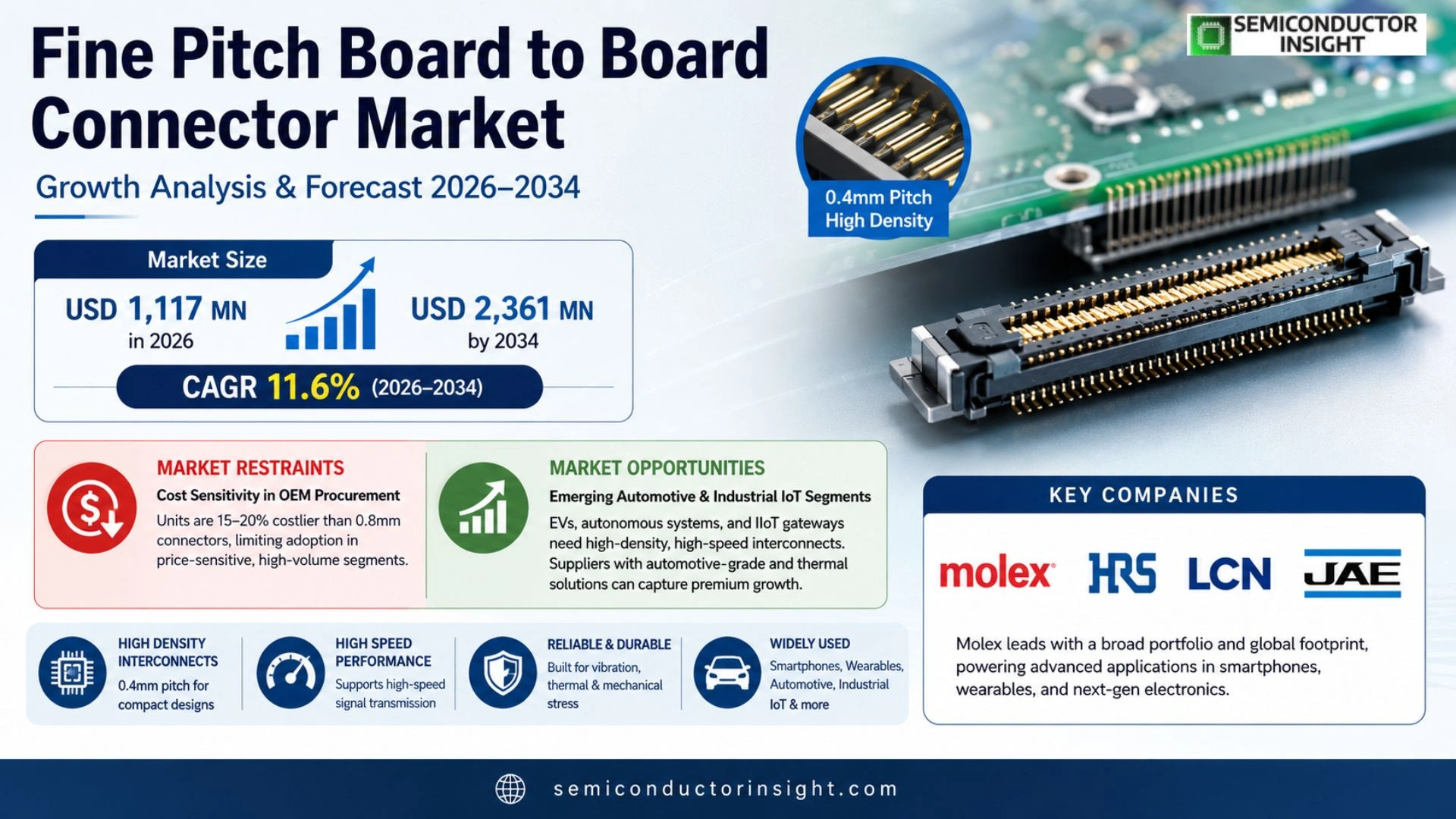
Fine Pitch Board to Board Connector market will grow from USD 1,117 million in 2026 to USD 2,361 million by 2034, exhibiting a CAGR of 11.6% during the forecast period.
Fine Pitch Board to Board Connectors are employed in a stackable configuration that enables precise interconnection between printed circuit boards (PCBs). They support diverse PCB orientations, spacing constraints and design flexibility, while offering multiple material choices, plating options and height variations to satisfy electrical and mechanical requirements. Depending on interconnection purpose, these connectors are available as high‑speed, floating or power variants.
MARKET DRIVERS
Miniaturization of Consumer Electronics
Designers of smartphones, wearables and portable medical devices are compressing functionality into ever‑smaller chassis. Fine Pitch Board to Board Connector Market solutions that occupy less than 0.5 mm of space enable stacking of multiple PCBs without sacrificing mechanical stability. This trend forces component suppliers to refine plating processes and adopt tighter tolerances, thereby creating a supply‑side incentive to invest in advanced tooling.
Adoption of High‑Speed Data Interfaces
5G base stations, AI accelerators and graphics processors now require interconnects capable of handling 10 Gb/s and above. Fine‑pitch connectors with reduced insertion loss and improved shielding meet those specifications while retaining a low profile. The performance edge translates into higher bill‑of‑materials justification for OEMs that can no longer rely on legacy 0.8 mm pitches.
➤ “Designers are forced to select fine pitch connectors that can sustain 10 Gbit/s throughput while maintaining a sub‑0.5 mm stack height.”
Collectively, the push for compactness and speed reshapes procurement strategies, encouraging manufacturers to lock in long‑term contracts with suppliers that demonstrate consistent yield rates. The resulting volume growth underpins the upward trajectory of Fine Pitch Board to Board Connector Market.
MARKET CHALLENGES
Manufacturing Complexity
Producing connectors with 0.3 mm pitch demands precision stamping, micro‑molding and inspection technologies that are capital‑intensive. Small‑to‑mid‑size firms often lack the economies of scale required to amortize those investments, leading to a fragmented supplier base and longer lead times for end‑users.
Other Challenges
Quality Assurance
Maintaining consistent contact resistance across thousands of pins is critical in high‑frequency applications. Minor deviations can trigger signal integrity failures that are costly to debug post‑assembly, prompting OEMs to enforce stringent qualification protocols that extend product development cycles.
MARKET RESTRAINTS
Cost Sensitivity in OEM Procurement
While fine‑pitch connectors deliver performance advantages, their unit price remains 15‑20 % higher than conventional 0.8 mm alternatives. Price‑conscious manufacturers in consumer sectors often substitute lower‑cost options, especially when product refresh cycles are short. This price differential caps market penetration in volume‑driven categories.
MARKET OPPORTUNITIES
Emerging Automotive and Industrial IoT Segments
Electric vehicles and autonomous driving platforms are integrating high‑resolution radar and LiDAR modules that rely on dense inter‑board routing. Fine Pitch Board to Board Connector Market participants that can certify their products to automotive reliability standards stand to capture a rapidly expanding niche, projected to contribute a double‑digit share of total revenue by 2028.
Industrial IoT gateways are increasingly employing multi‑core processors to enable edge analytics. The need for compact, high‑speed backplane connections creates a demand corridor for 0.4 mm‑pitch connectors with enhanced thermal performance. Suppliers that pair connector design with proprietary heat‑sink solutions could differentiate themselves and command premium pricing.
Fine Pitch Board to Board Connector Market Trends
Ultra‑Low Profile Adoption Accelerates
Design engineers targeting the next generation of smartphones, wearables and compact medical devices are insisting on Fine Pitch Board to Board Connector Market solutions that occupy less than 0.8 mm of stack height. The pressure to thin device enclosures forces a shift away from bulkier through‑hole interconnects toward board‑to‑board architectures that preserve high‑frequency performance while consuming virtually no board space. This transition shortens mechanical layouts, reduces the number of routing layers, and enables faster time‑to‑market. Moreover, the tighter packaging lowers material costs and eases thermal management, giving OEMs a cost‑side lever in fiercely price‑sensitive segments.
Other Trends
Material Innovations
Suppliers are expanding the metallurgical toolbox beyond standard copper alloys. Gold‑rich platings and nickel‑palladium composites are being introduced to cut contact resistance, a critical parameter for multi‑gigabit lanes. At the same time, high‑temperature polymer housings are gaining acceptance in automotive power‑train modules where ambient temperatures regularly exceed 150 °C. These material advances mitigate reliability concerns that historically constrained ultra‑thin connectors to consumer‑grade applications, opening pathways to more demanding industrial and automotive environments.
Application Portfolio Diversification
While mobile handsets remain the largest volume driver, Fine Pitch Board to Board Connector Market is now seeing substantive uptake in smart‑glasses, edge‑computing IoT nodes and portable diagnostic imaging equipment. Each of these niches demands dense routing of power and data within a constrained chassis, making micro‑pitch solutions the logical choice. Companies that align product development with these emerging form factors stand to capture incremental market share as OEMs broaden their product portfolios. Competitive pressure is intensifying among the established players,Molex, HRS, LCN, JAE and others,as they launch differentiated stacks that combine higher pin counts with enhanced shielding. The strategic implication for manufacturers is clear: invest in cross‑segment platforms that can be customized for both consumer and industrial applications, and secure partnerships with design houses early in the product development cycle.
COMPETITIVE LANDSCAPE
Key Industry Players
Fine Pitch Board‑to‑Board Connector Market: Competitive Overview
Molex dominates the fine‑pitch board‑to‑board arena, leveraging a deep catalogue that spans high‑speed, power and floating variants. Its extensive global manufacturing footprint, coupled with aggressive investment in miniaturisation technology, enables the company to serve the most demanding smartphone and wearable applications. By standardising critical dimensions such as sub‑0.7 mm stacking heights, Molex secures volume contracts with tier‑1 OEMs, reinforcing its position as the de‑facto reference supplier. The firm’s strategic acquisitions of niche material specialists have broadened its plating options, allowing customers to meet tighter impedance targets while reducing overall bill‑of‑materials. This breadth of capability creates a barrier to entry for smaller rivals and shapes the market’s pricing dynamics.
Beyond the market leader, a cohort of specialised manufacturers sustains competitive pressure. HRS and LCN focus on ultra‑low‑profile connectors for compact wearables, differentiating through proprietary spacer designs. JAE and ECT excel in high‑frequency applications, offering gold‑plated contacts that address signal‑integrity concerns in 5G modules. OCN and Sunway Communication pursue cost‑effective solutions for mass‑market tablets, while YXT and Acon target the automotive segment with ruggedised housings. Kyosera and Panasonic bring a legacy of reliability to power‑intensive devices, and TE Connectivity and Amphenol compete aggressively on global distribution networks. CSCONN, a newer entrant from Taiwan, carves out a niche in custom‑pitch offerings for niche industrial equipment. Collectively, these players diversify the supply base, compel continuous innovation, and give end‑users leverage in negotiating terms.
List of Key Fine Pitch Board to Board Connector Companies Profiled
- Molex
- HRS
- LCN
- JAE
- ECT
- OCN
- Sunway Communication
- YXT
- Acon
- Kyosera
- Panasonic
- TE Connectivity
- Amphenol
- CSCONN
Segment Analysis:
| Segment Category | Sub-Segments | Key Insights |
| By Type |
|
High‑speed Connectors are increasingly preferred for emerging electronic modules where signal integrity is critical.
|
| By Application |
|
Smartphone drives the most innovative uses of fine‑pitch board‑to‑board solutions.
|
| By End User |
|
Consumer Electronics remains the primary catalyst for connector innovation.
|
| By Stacking Height |
|
Below 0.7 mm is emerging as the preferred height for ultra‑compact modules.
|
| By Material |
|
Gold‑plated Contacts are viewed as the premium choice for high‑reliability applications.
|
Regional Analysis: Fine Pitch Board to Board Connector Market
Concentrated hubs in Taiwan, South Korea, and Mainland China host the majority of fine‑pitch assembly lines, leveraging dense labor pools and mature supply chains. The proximity of silicon fabs to connector producers shortens lead times, granting these manufacturers a decisive edge in responding to iterative product cycles.
Early adoption of high‑frequency materials and micro‑laser welding is evident, propelled by the rapid rollout of 5G and advanced driver‑assistance systems. Companies that embed these capabilities into their product roadmaps can command premium pricing and differentiate on reliability.
Recent disruptions have prompted firms to diversify sourcing of copper alloys and dielectric substrates. Multi‑tiered supplier strategies reduce exposure to single‑point failures and support continuous delivery to OEMs across the region.
Harmonized standards such as IEC 61310 are gaining traction, yet local compliance nuances persist, especially concerning RoHS exemptions for certain lead‑free alloys. Navigating this patchwork efficiently can accelerate market entry for new connector designs.
North America
North America remains a strong secondary market for fine‑pitch board‑to‑board connectors, anchored by deep R&D investments from leading semiconductor firms and a mature aerospace sector. The region’s emphasis on reliability and long‑term product lifecycles drives demand for connectors that meet stringent thermal and vibration criteria. Companies targeting this market must prioritize rigorous qualification processes and align with procurement practices that favor suppliers with robust quality management systems. The strategic implication is a shift toward value‑added services,such as custom packaging and lifecycle support,to sustain competitive advantage.
Europe
In Europe, the fine‑pitch connector market is shaped by a strong focus on sustainability and regulatory compliance, especially under EU directives that tighten material restrictions. Automotive manufacturers leading the electrification transition are integrating densely packed interconnects to accommodate battery management and sensor networks. European firms that can demonstrate traceability and environmentally responsible sourcing are better positioned to win contracts with original equipment manufacturers seeking to meet both performance and ESG objectives.
South America
South America presents a growing yet uneven landscape, with Brazil and Argentina leading adoption through expanding consumer electronics manufacturing. Local cost pressures encourage the use of standard‑grade materials, but niche applications in medical device assembly are catalyzing interest in higher‑specification connectors. Market entrants that can balance affordability with targeted performance enhancements are likely to capture modest but accelerating market share as regional supply chains mature.
Middle East & Africa
The Middle East & Africa region is gradually emerging as a niche hub for fine‑pitch connectors, driven primarily by infrastructure projects and an uptick in telecommunications rollout. While overall volume remains modest, the strategic importance of reliable interconnects in data‑center expansions and defense contracts creates pockets of high‑value demand. Suppliers that establish localized support and quick‑turn prototyping capabilities can differentiate themselves in this fragmented market.
Report Scope
This market research report provides a comprehensive analysis of the Fine Pitch Board to Board Connector Market , covering the forecast period 2026–2034. It offers detailed insights into market dynamics, technological advancements, competitive landscape, and key trends shaping the industry.
Key focus areas of the report include:
- Market Overview: The report begins with an overview outlining its current market scenario, key growth indicators, and industry transformation drivers. It discusses macroeconomic factors, demand–supply balance, regulatory landscape, and the strategic role of semiconductors in powering advancements across industries such as automotive, telecommunications, consumer electronics, and industrial automation.
- Market Size & Forecast: Historical data and future projections for revenue, unit shipments, and market value across major regions and segments.
- Segmentation Analysis: Detailed breakdown by product type, technology, application, and end-user industry to identify high-growth segments and investment opportunities.
- Regional Insights: Insights into market performance across North America, Europe, Asia-Pacific, Latin America, and the Middle East & Africa, including country-level analysis where relevant.
- Competitive Landscape: Profiles of leading market participants, including their product offerings, R&D focus, manufacturing capacity, pricing strategies, and recent developments such as mergers, acquisitions, and partnerships.
- Technology Trends & Innovation: Assessment of emerging technologies, integration of AI/IoT, semiconductor design trends, fabrication techniques, and evolving industry standards.
- Market Drivers & Restraints: Evaluation of factors driving market growth along with challenges, supply chain constraints, regulatory issues, and market-entry barriers.
- Stakeholder Insights: Insights for component suppliers, OEMs, system integrators, investors, and policymakers regarding the evolving ecosystem and strategic opportunities.
Primary and secondary research methods are employed, including interviews with industry experts, data from verified sources, and real-time market intelligence to ensure the accuracy and reliability of the insights presented.
FREQUENTLY ASKED QUESTIONS:
What is the current market size of Fine Pitch Board to Board Connector Market?
-> Fine Pitch Board to Board Connector market will grow from USD 1,117 million in 2026 to USD 2,361 million by 2034, exhibiting a CAGR of 11.6%
Which key companies operate in Fine Pitch Board to Board Connector Market?
-> Key players include Molex, HRS, LCN, JAE, ECT, OCN, Sunway Communication, YXT, Acon, Kyosera, Panasonic, TE Connectivity, Amphenol, and CSCONN, among others.
What are the key growth drivers?
-> Key growth drivers include the need for compact, high‑speed interconnections in smartphones, tablets, wearables and other consumer electronics, the flexibility offered by stackable designs, and increasing adoption of high‑performance power and floating connectors.
Which region dominates the market?
-> Asia (particularly China) and the United States are the largest individual markets, driving the majority of revenue growth.
What are the emerging trends?
-> Emerging trends include reduction of stacking height below 0.7 mm, development of ultra‑high‑speed and low‑profile connectors, and expanding application in emerging devices such as smart watches and portable music players.

Get Sample Report PDF for Exclusive Insights
Report Sample Includes
- Table of Contents
- List of Tables & Figures
- Charts, Research Methodology, and more...
 Download Sample Report PDF