Fanless Embedded Computer Market Insights
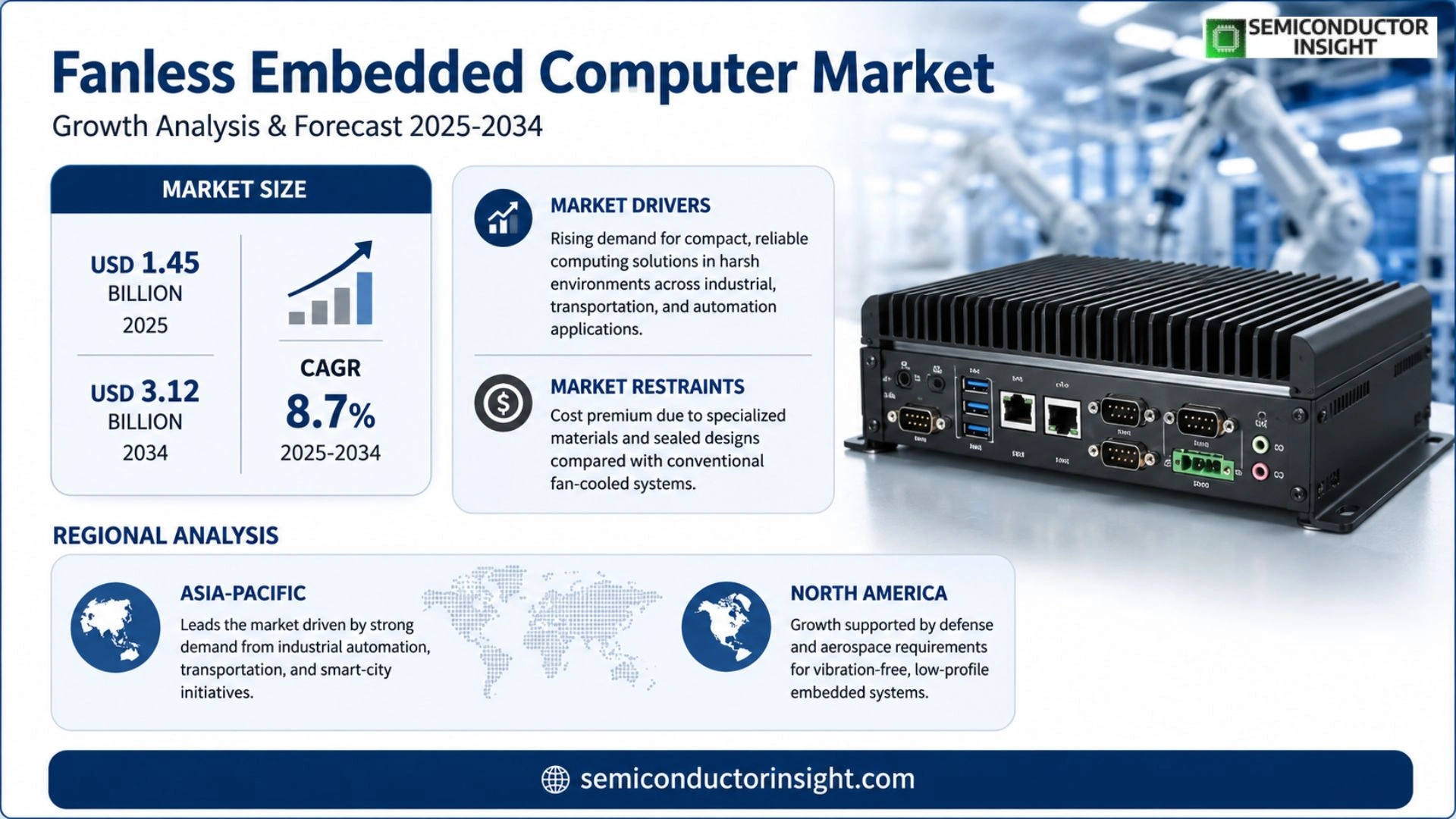
Fanless Embedded Computer market size was valued at USD 1.45 billion in 2025. The market is projected to grow from USD 3.12 billion by 2034, exhibiting a CAGR of 8.7% during the forecast period.
Fanless Embedded Computers are compact, solid‑state platforms designed for edge‑computing tasks where reliability outweighs cooling overhead. By eliminating moving fans, these systems deliver lower maintenance costs and superior operation in dusty or vibration‑prone environments,attributes that make them ideal for remote monitoring, industrial automation, medical imaging kiosks, transportation signaling and outdoor surveillance installations.
The surge in IoT deployments and expanding rollout of 5G networks amplify demand for rugged yet silent compute nodes, while energy‑efficiency mandates push OEMs toward fan‑free designs.
Key manufacturers such as Advantech, AAEON and Kontron are broadening their portfolios with modular chassis ranging from sub‑11‑inch panels to larger industrial‑grade enclosures, thereby addressing diverse form‑factor requirements across sectors.
MARKET DRIVERS
Thermal Efficiency as a Competitive Edge
Fanless Embedded Computer Market is benefitting from mounting pressure on OEMs to reduce device footprints while maintaining reliability. By eliminating moving parts, manufacturers achieve lower failure rates and can certify products for harsher environments, a factor that resonates with customers in transportation and industrial automation.
Regulatory and Energy‑Saving Imperatives
Stringent energy‑efficiency standards across Europe and North America compel designers to adopt solutions that draw minimal power. Fanless platforms, with their inherently low‑power consumption, align neatly with these mandates, allowing system integrators to market devices as green‑compliant without sacrificing computational capability.
➤ Design simplicity translates into shorter time‑to‑market, a decisive advantage when clients demand rapid deployment of edge‑computing nodes.
Finally, the proliferation of IoT edge deployments creates a demand for rugged compute that can operate unattended for years. Fanless Embedded Computer Market participants that offer sealed enclosures and extended service intervals are positioned to capture a growing slice of this expanding edge‑infrastructure spend.
MARKET CHALLENGES
Balancing Performance with Passive Cooling Limits
While passive cooling removes mechanical failure points, it also caps the thermal envelope for high‑performance CPUs. Vendors must navigate the trade‑off between processing power and heat dissipation, often resorting to custom PCB layouts or advanced heat‑pipe technologies to stay within acceptable temperature bands.
Other Challenges
Supply‑Chain Volatility
Component shortages in semiconductors and passive‑cooling alloys have introduced lead‑time uncertainties. Companies that maintain diversified supplier bases or invest in in‑house thermal‑module fabrication mitigate the risk of production bottlenecks.
Moreover, the niche nature of fanless solutions means that many design engineers lack deep expertise in passive thermal management, prompting additional training costs and engineering cycles that can erode margins.
MARKET RESTRAINTS
Cost Premium Compared with Conventional Boxes
Fanless designs often require specialized materials such as aluminum‑or‑copper heat spreaders and sealed enclosures, driving up unit costs relative to traditional fan‑cooled units. For price‑sensitive segments, this premium can limit adoption, especially when alternative cooling strategies are acceptable.
In addition, certification processes for ruggedized, sealed devices are more stringent, extending the time required to bring a product to market. The added engineering effort and testing expense contribute to a higher total cost of ownership, tempering enthusiasm among cost‑conscious buyers.
The market also faces a perception hurdle; some end‑users associate fanless architecture with lower performance, despite evidence to the contrary. Overcoming this bias demands educational outreach and demonstrable case studies, which entail additional marketing investment.
MARKET OPPORTUNITIES
Emergence of AI Edge Inference Nodes
As AI workloads migrate to the edge, there is a clear opening for fanless platforms that can host dedicated inference accelerators while staying within strict thermal budgets. Companies that integrate low‑power AI chips into sealed chassis stand to gain early‑mover advantage in sectors like smart manufacturing and autonomous logistics.
Expansion into Harsh‑Environment Sectors
Industries such as offshore oil & gas, mining, and rail transport require compute that can survive dust, vibration, and extreme temperatures. Tailoring fanless solutions with enhanced ingress protection ratings opens a high‑margin niche where reliability is valued over cost.
Finally, the rise of modular, plug‑and‑play edge architectures encourages OEMs to source standardized fanless compute blocks. By offering scalable, interoperable modules, vendors can tap into a growing ecosystem of system integrators seeking rapid, low‑maintenance deployments.
Fanless Embedded Computer Market Trends
Edge Computing Adoption Accelerates Demand
The rise of edge‑oriented architectures is reshaping Fanless Embedded Computer Market. Companies that need real‑time analytics in remote or harsh environments are turning to fanless platforms because they eliminate moving parts, thereby reducing maintenance windows and improving mean‑time‑between‑failures. In manufacturing plants, the removal of fans translates into lower vibration, which preserves sensor accuracy and prolongs equipment life. Likewise, transportation hubs are deploying these rugged nodes to monitor traction systems and signaling equipment, where standby reliability is paramount. The cumulative effect is a noticeable shift from traditional, fan‑cooled designs toward sealed, passive‑cooling solutions that can operate continuously without service interruptions.
Other Trends
IoT and 5G Integration
The convergence of Internet of Things connectivity and emerging 5G networks is creating a fertile ground for fanless embedded devices. 5G’s low‑latency profile permits devices to relay data streams instantly, while IoT standards provide a common language for disparate sensors. This synergy encourages manufacturers to embed fanless computers directly into edge nodes, eliminating the need for separate gateway hardware. As a result, system integrators can offer slimmer, more energy‑efficient deployments that fit inside constrained enclosures such as oil‑field rigs or medical imaging cabinets. The ability to run continuously on limited power budgets also aligns with the broader push toward greener, carbon‑aware solutions across industrial sectors.
Regulatory and Sustainability Pressures Shape Design
Environmental regulations and corporate sustainability mandates are increasingly influencing product roadmaps within Fanless Embedded Computer Market. Legislators in key regions are tightening limits on noise emissions and hazardous material use, prompting designers to favor passive‑cooling architectures that meet stricter acoustic thresholds. Moreover, customers are evaluating total‑cost‑of‑ownership through a sustainability lens, favoring systems that consume less electricity and generate fewer waste components over their lifecycle. The combined impact motivates vendors to invest in advanced chassis materials, optimized thermal pathways, and modular designs that can be upgraded rather than replaced, thereby extending service life and supporting circular‑economy objectives.
COMPETITIVE LANDSCAPE
Key Industry Players
Fanless Embedded Computer Market – Competitive Overview 2024
Advantech dominates the fanless embedded segment by leveraging a global supply chain and a portfolio that spans ruggedized boards, system‑on‑module (SoM) solutions, and fully configured gateways. Its ability to serve both high‑volume OEM contracts and specialized defense projects creates a tiered market structure where large integrators rely on Advantech’s engineering depth while smaller system builders tap into its modular offerings to accelerate time‑to‑market. AAEON, a sister brand within the same corporate family, concentrates on compact, low‑power designs that appeal to IoT edge deployments, reinforcing a competitive edge through close alignment with semiconductor partners. Kontron, operating out of Europe, differentiates itself with extensive certification for industrial and transportation standards, positioning the company as a preferred vendor for safety‑critical applications. The convergence of these three firms defines the upper echelon of the market, establishing price benchmarks and technology roadmaps that shape downstream supplier decisions.
Beyond the headline names, a cluster of niche innovators injects diversity into the ecosystem. Cincoze supplies fanless PCs tailored for harsh environments, emphasizing thermally efficient chassis that extend service life in outdoor installations. Beckhoff Automation brings a control‑centric approach, integrating fanless compute modules directly into its TwinCAT automation platform. Stealth and Teguar Computers focus on ultra‑compact, fan‑free white‑box designs for aerospace and medical wearables, respectively. Companies such as Acnodes Corporation, Darveen Technology, IBASE Technology, Acrosser Technology, MPL, and several emerging Asian OEMs round out the competitive fabric, each carving out specialty niches,whether it be low‑cost education kits, power‑constrained sensor hubs, or high‑reliability automotive infotainment units. Their collective activity drives product differentiation, prompting larger players to broaden feature sets and prompting customers to evaluate trade‑offs between cost, durability, and certification depth.
List of Key Fanless Embedded Computer Companies Profiled
- Advantech
- AAEON
- Kontron
- Cincoze
- Beckhoff Automation
- Stealth
- Teguar Computers
- Acnodes Corporation
- Darveen Technology
- IBASE Technology
- Acrosser Technology
- MPL
Segment Analysis:
| Segment Category | Sub-Segments | Key Insights |
| By Type |
|
Less than 11‑inch models are the primary growth driver because they address the need for ultra‑compact edge nodes.
|
| By Application |
|
Industrial Automation stands out as the leading application segment, driven by the demand for reliable compute platforms that can operate without active cooling.
|
| By End User |
|
Medical Devices benefit from fanless design due to stringent hygiene and reliability requirements.
|
| By Operating Environment |
|
Harsh Industrial environments drive demand for rugged fanless computers that resist vibration, dust, and temperature extremes.
|
| By Integration Level |
|
Modular Systems are gaining traction because they provide flexibility for OEMs to customize compute capabilities while preserving fanless reliability.
|
Regional Analysis: Fanless Embedded Computer Market
Concentrated electronics hubs in Shenzhen and Tokyo supply a steady flow of miniaturized components, enabling rapid iteration of fanless boards without compromising durability or performance.
Emerging noise‑reduction mandates and energy‑efficiency directives incentivize OEMs to replace active cooling with passive solutions across public‑infrastructure projects.
Localized component sourcing shortens lead times and mitigates geopolitical risks, granting manufacturers the flexibility to scale fanless designs quickly.
Industries such as rail transport and offshore wind are favoring fanless modules for their reduced maintenance overhead and enhanced reliability in harsh environments.
North America
In North America, Fanless Embedded Computer Market is being reshaped by defense and aerospace requirements that prioritize vibration‑free, low‑profile hardware. Procurement officials value the predictable lifespan of fanless units because they reduce the likelihood of unexpected failures during critical missions. Simultaneously, data‑center edge deployments are leveraging these devices to meet latency constraints while minimizing power draw. The confluence of security‑driven specifications and a growing emphasis on green IT is prompting system integrators to embed fanless platforms into next‑generation ruggedized solutions.
Europe
European stakeholders are motivated by stringent environmental legislation that limits both acoustic emissions and power consumption in industrial facilities. Companies operating within the automotive and rail sectors are integrating fanless embedded computers to align with the EU’s broader sustainability agenda. Moreover, the region’s strong emphasis on cybersecurity encourages manufacturers to choose inherently simpler cooling architectures, which present fewer attack vectors. The result is a measured but steady shift toward designs that combine robust performance with minimal ecological footprint.
South America
South American markets are witnessing a gradual uptake of fanless technology, driven largely by mining and oil‑and‑gas enterprises operating in remote locales. The absence of moving parts translates into reduced service intervals, a decisive factor where logistics are challenging. Local distributors are also bundling fanless solutions with customized software stacks to address sector‑specific monitoring needs, creating a niche ecosystem that supports incremental market growth.
Middle East & Africa
In the Middle East and Africa, extreme ambient temperatures and dusty conditions have historically limited the reliability of conventional cooling methods. Fanless embedded computers, with their sealed enclosures and passive heat dissipation, are increasingly viewed as a pragmatic answer to these challenges. Government‑led smart‑city initiatives across the Gulf are specifying fanless modules for street‑level sensors, while African telecom operators are experimenting with them to extend the lifespan of base‑station equipment in off‑grid sites.
Report Scope
This market research report provides a comprehensive analysis of the Fanless Embedded Computer Market , covering the forecast period 2026–2034. It offers detailed insights into market dynamics, technological advancements, competitive landscape, and key trends shaping the industry.
Key focus areas of the report include:
- Market Overview: The report begins with an overview outlining its current market scenario, key growth indicators, and industry transformation drivers. It discusses macroeconomic factors, demand–supply balance, regulatory landscape, and the strategic role of semiconductors in powering advancements across industries such as automotive, telecommunications, consumer electronics, and industrial automation.
- Market Size & Forecast: Historical data and future projections for revenue, unit shipments, and market value across major regions and segments.
- Segmentation Analysis: Detailed breakdown by product type, technology, application, and end-user industry to identify high-growth segments and investment opportunities.
- Regional Insights: Insights into market performance across North America, Europe, Asia-Pacific, Latin America, and the Middle East & Africa, including country-level analysis where relevant.
- Competitive Landscape: Profiles of leading market participants, including their product offerings, R&D focus, manufacturing capacity, pricing strategies, and recent developments such as mergers, acquisitions, and partnerships.
- Technology Trends & Innovation: Assessment of emerging technologies, integration of AI/IoT, semiconductor design trends, fabrication techniques, and evolving industry standards.
- Market Drivers & Restraints: Evaluation of factors driving market growth along with challenges, supply chain constraints, regulatory issues, and market-entry barriers.
- Stakeholder Insights: Insights for component suppliers, OEMs, system integrators, investors, and policymakers regarding the evolving ecosystem and strategic opportunities.
Primary and secondary research methods are employed, including interviews with industry experts, data from verified sources, and real-time market intelligence to ensure the accuracy and reliability of the insights presented.
FREQUENTLY ASKED QUESTIONS:
What is the current market size of Fanless Embedded Computer Market?
-> Fanless Embedded Computer market is projected to grow from USD 3.12 billion by 2034, exhibiting a CAGR of 8.7% during the forecast period.
Which key companies operate in Fanless Embedded Computer Market?
-> Key players include Cincoze, Beckhoff Automation, Stealth, Teguar Computers, Advantech, AAEON, Acnodes Corporation, Darveen Technology, IBASE Technology, Acrosser Technology, Kontron, MPL.
What are the key growth drivers?
-> Key growth drivers include increasing adoption of edge computing, rising demand for reliable outdoor deployments, expansion of IoT ecosystems, and widespread rollout of 5G technology.
Which region dominates the market?
-> Asia holds the largest market share driven by strong manufacturing bases, extensive automation investments, and rapid IoT & 5G penetration, while North America and Europe remain significant contributors.
What are the emerging trends?
-> Emerging trends include integration of AI-driven analytics at the edge, development of ultra‑low‑power fanless designs for remote monitoring, and increased use of fanless solutions in autonomous transportation and medical devices.
Get Sample Report PDF for Exclusive Insights
Report Sample Includes
- Table of Contents
- List of Tables & Figures
- Charts, Research Methodology, and more...
 Download Sample Report PDF