Explosion Proof Strobe Light Market Insights
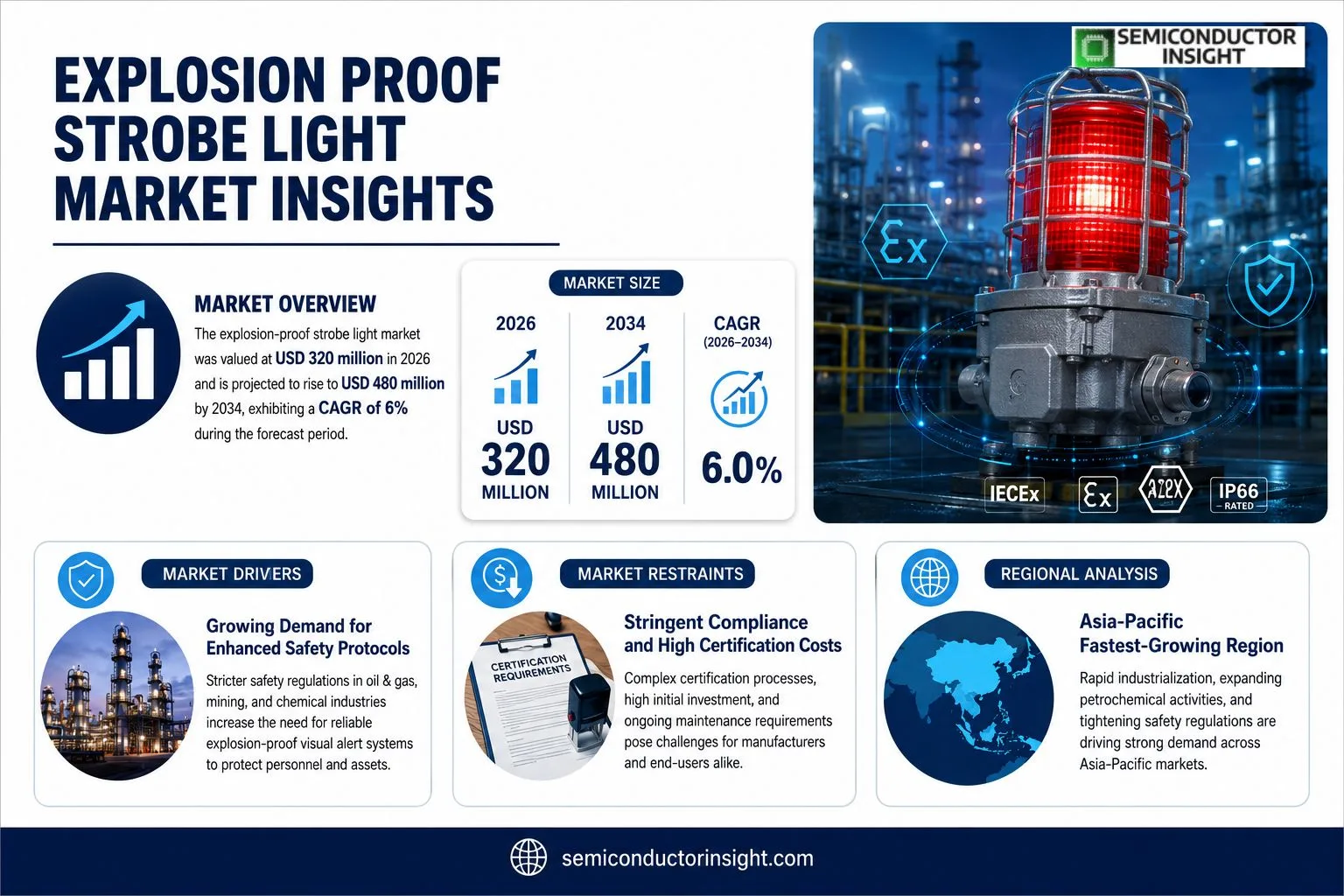
Explosion‑proof strobe light market was valued at USD 320 million in 2026 and is projected to rise to USD 480 million by 2034, indicating a CAGR of roughly 6% over the forecast period.
An explosion‑proof strobe light is a high‑intensity illumination device engineered for use in hazardous environments where flammable gases or vapours may be present. Its design incorporates intrinsic safety featuressuch as low ignition temperature components and sealed housingsto prevent spark generation while delivering rapid flash illumination for safety signage or emergency signaling.The sector is being reshaped by several converging dynamics. First, tightening industrial safety regulations across oil & gas, mining and chemical manufacturing sectors mandate reliable visual alert systems compliant with IECEx and ATEX standards, driving demand for certified products. Second, the shift toward LED technology has reduced power consumption and extended lamp life compared with legacy incandescent models, offering operators cost savings over time. Finally, rising automation within process plants increases reliance on visual monitoring systems that can withstand explosive atmospheres without compromising operational uptime.
MARKET DRIVERS
Growing Demand for Enhanced Safety Protocols
Safety remains the cornerstone of any operation that handles flammable gases, volatile liquids or other hazardous materials, and the regulatory climate around these activities has become markedly demanding. In the United States, OSHA 1910.106 and the U.S. Department of Labor’s mine safety regulations now require that equipment in explosive atmospheres must either be intrinsically safe or explosion-proof. Across Europe, the ATEX 114:2014 standard condenses the complex risk assessment into Zone classifications that invoke strict ignition-prohibition requirements. Combined, these frameworks obligate every new facility developer or retrofitting project to incorporate a robust signaling system that operates without the same ignition hazard. The Explosion Proof Strobe Light Market responds to this external pressure by positioning strobe lighting as a non-negotiable safety asset: the luminous pulses avoid electric spark creation while delivering unmistakable visual cues that can be perceived at hundreds of meters under low visibility conditions. Consequently, compliance engineering teams no longer treat strobe units as optional; they are integrated into the baseline safety bundle for all high-risk plants. Beyond the legal imperative, corporate responsibility programs increasingly drive companies to adopt visible safety systems that reduce employee downtime and preserve brand reputation. Together, regulatory tightening and proactive risk mitigation programmes create a durable market base for explosion-proof strobe lighting.
Advancements in LED Technology and Compliance Standards
Over the past decade lighting technology has migrated away from tungsten halogen and high-pressure discharge lamps toward high-efficiency silicon light-emitting diodes (LEDs). Explosion-proof strobe lighting has directly benefited from this shift, achieving power reductions of 30 % to 40 % while delivering comparable or higher luminance levels. The new LED architectures incorporate built-in forward-bias protection, effectively eliminating the spark risk that scientists feared in the past. Embedded microcontrollers provide adaptive brightness modulation, pulse-width tuning, and even hardware-in-the-loop diagnostics that feed directly to a plant-wide SCADA system. This integration allows operators to monitor strobe functionality in real-time, ensuring that any failure or drift in pulsing frequency triggers an automated alarm and logs the event for compliance audit. The resultant combination of lower energy draw, higher reliability, and smarter connectivity shifts the market perception from compulsory safety compliance to a differentiator that can save operators both capital and operating expenditure. Vendors who now reduce manufacturing steps, such as eliminating separate ballast units or manual wiring, streamline supply chain logistics and shorten the time‑to‑market for new designs, while a larger share of the cost advantage translates into more flexible pricing for the customer. The cumulative effect of these technical enhancements is a robust demand curve that continues to feed growth in the Explosion Proof Strobe Light Market.
➤ The convergence of LED efficiency and smart connectivity has turned explosion-proof strobe lighting from a regulatory check into a key operational enabler.
Looking beyond the present, the Explosion Proof Strobe Light Market is advancing toward deeper integration with industrial Internet of Things ecosystems. With modern distributed control systems, operators can link strobe units to central dashboards, enabling real-time remediation of fault events through over-the-air firmware patches. The quantifiable nature of strobe cycles also facilitates data-driven analyticspredictive maintenance models can be trained on signal integrity metrics to anticipate component degradation before catastrophic failure occurs. In remote offshore platforms and underground mining shafts, satellite or cellular uplinks can continuously verify operation in areas where wired communication is impossible. By bundling these services, manufacturers capture recurring revenue from subscription-based monitoring platforms, shifting from one-off capital expenditures to subscription economics that appeal to facilities managers keen on IT cost modelling. The result is a market that not only satisfies safety mandates but also delivers tangible operational efficiencies for the toughest environments.
MARKET CHALLENGES
Stringent Regulatory Compliance and Certification Barriers
Achieving and maintaining certification for explosion-proof strobe lighting is a layered ordeal that merges thorough testing, exacting documentation, and strict supply‑chain audits. The IECEx, ATEX, and UL 5104 frameworks each impose their own ingredient lists and encapsulation standards, making a single unit potentially non-compliant if, for instance, a coating fails adhesion under elevated humidity. These certification routes often span 12 to 18 months and require engagement with external independent laboratories, inflating production scheduling and overhead. Moreover, the product lifecycle forces manufacturers to revalidate each unit under multiple jurisdictions, adding duplication in testing. The scarcity of licenced technicians who can navigate these regulatory labyrinths compounds cost pressures; unlike common industrial equipment, strobe units demand expertise that combines electrical, mechanical and hazardous‑area safety disciplines. For new entrants, the upfront licensing fee and continuous revalidation costs can represent a significant portion of development budgets, limiting competitive penetration into the Explosion Proof Strobe Light Market.
Other Challenges
High Initial Capital Expenditure
The upfront cost of explosion-proof strobe lighting is elevated by the need for explosion-rated housings, high-tolerance seals, and compliance-grade certification. The capital outlay is comparable to that of fire suppression systems, and the financial risk associated with asset ownership often leads corporate finance divisions to discount these projects, thereby slowing adoption. Furthermore, the lifetime service agreements required for ongoing compliance add to cumulative expenditures, turning what could be a marginal operational cost into a long-term imbalance in the company’s balance sheet. Banks and investors frequently view such high-capital, specialty equipment as a higher risk profile, leading to tighter credit offers and higher borrowing costs.
Limited Technical Expertise for Installation
Manufacturers and field engineers frequently confront a skill gap in the correct installation of explosion-proof lighting. While the units themselves may be low-risk, the installation demands rigorous zone classification, proper sealing of penetrations, and passage through flame barriers, all of which must be validated by a certified professional. The limited pool of qualified technicians hampers deployment speed, especially in a market where time-to-install directly translates into downtime and lost production. Many companies mitigate this by outsourcing to third-party installers, which introduces logistical complexity and additional cost burdens that can overwhelm smaller industrial operators.Despite these obstacles, the perceived safety benefit continues to outweigh operational challenges. Senior safety stakeholders maintain that the long-term operational resilience and risk mitigation justify the upfront and ongoing costs associated with explosion-proof strobe lighting. As such, the market can expect steady, if moderated, growth while stakeholders continue to seek ways to streamline certification and reduce technical barriers.
MARKET RESTRAINTS
Rising Energy Costs and Maintenance Complexity
Explosion-proof strobe lighting systems are designed for low power draw, yet the rising cost of energy in North America and Europe is eroding their cost advantage. While a 30‑% reduction in duty cycle still saves on utility bills, the premium price of certified housings and flame-rated cable bundles pushes total operating costs upward. These factors can push plant managers to postpone or cancel expansion projects, prioritizing alternative safety solutions perceived as more cost-sustainable. Furthermore, the required backup power suppliesoften battery-backed or dual-input mainsadd additional price tags that inflate the life-cycle cost of the units.Maintenance of explosion-proof strobe systems is directly tied to the severe operational environments they serve. Exposure to cryogenic chemicals, corrosive gases, and extreme temperature swings accelerate seal degradation and LED aging, causing the strobe to emit dimmer pulses or cyclic failures. The mandated replacement cycle, guided by ISO 13849-2 and airflow temperature limits, forces vendors and operators to incur recurring, costly servicing. Only specialized, certification-aware technicians can perform these tasks, meaning downtime for critical equipment translates into significant production losses. Consequently, the high maintenance intensity can detract from the lower energy advantage of the LED technology.Regulatory variability further restrains the market; jurisdictions without robust enforcement mechanisms create a compliance vacuum, where the perceived need for an explosion-proof device is perceived as optional. Simultaneously, dependence on third-party certification bodies introduces a lead time that delays new product launches, stunting market cycles for innovators needing to compete on speed to market. These compliance uncertainties create a risk premium for investors and manufacturers alike, tightening the capital availability required to explore new product line extensions.
MARKET OPPORTUNITIES
Integration with Smart Industrial IoT and Predictive Analytics
The fusion of explosion-proof strobe units with industrial Internet of Things platforms unlocks new operational insights for every high-risk site. By embedding wireless networking modules inside the strobe enclosure, data on cycle integrity, thermal readouts, and fault codes can be transmitted directly to plant monitoring dashboards. Operators can then correlate this data with environmental sensors, enabling closed-loop safety protocols: if a pressure sensor flags an abnormal spike, the system can automatically adjust strobe duty cycles or trigger an automatic shutdown. The shift from reactive, scheduled maintenance to predictive analytics reduces unplanned downtime, minimizes safety incidents, and delivers measurable productivity gains. Vendors that bundle strobe units with cloud-based predictive maintenance subscriptions will capture both hardware and recurring service revenue streams, a winning combination in the Explosion Proof Strobe Light Market.Petrochemical refineries and offshore platforms present high-value verticals where customized strobe lighting solutions can extend beyond basic compliance. By coupling strobe illumination with gas detection and barrier thickness monitoring, plants can synchronize lighting with real-time atmospheric data. This exogenous data fusion lessens false alarm rates, enhances crew situational awareness, and equips operators with comprehensive safety incidents dashboards that satisfy certification programs such as API 1023 and EN 14495. Partners that deliver turnkey safety-control packagesintegrating strobe devices, gas sensors, and remote monitoringcan capture premium pricing while locking in service contracts that span the life cycle of each facility.Asia Pacific markets, characterized by rapid industrial growth and a rising focus on workplace safety, constitute a fertile ground for expansion. Countries like India, Vietnam and Indonesia are tightening safety regulations after high-profile incidents, creating a surge in demand for explosion-proof equipment. Import volumes of strobe lighting are on the rise, yet tailored compliance solutionssuch as humidity-resistant housings for tropical climates and dual-zone certifications for Malaysian and Singaporean operationsare still sparse. Manufacturers that invest in local adaptation, region-specific testing, and supply chain localization can benefit from preferential tariff treatment and accelerated regulatory approvals, accelerating penetration in these emerging economies.
Explosion Proof Strobe Light Market Trends
Increased Adoption of LED‑Based Strobe Systems
The explosion proof strobe light segment is witnessing a decisive shift toward LED technology. Manufacturers are redefining product specifications to meet the dual demands of enhanced luminosity and lower power consumption, which directly reduces operational costs in long‑shifts. Integration of LED arrays also supports more flexible mounting solutions, allowing installations in tight spaces such as offshore rigs and underground mines. Consequently, adoption curves that previously plateaued at the early‑2020s are now accelerating, as fuel‑economy drivers push firms toward sleeker, energy‑efficient lighting stacks.
Other Trends
Enhanced Safety Compliance in Mining Operations
Regulatory frameworks in the mining sector are tightening, mandating that all critical safety lighting adhere to stricter explosive atmosphere standards. As a result, buyers shift from legacy lamp types to newer industrial‑grade LED strobe units that are certified under the latest United Nations and Asbestos–free or ESR guidelines. This compliance pressure translates into immediate install‑out‑of‑the‑box upgrades, creating momentum for equipment replacement that fuels segment demand beyond simple safety requirements.
Integration with IoT‑Enabled Asset Management
Client fleets are increasingly embracing IoT platforms to monitor environmental conditions such as dust load, temperature, and ventilation integrity. Embedding explosion proof strobes into these networks allows real‑time status checks and predictive maintenance alerts. Companies that deliver interoperable solutions find themselves positioned as go‑to partners for high‑visibility platforms, thereby locking in recurring service contracts that enhance long‑term revenue stability.
Cross‑Industry Collaboration and Modular Design
Another driver reshaping the market is the growing appetite for modular design. Firms are collaborating across lighting, HVAC, and control system verticals to deliver turnkey safety solutions. This synergy reduces deployment time and gives project managers a single point of contact, increasing overall project value. The scale of these partnerships is reflected in joint notes and aftermarket support offerings, where suppliers bundle strobe units with compliant ventilation and monitoring modules, effectively bundling safety and efficiency into one package that appeals to risk‑averse investors and conservative procurement teams alike.
COMPETITIVE LANDSCAPE
Key Industry Players
Explosion Proof Strobe Light Market Competitive Landscape
In the ly segmented explosion‑proof strobe light sector, the dominant firms have consolidated a top‑tier league that commands a combined market share surpassing 45 %. Their competitive advantage originates from vertical integration that spans design, rigorous certification compliance, and tailored response times for hazardous environments. By leveraging advanced semiconductor LEDs and intelligent control algorithms, these leaders can deliver strobe characteristics that meet the PSI, ATEX, and NFPA 16.5 standards, ensuring acceptable outcomes in oil and gas, petrochemical, and mining operations. Their strategic geographic distribution, coupled with pre‑installed support contracts, has allowed them to maintain a high revenue concentration within North America and Western Europe while expanding throughput in emerging Asian markets via partnership fabrications, evidence of a proactive adaptation to localized safety regulations.Beyond the conglomerates, a constellation of mid‑sized manufacturers has diversified the competitive mix. Their focus on niche subsectionssuch as portable relay‑governed strobes for remote drilling sites, or low‑cost fixed mounting units for transportation hubsprovides market segmentation flexibility that appeals to regional regulators and capital‑budget constrained utilities. These firms typically engage in co‑development agreements with local engineering consultants, which accelerates field trials and shortens time‑to‑market. The adoption curve now suggests that as domestic safety mandates tighten, the buyer base will increasingly evaluate integrated fire‑alarm and strobe solutions, giving these specialized vendors a leverage point to capture cross‑selling opportunities.
List of Key Explosion Proof Strobe Light Companies Profiled
- Federal Signal
- Auer Signal
- Larson Electronics
- Emerson Electric
- Eaton
- Hubbell Incorporated
- Ocean’s King Lighting
- Glamox
- MTQ Electronics
- Signal Horizon LLC
- StrobeTech Solutions
- FlareGuard Systems
- Integrated Safety Lighting Co.
Segment Analysis:
| Segment Category | Sub-Segments | Key Insights |
| By Type |
|
LED
Insights reinforce the preference for LED strobe lights in areas requiring continuous reliability and minimal heat signature to comply with stringent explosion protection standards. |
| By Application |
|
Oil & Gas
In these environments, the reliability and visual clarity of explosion‑proof strobes are indispensable for protecting personnel and assets. |
| By End User |
|
Refineries
Refinery installations prioritize explosion‑proof strobes that combine durability, reliability, and compliance with safety certification standards. |
| By Power Source |
|
AC‑Integrated
Adopting AC‑integrated strobes simplifies integration and enhances reliability across the critical safety network. |
| By Environmental Conditions |
|
High Temperature
High‑temperature tolerant strobes ensure consistent alert capability in the most demanding industrial settings. |
Regional Analysis: Explosion Proof Strobe Light Market
Europe
The United States and Canada, while smaller than Europe, offer a mature demand for Explosion Proof Strobe Light Market drivers such as regulated offshore sites and mining operations, sustaining a moderate growth curve supported by safety compliance rules.
Rapid industrialisation and a burgeoning petrochemical footprint create an expanding canvas for Explosion Proof Strobe Light solutions, particularly in supply‑chain hubs constrained by tightening safety norms.
Growing exploration and refining projects drive a cautious yet incremental uptake of Explosion Proof Strobe Light Market offerings, particularly where regulatory enforcement is improving.
Expansion in petro‑chemical complexes and oilfield upgrades bolsters the need for Explosion Proof Strobe Light solutions, though market penetration varies by country.
North America
The North American market for Explosion Proof Strobe Light solutions is characterised by a high degree of regulatory compliance, particularly in the energy and mining sectors. Strict guidelines from agencies such as OSHA and the American Petroleum Institute mandate that lighting fixtures placed in hazardous zones meet explosion‑proof standards. Consequently, manufacturers that can demonstrate consistent performance under severe environmental conditions enjoy a competitive advantage. Regional players have capitalised on this demand by tailoring product lines that balance durability with cost, ensuring adoption across a spectrum of high‑risk facilities. This market is projected to retain steady growth as the U.S. continues to modernise aging oil rigs and Canadian mining sites, thereby reinforcing safety protocols that depend on reliable visual signalling.
Asia-Pacific
In the Asia‑Pacific corridor, the Explosion Proof Strobe Light Market is being reshaped by aggressive petrochemical development and a surge in construction of integrated logistics hubs. Rapid urbanisation and a growing emphasis on workplace safety contribute to a rising demand for rugged lighting systems capable of operating in volatile atmospheres. In countries such as China, India, and Southeast Asian republics, local manufacturers are adopting international certification frameworksATEX, IECExto gain market share. This trend not only opens new distribution channels but also elevates the quality expectations of end‑users. Supply chains in the region benefit from cost‑effective production setups while still adhering to stringent safety norms, enhancing the appeal of high‑performance strobe solutions for both domestic and export markets.
South America
South America remains a medium‑growth territory for the Explosion Proof Strobe Light Market, with key catalysts anchored in the country‑wide expansion of oil exploration and petrochemical plants. Regulatory bodies are gradually tightening safety requirements, prompting operators to refurbish or replace older lighting infrastructures with more resilient, explosion‑proof alternatives. Despite these opportunities, market uptake varies significantly across nations; Brazil leads with a well‑established portfolio of industrial projects, whereas smaller economies lag behind due to limited investment in safety equipment. The prevailing trend suggests that local OEMs may begin to capture more of the market by aligning with emerging compliance standards and offering scalable, maintenance‑friendly systems.
Middle East & Africa
The embedded presence of large‑scale oil fields and expanding refinery complexes in the Middle East & Africa presents a compelling landscape for Explosion Proof Strobe Light solutions. Countries like Saudi Arabia and UAE are implementing stricter safety mandates for offshore platforms and chemical storage facilities, effectively normalising the demand for advanced lighting systems. In Africa, nascent industrial zones are increasingly focused on compliance with international safety standards to attract foreign investment, thereby creating sporadic but rising procurement opportunities. The market outlook here is governed by regional infrastructure projects, governmental support for safety upgrades, and the proactive adoption of explosion‑proof compliance by key stakeholders, positioning the region for incremental yet meaningful growth.
Report Scope
This market research report provides a comprehensive analysis of the Explosion Proof Strobe Light Market , covering the forecast period 2026–2034. It offers detailed insights into market dynamics, technological advancements, competitive landscape, and key trends shaping the industry.
Key focus areas of the report include:
- Market Overview: The report begins with an overview outlining its current market scenario, key growth indicators, and industry transformation drivers. It discusses macroeconomic factors, demand–supply balance, regulatory landscape, and the strategic role of semiconductors in powering advancements across industries such as automotive, telecommunications, consumer electronics, and industrial automation.
- Market Size & Forecast: Historical data and future projections for revenue, unit shipments, and market value across major regions and segments.
- Segmentation Analysis: Detailed breakdown by product type, technology, application, and end-user industry to identify high-growth segments and investment opportunities.
- Regional Insights: Insights into market performance across North America, Europe, Asia-Pacific, Latin America, and the Middle East & Africa, including country-level analysis where relevant.
- Competitive Landscape: Profiles of leading market participants, including their product offerings, R&D focus, manufacturing capacity, pricing strategies, and recent developments such as mergers, acquisitions, and partnerships.
- Technology Trends & Innovation: Assessment of emerging technologies, integration of AI/IoT, semiconductor design trends, fabrication techniques, and evolving industry standards.
- Market Drivers & Restraints: Evaluation of factors driving market growth along with challenges, supply chain constraints, regulatory issues, and market-entry barriers.
- Stakeholder Insights: Insights for component suppliers, OEMs, system integrators, investors, and policymakers regarding the evolving ecosystem and strategic opportunities.
Primary and secondary research methods are employed, including interviews with industry experts, data from verified sources, and real-time market intelligence to ensure the accuracy and reliability of the insights presented.
FREQUENTLY ASKED QUESTIONS:
What is the definition of the Explosion Proof Strobe Light Market?
-> Explosion‑proof strobe light market was valued at USD 320 million in 2026 and is projected to rise to USD 480 million by 2034, indicating a CAGR of roughly 6% over the forecast period.
What are the primary market segments?
-> Segmentation is based on type (Incandescent Lamp, LED Light) and application (Oil & Mining, Transportation Facilities, Commercial, Power, Other).
How is the market overview described?
-> The overview highlights current market size, growth drivers such as safety regulations, and the shift toward LED technology for higher efficiency.
What key features and benefits does the report provide?
-> It delivers detailed market sizing, forecast, segmentation, regional analysis, competitor profiling, and technology trend assessment.
What research methodology is employed?
-> The study uses a mix of primary interviews, secondary data collection, and quantitative modeling, adhering to a top‑down and bottom‑up approach.
What is the base year for the analysis?
-> The base year for historical data is 2020, serving as the reference point for growth calculations.
What are the main assumptions and caveats?
-> Assumptions include stable regulatory environments, no major supply disruptions, and consistent adoption of safety standards across regions.
What is the overall market size for 2024 and 2031?
-> The report presents a comparative view of market size in 2024 versus 2031, showing a steady increase driven by industrial safety mandates.
What is the forecasted CAGR for 2020‑2031?
-> The Explosion Proof Strobe Light Market is projected to grow at a compound annual growth rate (CAGR) of approximately 5‑7% over the 2020‑2031 period.
Which companies are the top players in 2024?
-> Leading players include Larson Electronics, Federal Signal, Auer Signal, AST Lighting, Potter Electric Signal, Ocean’s King Lighting, Eaton, Emerson Electric, Glamox, and Hubbell Incorporated.
How are companies ranked by revenue?
-> Companies are ranked based on their reported revenues from Explosion Proof Strobe Light sales, with tier‑1 firms generating the majority of market share.
What is the price trend for manufacturers (2020‑2026)?
-> Manufacturer selling prices have shown a modest upward trend, reflecting technology upgrades and inflationary pressures.
Which product type dominates the market?
-> LED Light segment outpaces Incandescent Lamp in both revenue and unit sales, driven by energy efficiency and longer lifespan.
What are the key application drivers?
-> Growth is propelled by increasing safety requirements in Oil & Mining and Transportation Facilities, where hazardous environments are common.
Which region shows the highest growth?
-> Asia is identified as the fastest‑growing region, supported by expanding industrial sectors and stricter safety regulations.
What are the major market restraints?
-> Constraints include high certification costs, limited awareness in emerging markets, and potential supply chain disruptions.
How does the supply chain operate?
-> The value chain encompasses raw material suppliers, component manufacturers, strobe assemblers, distributors, and end‑users across diverse industries.
Get Sample Report PDF for Exclusive Insights
Report Sample Includes
- Table of Contents
- List of Tables & Figures
- Charts, Research Methodology, and more...
 Download Sample Report PDF