Expanded Beam Optical Ferrules Market Insights
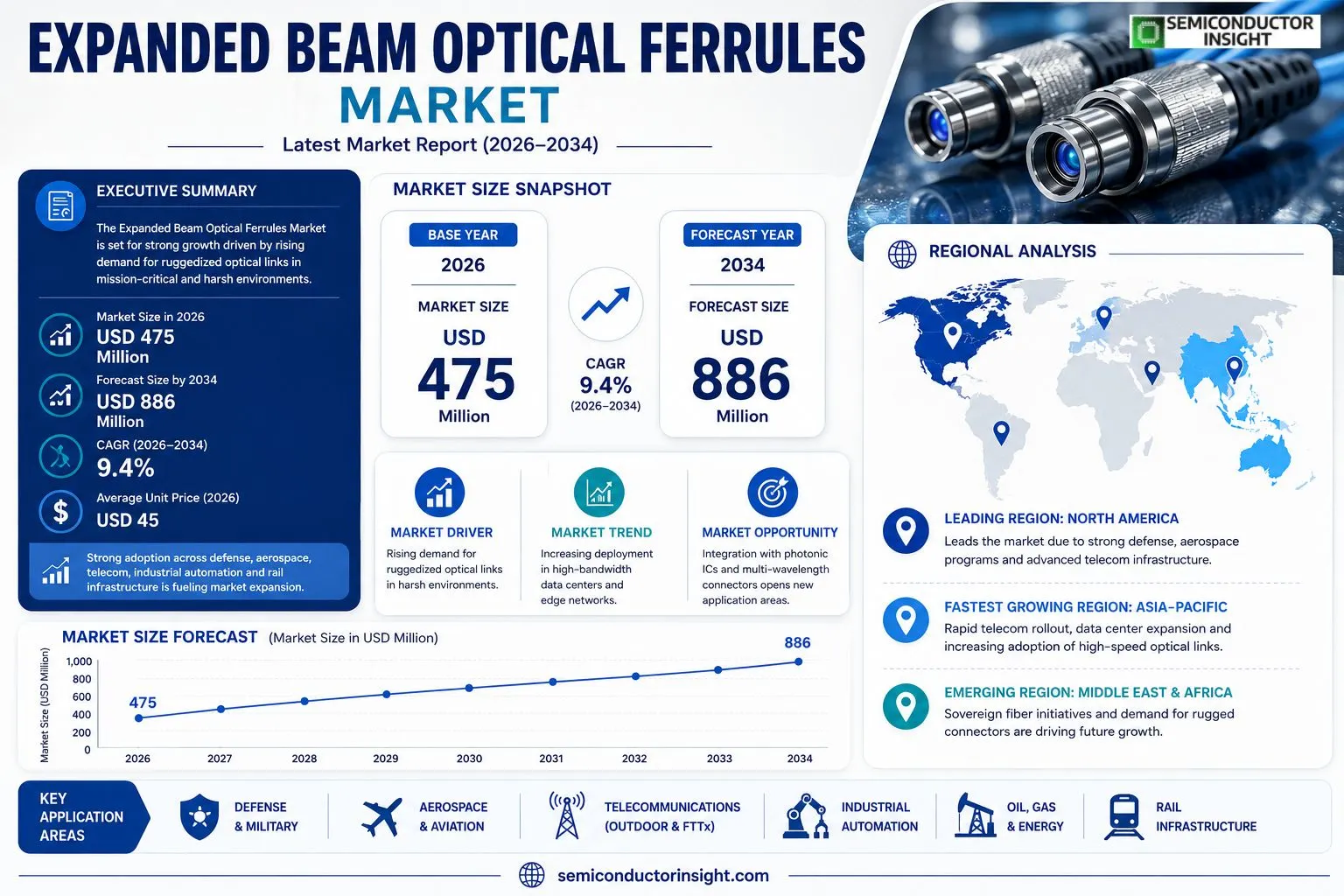
Expanded Beam Optical Ferrules market size was valued at USD 475 million in 2026. The market is projected to reach USD 886 million by 2034, exhibiting a CAGR of 9.4 % during the forecast period.
Expanded Beam Optical Ferrules are precision fiber‑optic interconnect components that incorporate micro‑opticstypically ball lenses or graded‑index lensesto broaden and collimate the light exiting the fiber. In 2026, worldwide production amounted to approximately 11.6 million units against a capacity of roughly 14 million units, with an average unit price of USD 45 and gross margins near 40 %. Their design mitigates sensitivity to dust, vibration and minor misalignment, making them suitable for harsh‑environment sectors such as defense, aerospace, oil & gas, outdoor telecommunications, industrial automation and rail infrastructure.The upward trajectory stems from rising demand for ruggedized optical links in mission‑critical systems and increasing adoption of high‑bandwidth connectivity in remote installations. Supply‑chain robustness is supported by upstream providers of high‑purity optical glass, sapphire and zirconia ceramics, while midstream manufacturers apply micromachining, lens polishing and laser‑weld assembly before rigorous interferometric testing. Key suppliersincluding TE Connectivity, Radiall, Amphenol Fiber Systems and Sumitomo Electriccontinue expanding product portfolios to address evolving OEM requirements.
MARKET DRIVERS
Rising Data‑Center Bandwidth Requirements
The surge in hyperscale data‑center deployments is compelling network architects to adopt higher‑speed links. Expanded beam optical ferrules enable low‑loss, high‑precision coupling between multimode fibers, directly addressing the need for reliable transmission at 40 Gbps and beyond. Operators are therefore prioritizing this technology to avoid costly retrofits.
Automotive Lidar and ADAS Expansion
Automakers are integrating increasingly sophisticated lidar sensors for advanced driver‑assistance systems. The compact form factor of expanded beam ferrules reduces alignment tolerances in cramped sensor packages, making them attractive for mass‑production vehicles. Manufacturers see a clear path to cost reduction while preserving optical performance.
➤ Industry surveys indicate that firms adopting expanded beam solutions have cut installation time by up to 30 % compared with traditional ferrules.
These dynamics are reshaping procurement strategies across telecom, aerospace, and defense sectors, where time‑to‑market and system reliability dominate decision‑making. The convergence of these forces is creating a fertile environment for Expanded Beam Optical Ferrules Market.
MARKET CHALLENGES
Stringent Certification Requirements
Regulatory bodies in aerospace and medical device industries impose rigorous testing protocols for fiber‑optic components. Achieving compliance often involves extensive burn‑in and environmental stress screening, extending the product development cycle and inflating costs for suppliers.
Other Challenges
Cost Competitiveness
While expanded beam ferrules deliver performance benefits, their manufacturing processes remain more labor‑intensive than conventional precision ferrules. Companies must balance price pressures from large telecom contracts with the premium cost structure of the technology.Additional hurdles include limited awareness among procurement teams that are accustomed to legacy components, requiring educational outreach and demonstrable ROI case studies to accelerate adoption.
MARKET RESTRAINTS
Supply‑Chain Vulnerabilities
Key raw materials such as high‑purity silica and specialty polymers are sourced from a narrow supplier base. Recent geopolitical tensions have highlighted the risk of bottlenecks, prompting buyers to re‑evaluate inventory strategies and potentially delay new projects.Furthermore, the niche nature of expanded beam technology means that a limited number of qualified contract manufacturers exist, constraining scaling efforts and leading to longer lead times for high‑volume orders.These supply‑side constraints can dampen enthusiasm for large‑scale rollouts, especially in regions where alternative fiber‑optic solutions are readily available at lower cost.
MARKET OPPORTUNITIES
Integration with Photonic Integrated Circuits (PICs)
The convergence of fiber optics and silicon photonics is unlocking new design architectures for data‑center interconnects. Expanded beam ferrules, with their relaxed alignment tolerances, are ideally suited for coupling light into PICs, creating a value‑added proposition for system integrators seeking to miniaturize optical modules.Emerging standards for 800 nm and 1310 nm multimode transmission in short‑reach applications further broaden the addressable market, encouraging vendors to develop custom ferrule kits tailored to specific wavelength windows.Strategic partnerships between ferrule manufacturers and optical component designers could accelerate time‑to‑market for next‑generation transceivers, positioning early adopters to capture a measurable share of the expanding ecosystem.
Expanded Beam Optical Ferrules Market Trends
Rising Adoption in Harsh Environments
The sector’s shift toward ruggedized optical interconnects reflects a growing demand for reliability in fields where downtime translates directly into operational risk. Manufacturers are engineering ferrules with micro‑optics that tolerate dust, vibration and minor mis‑alignment, allowing system integrators to replace traditional physical‑contact components without redesigning cable bundles. Defense contracts that require frequent mating cycles and telecom projects extending infrastructure to remote, exposed sites are fuelling this shift. Procurement patterns now favor suppliers capable of preserving healthy gross margins while moving closer to the 14 million‑unit production capacity that currently exceeds the 11.6 million units manufactured each year. The result is a market that rewards firms able to balance cost‑efficient scaling with the precision required for high‑performance fiber links.
Other Trends
Supply‑Chain Consolidation
Upstream producers of high‑purity glass and zirconia are aligning with midstream ferrule assemblers to lock in material pricing and shorten lead times. These collaborations compress the cycle from lens polishing to final environmental testing, a necessity for programs featuring rapid‑mating cycles such as rail signaling and offshore platforms. As larger, vertically integrated players capture the bulk of revenue, smaller niche firms are finding viability by concentrating on custom wavelength solutions or specialized connector form factors. The consolidation also mitigates exposure to geopolitical fluctuations in raw‑material sources, thereby enhancing supply‑chain resilience for OEMs that cannot afford interruptions.
Emergence of Multi‑Wavelength Connectors
Clients in aerospace and high‑speed data transport are requesting connectors that operate across the 850 nm, 1310 nm and 1550 nm bands within a single housing. This trend pushes manufacturers toward hybrid lens designs that retain the alignment tolerance of expanded‑beam technology while supporting broader spectral windows. Delivering multi‑band capability lets OEMs future‑proof platforms and reduces the inventory burden of maintaining separate product lines. Consequently, a modest but strategically important revenue stream is developing alongside the dominant single‑mode segment, encouraging firms to invest in R&D that blurs the line between traditional single‑mode and multimode offerings.
COMPETITIVE LANDSCAPEKey Industry Players
Expanded Beam Optical Ferrules Market: Competitive Overview
The market is anchored by a handful of multinational manufacturers that control the majority of high‑volume production capacity. TE Connectivity, with its extensive connector portfolio and deep ties to defense and aerospace OEMs, remains the de‑facto benchmark for reliability and price performance. Its vertical integrationfrom precision glass polishing to laser‑weld assemblyallows the firm to sustain gross margins close to the 40 % benchmark while pricing units near $45. Radiall and Amphenol Fiber Systems complement this tier by leveraging proprietary micro‑optic designs that improve dust‑tolerance, a feature increasingly demanded by rail‑infrastructure and outdoor telecom contracts. The concentration of these three players translates into roughly half of the 2026 revenue pool, shaping pricing dynamics and setting technology roadmaps that downstream system integrators must accommodate.Beyond the core tier, a diverse set of niche specialists adds depth to the ecosystem. Companies such as Amphenol Socapex, US Conec, and 3M Company focus on customized connector families for MIL‑DTC‑38999 or ARINC platforms, often winning contracts that require rapid mating cycles. European firmsincluding Diamond SA, ODU GmbH, and LEMO Groupdifferentiate through ultra‑low‑loss lens materials and bespoke packaging for aerospace avionics. Asian manufacturers like Sumitomo Electric, Molex, and Hirose Electric benefit from proximity to key optical‑glass suppliers, enabling faster response to emerging wavelength segments (850 nm, 1310 nm, 1550 nm). Smaller innovators such as Glenair, Fischer Connectors, and JAE supplement the landscape with limited‑run, high‑reliability offerings that serve niche maritime and subsea applications. Collectively, these firms broaden competitive pressure, stimulate incremental product improvements, and create acquisition targets for the larger players seeking to plug capability gaps.
List of Key Expanded Beam Optical Ferrules Companies Profiled
- TE Connectivity
- Radiall
- Amphenol Fiber Systems
- Amphenol Socapex
- US Conec
- 3M Company
- Diamond SA
- Sumitomo Electric
- ODU GmbH
- Molex
- Glenair
- LEMO Group
- Hirose Electric
- Fischer Connectors
- JAE (Japan Aviation Electronics)
Segment Analysis:
| Segment Category | Sub-Segments | Key Insights |
| By Type |
|
Single Mode (SM) Type dominates the market because its tighter mode field diameter aligns well with high‑precision micro‑optics, delivering superior beam stability in harsh environments. • Engineers favor SM ferrules for defense‑grade connectors where alignment tolerance is critical. • The SM architecture simplifies integration with single‑mode fiber networks, reducing the need for additional conditioning optics. • Its reliability under vibration and dust exposure makes it the preferred choice for aerospace and rugged telecom deployments. |
| By Application |
|
Defense & Military is the leading application segment because expanded‑beam ferrules meet the stringent reliability and repeatability requirements of mission‑critical systems. • Ruggedized connectors built with these ferrules survive extreme temperature swings and mechanical shock. • Frequent mating cycles in field‑deployed platforms are tolerated without performance degradation. • The technology’s inherent dust‑immunity aligns with the harsh, contaminated environments typical of defense communications. |
| By End User |
|
System Integrators lead this category as they orchestrate the deployment of expanded‑beam ferrules into complete communication solutions. • Their deep knowledge of optical engineering enables optimal lens‑to‑fiber alignment, maximizing performance. • They act as intermediaries between component makers and end‑users, ensuring that design specifications meet reliability standards. • Integration projects often involve multiple industries, reinforcing the cross‑sector relevance of the technology. |
| By Wavelength |
|
1550 nm emerges as the preferred wavelength for high‑performance expanded‑beam solutions due to its lower attenuation in silica and compatibility with long‑haul telecom standards. • The longer wavelength eases lens design, allowing larger spot sizes that improve tolerance to misalignment. • It aligns with existing infrastructure in defense and aerospace, facilitating seamless upgrades. • Manufacturers emphasize 1550 nm ferrules when targeting premium, low‑loss applications. |
| By Industry Vertical |
|
Telecommunications drives the most innovative uses of expanded‑beam ferrules, especially for outdoor and long‑distance fiber links. • Network operators value the dust‑resistance that reduces maintenance in remote sites. • The technology supports higher‑density connector arrays, enabling compact payloads in base‑stations. • Its robustness under temperature extremes aligns with the expanding rollout of 5G infrastructure in diverse climates. |
Regional Analysis: Expanded Beam Optical Ferrules Market
North America
Operators are integrating expanded beam ferrules into next‑generation passive optical networks to reduce insertion loss during rapid field splicing. The emphasis on low‑maintenance connectors reflects a shift toward service‑oriented architectures where downtime translates directly into revenue impact.
Federal standards for fiber optic safety and performance have been updated to recognize expanded‑beam configurations, prompting manufacturers to certify products against more stringent bend‑radius criteria and thereby easing market entry barriers.
The regional supply base benefits from a clustered ecosystem of precision glass producers and CNC machining firms, enabling short lead times for bespoke ferrule lengths that align with customized network rollouts.
Key players are leveraging strategic alliances with major telecom integrators, positioning their expanded beam offerings as the preferred choice for projects that demand both high performance and rapid field deployment.
Europe
European telecom operators are navigating a transition from legacy multimode systems to single‑mode platforms that rely heavily on precise connector alignment. In this context, expanded beam optical ferrules serve as a bridge, offering tolerance to mechanical stress while preserving signal integrity across densely packed urban fiber routes. National standards bodies are harmonizing specifications, which reduces fragmentation and encourages cross‑border procurement. Vendors that can demonstrate compliance with both IEC and EN norms gain a distinct advantage, especially in markets where public‑private partnership projects dominate network expansion. Moreover, the region’s strong emphasis on sustainability drives interest in ferrules that extend splice life, thereby lowering material waste and supporting circular‑economy objectives.
Asia‑Pacific
The Asia‑Pacific landscape is defined by a mix of ultra‑high‑capacity backbone projects and rapidly scaling metro networks. Expansion of data centers in emerging economies has heightened the need for connectors that tolerate tighter bend radii without compromising bandwidth. Local manufacturers are investing in additive manufacturing techniques to produce expanded beam ferrules at scale, responding to cost‑sensitivity while maintaining stringent optical performance. Regulatory agencies are gradually aligning with international standards, yet variations persist, prompting multinational suppliers to adopt flexible product portfolios that can be tailored to each country’s certification regime.
South America
In South America, incremental upgrades to aging fiber infrastructure create a niche for expanded beam ferrules that can be retrofitted onto existing splice trays. Operators prioritize solutions that minimize field re‑engineering, as terrain and logistical constraints often inflate installation expenses. Collaborative initiatives between regional utilities and equipment makers have spurred the development of ferrules optimized for tropical humidity, reducing degradation risk. The market narrative centers on cost‑effective performance gains rather than pure technological superiority, aligning with budget‑constrained rollout plans.
Middle East & Africa
Middle Eastern and African deployments are driven by ambitious sovereign fiber initiatives aimed at linking remote communities and supporting burgeoning digital economies. Harsh desert environments demand ferrules with enhanced thermal stability; expanded beam designs that incorporate ceramic sleeves are gaining attention for their resilience. In many African jurisdictions, regulatory frameworks remain nascent, allowing early adopters to shape specification standards. Consequently, suppliers that engage with governmental bodies to co‑create technical guidelines are positioning themselves as long‑term partners in the region’s connectivity agenda.
Report Scope
This market research report provides a comprehensive analysis of the Expanded Beam Optical Ferrules Market , covering the forecast period 2026–2034. It offers detailed insights into market dynamics, technological advancements, competitive landscape, and key trends shaping the industry.
Key focus areas of the report include:
- Market Overview: The report begins with an overview outlining its current market scenario, key growth indicators, and industry transformation drivers. It discusses macroeconomic factors, demand–supply balance, regulatory landscape, and the strategic role of semiconductors in powering advancements across industries such as automotive, telecommunications, consumer electronics, and industrial automation.
- Market Size & Forecast: Historical data and future projections for revenue, unit shipments, and market value across major regions and segments.
- Segmentation Analysis: Detailed breakdown by product type, technology, application, and end-user industry to identify high-growth segments and investment opportunities.
- Regional Insights: Insights into market performance across North America, Europe, Asia-Pacific, Latin America, and the Middle East & Africa, including country-level analysis where relevant.
- Competitive Landscape: Profiles of leading market participants, including their product offerings, R&D focus, manufacturing capacity, pricing strategies, and recent developments such as mergers, acquisitions, and partnerships.
- Technology Trends & Innovation: Assessment of emerging technologies, integration of AI/IoT, semiconductor design trends, fabrication techniques, and evolving industry standards.
- Market Drivers & Restraints: Evaluation of factors driving market growth along with challenges, supply chain constraints, regulatory issues, and market-entry barriers.
- Stakeholder Insights: Insights for component suppliers, OEMs, system integrators, investors, and policymakers regarding the evolving ecosystem and strategic opportunities.
Primary and secondary research methods are employed, including interviews with industry experts, data from verified sources, and real-time market intelligence to ensure the accuracy and reliability of the insights presented.
FREQUENTLY ASKED QUESTIONS:
What is the current market size of Expanded Beam Optical Ferrules Market?
-> Expanded Beam Optical Ferrules Market was valued at USD 475 million in 2026 and is expected to reach USD 886 million by 2034 with a CAGR of 9.4% during the forecast period.
Which key companies operate in Expanded Beam Optical Ferrules Market?
-> Key players include TE Connectivity, Radiall, Amphenol Fiber Systems, Amphenol Socapex, US Conec, 3M Company, Diamond SA, Sumitomo Electric, ODU GmbH, Molex, among others.
What are the key growth drivers?
-> Key growth drivers include the need for reliable fiber‑optic connections in harsh environments such as defense, aerospace, oil & gas, outdoor telecommunications, industrial automation and rail systems, which drive demand for expanded beam ferrules.
Which region dominates the market?
-> North America holds a significant share due to strong defense and aerospace programs, while Asia‑Pacific is experiencing rapid growth driven by telecom infrastructure rollout.
What are the emerging trends?
-> Emerging trends include integration of expanded beam ferrules into ruggedized connectors for MIL‑DTL‑38999 and ARINC standards, and the development of higher‑performance micro‑optics to support 1550 nm wavelengths for long‑haul telecom.
Get Sample Report PDF for Exclusive Insights
Report Sample Includes
- Table of Contents
- List of Tables & Figures
- Charts, Research Methodology, and more...
 Download Sample Report PDF