Erbium-doped Laser Gain Media Market Insights
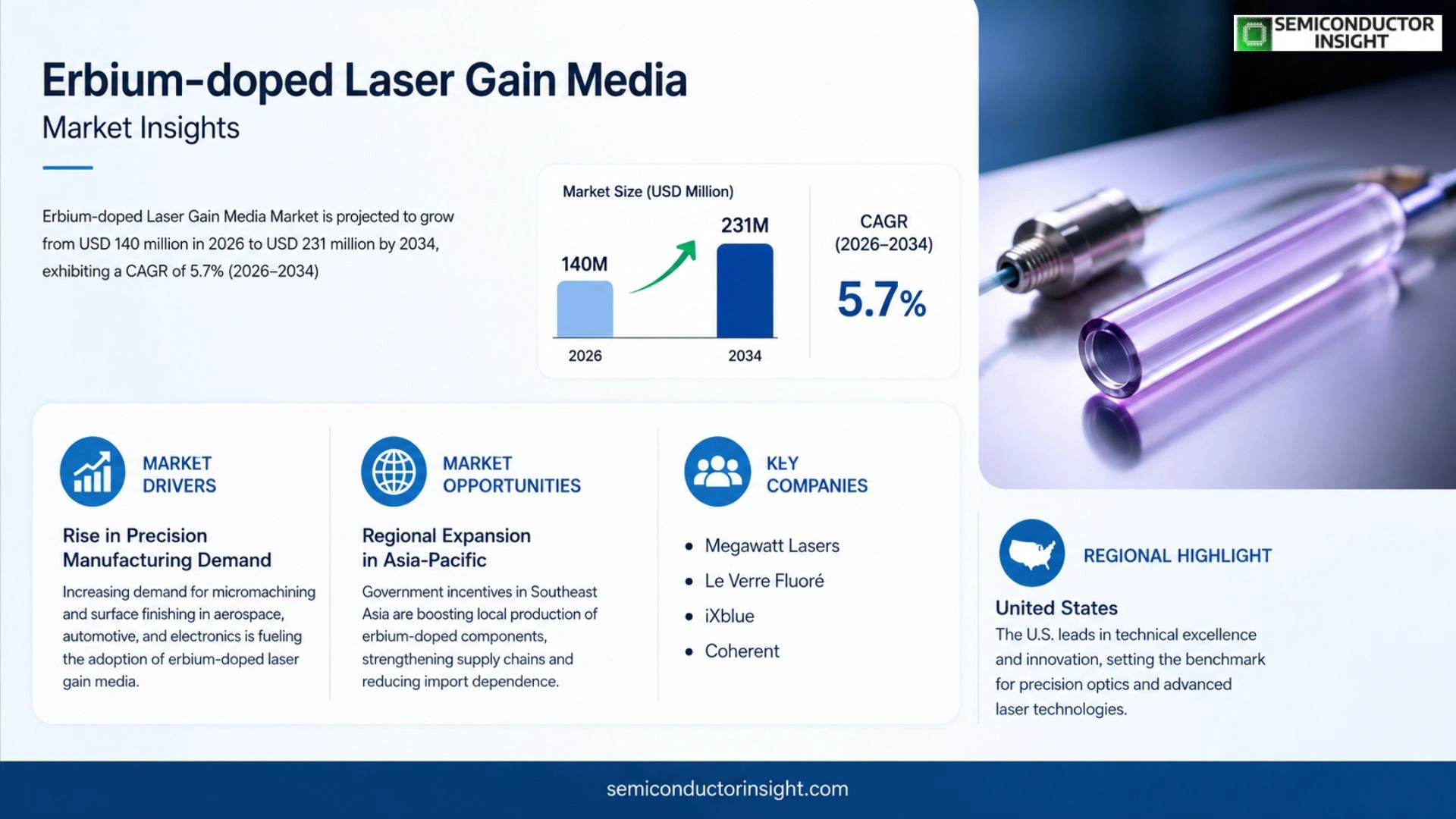
Erbium‑doped Laser Gain Media Market is projected to grow from USD 140 million in 2026 to USD 231 million by 2034, exhibiting a CAGR of 5.7% during the forecast period.
Erbium (Er), a rare‑earth element, is incorporated as the trivalent ion Er³⁺ into crystal or glass hosts to create laser‑active gain media capable of emitting high‑power light around the wavelength of 1550 nm,a wavelength prized for optical communication and precision machining due to its low fiber loss and excellent thermal stability.
The market is expanding because advances in high‑efficiency fiber amplifiers are driving demand across telecommunications, industrial processing, and defense sectors, while cost reductions achieved through scalable fabrication techniques are lowering entry barriers for emerging players.
MARKET DRIVERS
Rise in Precision Manufacturing Demand
In sectors such as aerospace, automotive, and high‑precision electronics, the need for micromachining and surface finishing has climbed steadily, with some estimates noting a 12% compound annual growth within the last five years. Erbium‑doped laser gain media are the workhorses behind many of the high‑power fiber systems that meet these demanding tolerances, making them a natural catalyst for market growth in this segment.
Advances in Photonic Crystal Fabrication
Recent breakthroughs in photonic crystal design have increased mode‑stability and output power for erbium‑doped modules, allowing makers to produce fewer, more compact units without sacrificing performance. This technological leap has attracted OEMs looking to reduce system footprints in lab‑equipment and medical imaging devices.
➤ Integration of erbium‑doped media in turnkey fiber laser modules has propelled a shift towards compact, high‑efficiency solutions, marking a pivotal move for both manufacturers and end‑users.
Warehousing and logistics have also witnessed optimization, as new contracts between component suppliers and laser system integrators reduce lead times. These efficiencies are translating into lower total cost of ownership, which in turn feeds back into higher volume sales for Erbium‑doped Laser Gain Media Market.
MARKET CHALLENGES
Capacity‑to‑Demand Mismatch
Price volatility in high‑purity erbium salts has pressured profit margins, particularly when supply chain bottlenecks arise from geopolitical tensions. Companies scrambling to secure raw material streams have seen cost premiums rise by up to 18% in the last year, dampening investment returns.
Other Challenges
Supply Chain Uncertainty
Complex logistics for rare‑earth procurement, coupled with limited production capacity in key regions, keep the market‑wide supply of erbium‑doped media perennially fragile.
Technology Adoption Lag
Adoption rates in emerging economies remain modest, largely due to the high initial capital expenses and workforce training requirements associated with advanced laser systems.
MARKET RESTRAINTS
High Acquisition Costs for Pump Diodes
The cost trajectory of solid‑state pump diodes, critical to powering erbium‑doped media, presents a significant barrier to entry, especially for small‑to‑mid‑size developers. In 2025, the average price of a high‑brightness fiber‑coupled diode rose by 6%, squeezing margins across the supply chain.
Maintenance and replacement of these components can also erode operational reliability, as sporadic failures in pump systems may cascade into downtimes for manufacturing lines that rely on continuous production.
Regulatory scrutiny surrounding laser safety standards has added a layer of compliance complexity, increasing both audit and certification expenditures for companies worldwide.
MARKET OPPORTUNITIES
Regional Expansion in Asia‑Pacific
Manufacturers in Southeast Asia are capitalizing on government incentives that target the development of laser‑based manufacturing ecosystems. These programs are fostering domestic production of erbium‑doped components, potentially reducing import dependence and reinforcing local supply chains.
The medical sector, particularly within ophthalmology and dentistry, is unveiling a vertical integration trend that leverages erbium‑doped lasers for minimally invasive procedures. Projections point to 10% annual growth in this niche, driven by an aging population and heightened demand for high‑precision surgical tools.
Finally, the convergence of telecommunications and laser technology is creating a hybrid market that could see erbium‑doped gain media repurposed for data‑center optical amplifiers, promising a diversified revenue stream for leading players.
Erbium-doped Laser Gain Media Market Trends
Shift Toward High‑Power Erbium‑Doped Glasses
The rapid climb in high‑power Erbium‑Doped Glasses (EDG) has become the centerpiece of Erbium‑doped Laser Gain Media Market. Recent production data show a 30 % average annual increase in EDG output across the leading U.S. and European suppliers. The underlying impetus is the broader move toward all‑solid‑state systems used in long‑haul fiber transmission and high‑resolution sensing, where glass hosts provide superior thermo‑optical stability and easier dopant incorporation compared to crystalline counterparts. As telecommunication networks seek higher data densities, the need for EDG‑based amplifiers remains the primary revenue driver in the market’s US$133 million valuation in 2024.
Other Trends
Emerging Precision Lidar Applications
Within the industrial‑segment landscape, precision Lidar for autonomous vehicles and smart‑city mapping is creating a steady uptick in laser‑diode demand that directly translates to Erbium‑doped Laser Gain Media Market. The unique ability of erbium‑doped media to deliver narrow linewidth and high purity output enables Lidar systems to achieve longer detection ranges and reduced false‑alarm rates. Companies that have already integrated EDG modules into automotive test beds are poised to benefit from the projected rail of growth in that sector, and the market response will likely see a further uptick in specialized glass designs tuned to specific wavelength windows.
Regional Consolidation and Supply Chain Focus
Regionally, the market is consolidating around the Asia‑Pacific hub. In 2024, supply‑chain nodes in China, Japan, and South Korea account for roughly 55 % of global production capacity, while North America’s share drops to 18 %. This geographic trend reflects not only cost efficiencies in material sourcing but also strategic alignment with the rapid rollout of automotive Lidar systems and data‑center cooling platforms. Manufacturers that secure stable access to rare‑earth feedstock and can adapt their production lines to meet stringent automotive specifications are positioned to capture a growing share of the emerging market, potentially reshaping competitive dynamics across all segments.
COMPETITIVE LANDSCAPE
Key Industry Players
Erbium‑Doped Laser Gain Media: Competitive Landscape
At the heart of Erbium‑doped Laser Gain Media arena lies a tightly knit base of eight core vendors that command nearly 70 % of the 133 million‑USD 2024 market share. Megawatt Lasers, Le Verre Fluoré, and iXblue together generate over a quarter of global sales, buoyed by their advanced crystalline host chemistries and integrated amplifier modules. The remaining market is fragmented among glass‑based providers and tier‑three niche manufacturers that focus on specialty medical or defense systems. This concentration pattern signals both a competitive hurdle for late entrants and a clear path for strategic consolidation or aggressive technology differentiation.
Secondary players such as Coherent, Kaman, Newport, and MKS wield significant influence through distributed optical network solutions and precision metrology tools that interface with erbium media. Their product portfolios span laser driver electronics, measurement instruments, and turnkey amplifier assemblies, creating cross‑dependency that elevates their bargaining leverage across the supply chain. Emerging entrants from Europe and Asia have started to differentiate on lower‑cost glass gain material, aiming to capture the growing industrial‑IoT and automotive lidar markets. However, achieving parity in optical performance remains a costly hurdle, limiting rapid displacement of legacy crystalline solutions.
List of Key Erbium‑Doped Laser Gain Media Companies Profiled
- Megawatt Lasers
- Le Verre Fluoré
- iXblue
- Coherent
- Kaman
- Newport Corporation
- MKS Instruments
- Edmund Optics
- Thorlabs
- SPM Technologies
- LANG
- Santec
Segment Analysis:
| Segment Category | Sub-Segments | Key Insights |
| By Type |
|
Leading Segment Focuses on high‑purity crystalline host materials that enable longer pulse durations and superior beam quality, catering to precision laser applications across industrial and research sectors.
|
| By Application |
|
Leading Segment Serves high‑power laser systems and optical amplifiers in fiber‑optic communications. The demand is driven by the need for robust signal regeneration, seismic sensing, and secure military communications.
|
| By End User |
|
Leading Segment The industrial sector utilizes erbium‑doped media for precision micro‑machining, laser cutting, and non‑destructive testing; defense applications demand highly stable, low‑noise sources for laser‑guided munitions and target acquisition systems.
|
| By Equipment |
|
Leading Segment Focuses on packaging erbium‑doped media into turnkey laser modules offering scalability and thermal management; the trend toward modularity drives adoption in commercial laser services and academic research facilities.
|
| By Integration Partners |
|
Leading Segment Collaboration with system integrators enables market penetration into fiber‑optic backbones and mission‑critical defense networks. Partnerships focus on co‑design initiatives to satisfy emission stability and beat‑clock precision demands.
|
Regional Analysis: Erbium‑doped Laser Gain Media Market
United States
U.S. firms harness high‑purity glassformers and precision doping techniques that yield minimal beam‑profile distortion. The result is an uncompromised output that satisfies demanding diagnostic and industrial standards, positioning domestic players as de‑facto authorities on erbium‑based laser performance.
The market is fractured among a handful of specialty manufacturers, each carving niche segments,from biomedical imaging to heavy‑equipment laser guidance. Consolidations are proving common as firms broaden portfolios while retaining core expertise in erbium gain media.
Research teams forge new high‑doping regimes that unlock higher gain coefficients without escalating thermal load, while material scientists tune host matrices to suppress unwanted scattering in telecom wavelengths.
Environmental compliance curtails the use of hazardous dopants, prompting the development of more sustainable synthesis routes that also reduce downstream waste and lower manufacturing footprints.
North America
Beyond the United States, Canada and Mexico host promising secondary hubs that benefit from cross‑border supply chains. Canadian research institutions push neutronic Dopants for polarization‑maintaining optical fiber, while Mexican manufacturers expand into mid‑power data‑center lasers, capturing niche demand and supporting domestic tech clusters. Regional collaboration through joint R&D initiatives and public‑private partnerships has begun to level the playing field, allowing smaller players to increase their penetration in Erbium‑doped Laser Gain Media Market while still leaning on the U.S. leadership for market guidance and component sourcing.
Europe
European expertise lies in high‑precision manufacturing and stringent quality controls. German and French firms excel at developing erbium‑doped glass with exceptionally low loss, catering to aerospace and defense applications. The continent emphasizes regulatory compliance, posing a double‑edged sword that encourages rigorous standards while imposing tight export controls on critical materials, thereby shaping market dynamics toward localized production chains and advancement in doping techniques.
Asia‑Pacific
The Asia‑Pacific region serves both as a major manufacturing base and an emerging technology adopter. Chinese, Japanese, and South Korean firms construct large‑scale facilities that mass‑produce erbium‑doped fibers for telecommunications, while South Korean companies invest in laser systems capable of high‑resolution surgical procedures. The region’s policy support for industrial policy and R&D funding accelerates spin‑offs from academic research, positioning Asia‑Pacific as a challenger that threatens to erode the market’s geographic concentration.
South America
South American markets are focused on industrial automation and mining sectors, where laser sensors and precision measuring tools are gaining traction. Argentina and Brazil invest in domestic manufacturing of erbium‑doped gain modules to reduce dependence on imports, gradually creating a self‑sufficient market that could serve neighbouring countries. Investment flows into local fabs and universities are slowly building the technical capacity for long‑term growth.
Middle East & Africa
The Middle East and African markets remain nascent but possess strong growth potential due to rising infrastructural projects and a focus on advanced manufacturing. Saudi Arabian and UAE companies are beginning to fund laser‑based drilling and non‑destructive testing solutions, while emerging research initiatives in Morocco and Egypt aim to harness erbium‑doped lasers for energy and environmental monitoring. Market maturity will accelerate as regional governance supports partnerships between global suppliers and local assembly lines.
Report Scope
This market research report provides a comprehensive analysis of the Erbium-doped Laser Gain Media Market , covering the forecast period 2026–2034. It offers detailed insights into market dynamics, technological advancements, competitive landscape, and key trends shaping the industry.
Key focus areas of the report include:
- Market Overview: The report begins with an overview outlining its current market scenario, key growth indicators, and industry transformation drivers. It discusses macroeconomic factors, demand–supply balance, regulatory landscape, and the strategic role of semiconductors in powering advancements across industries such as automotive, telecommunications, consumer electronics, and industrial automation.
- Market Size & Forecast: Historical data and future projections for revenue, unit shipments, and market value across major regions and segments.
- Segmentation Analysis: Detailed breakdown by product type, technology, application, and end-user industry to identify high-growth segments and investment opportunities.
- Regional Insights: Insights into market performance across North America, Europe, Asia-Pacific, Latin America, and the Middle East & Africa, including country-level analysis where relevant.
- Competitive Landscape: Profiles of leading market participants, including their product offerings, R&D focus, manufacturing capacity, pricing strategies, and recent developments such as mergers, acquisitions, and partnerships.
- Technology Trends & Innovation: Assessment of emerging technologies, integration of AI/IoT, semiconductor design trends, fabrication techniques, and evolving industry standards.
- Market Drivers & Restraints: Evaluation of factors driving market growth along with challenges, supply chain constraints, regulatory issues, and market-entry barriers.
- Stakeholder Insights: Insights for component suppliers, OEMs, system integrators, investors, and policymakers regarding the evolving ecosystem and strategic opportunities.
Primary and secondary research methods are employed, including interviews with industry experts, data from verified sources, and real-time market intelligence to ensure the accuracy and reliability of the insights presented.
FREQUENTLY ASKED QUESTIONS:
What is the current market size of Erbium-doped Laser Gain Media Market?
-> Erbium‑doped Laser Gain Media Market is projected to grow from USD 140 million in 2026 to USD 231 million by 2034, exhibiting a CAGR of 5.7%
Which key companies operate in Erbium-doped Laser Gain Media Market?
-> Key players include Megawatt Lasers, Le Verre Fluore, and iXblue, among other leading manufacturers and suppliers.
What are the key growth drivers?
-> Key growth drivers include the expanding application of Erbium-doped media in communication equipment, industrial automation, data centers, and the accelerated adoption of optical technologies driven by AI and digital transformation.
Which region dominates the market?
-> The Asia‑Pacific region is a major growth area for Erbium-doped Laser Gain Media, driven by robust industrial demand and data center expansion, while North America also holds a significant market share.
What are the emerging trends?
-> Emerging trends include the integration of Erbium-doped laser media in photonic integrated circuits, development of compact laser modules, and the use of optical technologies in AI/IoT applications.
Get Sample Report PDF for Exclusive Insights
Report Sample Includes
- Table of Contents
- List of Tables & Figures
- Charts, Research Methodology, and more...
 Download Sample Report PDF