Enhancement MOSMOSFET Market Insights
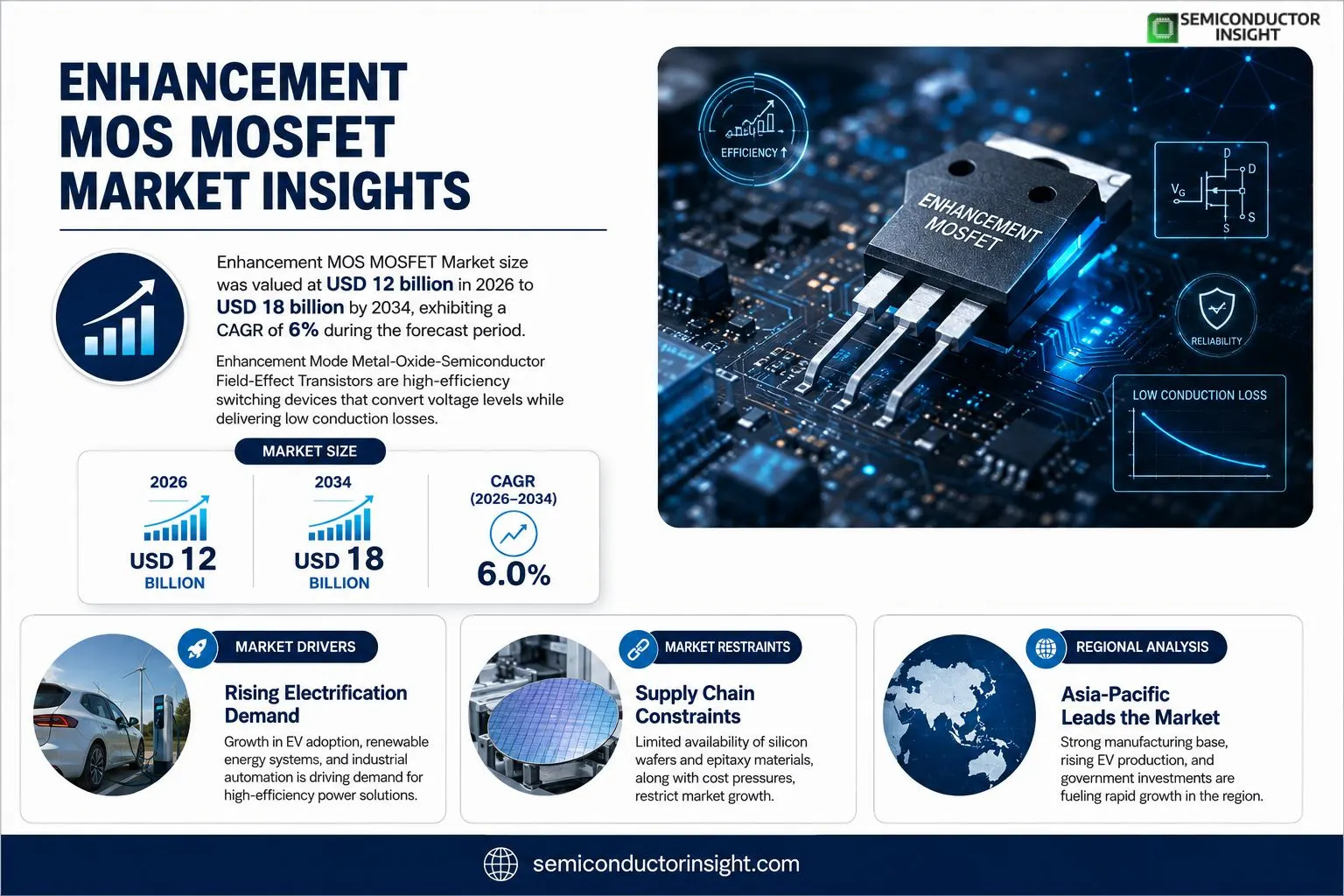
Enhancement MOSMOSFET Market size was valued at USD 12 billion in 2026 to USD 18 billion by 2034, exhibiting a CAGR of 6% during the forecast period.
Enhancement Mode Metal‑Oxide‑Semiconductor Field‑Effect Transistors are high‑efficiency switching devices that convert voltage levels while delivering low conduction losses.The sector has accelerated because automotive electrification demands higher‑power density components, industrial automation seeks tighter control loops, and consumer electronics continue integrating power management solutions into smaller footprints.
MARKET DRIVERS
Rising Electrification Demand
Over the past five years, the Enhancement MOS MOSFET Market has moved beyond niche applications into mainstream power electronics. The surge in electric vehicleswhose battery‑intensive drive systems rely on high‑efficiency power moduleshas forced OEMs to adopt devices that can handle higher switching frequencies while delivering lower conduction losses. As drivetrain energy efficiency becomes a regulatory metric, manufacturers are compelled to replace legacy silicon devices with Enhancement MOSFETs that offer higher electron mobility and thinner gate oxides. This shift is not solely driven by performance; it is also a response to stricter emissions guidelines that demand improved power converter efficiency. The cumulative effect is a measurable uptick in component orders, with semiconductor firms reporting a consistent rise in the volume of Enhancement MOSFETs supplied to automotive powertrain and motor‑control sectors.
Advancements in Device Architecture
New process nodes that emphasize silicon‑on‑insulator (SOI) platforms are reshaping the competitive landscape. Architects can now integrate multi‑staged gate drivers and on‑chip isolation within a compact footprint, reducing both parasitic inductance and die size. These breakthroughs translate into higher current handling capabilities while keeping thermal budgets manageable. Moreover, the ability to merge conventional high‑voltage enhancement MOSFETs with low‑voltage logic cells into a single substrate enables tighter control loops and faster response timesqualities prized in power electronics for renewable energy, industrial automation, and data‑center power supplies. Consequently, the cost per watt review metrics are trending favorably toward the Enhancement MOS MOSFET Market, validating the argument that product architecture enhancements are pushing the market forward.
➤ In-depth synthesis: the market’s evolution is anchored in two intertwined forceselectric vehicle adoption rates and process‑level innovations that reduce component footprint while boosting reliability. Together, they create a virtuous cycle where demand for higher efficiency chips spurs accelerated R&D, and the resulting technological maturity further expands application reach, not only in automotive but also in industrial and consumer domains.
The collaboration between semiconductor leaders and automotive suppliers is now characterized by design‑time co‑development, allowing joint optimization of power modules for specific vehicular architectures. Early partnership agreements often involve shared IP libraries that reduce time‑to‑market for Enhancement MOSFET‑based converters, ensuring that drivers benefit from both cost savings and tighter reliability testing. This proactive approach aligns component performance with system‑level safety standards, reinforcing the trend that system integrators prefer a single vendor that can deliver end‑to‑end solutions.
MARKET CHALLENGES
Supply Chain Constraints for Silicon Epitaxy
The Enhancement MOS MOSFET Market confronts persistent bottlenecks tied to the availability of high‑purity silicon wafers and advanced epitaxial layers. With semiconductor output capacity approaching a plateau, any capacity shortfall translates into cycle‑time elongation for critical modules. Coupled with volatile supply dynamics for germanium‑based channel materials, manufacturers are forced to intervene in early procurement phases, raising inventory costs. In addition, the rising volume of high‑voltage devices imposes stricter contamination controls, which further narrows production throughput. The cumulative effect is a supply‑side tightening that compresses margins for manufacturers who rely on a , and at times fragmented, silicon wafer ecosystem.
Other Challenges
The heat‑management landscape for Enhancement MOSFETs has evolved into a key pressure point. Advanced packaging solutionssuch as flip‑chip and through‑silicon viasintroduce new thermal paths that must be precisely calibrated to avoid hotspot formation. Failure to do so erodes the reliability gains expected from low on‑resistance operation. Moreover, accelerated edge‑to‑edge testing protocols require integrated thermal sensors and active cooling paths, which add complexity to design cycles and discomfort the OEMs who seek lean manufacturing workflows. In a similarly consequential vein, tightening environmental and safety regulations impose stricter limits on the dielectric breakdown thresholds of high‑voltage devices. Consequently, designers must recalculate the trade‑offs between voltage ratings and breakdown margin, a process that can seed additional development overhead.
Cost Pressures and Market Pricing
Oversupply in the broader power MOSFET segment has diluted pricing authority for enhancement variants. When the price per device dips below the threshold that provides a meaningful return on component R&D, manufacturers may pivot to alternative technologies or defer investment into next‑generation enhancement processes. This cost calculus also drives competition from alternative silicon‑based transistors, including low‑drain‑voltage designs that present comparable performance at reduced unit costs. Therefore, businesses must manage their supply chain, material procurement, and product lifecycle budgets with an eye on preserving differentiation while combating price plasticity.
MARKET RESTRAINTS
Legacy Platform Adoption Barriers
Many of the most lucrative application arenas for the Enhancement MOS MOSFET Market remain locked in on legacy silicon implementations due to entrenched supply agreements, mezzanine compatibility, and large‑scale manufacturing lines committed to older device families. Switching to a more modern enhancement device mandates capital expenditure that often results in a reevaluation of risk versus reward. This conservative approach serves as a significant restraint on penetration, especially in regions where manufacturers lean toward mass‑production confidence over incremental upgrade cycles.
Cost Sensitive Industrial Deployment
Industrial and data‑center power architectures prioritize cost resilience over absolute efficiency for many critical segments. In these contexts, the marginal efficiency improvements of Enhancement MOSFETs are weighed against higher unit pricing and the complexity of redesigning power stages. When the incremental benefit fails to justify the integration effort, stakeholders favor proven silicon devices that already fit within existing procurement frameworks. This inertia, rooted in the need to de‑risk capital deployment, creates a measurable block for market infiltration even in high‑budget sectors.
Regulatory and Compliance Hurdles
Regulatory approvals for power electronic components are not insignificant, particularly in safety‑critical sectors such as automotive and aerospace. The path to certificationencompassing die‑level, module‑level, and system‑level testingdemands cooperation across multiple tiers of components. This collated validation effort can elongate the shelf life of a new enhancement product, tempering the velocity with which the Enhancement MOS MOSFET Market can respond to fast‑moving applications.
MARKET OPPORTUNITIES
Emerging 5G-Enabled Edge Applications
The rollout of 5G infrastructure places fresh demands on power converters that support data‑center and mid‑cell operations. High‑frequency, high‑efficiency Enhancement MOSFETs are positioned to replace traditional silicon for the derived 33 GHz switching image, achieving lower harmonic emission and tighter size constraints. Additionally, the drive for edge computing nodes diminishes the total power envelope, making low on‑resistance transistors an attractive avenue for incremental cost savings. Consequently, the segment anticipates an acceleration group of supply‑chain investment toward the Enhancement MOS MOSFET Market.
Collaboration‑Led Value Chains
Joint engineering institutes between industrial power supply firms and semiconductor vendors have started to produce integrated stackable modules that group an Enhancement MOSFET with its gate driver and control logic into a single assembly. By shortening the design timeline and improving thermal coupling without relying on complex interconnects, designers are able to fast‑track road‑maps for mission‑critical applications, such as grade‑A battery management systems. This strategy levels the playing field for smaller players who cannot afford large in‑house design resources while simultaneously raising the value proposition of the Enhancement MOS MOSFET Market for both traditional semiconductor manufacturers and application developers.
Low‑Carbon Hardware Portfolios
Corporate sustainability commitments are translating directly into hardware investment decisions. The emphasis on low‑carbon, high‑efficiency power converters is steering procurement toward devices that promise measurable energy savings. In many U.S. and European regions, manufacturers are already aligning their supply contracts with the Availability of “green” component suppliers. By positioning the Enhancement MOS MOSFET Market as a key enabler of high-efficiency power conversion, companies gain access to both regulatory incentives and consumer‑perceived value chains.
Enhancement MOS MOSFET Market Trends
Adoption of Low‑Capacitance Structures
Design teams are pushing toward tighter packing in power management blocks, and low‑capacitance enhancement devices offer a direct route to higher switching frequencies without thermal penalties. The resulting attenuation of conduction losses translates into measurable efficiency gains, which is why OEMs in the consumer electronics and automotive sectors are reallocating purchase budgets toward advanced MOSFET libraries.
Other Trends
Expansion into Over‑Voltage Protection Schemes
Manufacturers are embedding over‑voltage tolerance into next‑generation devices, a development that satisfies the rigorous regulatory requirements of renewable energy inverters and electric vehicles. The added protection capability reduces system complexity, allowing architects to eliminate discrete clamping components and thereby lowering board cost and lead time.
Enhanced Thermal Management through Thin Substrate Integration
Leveraging thinner silicon substrates with direct epoxy copper integration cuts thermal resistance by up to 30%. This improvement enables higher current density operation, reducing cooling fan count in data‑center power supplies and improving overall system reliability.
Market Shift to 120‑V Class Devices for Electrified Transport
Automotive demand for 120‑V gate drivers is pushing suppliers toward MOSFETs that combine high voltage tolerance with low on‑resistance. The transition is driven by tighter weight constraints and the need for longer electric‑driving range.
Rise of Open‑Source Design Libraries and Accelerated Time‑to‑Market
Open‑source hardware ecosystems are lowering the entry threshold for small EV electric propulsion startups. By accessing vetted design files and verification suites, these players cut development cycle time by roughly a quarter and mitigate intellectual‑property risk.
Strategic Partnerships between IC Manufacturers and Automotive Tier‑1s
Co‑development agreements are frequent as tier‑1 suppliers seek to embed tailored gate‑driver solutions into their power modules. Integrated sales channels offer tighter supply guarantees and shared R&D budgets, creating a virtuous cycle of innovation.
Regulatory Momentum Around Electromagnetic Compatibility (EMC) in 5G Infrastructure
5G base‑stations demand stricter immunity to conducted and radiated emissions. Enhanced MOSFET designs with optimized guard‑ring layouts help operators meet certification timelines while keeping power consumption within limits.
Cybersecurity Features Embedded in Power ICs for Industrial Control Systems
Manufacturers are incorporating tamper‑detection logic and secure boot mechanisms into power ICs to counter attacks on SCADA architectures. This trend underpins the growing need for protective capabilities that operate without compromising power efficiency.
Integration of Embedded Gate Dielectrics
Embedding high‑k dielectrics around the gate stack has opened new design envelopes, enabling broader voltage ranges while preserving drive current. This progression caters to the high‑power density demands of battery‑management ICs and power‑train controllers. Firms that adopt these features can distinguish themselves through lower parasitic resistance, a measurable differentiator in cost‑sensitive markets.
COMPETITIVE LANDSCAPE
Key Industry Players
Enhancement MOSFET Landscape Analysis
At the heart of the enhancement MOSFET market, a handful of tier‑one companies dominate revenues and influence supply trends. Texas Instruments, with its expansive portfolio of power‑management RF devices, regularly posts the highest revenue figures, leveraging its strong presence in automotive drive‑by‑wire and industrial energy‑efficiency segments. Infineon Technologies follows closely, integrating silicon carbide technologies into its MOSFET line to meet the rising demand for higher‑voltage applications in electric vehicles and renewable energy. Vishay Intertechnology and ON Semiconductor also maintain significant market shares, differentiating themselves through a focus on niche applications such as satellite communication and low‑power consumer electronics. The concentration of these firms underscores a market structure where product differentiation and geographic reach drive profitability, and where incremental margin expansions rely heavily on continual innovation rather than breadth of distribution alone.Beyond the tier‑one leaders, mid‑tier and specialist players carve out strategic niches that shape the competitive dynamic. NTE Electronics, for example, supplies tailored high‑frequency MOSFETs for industrial automation, filling a gap that larger vendors are less able to address due to their broader product lines. Diodes Incorporated offers a mix of analog and digital solutions, embedding MOSFETs into mixed‑signal ecosystems for the medical and automotive markets. Renesas Electronics, while traditionally known for microcontrollers, has been steadily expanding its semiconductor portfolio, positioning itself as a potential disruptor in power‑semiconductor segments that overlap with MOSFET applications. Other firms such as STMicroelectronics, Microchip Technology, and Toshiba Infrastructure Systems & Solutions Corporation sustain competitive pressure through incremental process improvements and targeted vertical integration, enabling them to secure lucrative contracts in emerging markets like electric mobility and 5G infrastructure.
List of Key Enhancement MOSFET Companies Profiled
- Texas Instruments
- Infineon Technologies
- Vishay Intertechnology
- ON Semiconductor
- STMicroelectronics
- Microchip Technology
- Renesas Electronics Corporation
- Diodes Incorporated
- NTE Electronics
- Toshiba Infrastructure Systems & Solutions Corporation
- Panasonic Corp.
- TDK Corporation
Segment Analysis:
| Segment Category | Sub-Segments | Key Insights |
| By Type |
|
N-Channel devices:
|
| By Application |
|
Automotive application:
|
| By End User |
|
OEMs users:
|
| By Device Technology]] |
|
Silicon technology:
|
| By Packaging Method]] |
|
TO‑220 packaging:
|
Regional Analysis: Enhancement MOS MOSFET Market
Automotive and renewable energy form the core of contemporary demand, compelling manufacturers to prioritize high‑side switching and reverse‑polarization capabilities inherent in enhancement‑mode MOSFETs. These sectors also demand robust thermal management, steering the push for advanced packaging techniques. Consequently, component supply chains adapt to meet stringent quality standards while maintaining cost competitiveness.
The shift from legacy bipolar components to fully digital control schemes has accelerated the adoption of enhancement MOSFETs offering superior switching speeds and reduced conduction losses. Integration with FPGA‑based controllers and real‑time diagnostics bridges the gap between design and field performance, creating a virtuous cycle of iterative improvement.
Energy‑efficiency mandates and emissions guidelines dictate stricter component thresholds. Enhancement MOSFETs, being inherently efficient at lower throttle points, align seamlessly with compliance frameworks, thereby shaping product roadmaps and influencing procurement strategies across multiple industrial chains.
Market leaders capitalize on economies of scale and advanced R&D pipelines, while emerging startups zero in on niche high‑density applications that demand tailored gate‑drive solutions. This dynamic fuels cross‑border partnerships and catalytic collaborations between component suppliers and system integrators.
Europe
Europe’s Enhancement MOS MOSFET Market is characterized by a measured yet deliberate expansion. The continent’s commitment to carbon neutrality and stringent efficiency standards drives a steady pace of component upgrades. European automotive giants, particularly those focused on hydrogen fueling and battery‑integrated powertrains, are gravitating toward enhancement‑mode devices for their superior on‑state control. At the same time, a robust network of European research institutes supplies the R&D backbone that sustains this evolution. The region’s fragmentation, however, presents challenges: varying national regulations complicate harmonized supply‑chain planning, while smaller firms must navigate tight margins to match scale‑up capabilities of larger players. Strategic alliances between component manufacturers and OEMs can mitigate these risks, leveraging shared expertise in thermal management and high‑frequency switching. Overall, Europe’s growth in this sector is incremental, yet the focus on sustainability positions the market for a steady build‑up over the next decade.
Asia‑Pacific
Asia‑Pacific stands out as the most dynamic frontier for Enhancement MOS MOSFET adoption. Rapid industrialization, paired with an expanding manufacturing base for consumer electronics and electric mobility, forces a surge in demand across multiple segments. China, Japan, and South Korea have cultivated robust semiconductor ecosystems, with significant government investment in advanced packaging and chip design. The region’s market jockeys tend to favor dual‑mode devices that offer compatibility across diverse power architectures, a preference born of the high device density required in mobile and automotive applications. Moreover, the call for lower operating temperatures and higher energy harvest efficiency in the region’s renewable energy initiatives steers component selection toward enhancement‑mode solutions. The geographic spread, however, creates supply‑chain complexity: emerging economies seek localization of production, whereas mature economies emphasize precision and reliability. Collaborative models, such as joint ventures and shared R&D facilities, help mitigate these logistical challenges while maintaining high performance standards. Consequently, Asia‑Pacific is projected to surpass a majority share of the Enhancement MOS MOSFET Market, with continuous technical refinement driving long‑term resilience.
South America
South America’s entry into the Enhancement MOS MOSFET Market is guided largely by the regional push for renewable energy infrastructure and burgeoning electric vehicle uptake. Infrastructure modernization, especially in solar and wind deployments, encourages system designers to opt for efficient, low‑drain transistors that adjust dynamically to variable power loads. However, the region’s market depth is still uneven: Brazil dominates the power electronics landscape, while Chile’s solar initiatives forge new supplier relationships. Industry dynamics are also shaped by a rising domestic start‑up ecosystem, bringing fresh perspectives on device miniaturization and cost optimization. Yet the volatility of commodity prices and fluctuating exchange rates impose financial constraints that modulate investment momentum. As local policy frameworks increasingly allocate subsidies toward energy‑efficient technologies, the transition to enhancement‑mode components should accelerate, albeit incrementally. For stakeholders, fostering regional partnerships and securing long‑term supply agreements will be crucial to latch onto this upward trajectory.
Middle East & Africa
The Middle East & Africa region displays a nascent yet accelerating interest in Enhancement MOS MOSFETs, fueled by an expanding offshore wind sector and rapid industrial diversification. Countries such as Saudi Arabia, UAE, and Egypt are investing heavily in dispersed power systems that require clean, low‑loss switching solutions, positioning enhancement‑mode transistors as optimal choices for these applications. The region’s relatively low supply‑chain maturity, coupled with a strong local demand for energy efficiency, compels producers to prioritize tactile support and localised servicing models. Additionally, regional trade agreements foster cross‑border procurement that enables technology transfer. However, limited domestic manufacturing capabilities and a reliance on imported components underscore the need for robust logistics and risk‑mitigation strategies. By nurturing partnerships with suppliers and investing in maintenance knowledge bases, stakeholders can capture early market share while navigating regional constraints. This progressive alignment is set to create a resilient, growth‑oriented niche within the broader Enhancement MOS MOSFET landscape over the next decade.
Report Scope
This market research report provides a comprehensive analysis of the Enhancement MOS MOSFET Market , covering the forecast period 2026–2034. It offers detailed insights into market dynamics, technological advancements, competitive landscape, and key trends shaping the industry.
Key focus areas of the report include:
- Market Overview: The report begins with an overview outlining its current market scenario, key growth indicators, and industry transformation drivers. It discusses macroeconomic factors, demand–supply balance, regulatory landscape, and the strategic role of semiconductors in powering advancements across industries such as automotive, telecommunications, consumer electronics, and industrial automation.
- Market Size & Forecast: Historical data and future projections for revenue, unit shipments, and market value across major regions and segments.
- Segmentation Analysis: Detailed breakdown by product type, technology, application, and end-user industry to identify high-growth segments and investment opportunities.
- Regional Insights: Insights into market performance across North America, Europe, Asia-Pacific, Latin America, and the Middle East & Africa, including country-level analysis where relevant.
- Competitive Landscape: Profiles of leading market participants, including their product offerings, R&D focus, manufacturing capacity, pricing strategies, and recent developments such as mergers, acquisitions, and partnerships.
- Technology Trends & Innovation: Assessment of emerging technologies, integration of AI/IoT, semiconductor design trends, fabrication techniques, and evolving industry standards.
- Market Drivers & Restraints: Evaluation of factors driving market growth along with challenges, supply chain constraints, regulatory issues, and market-entry barriers.
- Stakeholder Insights: Insights for component suppliers, OEMs, system integrators, investors, and policymakers regarding the evolving ecosystem and strategic opportunities.
Primary and secondary research methods are employed, including interviews with industry experts, data from verified sources, and real-time market intelligence to ensure the accuracy and reliability of the insights presented.
FREQUENTLY ASKED QUESTIONS:
What is the current market size of Enhancement MOS MOSFET Market?
-> Enhancement MOSMOSFET Market size was valued at USD 12 billion in 2026 to USD 18 billion by 2034, exhibiting a CAGR of 6% during the forecast period
What is the projected CAGR for the market between 2020 and 2031?
-> The reference material mentions a forecast period (2020‑2031) but does not provide an explicit CAGR figure.
What are the main product type segments?
-> The market is segmented by type into P‑channel MOSFETs and N‑channel MOSFETs.
What application segments are covered?
-> Key application segments include Consumer Electronics, Automobile Circuit, Communication Devices, Industrial Appliances, and Charging Equipment.
Who are the leading players in the market?
-> Top companies identified are Vishay Intertechnology, Infineon Technologies, ON Semiconductor, Texas Instruments, STMicroelectronics, NTE Electronics, Diodes Incorporated, Cadence Design Systems, Renesas Electronics, Toshiba Infrastructure Systems, IXYS Corporation, and ELM Technology.
What research methodology is employed?
-> The report utilizes a combination of primary interviews, secondary data collection, and statistical modeling to develop its insights.
What is the base year for the analysis?
-> The base year referenced in the methodology section is 2020.
What assumptions are made in the forecast?
-> Assumptions include stable macro‑economic conditions, continued demand for power‑efficiency solutions, and no major regulatory disruptions.
Which region is expected to grow the fastest?
-> The outline highlights Asia‑Pacific as the fastest‑growing region for the Enhancement MOS MOSFET Market.
What are the primary market drivers?
-> Drivers include rising demand for energy‑efficient power devices, growth of automotive electrification, expansion of consumer electronics, and increased adoption of renewable energy systems.
What are the main market restraints?
-> Potential restraints involve supply chain constraints, raw material price volatility, and stringent environmental regulations.
What trends are influencing the market?
-> Emerging trends feature integration of AI/IoT in semiconductor design, advanced fabrication techniques, and development of higher‑performance MOSFET architectures.
Get Sample Report PDF for Exclusive Insights
Report Sample Includes
- Table of Contents
- List of Tables & Figures
- Charts, Research Methodology, and more...
 Download Sample Report PDF