Energy Metering Chips Market Insights
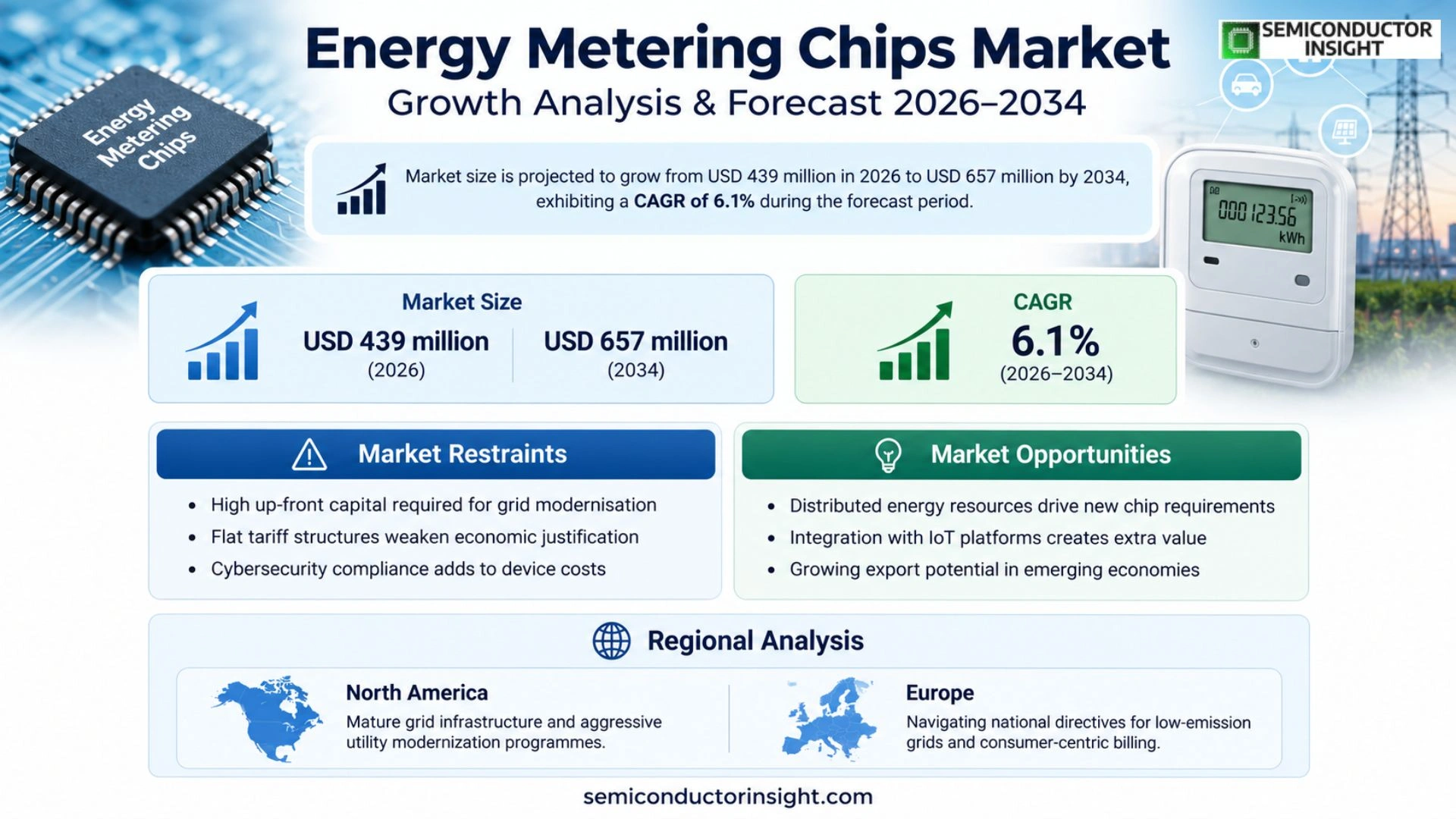
Global Energy Metering Chips market is projected to grow from USD 439 million in 2026 to USD 657 million by 2034, exhibiting a CAGR of 6.1% during the forecast period.
Energy metering chips are semiconductor components that convert electrical current and voltage measurements into digital information representing energy usage, typically recorded in kilowatt‑hours (kWh). These chips reside inside residential, commercial and industrial electric meters, providing real‑time consumption data, remote readout capability and seamless integration with smart‑grid communication protocols such as IEC 62056.
The expansion is driven by utilities worldwide replacing legacy meters with advanced metering infrastructure (AMI) to enhance billing precision and enable demand‑side management programs. Regulatory pressures for greater energy efficiency reporting further stimulate adoption across both utility‑scale deployments and consumer smart‑home solutions. Prominent manufacturers,including Analog Devices, STMicroelectronics, Microchip Technology, Maxim Integrated and Texas Instruments,are broadening their offerings through low‑power designs and integrated connectivity features.
MARKET DRIVERS
Regulatory Mandates Accelerating Smart‑Grid Deployment
Recent electricity‑policy reforms in North America, Europe and parts of Asia have stipulated mandatory smart‑meter roll‑outs by 2028. Utilities are therefore compelled to replace legacy electromechanical meters with digital alternatives, a shift that directly inflates demand for high‑precision Energy Metering Chips Market solutions. The regulatory pressure not only guarantees a steady order pipeline but also shortens the sales cycle because compliance dates are legislated, leaving little room for deferral.
Advances in Low‑Power Analog‑Digital Conversion
Silicon‑on‑insulator (SOI) and FinFET designs have pushed power consumption of metering ASICs below 10 µW per channel, a threshold that makes large‑scale deployment economically viable for residential and commercial feeders. The cost advantage stems from reduced cooling requirements and longer device lifespans, which utilities quantify as lower total‑ownership cost. Consequently, manufacturers that can embed these ultra‑low‑power converters into a single‑chip solution enjoy a competitive edge in Energy Metering Chips Market.
➤ “The convergence of policy pressure and silicon efficiency is reshaping procurement strategies across the utility sector.”
These twin forces,policy certainty and technology‑driven cost reductions,are translating into multi‑year contracts for chipset suppliers. Companies that align product roadmaps with upcoming standards, such as IEC 62056‑21, are positioned to capture a sizable share of the upcoming investment wave, reinforcing the upward trajectory of Energy Metering Chips Market.
MARKET CHALLENGES
Supply‑Chain Fragility for Advanced Semiconductor Materials
While the demand outlook remains positive, the industry still wrestles with shortages of high‑purity silicon wafers and specialty packaging substrates. The bottleneck originates from a limited number of foundries capable of delivering sub‑10 nm processes at scale, creating lead‑times that can stretch beyond six months. Utilities facing tight upgrade schedules may postpone projects, directly curbing short‑term orders for metering chips.
Other Challenges
Manufacturing Yield Variability
Yield fluctuations in advanced nodes, especially when integrating mixed‑signal blocks, drive up unit costs and erode margin buffers. OEMs that cannot guarantee consistent yields risk losing contracts to rivals with more mature production lines.
MARKET RESTRAINTS
High Up‑Front Capital Required for Grid Modernisation
Utilities must allocate billions of dollars to overhaul substations, communication back‑haul and data‑analytics platforms before the newly installed metering chips can deliver value. This capital intensity forces many smaller distribution companies to defer investment, limiting the addressable market for chipset vendors.
In regions where tariff structures remain flat, the economic justification for sophisticated metering functions,such as demand‑response signaling,weakens, further dampening willingness to fund large‑scale deployments.
Cybersecurity compliance adds another layer of expense; devices must satisfy rigorous encryption standards, prompting manufacturers to embed additional hardware security modules, which raises bill‑of‑materials costs.
MARKET OPPORTUNITIES
Distributed Energy Resources Fuel New Chip Requirements
The proliferation of rooftop photovoltaics, battery storage and electric‑vehicle charging stations is creating a demand for meters that can handle bidirectional power flow and real‑time telemetry. Chipsets that support granular voltage‑and‑current sampling while maintaining low latency are becoming indispensable, opening a niche for specialized suppliers within Energy Metering Chips Market.
Integration with Internet‑of‑Things platforms offers a parallel revenue stream. Vendors that expose standardized API layers enable third‑party developers to build value‑added services,such as predictive maintenance dashboards,thereby extending the usefulness of a single metering chip beyond basic billing.
Export potential is rising as emerging economies launch their first nationwide smart‑grid initiatives. Early‑mover chipset manufacturers that have already qualified their products against international standards can capture a disproportionate share of these nascent contracts, especially in regions where local semiconductor capacity is still developing.
Energy Metering Chips Market Trends
Smart‑Grid Deployment Accelerates Chip Adoption
The rollout of advanced distribution networks has turned electric meters into data collection nodes rather than passive billing devices. Utilities now require metering chips that can handle two‑way communication, support firmware upgrades, and maintain accuracy under varying load conditions. This shift compels manufacturers to embed low‑power communication stacks and robust calibration algorithms directly into silicon, shortening time‑to‑market for smart‑meter projects. As a result, procurement cycles have tightened, prompting suppliers to prioritize modular designs that can be customized for residential or commercial deployments without extensive redesign.
Other Trends
Multi‑Phase Chip Preference Strengthens
Three‑phase installations, once limited to industrial sites, are increasingly common in larger commercial buildings seeking higher efficiency. Chip vendors are therefore expanding their product portfolios beyond single‑phase offerings, integrating higher voltage tolerance and advanced harmonic filtering. This diversification reduces inventory complexity for OEMs and enables utilities to standardize on a single chip family across diverse load profiles, lowering total cost of ownership.
Embedded Security Becomes a Competitive Differentiator
Cyber‑risk considerations are reshaping specifications for metering silicon. Regulators demand authenticated firmware updates and encrypted data paths, prompting chip makers to embed hardware security modules and tamper‑detect circuitry. Companies that can certify compliance with emerging security standards gain a clear market advantage, as utilities prefer solutions that mitigate the liability of remote attacks. This trend also spurs collaboration between semiconductor firms and cybersecurity specialists, leading to joint development programs that accelerate the introduction of hardened metering chips.
COMPETITIVE LANDSCAPE
Key Industry Players
Energy Metering Chips: Competitive Dynamics and Market Structure
Analog Devices continues to dominate the Energy Metering Chip arena, leveraging its extensive analog‑signal portfolio and deep relationships with utility‑grade metering OEMs. The firm’s ability to integrate high‑precision ADCs with low‑power support circuitry gives it a decisive edge in both three‑phase and single‑phase meter designs. This dominance shapes the market’s tiered structure: a handful of global vendors supply the bulk of volume‑critical silicon, while a broader set of specialists target niche applications such as industrial‑grade load profiling or smart‑home integration. The concentration of design talent and IP in the top tier forces smaller players to differentiate through application‑specific features, aggressive pricing, or regional manufacturing footprints.
Beyond the market leader, a constellation of capable rivals contributes to a vibrant competitive ecosystem. STMicroelectronics and Texas Instruments each offer mixed‑signal families that pair metering cores with communication blocks, enabling rapid integration for smart‑grid deployments. Microchip Technology and Maxim Integrated focus on cost‑effective single‑phase solutions, carving out market share in residential retrofits. Emerging Chinese firms,Hiliwi, HiTrendtech, Shanghai Belling, Solidic, and Hisilicon,are expanding capacity and tailoring products to local regulatory standards, thereby pressuring incumbents on price and delivery timelines. Meanwhile niche innovators such as Renergy provide ultra‑low‑power chips for battery‑operated meters, illustrating how specialized performance attributes can sustain profitability even in a price‑sensitive segment.
List of Key Energy Metering Chips Companies Profiled
- Analog Devices
- STMicroelectronics
- Microchip Technology
- Maxim Integrated
- Texas Instruments
- Cirrus Logic
- Hiliwi
- HiTrendtech
- Shanghai Belling
- Solidic
- Hisilicon
- Renergy
Segment Analysis:
| Segment Category | Sub-Segments | Key Insights |
| By Type |
|
Three‑phase Metering Chip
|
| By Application |
|
Industrial Power Management
|
| By End User |
|
Utility Companies
|
| By Integration Level |
|
System‑on‑Module (SoM) Solution
|
| By Power Range |
|
Medium Voltage (100 V‑1 kV)
|
Regional Analysis: Energy Metering Chips Market
Utilities are deploying advanced distribution management systems, creating a fertile environment for chips that can handle granular voltage and current sensing while supporting secure communication protocols. The emphasis on real‑time visibility drives designers toward integrating edge‑processing capabilities directly on the metering silicon.
Factories are standardising on energy‑aware controllers, requiring metering chips that can operate reliably under harsh thermal conditions. The convergence of industrial IoT and metering technology prompts vendors to embed diagnostic functions that anticipate maintenance needs.
Updated accuracy and interoperability mandates compel manufacturers to redesign chip architectures for tighter tolerance and broader protocol support. Compliance accelerates the rollout of next‑generation devices across public and private utilities.
Recent material shortages have highlighted the importance of diversified wafer fabs and localised assembly. Companies that secure regional fabrication partnerships can sustain output while mitigating lead‑time volatility.
Europe
European utilities are navigating a patchwork of national directives that push for low‑emission grids and consumer‑centric billing. The emphasis on interoperability within the EU’s smart‑metering framework compels chip makers to adopt multi‑standard transceivers and robust encryption. In parallel, Germany’s Industrie 4.0 agenda encourages factories to embed metering chips that interface seamlessly with manufacturing execution systems, creating a niche for high‑precision, low‑latency devices. While the market remains less fragmented than in emerging economies, the rigorous certification process prolongs product introduction cycles, rewarding firms with deep regulatory expertise.
Asia‑Pacific
The Asia‑Pacific region exhibits a heterogeneous landscape, where rapid urbanisation in China and India fuels demand for mass‑deployment of smart meters, yet divergent standards challenge manufacturers. Nations such as Japan and South Korea prioritize ultra‑low‑power chips to support battery‑operated devices in remote installations, whereas Southeast Asian markets favour cost‑effective solutions for widespread residential rollout. The proliferation of renewable micro‑grids in Pacific islands also demands chips capable of handling variable frequency inputs, prompting a shift toward adaptable measurement cores that can be tuned post‑deployment.
South America
South American utilities are contending with aging distribution networks that impede reliable data capture. Recent governmental incentives aim to retrofit meters in Brazil, Argentina, and Chile, creating a surge in demand for chips that can survive high humidity and temperature fluctuations. Energy‑intensive industries, particularly mining, are adopting metering chips to monitor power quality and reduce downtime, a trend that encourages manufacturers to embed ruggedised casings and self‑diagnostic features within their silicon offerings.
Middle East & Africa
In the Middle East, the expansion of large‑scale solar farms and desalination plants drives a requirement for metering chips that can handle high‑voltage, high‑current scenarios while maintaining measurement fidelity. Meanwhile, African nations are launching pilot smart‑meter projects to improve billing transparency, often in off‑grid contexts where longevity and low power consumption are paramount. The divergent needs across the region incentivise vendors to develop modular chip platforms that can be customised for either high‑capacity industrial sites or low‑resource community networks.
Report Scope
This market research report provides a comprehensive analysis of the Energy Metering Chips Market , covering the forecast period 2026–2034. It offers detailed insights into market dynamics, technological advancements, competitive landscape, and key trends shaping the industry.
Key focus areas of the report include:
- Market Overview: The report begins with an overview outlining its current market scenario, key growth indicators, and industry transformation drivers. It discusses macroeconomic factors, demand–supply balance, regulatory landscape, and the strategic role of semiconductors in powering advancements across industries such as automotive, telecommunications, consumer electronics, and industrial automation.
- Market Size & Forecast: Historical data and future projections for revenue, unit shipments, and market value across major regions and segments.
- Segmentation Analysis: Detailed breakdown by product type, technology, application, and end-user industry to identify high-growth segments and investment opportunities.
- Regional Insights: Insights into market performance across North America, Europe, Asia-Pacific, Latin America, and the Middle East & Africa, including country-level analysis where relevant.
- Competitive Landscape: Profiles of leading market participants, including their product offerings, R&D focus, manufacturing capacity, pricing strategies, and recent developments such as mergers, acquisitions, and partnerships.
- Technology Trends & Innovation: Assessment of emerging technologies, integration of AI/IoT, semiconductor design trends, fabrication techniques, and evolving industry standards.
- Market Drivers & Restraints: Evaluation of factors driving market growth along with challenges, supply chain constraints, regulatory issues, and market-entry barriers.
- Stakeholder Insights: Insights for component suppliers, OEMs, system integrators, investors, and policymakers regarding the evolving ecosystem and strategic opportunities.
Primary and secondary research methods are employed, including interviews with industry experts, data from verified sources, and real-time market intelligence to ensure the accuracy and reliability of the insights presented.
FREQUENTLY ASKED QUESTIONS:
What is the current market size of Energy Metering Chips Market?
-> Energy Metering Chips market is projected to grow from USD 439 million in 2026 to USD 657 million by 2034, exhibiting a CAGR of 6.1%
Which key companies operate in Energy Metering Chips Market?
-> Key players include Analog Devices, STMicroelectronics, Microchip Technology, Maxim Integrated, Texas Instruments, Cirrus Logic, Hiliwi, HiTrendtech, Shanghai Belling, Solidic, Hisilicon, Renergy.
What are the key growth drivers?
-> Key growth drivers include rising electricity consumption, deployment of smart meters, regulatory push for accurate billing, and integration of IoT and AI in energy management systems.
Which region dominates the market?
-> Asia‑Pacific remains the largest market by revenue, followed by the Americas and Europe, despite a modest decline in 2022.
What are the emerging trends?
-> Emerging trends include advanced three‑phase metering chips, integration with cloud‑based energy analytics, and the development of low‑power, high‑precision single‑phase chips for residential smart‑grid applications.
Get Sample Report PDF for Exclusive Insights
Report Sample Includes
- Table of Contents
- List of Tables & Figures
- Charts, Research Methodology, and more...
 Download Sample Report PDF