Embedded Fanless PC Market Insights
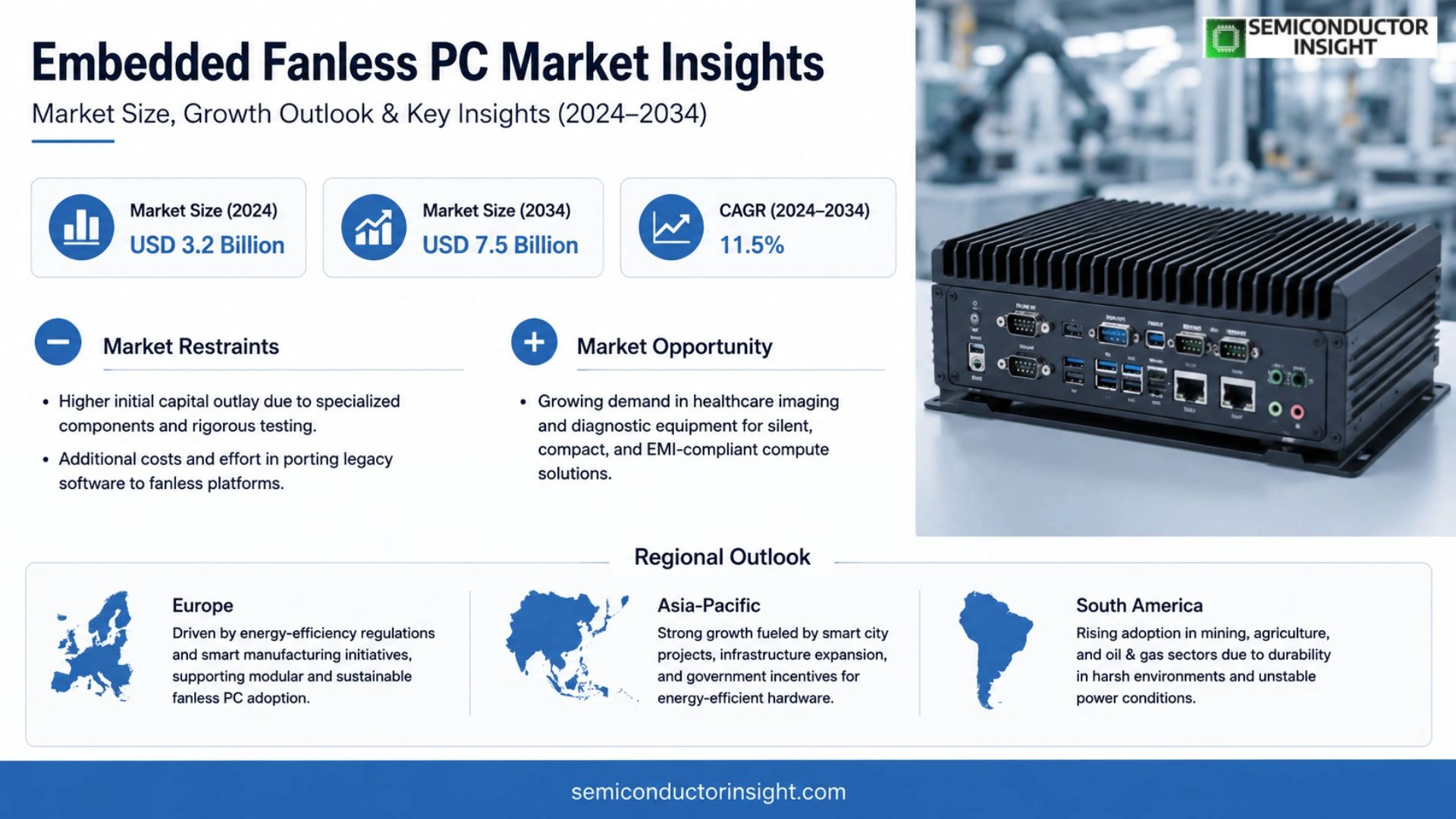
Embedded Fanless PC market size was valued at USD 3.2 billion in 2024. The market is projected to grow from USD 7.5 billion by 2034, exhibiting a CAGR of 11.5% during the forecast period.
Fanless Embedded Computers are compact systems designed for edge‑computing workloads and are especially suited for remote monitoring and control tasks. Their architecture eliminates moving parts, resulting in low power draw, high thermal stability and extensive customization options.
The expansion of this segment correlates with broader digitization initiatives and the proliferation of Internet‑of‑Things deployments across manufacturing floors, medical equipment, traffic‑management infrastructure, defence platforms and self‑service kiosks. Because these units operate without fans, they lower maintenance overhead while delivering reliable performance in harsh environments. Vendors such as Advantech, AAEON and Cincoze are incorporating on‑board AI accelerators and adopting sustainable component choices to meet emerging intelligence requirements and green‑technology mandates.
MARKET DRIVERS
Industrial Automation and Harsh Environments
Manufacturers are replacing legacy controllers with Embedded Fanless PC solutions because the sealed chassis tolerates dust, vibration and extreme temperatures better than conventional platforms. The absence of moving parts eliminates failure points that historically forced frequent shutdowns for preventive maintenance, directly boosting line uptime. Companies that integrate fanless units report up to a 20% reduction in downtime‑related losses.
Edge Computing and 5G Rollout
As enterprises migrate processing to the edge, the need for compact, low‑power compute grows. Fanless designs consume less energy, align with the power budgets of remote sites, and present a smaller thermal footprint that simplifies enclosure design. The convergence of 5G connectivity and edge analytics creates a clear incentive for firms to adopt devices that can operate reliably without active cooling.
➤ Fanless architectures lower maintenance expenses while preserving processing capability, delivering a compelling value proposition for mission‑critical deployments.
Overall, the convergence of stricter reliability standards and the surge in decentralized data processing fuels demand for Embedded Fanless PC Market. Providers that can couple rugged hardware with scalable software ecosystems are positioned to capture the bulk of this momentum.
MARKET CHALLENGES
Thermal Management Limits in Compact Enclosures
Even without fans, densely packed components generate heat that must be dissipated through conduction and radiation. Designers face a trade‑off between performance and enclosure size; pushing processors to higher clock speeds can quickly exceed the thermal budget of a sealed chassis, forcing a downgrade in compute power or the adoption of more expensive heat‑pipe solutions.
Other Challenges
Supply Chain Volatility
Component shortages, especially for high‑end SoCs and solid‑state storage, inflate lead times and squeeze margins. OEMs that lack diversified supplier networks may experience delayed product launches, eroding competitive advantage.
MARKET RESTRAINTS
Higher Initial Capital Outlay
Fanless systems often command a premium because of specialized chassis materials and rigorous testing for reliability. For midsize firms operating on tight CAPEX budgets, the upfront cost can discourage adoption, even when lifecycle savings are evident.
Additionally, many legacy software stacks are optimized for traditional x86 desktops that rely on active cooling. Porting these applications to fanless platforms may require code refactoring or licensing of lightweight operating systems, adding another layer of financial and technical restraint.
MARKET OPPORTUNITIES
Healthcare Imaging and Diagnostic Equipment
Medical devices increasingly demand compact, silent compute that can operate continuously within sterile environments. Fanless PCs meet these criteria while also complying with stringent electromagnetic interference (EMI) standards, opening a niche for OEMs to supply turnkey solutions to imaging manufacturers.
Smart‑city initiatives are deploying edge nodes for real‑time traffic monitoring, environmental sensing and public‑safety analytics. The low‑maintenance profile of fanless hardware aligns with municipal budget cycles, presenting a clear route for long‑term contracts.
Automotive infotainment and ADAS (advanced driver‑assistance systems) require rugged electronics that can survive temperature swings without compromising passenger comfort. Integrating fanless compute into vehicle architectures reduces acoustic noise and simplifies thermal design, a combination that OEMs are actively exploring for next‑generation models.
Embedded Fanless PC Market Trends
Edge Computing Adoption Accelerates Fanless PC Use
The rise of edge computing has altered the value proposition of fanless embedded systems. By processing data close to the source, these devices reduce latency and limit bandwidth costs, a combination that appeals to manufacturers of remote‑monitoring equipment. Consequently, equipment integrators are selecting fanless platforms for applications that demand uninterrupted operation in harsh environments, such as outdoor sensors and industrial controllers. The absence of moving parts translates into lower maintenance cycles, which in turn improves total cost of ownership for end users. This technical advantage is reshaping procurement criteria, prompting OEMs to prioritize reliability and power efficiency over conventional performance metrics.
Other Trends
AI and Machine Learning Embedded at the Edge
Recent product releases show that vendors are embedding inference engines directly onto fanless boards. By off‑loading model execution from central servers, customers can achieve real‑time decision making without incurring the energy penalty of active cooling. This shift is particularly evident in smart manufacturing lines where predictive maintenance algorithms run on localized hardware, delivering alerts before a component fails. The capability to run AI workloads on a silent, low‑power platform is nudging traditionally non‑AI sectors,such as medical diagnostics and traffic management,toward more sophisticated analytics.
Customization and Sustainability Trends
Manufacturers are responding to client requests for highly tailored form factors by expanding modular designs that accommodate a variety of I/O configurations. This flexibility enables system integrators to assemble solutions that fit tight spatial constraints while preserving the thermal stability inherent to fanless architecture. Parallel to this, the industry is aligning product roadmaps with green‑technology initiatives. The elimination of fans reduces material usage and simplifies end‑of‑life recycling, positioning fanless PCs as a compelling option for companies pursuing carbon‑reduction targets. As supply chains incorporate recycled alloys and low‑voltage components, the overall environmental footprint of embedded deployments is expected to shrink, reinforcing the market’s appeal to sustainability‑focused buyers.
COMPETITIVE LANDSCAPE
Key Industry Players
Embedded Fanless PC Market – Competitive Overview
Advantech dominates the fanless embedded segment by leveraging a global design‑manufacturing network that spans Asia, Europe and North America. Its portfolio ranges from sub‑10 inch rugged modules to 17‑inch industrial panels, allowing customers in manufacturing, transportation and medical fields to source a single supplier for hardware, firmware and long‑term support. The company’s vertical integration,silicon sourcing, system‑in‑package assembly and a worldwide service ecosystem,creates pricing leverage and short lead‑times, which smaller rivals struggle to match. Recent acquisitions in AI edge software have fortified Advantech’s position as a one‑stop solution provider, compelling OEMs to align product roadmaps with its development cadence.
Beyond the market leader, a constellation of specialized firms fuels innovation in niche applications. Cincoze and Stealth focus on ultra‑compact, low‑power boards for IoT gateways, while Beckhoff Automation and Kontron marry fanless hardware with proprietary motion‑control stacks for automation plants. Companies such as AAEON, MPL and IBASE Technology differentiate through custom enclosure designs that meet stringent certifications for aerospace and defense. The presence of boutique players like Acnodes Corporation and Darveen Technology sustains a healthy competitive pressure, pushing the incumbents toward faster refresh cycles and more aggressive sustainability pledges.
List of Key Embedded Fanless PC Companies Profiled
- Cincoze, Stealth, Beckhoff Automation, MPL, IBASE Technology, Acnodes Corporation, Darveen Technology, Acrosser Technology, Portwell, ThroughTek
- Advantech, AAEON, Kontron, Axiomtek
- Advantech, AAEON, Kontron, Axiomtek, Teguar Computers, AAEON, Advantech
Segment Analysis:
| Segment Category | Sub-Segments | Key Insights |
| By Type |
|
Less than 11‑inch
|
| By Application |
|
Manufacturing
|
| By End User |
|
Industrial Automation
|
| By Industry Vertical |
|
Industrial Automation
|
| By Technology Trend |
|
AI Integration
|
Regional Analysis: Embedded Fanless PC Market
U.S. manufacturers are embedding fanless processors into PLCs and smart sensors, capitalising on the technology’s resistance to dust and vibration, which shortens maintenance intervals and lowers total cost of ownership.
Rail operators are retrofitting legacy control cabinets with fanless boards, attracted by the minimal acoustic footprint and compliance with harsh temperature swings encountered on north‑bound corridors.
Edge‑AI deployments in warehousing and logistics favour fanless silicon because it sustains 24‑hour operation without the risk of particulate ingress that can degrade algorithmic performance.
Recent policy incentives encourage on‑shore production of enclosures and PCBs, shortening lead times and aligning with client expectations for rapid rollout of fanless solutions.
Europe
European manufacturers are leveraging Embedded Fanless PC Market to meet stringent energy‑efficiency directives while addressing the rise of smart manufacturing hubs in Germany and the Nordics. The region’s emphasis on modular design standards enables rapid integration of fanless compute blocks into existing production lines, reducing retrofitting costs. Collaborative R&D consortia, especially in France and the United Kingdom, are exploring thermal‑passive architectures that align with the EU’s circular‑economy goals, thereby extending product lifecycles and limiting electronic waste. This regulatory focus, combined with a well‑established industrial ecosystem, is prompting firms to adopt fanless platforms as a cornerstone of their digital‑transformation strategies.
Asia‑Pacific
In Asia‑Pacific, the appetite for fanless solutions is driven by the explosive growth of smart city projects and large‑scale infrastructure upgrades in China, India, and Southeast Asia. Deployments in remote monitoring stations and outdoor digital signage benefit from the technology’s ability to operate in extreme humidity and temperature without active cooling. Local system integrators are capitalising on low‑cost manufacturing capabilities to produce competitive fanless enclosures, while governments incentivise the use of energy‑conservative hardware for public‑sector ICT initiatives. These factors converge to create a fertile landscape for Embedded Fanless PC Market, especially where ruggedness and low power draw are decisive advantages.
South America
South American enterprises are gradually embracing fanless compute platforms to overcome challenges posed by uneven power grids and harsh climatic conditions in Brazil, Argentina, and Chile. The technology’s tolerance for voltage fluctuations reduces reliance on auxiliary cooling equipment, which can be costly to maintain in remote mining and agricultural settings. Additionally, regional trade agreements are facilitating the import of specialized chassis components, allowing local assemblers to customise solutions for sectors such as agritech and oil‑field monitoring, where durability is paramount.
Middle East & Africa
The Middle East & Africa region is witnessing a cautious yet steady uptake of fanless embedded systems, particularly in oil‑and‑gas extraction sites and desert‑based renewable‑energy farms. Extreme temperatures and sand infiltration make active cooling impractical, prompting operators to favour passive‑thermal designs that guarantee uninterrupted operation. Partnerships between Gulf‑based engineering firms and Asian OEMs are accelerating technology transfer, while African nations are piloting fanless modules in off‑grid education and health‑care kiosks, leveraging the low maintenance profile to extend service intervals in remote locales.
Report Scope
This market research report provides a comprehensive analysis of the Embedded Fanless PC Market , covering the forecast period 2026–2034. It offers detailed insights into market dynamics, technological advancements, competitive landscape, and key trends shaping the industry.
Key focus areas of the report include:
- Market Overview: The report begins with an overview outlining its current market scenario, key growth indicators, and industry transformation drivers. It discusses macroeconomic factors, demand–supply balance, regulatory landscape, and the strategic role of semiconductors in powering advancements across industries such as automotive, telecommunications, consumer electronics, and industrial automation.
- Market Size & Forecast: Historical data and future projections for revenue, unit shipments, and market value across major regions and segments.
- Segmentation Analysis: Detailed breakdown by product type, technology, application, and end-user industry to identify high-growth segments and investment opportunities.
- Regional Insights: Insights into market performance across North America, Europe, Asia-Pacific, Latin America, and the Middle East & Africa, including country-level analysis where relevant.
- Competitive Landscape: Profiles of leading market participants, including their product offerings, R&D focus, manufacturing capacity, pricing strategies, and recent developments such as mergers, acquisitions, and partnerships.
- Technology Trends & Innovation: Assessment of emerging technologies, integration of AI/IoT, semiconductor design trends, fabrication techniques, and evolving industry standards.
- Market Drivers & Restraints: Evaluation of factors driving market growth along with challenges, supply chain constraints, regulatory issues, and market-entry barriers.
- Stakeholder Insights: Insights for component suppliers, OEMs, system integrators, investors, and policymakers regarding the evolving ecosystem and strategic opportunities.
Primary and secondary research methods are employed, including interviews with industry experts, data from verified sources, and real-time market intelligence to ensure the accuracy and reliability of the insights presented.
FREQUENTLY ASKED QUESTIONS:
What is the current market size of Embedded Fanless PC Market?
-> Embedded Fanless PC market is projected to grow from USD 7.5 billion by 2034, exhibiting a CAGR of 11.5% during the forecast period.
Which key companies operate in Embedded Fanless PC Market?
-> Key players include Cincoze, Beckhoff Automation, Stealth, Teguar Computers, Advantech, AAEON, Acnodes Corporation, Darveen Technology, IBASE Technology, Acrosser Technology, Kontron, MPL.
What are the key growth drivers?
-> Key growth drivers include digitization, the Internet of Things (IoT) adoption, low power consumption, system stability, and high customization flexibility of fanless embedded computers.
Which region dominates the market?
-> The market exhibits strong global presence with notable activity in North America, Europe, and Asia, reflecting widespread adoption across industrial automation, medical devices, and other verticals.
What are the emerging trends?
-> Emerging trends include integration of AI and machine‑learning capabilities, increased focus on sustainability and green technology, and expanded use in edge‑computing applications such as remote monitoring and control.

Get Sample Report PDF for Exclusive Insights
Report Sample Includes
- Table of Contents
- List of Tables & Figures
- Charts, Research Methodology, and more...
 Download Sample Report PDF