eCall (Emergency Call) Module IC Market Insights
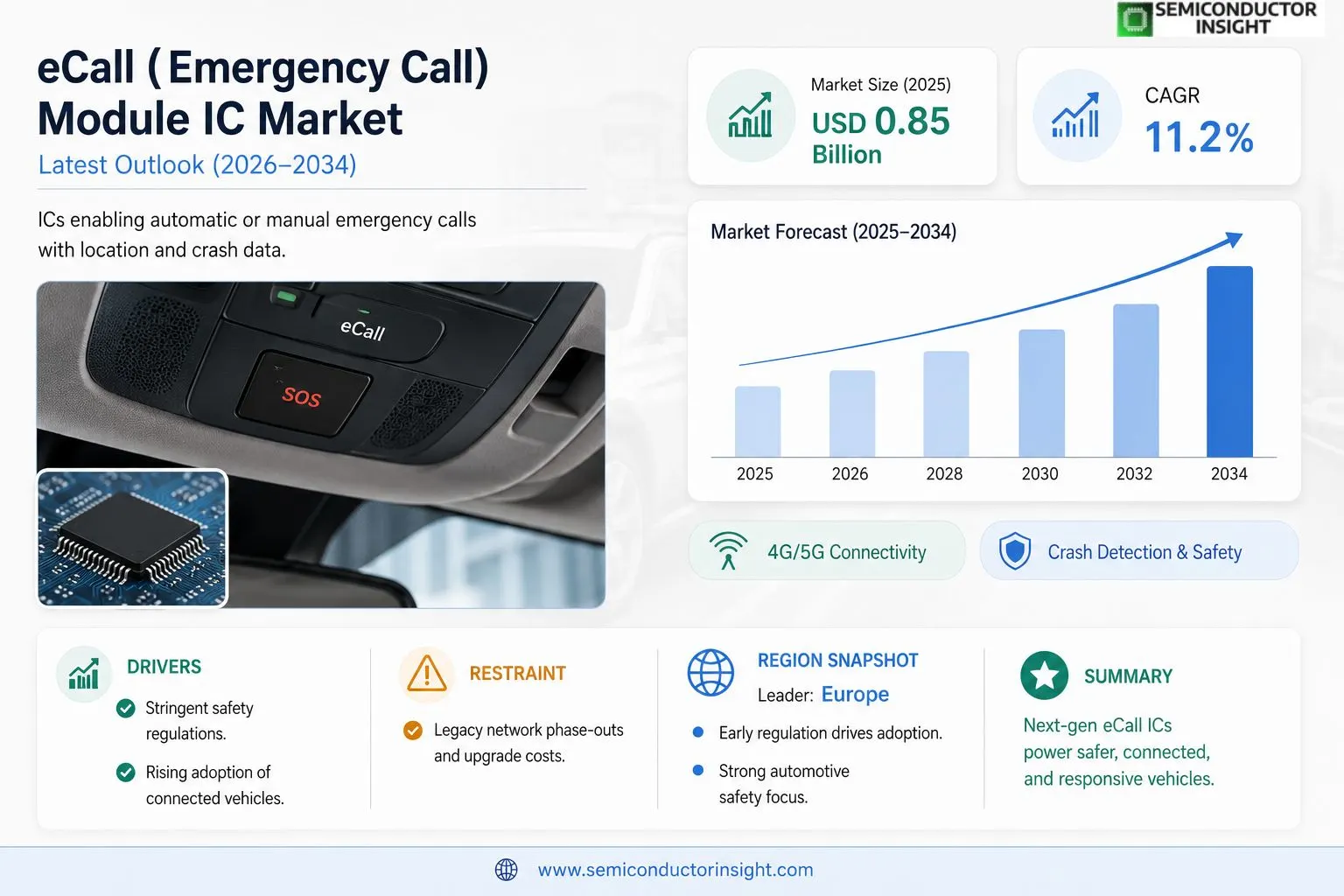
Global eCall (Emergency Call) Module IC market size was valued at USD 0.85 billion in 2025. The market is projected to grow from USD 0.92 billion in 2026 to USD 1.95 billion by 2034, exhibiting a CAGR of 11.2% during the forecast period.
eCall (Emergency Call) Module ICs are specialized semiconductor components designed to enable automatic or manual emergency communication in vehicles during accidents or critical situations. These integrated circuits integrate key functionalities such as cellular connectivity, GPS positioning, crash detection interfaces, power management, and audio processing to ensure reliable transmission of critical data including vehicle location, direction, and occupant information to emergency services.
The market is experiencing steady growth due to several factors, including stringent government regulations mandating advanced safety features in vehicles, rising adoption of connected car technologies, and increasing consumer demand for enhanced road safety systems. Furthermore, the transition toward next-generation networks including 4G and 5G support in eCall modules is contributing to market expansion. Advancements in semiconductor design have enabled more compact, power-efficient, and cost-effective solutions suitable for both passenger cars and commercial vehicles. Key players continue to innovate with robust, automotive-grade ICs that meet rigorous reliability standards for emergency response applications.
MARKET DRIVERS
Stringent Regulatory Mandates for Vehicle Safety
eCall (Emergency Call) Module IC Market is primarily propelled by government regulations requiring automatic emergency call systems in new vehicles. In the European Union, eCall has been mandatory for all new passenger cars and light commercial vehicles since 2018, significantly boosting demand for specialized integrated circuits that enable reliable crash detection, location transmission, and emergency communication. Similar safety-focused initiatives in other regions are further accelerating adoption of advanced eCall module ICs.
Rising Adoption of Connected and Autonomous Vehicles
Growing integration of telematics and IoT technologies in modern vehicles has increased the need for sophisticated eCall module ICs capable of supporting 4G/5G connectivity. The transition toward software-defined vehicles and electric mobility is driving semiconductor innovation to deliver low-power, high-reliability solutions for emergency response systems.
➤ The shift from legacy 2G/3G networks to Next Generation eCall (NG eCall) using LTE and 5G infrastructure is creating substantial demand for upgraded module ICs designed for faster connection times and enhanced data transmission.
Consumer awareness of vehicle safety features, combined with increasing road accident statistics globally, continues to support steady market expansion for eCall-enabled semiconductor solutions.
MARKET CHALLENGES
Network Infrastructure Transition and Compatibility
The phase-out of 2G and 3G networks poses significant technical challenges for existing eCall systems, requiring widespread upgrades to NG eCall solutions compatible with 4G/5G packet-switched networks. This transition demands substantial investment in new module IC designs and testing protocols to ensure uninterrupted emergency functionality.
High Development Costs
Advanced eCall module ICs require compliance with stringent automotive-grade standards (AEC-Q100), functional safety (ISO 26262), and cybersecurity requirements, increasing R&D expenses for semiconductor manufacturers.
Regional Infrastructure Disparities
Limited availability of reliable mobile networks and emergency response infrastructure in emerging markets slows broader global deployment of eCall technology.
MARKET RESTRAINTS
Legacy System Dependence and Network Shutdowns
A significant restraint in eCall (Emergency Call) Module IC Market stems from the reliance of many deployed systems on outdated 2G/3G infrastructure that is being decommissioned in major markets. This necessitates costly retrofits or replacements with modern IC solutions supporting NG eCall standards, particularly affecting aftermarket and older vehicle fleets.
Integration complexities and higher initial costs for advanced semiconductor components can slow adoption rates among smaller vehicle manufacturers and in price-sensitive regions.
MARKET OPPORTUNITIES
Expansion of NG eCall and 5G Integration
The mandatory rollout of Next Generation eCall across Europe starting in 2026, along with expected adoption in other regions, presents major growth opportunities for manufacturers of advanced eCall module ICs. These next-generation solutions offer improved latency, richer data transmission including vehicle diagnostics, and better integration with V2X communications. Opportunities also exist in the proliferation of connected electric vehicles and commercial fleets, where enhanced eCall functionality can be bundled with broader telematics platforms for comprehensive safety and fleet management solutions.
eCall (Emergency Call) Module IC Market Trends
Regulatory Mandates and Connected Vehicle Adoption Fueling Demand
eCall (Emergency Call) Module IC Market continues to expand as governments worldwide implement stricter regulations requiring advanced safety systems in vehicles. These specialized integrated circuits serve as critical components that enable automatic or manual emergency communications during accidents or critical situations. By integrating cellular connectivity, GPS positioning, crash detection interfaces, power management, and audio processing capabilities, eCall Module ICs ensure reliable transmission of essential data including vehicle location, direction of travel, and occupant information to emergency services.
Other Trends
Transition to Next-Generation Networks
A notable development in eCall (Emergency Call) Module IC Market involves the shift toward 4G and 5G network support within emergency call modules. This evolution enhances connectivity reliability and data transmission speeds, allowing for more comprehensive emergency response capabilities. Manufacturers are focusing on developing ICs that maintain backward compatibility while incorporating these advanced network features to meet evolving infrastructure requirements across different regions.
Integration Across Vehicle Segments
The adoption of eCall technology is broadening beyond passenger cars to include commercial vehicles, driven by the need for uniform safety standards across fleets. eCall (Emergency Call) Module ICs are being optimized for diverse applications, supporting both light and heavy-duty vehicles while addressing specific operational demands such as extended durability in challenging environments.
Technological Advancements in Semiconductor Design
Innovations in semiconductor engineering are enabling the production of more compact, power-efficient, and cost-effective eCall Module IC solutions. These advancements allow for seamless integration into modern vehicle architectures without compromising performance or reliability. Automotive-grade components are being refined to meet stringent quality and safety standards essential for life-critical emergency response applications. Key industry players are investing in robust designs that combine multiple functionalities into single chips, reducing complexity while improving overall system efficiency and supporting the broader trend toward connected car technologies.
The convergence of rising consumer awareness regarding road safety and ongoing development of intelligent transportation systems positions eCall (Emergency Call) Module ICs as a foundational element in future vehicle safety ecosystems. Continued focus on power optimization and enhanced processing capabilities will likely sustain momentum in this specialized market segment.
COMPETITIVE LANDSCAPE
Key Industry Players
eCall (Emergency Call) Module IC Market Features a Consolidated Structure Led by Established Automotive Semiconductor and Telematics Specialists
eCall Module IC Market is led by a select group of Tier 1 suppliers and semiconductor manufacturers with deep expertise in automotive-grade connectivity, positioning, and safety systems. Continental AG and Robert Bosch GmbH stand out as dominant players, offering highly integrated eCall solutions that combine ICs with full telematics control units, benefiting from strong OEM relationships across Europe and global markets. These leaders drive innovation in power-efficient designs supporting 4G/5G transitions while meeting stringent automotive reliability standards such as AEC-Q100.
Other significant players include specialized semiconductor firms and module providers carving niches in cost-effective, compact ICs for both passenger and commercial vehicles. Companies like STMicroelectronics, Infineon Technologies, and u-blox excel in providing core components such as cellular modems, GNSS integration, and crash sensor interfaces, enabling broader adoption amid rising regulatory mandates for advanced vehicle safety features.
List of Key eCall (Emergency Call) Module IC Companies Profiled
- Continental AG
- Robert Bosch GmbH
- STMicroelectronics
- Infineon Technologies AG
- u-blox Holding AG
- Telit Cinterion
- Texas Instruments Incorporated
- Valeo SA
- DENSO Corporation
- Thales Group
- Visteon Corporation
- Quectel Wireless Solutions
- NXP Semiconductors
- Harman International
- Ficosa International S.A.
Segment Analysis:
| Segment Category | Sub-Segments | Key Insights |
| By Type |
|
5G NR eCall ICs represent the forefront of innovation in emergency communication systems. These advanced integrated circuits deliver superior data transmission speeds and enhanced reliability during critical situations. They seamlessly integrate GPS positioning, crash detection interfaces, and power-efficient audio processing capabilities. Manufacturers prioritize these solutions for their ability to support next-generation vehicle connectivity while maintaining automotive-grade durability and low power consumption essential for continuous operation. |
| By Application |
|
Passenger Vehicles lead adoption as safety features become standard expectations among consumers and regulators. These ICs enable rapid transmission of precise location data, vehicle direction, and occupant status to emergency responders. Integration with existing vehicle systems allows for automatic activation upon impact detection. The focus remains on compact designs that fit modern vehicle architectures while ensuring uninterrupted performance in harsh automotive environments. |
| By End User |
|
Automotive OEMs drive primary demand through direct integration during vehicle manufacturing. They seek robust, reliable IC solutions that comply with stringent safety standards and support seamless connected car ecosystems. These end users value long-term durability, ease of system integration, and compatibility with evolving communication networks. Collaboration between semiconductor suppliers and OEMs accelerates innovation tailored to specific vehicle platforms and safety architectures. |
| By Connectivity |
|
Cellular-Based connectivity dominates due to its widespread infrastructure and proven reliability in emergency scenarios. These ICs ensure consistent performance across diverse geographic areas with strong network coverage. They incorporate advanced power management to maintain functionality even when primary vehicle power is compromised. Ongoing enhancements focus on backward compatibility and forward readiness for network upgrades. |
| By Integration Level |
|
System-on-Chip Solutions gain preference for their compact footprint and efficient performance characteristics. These highly integrated circuits combine multiple functions including cellular modem, positioning systems, and sensor interfaces into a single component. This approach reduces overall system complexity while improving reliability through fewer interconnects. Automotive designers appreciate the simplified validation processes and enhanced power efficiency that support extended operational life in vehicles. |
Regional Analysis: eCall (Emergency Call) Module IC Market
Europe
Regulatory Framework
Europe’s comprehensive safety regulations have created a stable environment for eCall module IC development. Harmonized standards across member states ensure consistent performance requirements, encouraging manufacturers to focus on compliance-ready solutions that accelerate time-to-market while maintaining high reliability in emergency scenarios.
The region excels in integrating advanced semiconductor technologies with vehicle connectivity platforms. Collaborative projects between research institutions and industry players drive improvements in power efficiency, multi-network support, and real-time data processing within eCall systems.
Strong partnerships between automakers, semiconductor firms, and telecom operators facilitate seamless ecosystem development. This collaborative approach ensures eCall module ICs meet diverse vehicle architectures and support future-proof features aligned with evolving mobility trends.
High penetration of equipped vehicles has shifted focus toward upgrades and replacements. Established infrastructure supports continuous innovation, positioning Europe as a testbed for next-generation emergency communication technologies.
North America
North America exhibits dynamic growth in eCall (Emergency Call) Module IC Market, propelled by increasing emphasis on connected vehicle safety features and voluntary adoption by major automakers. The region’s vast road networks and diverse climatic conditions demand robust IC solutions capable of reliable performance under challenging environments. Innovation hubs in the United States and Canada foster development of advanced eCall technologies that integrate with broader telematics platforms, enhancing overall vehicle intelligence. Strategic investments by semiconductor companies aim to address local requirements for enhanced location services and emergency response coordination with public safety networks. Consumer preference for premium safety packages further stimulates demand, while cross-border harmonization efforts with neighboring markets support standardized component deployment across the continent.
Asia-Pacific
Asia-Pacific represents a rapidly evolving landscape for eCall (Emergency Call) Module IC Market, characterized by expanding automotive production and growing government initiatives toward intelligent transportation systems. Countries with significant vehicle manufacturing capabilities are incorporating emergency call functionalities to improve road safety outcomes. The region’s competitive electronics industry accelerates innovation in compact, cost-effective IC designs suitable for both premium and mass-market vehicles. Rising urbanization and increasing vehicle connectivity awareness contribute to broader acceptance of these safety technologies. Collaborative efforts between local manufacturers and global technology providers help adapt eCall solutions to regional network infrastructures and regulatory nuances, positioning Asia-Pacific as an important growth engine for Global market.
South America
South America is gradually advancing in eCall (Emergency Call) Module IC Market through targeted safety improvement programs and increasing integration of connected technologies in modern vehicles. Economic development in key countries drives demand for affordable yet reliable emergency communication modules tailored to local infrastructure realities. Automotive assembly operations benefit from technology transfers that incorporate essential safety ICs, supporting gradual market expansion. Challenges related to diverse terrain and varying network coverage encourage development of resilient solutions that maintain functionality across different conditions. Growing awareness among fleet operators and individual consumers regarding emergency response capabilities supports steady adoption, with potential for accelerated growth as regional harmonization initiatives mature.
Middle East & Africa
The Middle East and Africa region shows emerging potential in eCall (Emergency Call) Module IC Market, driven by infrastructure modernization efforts and a focus on enhancing transportation safety standards. Strategic investments in smart city projects and intelligent mobility solutions create opportunities for eCall system deployment, particularly in high-traffic corridors. Local partnerships with international suppliers facilitate technology adaptation to regional requirements, including extreme climate resilience and compatibility with developing communication networks. Government initiatives aimed at reducing road fatalities promote the inclusion of emergency call features in both passenger and commercial vehicles. While market maturity varies across countries, increasing vehicle connectivity trends and economic diversification efforts are laying the foundation for sustained development of eCall module IC applications throughout the region.
Report Scope
This market research report provides a comprehensive analysis of the eCall (Emergency Call) Module IC Market , covering the forecast period 2026–2034. It offers detailed insights into market dynamics, technological advancements, competitive landscape, and key trends shaping the industry.
Key focus areas of the report include:
- Market Overview: The report begins with an overview outlining its current market scenario, key growth indicators, and industry transformation drivers. It discusses macroeconomic factors, demand–supply balance, regulatory landscape, and the strategic role of semiconductors in powering advancements across industries such as automotive, telecommunications, consumer electronics, and industrial automation.
- Market Size & Forecast: Historical data and future projections for revenue, unit shipments, and market value across major regions and segments.
- Segmentation Analysis: Detailed breakdown by product type, technology, application, and end-user industry to identify high-growth segments and investment opportunities.
- Regional Insights: Insights into market performance across North America, Europe, Asia-Pacific, Latin America, and the Middle East & Africa, including country-level analysis where relevant.
- Competitive Landscape: Profiles of leading market participants, including their product offerings, R&D focus, manufacturing capacity, pricing strategies, and recent developments such as mergers, acquisitions, and partnerships.
- Technology Trends & Innovation: Assessment of emerging technologies, integration of AI/IoT, semiconductor design trends, fabrication techniques, and evolving industry standards.
- Market Drivers & Restraints: Evaluation of factors driving market growth along with challenges, supply chain constraints, regulatory issues, and market-entry barriers.
- Stakeholder Insights: Insights for component suppliers, OEMs, system integrators, investors, and policymakers regarding the evolving ecosystem and strategic opportunities.
Primary and secondary research methods are employed, including interviews with industry experts, data from verified sources, and real-time market intelligence to ensure the accuracy and reliability of the insights presented.
FREQUENTLY ASKED QUESTIONS:
What is the current market size of eCall (Emergency Call) Module IC Market?
-> eCall (Emergency Call) Module IC Market was valued at USD 0.85 billion in 2025 and is expected to reach USD 1.95 billion by 2034.
Which key companies operate in eCall (Emergency Call) Module IC Market?
-> Key players include NXP Semiconductors, Infineon Technologies, STMicroelectronics, Qualcomm, and Texas Instruments, among others.
What are the key growth drivers?
-> Key growth drivers include stringent government regulations mandating advanced safety features in vehicles, rising adoption of connected car technologies, and increasing consumer demand for enhanced road safety systems.
Which region dominates the market?
-> Asia-Pacific is the fastest-growing region, while Europe remains a dominant market.
What are the emerging trends?
-> Emerging trends include transition toward 4G and 5G support, advancements in compact and power-efficient semiconductor designs, and integration of crash detection with reliable emergency communication systems.

Get Sample Report PDF for Exclusive Insights
Report Sample Includes
- Table of Contents
- List of Tables & Figures
- Charts, Research Methodology, and more...
 Download Sample Report PDF