Dry Etch Gas (CF4, C4F8, Cl2, BCl3) Market Insights
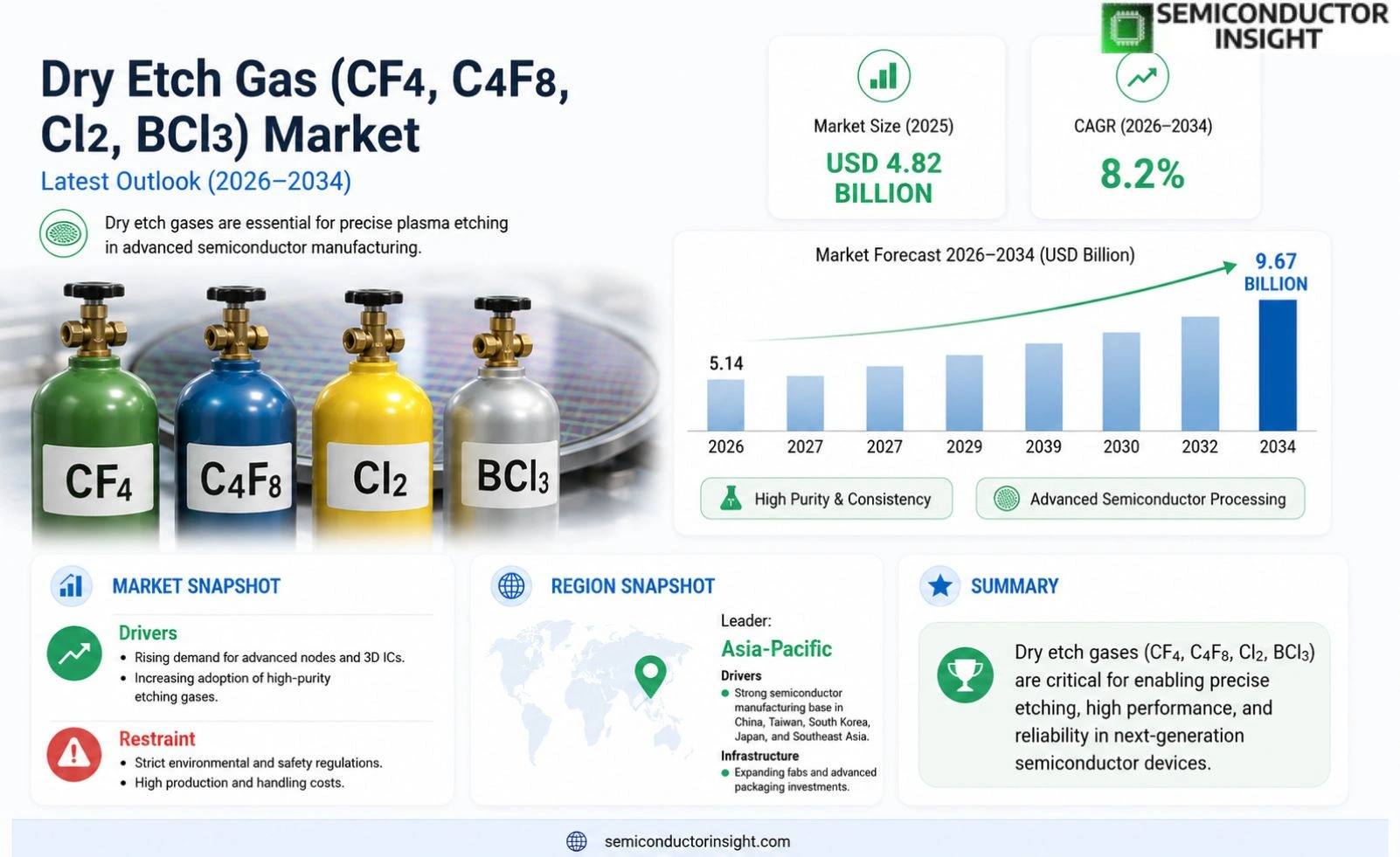
Global Dry Etch Gas (CF4, C4F8, Cl2, BCl3) Market size was valued at USD 4.82 billion in 2025. The market is projected to grow from USD 5.14 billion in 2026 to USD 9.67 billion by 2034, exhibiting a CAGR of 8.2% during the forecast period.
Dry etch gases are specialized chemical compounds essential for semiconductor fabrication processes, particularly in plasma etching applications. These gases include carbon tetrafluoride (CF4), hexafluoroethane (C4F8), chlorine (Cl2), and boron trichloride (BCl3), which enable precise material removal from silicon wafers and other substrates without liquid-based processing. Because these gases operate in plasma environments, they facilitate highly anisotropic etching critical for advanced node manufacturing, encompassing applications such as dielectric etching, polysilicon patterning, metal layer processing, and deep reactive-ion etching.
The market is experiencing robust expansion driven by several interconnected factors, including surging demand for advanced semiconductors in artificial intelligence and consumer electronics sectors, accelerated investment in domestic chip manufacturing capacity across major economies, and the progressive miniaturization of device architectures requiring increasingly sophisticated etching chemistries. Furthermore, the global push toward semiconductor self-sufficiency has intensified fab construction activities; for instance, the U.S. CHIPS and Science Act allocated approximately USD 52.7 billion for semiconductor research and manufacturing incentives through 2030, directly stimulating dry etch gas consumption. While environmental regulations concerning perfluorinated compound emissions present ongoing challenges because of their high global warming potential, industry participants are actively developing abatement technologies and alternative chemistries to sustain growth trajectories. Linde plc, Air Liquide S.A., Merck KGaA, and SK Materials Co., Ltd. represent key suppliers operating within this market with comprehensive product portfolios spanning high-purity electronic specialty gases.
MARKET DRIVERS
Expansion in Global Semiconductor Manufacturing
The rapid expansion of semiconductor fabrication facilities globally is a primary catalyst for the market. As chipmakers advance into sub-10nm process nodes, the demand for highly specialized etching gases increases significantly, propelling the growth of Dry Etch Gas (CF4, C4F8, Cl2, BCl3) Market. The transition to smaller feature sizes necessitates the use of precise chemistries to ensure dimensional accuracy in silicon substrates.
Proliferation of 3D NAND and 3D Packaging
Another significant driver stems from the increased adoption of 3D Vertical NAND flash memory, which requires complex etching techniques to stack layers. Furthermore, advancements in chip stacking and heterogeneous integration drive the consumption of chlorine and bromine-based gases. Dry Etch Gas (CF4, C4F8, Cl2, BCl3) Market benefits directly from the need to etch high-k dielectric materials and deep trenches efficiently.
➤ The shift toward advanced packaging architectures requires higher selectivity and throughput in etch processes.
Manufacturers are continuously investing in R&D to optimize gas mixtures that reduce side reactions and improve yield rates. This innovation focus ensures the long-term stability and growth potential of the market.
MARKET CHALLENGES
Supply Chain Volatility and Raw Material Costs
The market faces significant hurdles regarding the stability of the global supply chain for specialty raw materials. Dry Etch Gas (CF4, C4F8, Cl2, BCl3) Market is heavily reliant on imported feedstocks, making it susceptible to geopolitical tensions and transportation disruptions. Fluctuations in the price of commodities such as sulfur and elemental chlorine can adversely affect production costs.
Other Challenges
Safety and Environmental Compliance
Handling toxic and corrosive etch gases presents operational challenges. Facilities must adhere to strict safety protocols to prevent leaks and exposure, which increases operational expenditure. Additionally, compliance with evolving environmental regulations regarding halogenated gases adds a layer of complexity.
MARKET RESTRAINTS
Stringent Environmental Regulations
Restrictive policies on the emission of greenhouse gases and ozone-depleting substances pose a formidable challenge to growth. Dry Etch Gas (CF4, C4F8, Cl2, BCl3) Market must navigate complex legislation such as the F-gas regulation and local environmental standards. Manufacturers are pressured to reduce their carbon footprint while maintaining high etch performance levels.
MARKET OPPORTUNITIES
Innovation in Green Etch Technologies
The development of next-generation, lower-global-warming-potential gases presents a lucrative opportunity for market players. Innovations Dry Etch Gas (CF4, C4F8, Cl2, BCl3) Market focus on creating chemistries that are effective yet environmentally sustainable. Companies that can engineer eco-friendly alternatives will capture a significant share of the evolving customer base.
Trends
Expansion through Advanced Semiconductor Fabrication Needs
Dry Etch Gas (CF4, C4F8, Cl2, BCl3) Market is currently experiencing robust expansion driven by the relentless evolution of semiconductor technology. These specialized chemical compounds, including Carbon Tetrafluoride (CF4), Hexafluoroethane (C2F6), Chlorine (Cl2), and Boron Trichloride (BCl3), are indispensable for plasma etching applications. They function within plasma environments to facilitate highly anisotropic etching, removing material from silicon wafers and other substrates without liquid-based processing. This capability is essential for advanced node manufacturing, encompassing specific applications such as dielectric etching, polysilicon patterning, and metal layer processing. As consumer electronics and AI sectors surge, the relentless push for smaller electronic components necessitates increasingly sophisticated etching chemistry to minimize defect rates and ensure process precision in the global supply chain.
Other Trends
Global Infrastructure and Government Support
Global infrastructure development has become a primary driver for Dry Etch Gas (CF4, C4F8, Cl2, BCl3) Market. A major catalyst for this rise is the accelerated investment in domestic chip manufacturing capacity across major economies. Massive capital influxes aimed at boosting semiconductor self-sufficiency have led to a surge in new fabrication plant construction. From specialized research labs to large-scale manufacturing facilities, the demand for high-purity gas infrastructure is peaking quickly. Established suppliers such as Linde plc and Air Liquide S.A. are strategically positioning themselves to meet this elevated demand, leveraging their expertise in electronic specialty gases to support the construction and ramp-up of these critical fabrication hubs worldwide, ensuring a stable supply for future demands.
Environmental Sustainability and Regulatory Compliance
Despite this growth, the industry faces persistent challenges related to environmental compliance. Environmental regulations concerning perfluorinated compound emissions present ongoing challenges because of their high global warming potential. Consequently, industry participants are actively developing abatement technologies and alternative chemistries to sustain growth trajectories while meeting strict regulatory standards. This focus on sustainability ensures that market participants can maintain high yield rates without incurring penalties. The integration of green chemistry principles is rapidly becoming a standard operational requirement, and by balancing the technical requirements of advanced manufacturing with ecological responsibilities, Dry Etch Gas (CF4, C4F8, Cl2, BCl3) Market demonstrates maturity and foresight, securing its long-term viability in a regulated global economy.
COMPETITIVE LANDSCAPE
Key Industry Players
Global Dry Etch Gas Market Competitive Analysis and Growth Projections
Global dry etch gas market size was valued at USD 4.82 billion in 2025. The market is projected to grow from USD 5.14 billion in 2026 to USD 9.67 billion by 2034, exhibiting a CAGR of 8.2% during the forecast period. Dry etch gases are specialized chemical compounds, such as carbon tetrafluoride, hexafluoroethane, chlorine, and boron trichloride, which are essential for semiconductor fabrication processes. These gases operate in plasma environments and enable precise material removal from silicon wafers and substrates without the need for liquid-based processing.
The market is experiencing robust expansion driven by surging demand for advanced semiconductors in artificial intelligence and consumer electronics sectors. Furthermore, accelerated investment in domestic chip manufacturing capacity across major economies and the progressive miniaturization of device architectures are key drivers. Significant government support initiatives, such as the U.S. CHIPS and Science Act, have allocated substantial incentives for semiconductor research and manufacturing, directly stimulating consumption of dry etch gases despite challenges posed by environmental regulations on perfluorinated compounds.
List of Key Dry Etch Gas Companies Profiled
- Linde plc
- Linde plc
- Air Liquide S.A.
- Air Liquide S.A.
- Air Products and Chemicals, Inc.
- Taiyo Nippon Sanso Corporation
- Messer Group
- Solomon Sulfur Products Company
- SK Materials Co., Ltd.
- Matheson Tri-Gas, Inc.
- Nippon Sanso Corporation
- JNC Corporation
- Versalis S.p.A.
- Shin-Etsu Chemical Co., Ltd.
- JFE Chemical Corporation
Segment Analysis:
| Segment Category | Sub-Segments | Key Insights |
| By Type |
|
CF4 and C2F6 currently dominate the market due to their cost-effectiveness in high-volume oxide removal processes essential for bulk silicon handling within standard logic and memory manufacturing nodes. The Cl2 and BCl3 segment is experiencing rapid growth, driven by aggressive, anisotropic etching requirements in gate-last processes for Advanced Logic devices that demand high selectivity between metal and semiconductor layers. Overall, the market exhibits a distinct trend towards fluorocarbon chemistries that mitigate the high global warming potential associated with legacy compounds, balancing performance with regulatory compliance. |
| By Application |
|
Dielectric Etching applications remain the primary volume driver, serving as the foundational step for defining interconnect and via structures within silicon wafers. Polysilicon Patterning is seeing consistent growth as logic nodes shrink, requiring extremely precise control over gate stack definition to ensure operational efficiency. Metal Layer Processing constitutes a critical sub-segment, with chlorine-based chemistries being paramount for removing barrier metals and interconnect layers without damage. Deep Reactive-Ion Etching is increasingly vital for MEMS structures and 3D integration, necessitating tailored chemistries to achieve high-aspect-depth profiles with vertical sidewalls. |
| By End User |
|
Semiconductor Factories are the dominant end-user segment, continuously expanding production capacity to meet surging global demand driven by AI and automotive sectors. Integrated Device Manufacturers (IDMs) follow closely, prioritizing vertical integration and tight control over the etching process for proprietary chip designs. An emerging but significant segment is Advanced Packaging Houses, which are driving demand for specific RIE chemistries capable of handling heterogeneous substrates and intricate 3D stacking architectures to support future heterogeneous integration needs. |
| By Process Specificity |
|
High-Aspect-Ratio (HAR) Etching capabilities are the benchmark for meeting future node specifications, requiring sophisticated gas flow dynamics and pressure control to achieve deep, vertical trenches needed for advanced interconnects. Selective Etching is vital for complex multi-layer structures, ensuring that the top material is cleanly removed without attacking sidewalls, dielectrics, or underlying layers. Low-damage etch requirements are becoming paramount for future transistors to prevent surface degradation and ensure electrical reliability as scaling continues down to sub-3nm nodes. |
| By Wafer Geometry |
|
300mm Wafer Standard remains the primary volume driver due to established global infrastructure and optimized manufacturing throughput across the industry. 450mm Wafer Adoption commands significant attention due to its potential for massive process gains, though it necessitates exquisite uniformity control of etch gases and plasma density across the massive surface area. 200mm Wafers continue to serve niche and specific industrial and automotive applications, though they remain a smaller segment compared to the high-volume standard sizes required for leading-edge electronics. |
Regional Analysis: Dry Etch Gas (CF4, C4F8, Cl2, BCl3) Market
North America Leadership
Market leaders are prioritizing localized production facilities for specialty gases to mitigate risks associated with global logistics and geopolitical instability. This strategic pivot helps maintain consistent availability of CF4 and C4F8 for plasma etching applications.
Technicians focus on optimizing gas delivery systems for high-density plasma etching. The precise flow control of chlorine-based gases like Cl2 is essential for reducing pattern transfer errors in deep submicron semiconductor fabrication.Strict environmental compliance standards govern the handling and emissions of fluorinated and chlorinated compounds. The region’s adherence to REACH and similar regulations drives the demand for low-global warming potential alternatives.Collaborative efforts between university labs and corporate research arms are accelerating the discovery of novel gas mixtures. These innovations aim to improve selectivity and throughput in etching silicon, dioxide, and metal interconnects.
Asia-Pacific
The Asia-Pacific region is currently experiencing the highest volume growth in the Dry Etch Gas (CF4, C4F8, Cl2, BCl3) Market, largely driven by the massive concentration of semiconductor fabrication capacity in Taiwan, South Korea, and Japan. While the focus remains on high-volume production, the region is gradually transitioning towards more advanced packaging and memory solutions, which require sophisticated etch techniques. Companies in this region are facing unique challenges regarding supply chain dependencies but are actively localizing procurement. The adoption of chlorine-based etchants is particularly prevalent here due to their cost-effectiveness and efficiency in standard CMOS manufacturing. As the demand for consumer electronics and automotive semiconductors rises, the local adoption of BCl3 for cleaning chamber walls and reducing metal contamination is increasing, reflecting a maturing industrial requirement for process gases.
Europe
Europe maintains a strategic position in the Dry Etch Gas (CF4, C4F8, Cl2, BCl3) Market, characterized by a strong industrial base in automotive electronics and industrial automation. German and French manufacturers are key contributors, focusing heavily on energy-efficient semiconductor manufacturing processes. The region places a high premium on environmental sustainability, leading to a growing market for specialty etch gases that have lower toxicity profiles. Business strategies in Europe increasingly revolve around circular economy principles, where gas recycling technologies are integrated directly into fab infrastructure. The demand for Cl2 and CF4 remains steady for the production of legacy and mature node semiconductors, which power the continent’s robust automotive and industrial control sectors. Collaboration within the European Semiconductor Council ensures that the requirements for process materials align with high-performance and green manufacturing goals.
South America
South American markets for Dry Etch Gas (CF4, C4F8, Cl2, BCl3) are in nascent but distinct stages of development, heavily reliant on imports to satisfy the limited local demand. Brazil represents the largest market within the region, driven by the expansion of the nation’s solar panel manufacturing and automotive industries. As the region moves towards industrialization and local production incentives, the requirement for basic metal etching gases will rise. However, the market is constrained by capital expenditure limitations and lower adoption rates for high-end logic processes. Companies entering this space must prioritize high-value-added applications, such as etching for power management ICs, to ensure market sustainability. The focus remains on affordable, standard chlorine-based etchants rather than the most advanced fluorinated compounds currently used in leading-edge nodes.
Middle East & Africa
The Middle East & Africa region is an emerging frontier in the Dry Etch Gas (CF4, C4F8, Cl2, BCl3) landscape, currently characterized by a focus on diversification and infrastructure development. Investment into electronics manufacturing is taking place primarily within the UAE and Saudi Arabia, with the goal of creating regional value chains rather than just assembly. The market dynamics here suggest a long-term growth potential driven by government initiatives such as Vision 2030 and National Digital Strategies. Currently, the demand is skewed towards general industrial applications and basic memory fabrication, necessitating a steady supply of robust and versatile gases like C4F8. Local market participants are exploring opportunities in gas distribution and facility maintenance, which are critical enablers of industrial growth before large-scale wafer fabrication capabilities can be established.
Report Scope
This market research report provides a comprehensive analysis of the Dry Etch Gas (CF4, C4F8, Cl2, BCl3) Market , covering the forecast period 2026–2034. It offers detailed insights into market dynamics, technological advancements, competitive landscape, and key trends shaping the industry.
Key focus areas of the report include:
- Market Overview: The report begins with an overview outlining its current market scenario, key growth indicators, and industry transformation drivers. It discusses macroeconomic factors, demand–supply balance, regulatory landscape, and the strategic role of semiconductors in powering advancements across industries such as automotive, telecommunications, consumer electronics, and industrial automation.
- Market Size & Forecast: Historical data and future projections for revenue, unit shipments, and market value across major regions and segments.
- Segmentation Analysis: Detailed breakdown by product type, technology, application, and end-user industry to identify high-growth segments and investment opportunities.
- Regional Insights: Insights into market performance across North America, Europe, Asia-Pacific, Latin America, and the Middle East & Africa, including country-level analysis where relevant.
- Competitive Landscape: Profiles of leading market participants, including their product offerings, R&D focus, manufacturing capacity, pricing strategies, and recent developments such as mergers, acquisitions, and partnerships.
- Technology Trends & Innovation: Assessment of emerging technologies, integration of AI/IoT, semiconductor design trends, fabrication techniques, and evolving industry standards.
- Market Drivers & Restraints: Evaluation of factors driving market growth along with challenges, supply chain constraints, regulatory issues, and market-entry barriers.
- Stakeholder Insights: Insights for component suppliers, OEMs, system integrators, investors, and policymakers regarding the evolving ecosystem and strategic opportunities.
Primary and secondary research methods are employed, including interviews with industry experts, data from verified sources, and real-time market intelligence to ensure the accuracy and reliability of the insights presented.
FREQUENTLY ASKED QUESTIONS:
What is the current market size of Dry Etch Gas (CF4, C4F8, Cl2, BCl3) Market?
-> Dry Etch Gas (CF4, C4F8, Cl2, BCl3) Market size was valued at USD 4.82 billion in 2025. The market is projected to grow from USD 5.14 billion in 2026 to USD 9.67 billion by 2034, exhibiting a CAGR of 8.2% during the forecast period.
Which key companies operate Dry Etch Gas (CF4, C4F8, Cl2, BCl3) Market?
-> Key players include Linde plc, Air Liquide S.A., Merck KGaA, and SK Materials Co., Ltd., among others.
What are the key growth drivers?
-> Key growth drivers include surging demand for advanced semiconductors in AI and consumer electronics sectors, CHIPS Act investments, and miniaturization of device architectures.
Which region dominates the market?
-> Asia-Pacific is the fastest-growing region, while North America is expected to lead due to domestic manufacturing incentives.
What are the emerging trends?
-> Emerging trends include abatement technologies for emission reduction and sophisticated plasma etching chemistries for advanced nodes.

Get Sample Report PDF for Exclusive Insights
Report Sample Includes
- Table of Contents
- List of Tables & Figures
- Charts, Research Methodology, and more...
 Download Sample Report PDF