Dock Connector Market Insights
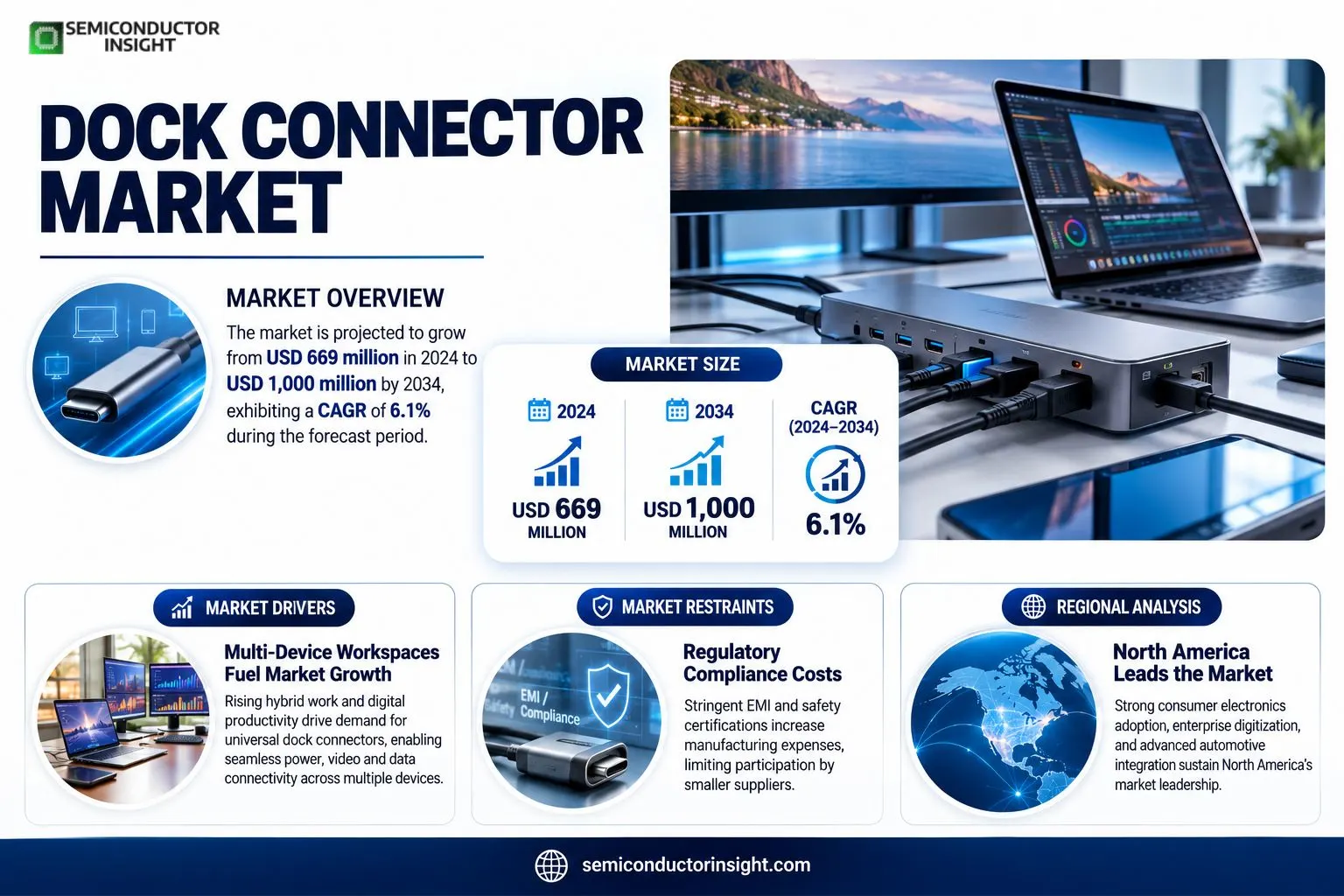
Dock Connector Market size was valued at USD 669 million in 2024. The market is projected to grow from USD 669 million in 2024 to USD 1,000 million by 2034, exhibiting a CAGR of 6.1% during the forecast period.
A dock connector is a connector used to attach a mobile electronic device simultaneously to multiple external resources. The dock connector typically carries a variety of signals and power through a single interface, simplifying docking operations. It may be integrated into a mechanical fixture that supports or aligns the device, or it can terminate a cable. Originally linked to laptops, the concept now spans smartphones, tablets and other portable electronics.
MARKET DRIVERS
Increasing Adoption of Multi‑Device Workspaces
The surge in hybrid‑working models has pushed enterprises to equip desks with universal docking stations. Companies are choosing docking solutions that can simultaneously feed power, video, and data to laptops, tablets and smartphones. This shift translates into a 15‑20 % yearly uplift in unit shipments for manufacturers that support the Dock Connector Market.
Standardisation Pressures from OEM Alliances
Major original equipment manufacturers have formed consortia to harmonise connector dimensions and pin‑out assignments. By converging on a common interface, they reduce inventory complexity for corporate buyers and open a pathway for smaller suppliers to enter the ecosystem. The result is a steady expansion of the addressable base as mid‑size firms upgrade legacy equipment.
➤ “Compatibility guarantees are becoming a non‑negotiable procurement criterion for 2025‑focused IT budgets.”
Beyond hardware, software vendors are embedding dock‑aware APIs into operating systems, enabling seamless peripheral auto‑configuration. This synergy accelerates replacement cycles, prompting firms to replace aging adapters with next‑generation units that comply with the Dock Connector Market’s emerging specifications.
MARKET CHALLENGES
Fragmented Legacy Infrastructure
Many organizations still operate with heterogeneous docking ecosystems installed over the past decade. The cost of retrofitting these environments – often exceeding 30 % of a typical IT refresh budget – creates resistance to adopting newer standards, slowing overall market momentum.
Other Challenges
Supply‑Chain Volatility
Component shortages for high‑speed data lanes and power delivery chips have led to lead‑time extensions of up to 12 weeks, prompting OEMs to hold larger safety stocks and inflate prices.
MARKET RESTRAINTS
Regulatory Compliance Costs
Stringent electromagnetic‑interference (EMI) and safety certifications required for docked power delivery add 5‑8 % to manufacturing expenses. Smaller players often lack the certification infrastructure, limiting their ability to compete on price and further narrowing the competitive set.
MARKET OPPORTUNITIES
Emerging 8K Display Integration
The rollout of 8K monitors in design‑intensive sectors drives demand for docks capable of supporting 48 Gbps video streams alongside 100 W power delivery. Vendors that engineer high‑bandwidth, low‑latency connectors stand to capture a double‑digit share of the Dock Connector Market’s premium segment within the next three years.
Dock Connector Market Trends
Convergence Toward Multi‑Function Connectors
Today’s Dock Connector Market is being reshaped by the push for single‑point interfaces that combine power, data, and audiovisual signals. As smartphones and tablets become the primary computing devices for many consumers, manufacturers are abandoning legacy ports in favor of compact connectors that can handle fast data streams while delivering higher wattage charging. This shift reduces device thickness, simplifies accessory design, and aligns with consumer expectations for a clutter‑free experience. Companies that have embraced the multi‑function approach are already seeing stronger OEM relationships because they can supply a single part that satisfies multiple use cases.
Other Trends
Emerging Applications in Smart Home and IoT
The expansion of connected home appliances is creating a steady demand for dock connectors that bridge low‑power sensors with central hubs. Unlike earlier generations that required separate cables for power and data, newer connectors embed both functions, allowing smart speakers, thermostats, and security cameras to be installed with minimal wiring. This integration not only shortens product development cycles but also opens up aftermarket opportunities for modular docking stations that can be retrofitted to legacy devices.
Automotive Integration and In‑Vehicle Entertainment
Vehicle infotainment systems are increasingly reliant on dock connectors to link passengers’ personal devices with built‑in displays and audio arrays. The rise of wireless charging pads has not eliminated the need for a physical link; instead, it has heightened expectations for connectors that support simultaneous high‑speed data transfer and rapid charging. Automakers that standardize on a common connector can streamline supply chains and offer consumers a more seamless transition from mobile device to car entertainment console.
COMPETITIVE LANDSCAPE
Key Industry Players
Dock Connector Market – Competitive Overview
TE Connectivity dominates the dock‑connector segment, leveraging a portfolio that spans automotive infotainment, consumer‑electronics charging, and industrial IoT interfaces. Its scale permits aggressive pricing while maintaining rigorous quality standards, a combination that secures long‑term supply contracts with major OEMs such as Apple, Samsung, and leading automobile manufacturers. Recent acquisitions in high‑speed data‑transfer technology have widened its addressable market, allowing it to capture value from emerging USB‑type‑C and Thunderbolt‑compatible docking solutions. The overall market exhibits an oligopolistic shape: a handful of multinationals control roughly 55 % of revenue, while the remainder is fragmented among specialized Asian firms that cater to niche applications or custom OEM requests.Beyond the tier‑one leaders, a dense cluster of Asian manufacturers fuels product differentiation and cost competition. Luxshare, Amphenol and Molex retain strong footholds in both consumer and automotive spaces, yet companies such as Wonke Electric, Deren, JCE, Lotes, Shenzhen Alex, and Shenzhen CYD Electronics focus on rapid prototyping for start‑ups and regional brands. Their agility in adopting new pin‑configurations and material innovations enables them to serve emerging markets like smart‑home hubs and portable medical devices. Smaller playersYiwanda, Prolink, Zhaolong, Kaiboer, Lulian, PowerSync, Wiretek, JIB Electronic and Bechtle AGrely on localized distribution networks, often partnering with system integrators to secure niche projects that larger firms overlook.
List of Key Dock Connector Companies Profiled
- TE Connectivity
- Amphenol
- Molex
- Luxshare
- Wonke Electric Co.,Ltd
- Deren
- JCE
- Lotes
- Shenzhen Alex
- Shenzhen CYD Electronics
- Yiwanda
- Prolink
- Zhaolong
- Kaiboer
- Lulian
- PowerSync
- Wiretek
- JIB Electronic
- Bechtle AG
Segment Analysis:
| Segment Category | Sub-Segments | Key Insights |
| By Type |
|
Mobile Connector leads due to:
|
| By Application |
|
Smartphones and Tablets dominate because:
|
| By End User |
|
Consumers are the primary driver:
|
| By Technology |
|
USB‑C emerges as the preferred technology:
|
| By Integration Mode |
|
Embedded Docking Stations gain traction:
|
Regional Analysis: Dock Connector Market
North America
Smartphone and tablet manufacturers in the United States and Canada routinely design next‑generation devices around proprietary docking standards, prompting a cascade of accessory development that reinforces the market’s depth.
Proximity of key semiconductor fabs and connector assemblers enables quicker turnaround on design revisions, reducing the lag between product announcement and connector availability.
Stringent e‑waste directives push firms toward reusable dock solutions, prompting a strategic shift from disposable accessories to more durable, service‑oriented offerings.
The concentration of venture capital in Silicon Valley accelerates the rollout of smart‑office docking stations, expanding the market beyond traditional consumer channels.
Europe
European countries exhibit a nuanced approach to the Dock Connector Market, balancing strong demand for high‑performance workstations with rigorous environmental regulations. Manufacturers are increasingly adopting circular‑economy principles, designing connectors that can be easily disassembled for repair or recycling. This trend encourages component suppliers to develop modular designs that satisfy both performance expectations and compliance mandates. At the same time, the region’s focus on data‑privacy standards drives enterprises to favor docking solutions that incorporate secure data pathways, creating a niche for connectors with embedded encryption capabilities. Companies that can align product development with these dual pressures are likely to secure a competitive edge across the EU market.
Asia‑Pacific
Asia‑Pacific’s rapid consumer‑device turnover fuels a vibrant demand for adaptable docking interfaces, yet the market is fragmented by diverse standards across national borders. Nations such as Japan and South Korea maintain strong domestic ecosystems, while emerging economies like India prioritize cost‑effective solutions that can be mass‑produced. Supply‑chain agility is a decisive factor; regional hub ports and a dense network of contract manufacturers enable swift scale‑up for new connector designs. Firms that cultivate flexible production footprints across the sub‑region can tap into both premium and volume‑driven segments, capturing value from the broad spectrum of device adoption patterns.
South America
In South America, the Dock Connector Market is shaped by a growing appetite for mobile productivity tools amid improving broadband penetration. Local OEMs often partner with North American firms to license connector technologies, leading to hybrid product lines that blend standards with regional cost considerations. Economic volatility imposes a cautious investment climate, prompting vendors to emphasize modularity that extends device lifecycles. Companies that offer turnkey docking kits with clear upgrade paths are better positioned to navigate the price sensitivity while still meeting the performance expectations of corporate buyers.
Middle East & Africa
The Middle East & Africa region is witnessing a gradual shift from basic charging accessories toward multifunctional docking stations that support remote‑work infrastructures. High‑income markets such as the Gulf Cooperation Council invest heavily in premium office equipment, creating a niche for premium‑grade connectors with robust build quality. Conversely, sub‑Saharan markets prioritize affordability and durability, encouraging suppliers to design connectors that can withstand harsh operating environments. Success in this diverse landscape hinges on the ability to segment offerings: premium, feature‑rich solutions for affluent hubs and rugged, cost‑effective models for emerging economies.
Report Scope
This market research report provides a comprehensive analysis of the Dock Connector Market , covering the forecast period 2026–2034. It offers detailed insights into market dynamics, technological advancements, competitive landscape, and key trends shaping the industry.
Key focus areas of the report include:
- Market Overview: The report begins with an overview outlining its current market scenario, key growth indicators, and industry transformation drivers. It discusses macroeconomic factors, demand–supply balance, regulatory landscape, and the strategic role of semiconductors in powering advancements across industries such as automotive, telecommunications, consumer electronics, and industrial automation.
- Market Size & Forecast: Historical data and future projections for revenue, unit shipments, and market value across major regions and segments.
- Segmentation Analysis: Detailed breakdown by product type, technology, application, and end-user industry to identify high-growth segments and investment opportunities.
- Regional Insights: Insights into market performance across North America, Europe, Asia-Pacific, Latin America, and the Middle East & Africa, including country-level analysis where relevant.
- Competitive Landscape: Profiles of leading market participants, including their product offerings, R&D focus, manufacturing capacity, pricing strategies, and recent developments such as mergers, acquisitions, and partnerships.
- Technology Trends & Innovation: Assessment of emerging technologies, integration of AI/IoT, semiconductor design trends, fabrication techniques, and evolving industry standards.
- Market Drivers & Restraints: Evaluation of factors driving market growth along with challenges, supply chain constraints, regulatory issues, and market-entry barriers.
- Stakeholder Insights: Insights for component suppliers, OEMs, system integrators, investors, and policymakers regarding the evolving ecosystem and strategic opportunities.
Primary and secondary research methods are employed, including interviews with industry experts, data from verified sources, and real-time market intelligence to ensure the accuracy and reliability of the insights presented.
FREQUENTLY ASKED QUESTIONS:
What is the current market size of Dock Connector Market?
-> Dock Connector Market was valued at USD 669 million in 2024 and is expected to reach USD 1000 million by 2034, growing at a CAGR of 6.1% during the forecast period.
Which key companies operate in Dock Connector Market?
-> Key players include Luxshare, TE Connectivity, Amphenol, Molex, Wonke Electric Co.,Ltd, Deren, JCE, Lotes, Shenzhen Alex, Shenzhen CYD Electronics, Yiwanda, Prolink, Zhaolong, Kaiboer, Lulian, PowerSync, Wiretek, JIB Electronic, Bechtle AG, among others.
What are the key growth drivers?
-> Key growth drivers include increasing adoption of smartphones and tablets, expansion of consumer electronics, technological advancements in connector design, growth of IoT and smart home ecosystems, automotive connectivity enhancements, and rising demand in medical device applications.
Which region dominates the market?
-> Asia-Pacific is the fastest‑growing region, while North America remains a major market due to high device penetration and advanced automotive integration.
What are the emerging trends?
-> Emerging trends include integration of high‑speed data transfer standards, multifunctional connectors supporting power‑over‑Ethernet, enhanced durability for automotive and medical applications, and the convergence of dock connectors with wireless charging technologies.
Get Sample Report PDF for Exclusive Insights
Report Sample Includes
- Table of Contents
- List of Tables & Figures
- Charts, Research Methodology, and more...
 Download Sample Report PDF