Distributed Acoustic Sensing Systems Market Insights
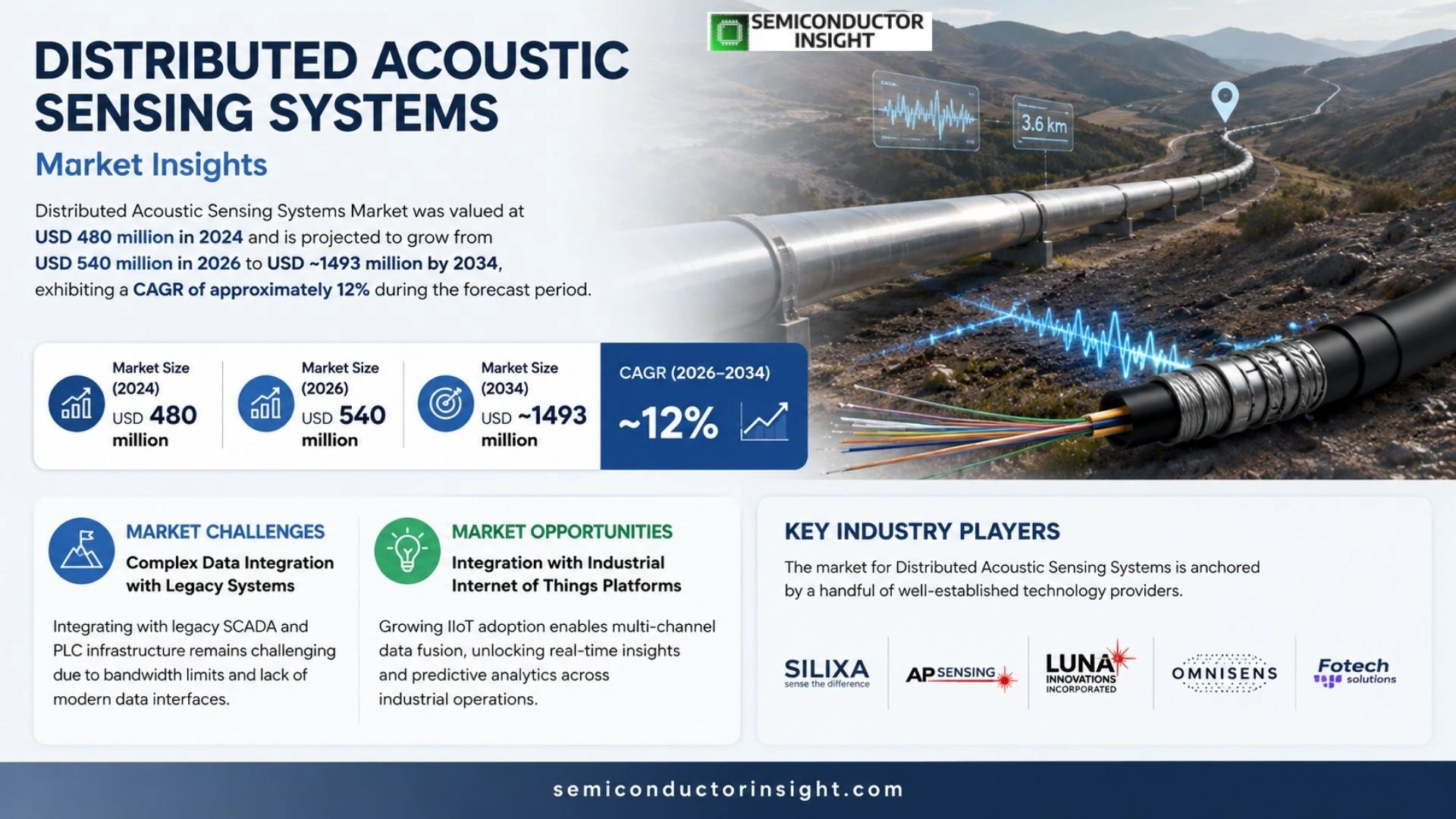
Distributed Acoustic Sensing Systems Market was valued at USD 480 million in 2024 and is projected to grow from USD 540 million in 2026 to USD ~1493 million by 2034, exhibiting a CAGR of approximately 12% during the forecast period.
Distributed acoustic sensing systems are fiber‑optic based optoelectronic instruments that convert standard communication fibre into a continuous array of vibration sensors, enabling real‑time monitoring of acoustic interactions along the cable length – a capability that underpins infrastructure safety, asset integrity and operational efficiency across oil & gas, power utilities and security sectors.
MARKET DRIVERS
Advanced Fault Detection in Oil & Gas Infrastructure
Digital sensing technologies have gradually supplanted traditional point‑based monitoring in the energy sector. Engineers now rely on continuous acoustic surveillance to spot micro‑cracks, pipe wall thinning, and corrosion in real time. Distributed Acoustic Sensing Systems Market is reacting to increasing regulatory pressure for leak detection, especially in aging offshore platforms where a single undetected fault can lead to costly spill incidents. By embedding inline fiber arrays, operators gain spatial resolution at the meter level, empowering teams to localise anomalies and initiate targeted repairs. Faster diagnostics translate into significant savings on downtime, maintenance budgets, and environmental compliance, compelling industry players to accelerate deployment. Moreover, the convergence of machine learning algorithms with raw acoustic data enables predictive analytics that foresee wear trajectories. This predictive edge encourages oil and gas companies to invest in turnkey DASE solutions as a risk‑mitigation strategy. Consequently, the market is nudged toward higher penetration in reservoir pipelines, water‑handling systems, and subsea flowlines, where acoustic signatures are less ambiguous and regulatory oversight is stringent.
Data‑Driven Asset Management Across Rail Networks
In high‑speed rail corridors, infrastructure stability is paramount for safety and schedule adherence. Distributed Acoustic Sensing Systems Market participants are now offering integrated acoustic platforms that monitor track beds, ballast fatigue, and subgrade movements. The shift from manual inspections to continuous acoustic streams reduces labor intensity and increases temporal coverage, which is essential for detecting subtle excitations that precede critical failures such as rail head separation. Moreover, rail operators are mandated to demonstrate real‑time monitoring of bridge structures, platforms, and signaling tunnels; fiber‑based acoustic sensors fulfill these obligations with higher fidelity than conventional vibrationometers. The adoption curve is further accelerated by the proliferation of cyber‑physical security protocols that intertwine infrastructure monitoring with digital threat surveillance. As train operations become more data‑centric, the economic case for acoustic sensors strengthens: reduced dispatch interruptions, commendable safety records, and compliance with international rail safety standards translate directly into lower insurance premiums and higher shareholder confidence.
➤ Industry analysts note that the integration of acoustic data with predictive analytics is reshaping operational strategies across both energy and transport sectors, creating a resilient asset management framework that supports both safety and profitability.
Beyond sector‑specific applications, Distributed Acoustic Sensing Systems Market benefits from rising infrastructure investment in smart cities, petroleum pipelines, and transit systems. Utility companies are scaling fiber deployments to surveil municipal water mains for leak and intrusion detection, reducing potable water loss and associated repair costs. Moreover, the digital divide is narrowing as fiber becomes cheaper and more robust to harsh environments; this technological democratization widens the addressable customer base. The momentum generated by regulatory mandates for real‑time monitoring, coupled with the proven return on investment of acoustic analytics, positions the market for sustained expansion across multiple verticals. Companies that invest in a modular, cloud‑enabled data platform will differentiate themselves by delivering actionable insights rather than raw sensor data, thereby capturing a premium share of the market.
MARKET CHALLENGES
Complex Data Integration with Legacy Systems
Adopting Distributed Acoustic Sensing Solutions demands seamless integration with existing SCADA and asset management platforms. Many entities still operate on older PLC infrastructures that lack the bandwidth or APIs required to ingest high‑frequency acoustic streams. The necessity for costly middleware or custom firmware development introduces delays and bears a direct cost on capital budgets. As a result, organizations may hesitate to upgrade legacy systems, thereby postponing the installation of acoustic sensors. Additionally, data overload remains a pressing issue; the sheer volume of acoustic recordings can swamp existing storage and processing pipelines unless the organization implements efficient compression, edge analytics, or scalable cloud solutions. Inadequate data management can suppress the anticipated benefits, causing friction in the adoption curve and fostering skepticism among operational decision‑makers who expected rapid gains.
Other Challenges
Barrier of Technical Expertise
The successful deployment of fiber‑based acoustic systems relies heavily on multidisciplinary expertise spanning civil engineering, signal processing, and data science. The current talent pool for designing, calibrating, and interpreting acoustic signatures is sparse, often requiring the recruitment of consultants or the training of in‑house teams at a significant expense. This skill gap may stall implementation timelines and inflate deployment costs, particularly for mid‑sized utilities and transport operators that operate on thinner margins. As a consequence, market growth becomes uneven, with large enterprises accelerating adoption while smaller firms remain hesitant without clear, readily available expertise. The industry must therefore address this educational barrier to sustain momentum.
MARKET RESTRAINTS
High Initial Capital Expenditure for Fiber Deployment
Deploying Distributed Acoustic Sensing Solutions typically requires significant upfront investment in optical fiber, specialized transceivers, and installation crews. The total cost of ownership is amplified when the network lies beneath challenging terrains such as urban underground, seismic zones, or marine environments, where trenching or cable laying becomes prohibitive. For capital‑constrained utilities, the initial outlay can be a deterrent when compared to legacy monitoring techniques that demand lower initial expenditure. Even with projected long‑term savings, organizational decision‑makers may be reluctant to commit to a technology that requires such a sizable immediate capital commitment, especially when returns unfold gradually over several years. This financial hurdle creates a notable restraint on market expansion, particularly within smaller jurisdictions or in regions with limited public funding for infrastructure upgrades.
MARKET OPPORTUNITIES
Integration with Industrial Internet of Things Platforms
As Distributed Acoustic Sensing Systems Market intersects increasingly with industrial IoT ecosystems, there is a clear opening for multi‑channel data fusion solutions. By embedding acoustic data streams into a unified analytics framework that also ingests pressure, temperature, and flow metrics, operators can build a holistic view of asset performance. This convergence unlocks advanced predictive maintenance models that leverage cross‑modal correlations, thereby reducing false positives and elevating fault‑prediction accuracy. Companies that fashion an end‑to‑end platform,encompassing fiber deployment, edge processors, and cloud‑based AI,can capture higher value services and command premium pricing. Furthermore, the expanding government push towards resilient infrastructure positions the sector to benefit from public sector contracts and subsidies that favor comprehensive, data‑rich monitoring solutions over isolated sensor packages.
Distributed Acoustic Sensing Systems Market Trends
Regulatory Compliance and IoT Integration Drive Adoption
Distributed Acoustic Sensing Systems Market continues to attract attention as functionally mature fiber‑optic instrumentation delivers real‑time insight into infrastructure integrity. Regulatory requirements on pipeline safety, environmental compliance, and critical asset protection have pushed operators toward continuous monitoring solutions. Coupled with the maturation of IoT and AI analytics, DAS systems now offer granular event detection, classification, and actionable reporting across kilometres of fibre. This convergence reduces inspection cycles, lowers operational cost, and provides a data foundation for risk‑based maintenance. Firms that deploy integrated sensor networks position themselves to meet stringent reporting mandates while unlocking new revenue streams from value‑added data services. Moreover, the scalability of DAS platforms allows operators to expand coverage incrementally without substantial capital outlays, aligning investment with project maturity. The synergy between advanced fibre‑optic hardware and cloud‑based analytics also facilitates remote diagnostics, further shortening response times and enhancing operational resilience.
Other Trends
Perimeter Security Enhancements
Perimeter security remains a top priority for municipalities and border agencies seeking non‑intrusive, 24/7 vigilance. By reconfiguring existing fibre routes into fine‑grain vibration arrays, DAS units detect footfall, intrusion, or vehicle movement with metre‑scale accuracy, eliminating blind zones typical of camera‑based systems. The residual need for manual patrolling drops markedly, while the reduced risk of false positives translates into lower alarm costs. As governments invest in hardened perimeters, the DAS market rewards firms that can deliver turnkey security solutions with scalable analytics platforms.
Smart City Infrastructure Integration
Smart city initiatives are increasingly leveraging distributed acoustic sensing to decode urban dynamics. In dense neighbourhoods, DAS tracks noise, vehicle counts, and pedestrian flow, feeding predictive models that inform traffic congestion mitigation and public safety schedules. Structural health monitoring,identifying micro‑cracks in bridge decks or vibration anomalies in high‑rise facades,also benefits from fibre‑optic distributed observation, allowing maintenance teams to intervene before aesthetic or safety thresholds are breached. The synthesis of acoustic data with existing municipal sensor grids creates a holistic view that city planners can use to optimise infrastructure lifecycle costs.
Expansion into Oil & Gas and Pipeline Monitoring
Oil and gas operators recognize the value of distributed acoustic sensing in every segment of their production chain,from wellbore real‑time monitoring to pipeline integrity and offshore platform stability. With near‑real‑time anomaly detection, operators can pre‑empt corrosion hotspots, reduce downtime, and maintain regulatory compliance without intrusive inspections. The integration of DAS outputs into asset‑management platforms provides actionable visibility that translates into measurable savings in maintenance budgets and risk mitigation. As sector participants seek to reduce operational drawdowns, the demand for fibre‑optic distributed monitoring solutions is set to grow, reshaping deployment strategies and investment priorities across the industry.
COMPETITIVE LANDSCAPE
Key Industry Players
Distribution Acoustic Sensing Systems Market Analysis
The market for Distributed Acoustic Sensing Systems is anchored by a handful of well-established technology providers that have achieved early momentum through flagship deployments in critical infrastructure corridors. Companies such as Schlumberger, Halliburton, and Baker Hughes leverage their deep industry relationships and integrated service offerings to secure long‑term contracts for monitoring pipelines, rail networks, and utility assets. Their extensive portfolios include end‑to‑end solutions that bundle optical cable, processing hardware, and advanced analytics, generating recurring revenue streams tied to uptime guarantees. This concentration of market power is a direct consequence of the high up‑front capital investment required to build and maintain reliable sensing installations, which naturally limits the entry of smaller competitors. Consequently, these incumbents maintain a competitive edge through economies of scale, vertical integration, and experience‑based pricing models that capture significant market share across North America and Europe.
In contrast, a cohort of mid‑sized and niche firms has carved out strong positions by focusing on high‑margin, sector‑specific applications. Silixa, Hifi Engineering, and Future Fibre Technologies (Ava Group) target pipeline integrity monitoring, offering modulable sensor arrays and real‑time data services that appeal to operations teams in the oil and gas sector. AP Sensing and Banweaver provide tailored solutions for environmental monitoring, delivering granular vibration metrics for seismic and ground‑movement studies. Omnisens and Optromix specialize in perimeter security and crowd‑management deployments in urban environments, while Senstar and Aragon Photonics bring advanced signal‑processing algorithms that enhance event classification for security and safety applications. FEBUS Optics and Fiber SenSys (OPTEX) focus on power‑line surveillance in the utilities market, integrating sensor hardware with cloud‑based analytics platforms. This fragmentation across application verticals creates multiple growth avenues and mitigates the risk of a single point of failure in the supply chain.
List of Key Distributed Acoustic Sensing Systems Companies Profiled
- Schlumberger
- Halliburton
- Baker Hughes
- Silixa
- Hifi Engineering
- Future Fibre Technologies
- AP Sensing
- Banweaver
- Omnisens
- Optromix, Inc.
- Senstar
- Aragon Photonics
- FEBUS Optics
- Fiber SenSys (OPTEX)
Segment Analysis:
| Segment Category | Sub-Segments | Key Insights |
| By Type |
|
Leading Segment • Continuous real‑time monitoring of fiber optic lines; • Enables fine‑grained detection of micro‑vibrations across thousands of meters; • Reduces manual inspection cycles; • Facilitates predictive maintenance; • Enhances safety by spotting anomalies before escalation. |
| By Application |
|
Leading Segment • Pipeline integrity surveillance mitigates leak risk before escalation; • Railway track monitoring detects hidden deformations ending costly downtimes; • Urban traffic flow analyses improve congestion management; • Perimeter security integrates with CCTV for comprehensive defense; • Seismic activity monitoring supports disaster preparedness. |
| By End User |
|
Leading Segment • Oil & Gas operators leverage DAS for wellbore surveillance; • Utilities use DAS for underground cable fault detection; • Transportation authorities benefit from rail safety and road monitoring; • Industrial plants monitor equipment reliability; • Public infrastructure authorities implement comprehensive integrity programs. |
| By Deployment Environment |
|
Leading Segment • On‑site installation ensures immediate data capture during construction; • Remote deployment via existing telecom fiber scales cost; • Managed services enable continuous monitoring with reduced on‑site staff; • Hybrid deployments combine on‑site expertise with cloud analytics. |
| By Integration Mode |
|
Leading Segment • AI‑driven analytics classify vibration signatures for rapid decision‑making; • IoT‑enabled gateways allow seamless sensor data flow to central dashboards; • Cloud‑based platforms provide elastic scalability for high‑volume data streams; • Enterprise ERP integration aligns DAS data with operational workflows. |
Regional Analysis: Distributed Acoustic Sensing Systems Market
North America
Fiber‑optic corridors across the U.S. and Canada have been swiftly retrofitted with acoustic routing capabilities, creating a dense sensor mesh that delivers granular data for pipeline health. This trend has outpaced traditional flow‑metering solutions without compromising system reliability, positioning distributors as key enablers of efficient asset management.
Emerging standards on leak detection and asset integrity issued by national bodies now reference acoustic sensing as a compliant solution, creating a market cue that shifts procurement pathways toward sensor‑based monitoring in both public and private sectors.
Consolidation within the sensor‑equipped services tier has accelerated, as larger integrators seek to broaden their offerings with robust acoustic solution portfolios, thereby better positioning themselves for long‑term infrastructure contracts.
Continued investment in predictive analytics, coupled with a growing demand for real‑time threat detection, is expected to reinforce North America’s leadership and expand deployment into emerging asset classes such as offshore wind and underground energy grids.
Europe’s distributed acoustic sensing scene is shaped by stringent environmental policies and a drive to modernize aging transport and oil‑aerospace infrastructure. Adoption is rising in regions with dense pipelines and comprehensive rail networks, where sensors allow for low‑impact monitoring that aligns with sustainability objectives. However, market penetration lags behind North America, largely because of fragmented procurement and a higher reliance on legacy leak‑detection equipment. European operators are now evaluating acoustic solutions primarily for high‑risk sites,such as cross‑border oil pipelines,where the cost of failure outweighs the upfront investment. The region’s regulatory push toward emissions reduction is also encouraging sensor deployment in new renewable projects, including offshore wind farms, positioning Europe for a balanced shift toward preventive as well as reactive monitoring strategies.
In Asia‑Pacific, distributed acoustic sensing is gaining traction through the expansion of cybersecurity‑driven monitoring in critical infrastructure such as oil‑and‑gas pipelines and urban water networks. Rapid infrastructure development delivers an expansive fiber network, which provides a ready canvas for acoustic probe integration. The market is still nascent, but significant public‑private partnerships are forging pathways to embed sensor technology in national resiliency frameworks, especially across China, India, and Southeast Asia. Regulatory bodies are beginning to consider acoustic sensing in safety compliance guidelines, a shift that could spur broader adoption as utility operators seek to mitigate costly leaks and regulatory penalties. The region’s high population density and volatile climate patterns add urgency, positioning acoustic monitoring as a strategic tool for risk mitigation in both mature and emerging sectors.
In South America, the market remains in early stages, largely restricted to a handful of large petrochemical and mining corporations that view acoustic sensing as a high‑risk mitigation tool. The scarcity of fiber infrastructure and limited local manufacturing capacity hinder wider uptake. However, regional initiatives aimed at enhancing supply‑chain transparency and European‑style pipeline safety regulations are slowly opening doors for sensor deployment. Early adopters are focusing on remote pipeline corridors where conventional monitoring is either too costly or technically infeasible. As funding flows from international development agencies heat project pipelines, a gradual increase in distributed acoustic sensing adoption is expected, particularly in Brazil and Argentina, where oil and gas exports continue to dominate.
The Middle East & Africa region presents a heterogeneous landscape for distributed acoustic sensing, with oil‑rich Gulf countries leading early adoption, partly due to stringent leak‑detection obligations imposed by international sanctions. In contrast, Sub‑Saharan Africa is still exploring cost‑effective solutions for its oil pipelines, often prioritizing traditional instrumentation. Emerging digital infrastructure and foreign investment in the Gulf States create a clear avenue for sensor integration across large cross‑border pipelines and offshore facilities. Meanwhile, the region’s mixed regulatory environment places emphasis on risk‑based maintenance, encouraging operators to adopt distributed acoustic sensing as part of comprehensive asset‑integrity strategies. Market penetration is poised to expand as the region intensifies its focus on safe-asset expansion and digital transformation initiatives.
Report Scope
This market research report provides a comprehensive analysis of the Distributed Acoustic Sensing Systems Market , covering the forecast period 2026–2034. It offers detailed insights into market dynamics, technological advancements, competitive landscape, and key trends shaping the industry.
Key focus areas of the report include:
- Market Overview: The report begins with an overview outlining its current market scenario, key growth indicators, and industry transformation drivers. It discusses macroeconomic factors, demand–supply balance, regulatory landscape, and the strategic role of semiconductors in powering advancements across industries such as automotive, telecommunications, consumer electronics, and industrial automation.
- Market Size & Forecast: Historical data and future projections for revenue, unit shipments, and market value across major regions and segments.
- Segmentation Analysis: Detailed breakdown by product type, technology, application, and end-user industry to identify high-growth segments and investment opportunities.
- Regional Insights: Insights into market performance across North America, Europe, Asia-Pacific, Latin America, and the Middle East & Africa, including country-level analysis where relevant.
- Competitive Landscape: Profiles of leading market participants, including their product offerings, R&D focus, manufacturing capacity, pricing strategies, and recent developments such as mergers, acquisitions, and partnerships.
- Technology Trends & Innovation: Assessment of emerging technologies, integration of AI/IoT, semiconductor design trends, fabrication techniques, and evolving industry standards.
- Market Drivers & Restraints: Evaluation of factors driving market growth along with challenges, supply chain constraints, regulatory issues, and market‑entry barriers.
- Stakeholder Insights: Insights for component suppliers, OEMs, system integrators, investors, and policymakers regarding the evolving ecosystem and strategic opportunities.
Primary and secondary research methods are employed, including interviews with industry experts, data from verified sources, and real‑time market intelligence to ensure the accuracy and reliability of the insights presented.
FREQUENTLY ASKED QUESTIONS:
What is the current market size of Distributed Acoustic Sensing Systems Market?
-> Distributed Acoustic Sensing Systems Market is projected to grow from USD 540 million in 2026 to USD ~1493 million by 2034, exhibiting a CAGR of 12%
What is the projected market size of Distributed Acoustic Sensing Systems Market by 2031?
-> The market is expected to grow to USD 1,071 million by 2031, reflecting a significant expansion driven by increasing adoption across multiple sectors.
What is the CAGR of Distributed Acoustic Sensing Systems Market during the forecast period?
-> The market is forecast to grow at a CAGR of 12.5% from 2024 to 2031.
Which application sectors contribute most to market growth?
-> Key application sectors include Oil & Gas, Power & Utilities, Transportation, and Others, with Oil & Gas leading adoption due to pipeline and wellmonitoring needs.
What are the primary drivers of market growth?
-> Primary drivers include Infrastructure Monitoring, Oil & Gas Optimization, Enhanced Security, Environmental Monitoring, Smart Cities, Railway Safety, Energy Sector, Industrial Process Monitoring, Real‑Time Data, Cost Savings, Safety Enhancement, IoT and AI Integration, Regulatory Compliance, and Emerging Applications.
Which technologies are most widely adopted?
-> The predominant technology type is the DASI type, while the emerging DASP type is gaining traction due to advanced sensing capabilities.
What geographic regions dominate the market?
-> Key regions include North America, Europe, and Asia-Pacific, with North America leading in adoption due to robust infrastructure and regulatory support.
How is the market segmented by geography?
-> Geographic segmentation highlights North America (US, Canada, Mexico), Europe (Germany, France, UK, Italy, Russia, Nordic Countries, Benelux, Rest of Europe), Asia (China, Japan, South Korea, Southeast Asia, India, Rest of Asia), South America (Brazil, Argentina, Rest of South America), and Middle East & Africa (Turkey, Israel, Saudi Arabia, UAE, Rest of Middle East & Africa).
Which companies are leading in revenue and market share?
-> Leading market participants include Optasense (Luna), Schlumberger, Halliburton, Baker Hughes (GE), Fotech Solutions, Silixa, Hifi Engineering, Future Fibre Technologies (Ava Group), AP Sensing, and Banweaver, among others.
What are the emerging trends in the market?
-> Emerging trends include Integration with IoT and AI, Real‑time Data Analytics, Enhanced Security Applications, and Fiber-Optic Infrastructure Utilization.
Which sectors benefit most from real-time data and predictive maintenance?
-> Sectors such as Oil & Gas, Transportation, and Power & Utilities benefit significantly from real‑time data, offering improved fault detection, maintenance efficiency, and safety.

Get Sample Report PDF for Exclusive Insights
Report Sample Includes
- Table of Contents
- List of Tables & Figures
- Charts, Research Methodology, and more...
 Download Sample Report PDF