Digital Instrument Cluster (IC) SoC Market Insights
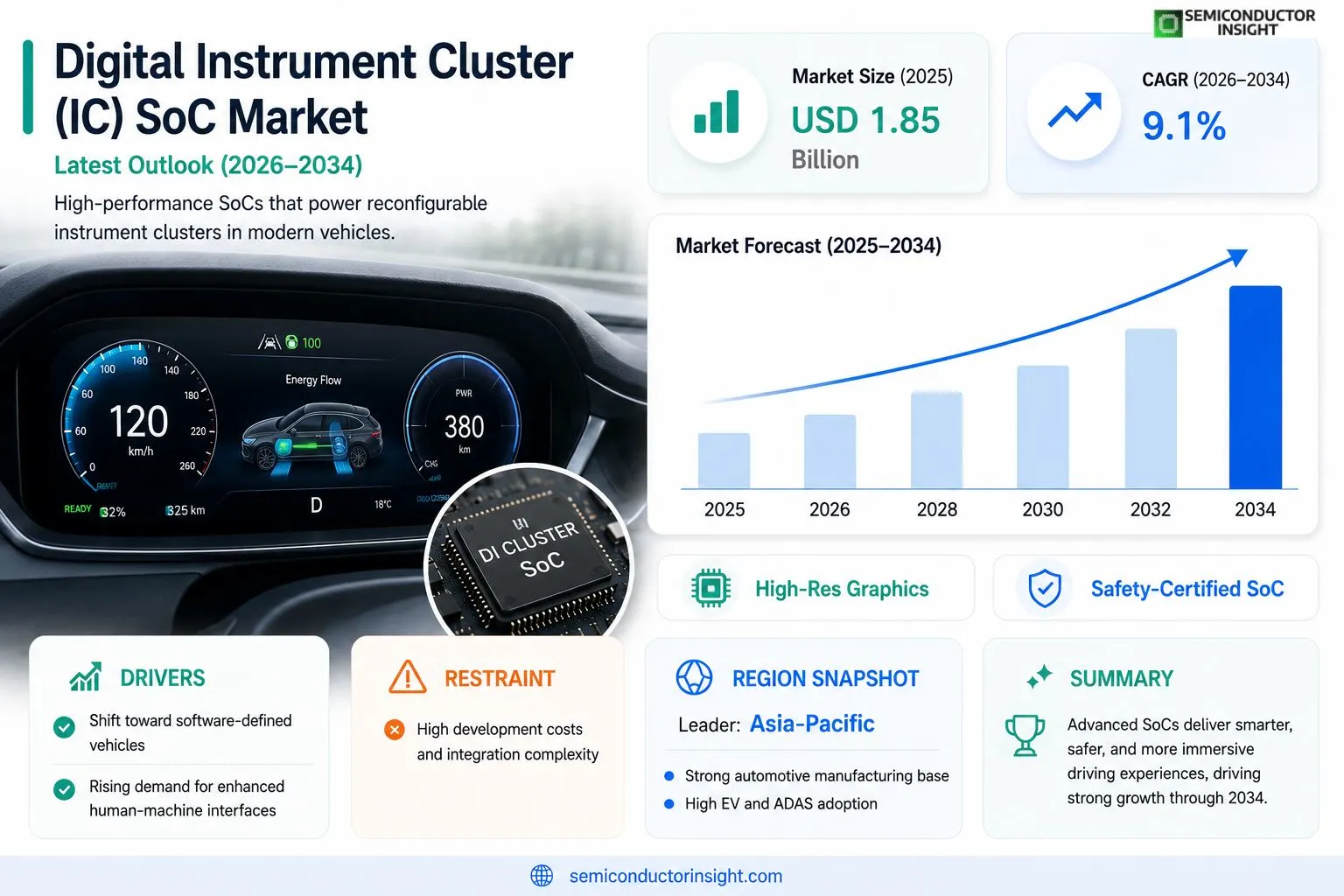
Global Digital Instrument Cluster (IC) SoC market size was valued at USD 1.85 billion in 2025. The market is projected to grow from USD 2.05 billion in 2026 to USD 4.12 billion by 2034, exhibiting a CAGR of 9.1% during the forecast period.
Digital Instrument Cluster (IC) SoCs are specialized system-on-chip solutions designed to power fully digital and reconfigurable instrument clusters in modern vehicles. These integrated circuits combine high-performance processors, graphics engines, memory, and connectivity modules on a single chip to deliver real-time vehicle information, customizable displays, and seamless integration with advanced driver assistance systems (ADAS) and infotainment platforms.
The market is experiencing robust growth due to several factors, including the accelerating shift toward software-defined vehicles, rising demand for enhanced human-machine interfaces, and the proliferation of electric vehicles that require sophisticated visualization of battery status and energy management data. Furthermore, advancements in semiconductor technology enabling higher resolution graphics and AI-driven personalization are contributing to market expansion. Initiatives by key players in the market are also expected to fuel the market growth. For instance, leading semiconductor companies continue to develop next-generation automotive-grade SoCs optimized for safety-critical applications and high-performance rendering. Qualcomm, NVIDIA, Texas Instruments, NXP Semiconductors, and Renesas Electronics are some of the key players that operate in the market with a wide range of portfolios.
MARKET DRIVERS
Rising Demand for Integrated Digital Cockpits in Vehicles
Digital Instrument Cluster (IC) SoC Market is propelled by the automotive industry’s shift toward software-defined vehicles, where SoCs integrate instrument cluster functions with infotainment and ADAS visualization on a single platform. Larger high-resolution displays, expanding from traditional sizes to 12.3 inches and beyond, require powerful processing capabilities for smooth 3D graphics and real-time data rendering.
Electrification and Premium Vehicle Growth
Expansion of electric and premium vehicles significantly boosts adoption of advanced Digital Instrument Cluster SoCs, as these platforms support customizable interfaces for battery management, range information, and enhanced driver experiences. OEMs increasingly deploy domain controllers that consolidate multiple functions, driving demand for high-performance automotive-grade SoCs with robust graphics and safety features.
➤ SoC platforms enable seamless merging of cluster, infotainment, and safety systems, supporting the transition to fully reconfigurable digital cockpits across vehicle segments.
Technological advancements in process nodes and AI integration further accelerate market expansion, allowing efficient handling of complex visualizations while meeting stringent automotive safety standards.
MARKET CHALLENGES
High Development Costs and Integration Complexity
Developing reliable Digital Instrument Cluster (IC) SoCs involves substantial R&D investment due to the need for functional safety certifications such as ASIL-B and ASIL-D, alongside complex software integration for real-time performance. Supply chain constraints on specialized components like display drivers add pressure on manufacturers.
Other Challenges
Cybersecurity Vulnerabilities
Increasing connectivity in digital cockpits heightens exposure to cyber threats, requiring robust security measures embedded directly into SoC architectures to protect critical driver information systems.
Technical Reliability Issues
Ensuring consistent performance across varying environmental conditions, including extreme temperatures and electromagnetic interference, remains a key hurdle for widespread adoption in mass-market vehicles.
MARKET RESTRAINTS
High Costs Associated with Advanced Systems
The elevated costs of premium displays, sophisticated integrated circuits, and ongoing maintenance continue to restrain broader penetration of advanced Digital Instrument Cluster (IC) SoCs, particularly in entry-level and mid-range vehicle segments where price sensitivity is high.Prolonged qualification cycles and functional safety certification timelines further delay time-to-market for new SoC solutions, impacting overall industry growth momentum.
MARKET OPPORTUNITIES
Expansion into Entry-Level and Emerging Markets
Declining costs of display technologies and maturing SoC platforms create significant opportunities for Digital Instrument Cluster (IC) SoC providers to penetrate mass-market and emerging economy vehicles, supported by OEM mandates for enhanced digital interfaces. Advancements in single-chip solutions that unify cluster processing with other cockpit domains, combined with generative AI features, position the market for substantial growth through 2030 and beyond.
Digital Instrument Cluster (IC) SoC Market Trends
Shift Toward Software-Defined Vehicles Driving SoC Innovation
Digital Instrument Cluster (IC) SoC Market is witnessing significant momentum as the automotive industry transitions to software-defined vehicles. These specialized system-on-chip solutions integrate high-performance processors, graphics engines, memory, and connectivity modules to enable fully digital and reconfigurable instrument clusters. This evolution supports real-time vehicle information delivery and seamless customization, meeting the growing expectations for advanced human-machine interfaces in modern vehicles.
Other Trends
Proliferation of Electric Vehicles and Enhanced Visualization Needs
The rise of electric vehicles has created specific demands within Digital Instrument Cluster (IC) SoC Market for sophisticated visualization of battery status, energy management data, and charging information. SoC solutions are evolving to handle these unique requirements while maintaining high reliability for safety-critical applications. Integration with advanced driver assistance systems (ADAS) further amplifies the need for powerful, efficient chips that can process complex data streams without compromising performance.
Advancements in Semiconductor Technology and Graphics Capabilities
Continuous improvements in semiconductor processes are enabling higher resolution graphics and faster rendering in Digital Instrument Cluster (IC) SoC designs. Manufacturers are focusing on automotive-grade components that support AI-driven personalization features, allowing drivers to configure displays according to preferences and driving conditions. This technological progress facilitates smoother integration with broader vehicle ecosystems, including infotainment platforms.
Key Player Initiatives and Industry Collaboration
Leading semiconductor companies such as Qualcomm, NVIDIA, Texas Instruments, NXP Semiconductors, and Renesas Electronics are actively developing next-generation solutions optimized for Digital Instrument Cluster (IC) SoC Market. Their efforts emphasize safety compliance, high-performance rendering, and platform consolidation where instrument clusters converge with other cockpit functions on single-chip architectures. These initiatives are accelerating the adoption of reconfigurable digital displays across vehicle segments, from premium models to more mainstream applications. The emphasis on connectivity and real-time analytics continues to shape product roadmaps, ensuring SoCs can support future software updates and enhanced user experiences.
As vehicle architectures become increasingly centralized, Digital Instrument Cluster (IC) SoC Market trends point toward greater efficiency through domain controller integration. This approach reduces system complexity while improving overall responsiveness and upgradability. Industry participants are prioritizing robust solutions that balance power consumption with advanced features, positioning the market for sustained expansion amid evolving automotive technologies.
COMPETITIVE LANDSCAPE
Key Industry Players
Digital Instrument Cluster (IC) SoC Market Competitive Analysis
Digital Instrument Cluster (IC) SoC Market is led by semiconductor giants specializing in high-performance automotive-grade processors optimized for real-time graphics rendering, safety compliance, and seamless integration with vehicle ecosystems. NVIDIA and Qualcomm stand out as frontrunners with their powerful SoC platforms that support advanced visualization, AI features, and domain controller architectures essential for software-defined vehicles.Complementing these leaders are established players like Renesas Electronics, NXP Semiconductors, and Texas Instruments, who excel in providing reliable, cost-effective solutions with strong functional safety credentials. Niche contributors and system integrators further enrich the ecosystem, delivering tailored SoCs and hybrid platforms for electric vehicles and premium automotive segments.
List of Key Digital Instrument Cluster (IC) SoC Companies Profiled
- NVIDIA Corporation
- Qualcomm Technologies
- Renesas Electronics Corporation
- NXP Semiconductors
- Texas Instruments Incorporated
- Infineon Technologies AG
- STMicroelectronics
- Robert Bosch GmbH
- Continental AG
- Visteon Corporation
- Denso Corporation
- Panasonic Corporation
- Marelli Holdings Co., Ltd.
- Yazaki Corporation
- Nippon Seiki Co., Ltd.
Segment Analysis:
| Segment Category | Sub-Segments | Key Insights |
| By Type |
|
High-Performance Graphics SoCs lead the segment by delivering superior real-time rendering capabilities essential for crisp, customizable digital displays. These solutions excel in handling complex visualizations including 3D vehicle representations and dynamic gauge animations. They seamlessly support integration with advanced driver assistance systems for unified information presentation. Their robust architecture enables smooth transitions between multiple display modes while maintaining low latency critical for driver safety and situational awareness. |
| By Application |
|
ADAS Integration emerges as the dominant application area as Digital Instrument Cluster SoCs become central to delivering unified safety information. These chips facilitate real-time fusion of sensor data into intuitive visual alerts and warnings directly within the driver’s primary view. They enable contextual overlays that enhance decision-making during complex driving scenarios. Manufacturers prioritize these solutions for their ability to maintain functional safety compliance while providing rich graphical interfaces that improve overall vehicle intelligence and occupant confidence. |
| By End User |
|
Passenger Vehicle OEMs represent the leading end user group due to their relentless focus on premium cabin experiences and differentiated human-machine interfaces. These manufacturers leverage advanced SoCs to create highly personalized instrument clusters that adapt to individual driver preferences and driving modes. The chips support seamless connectivity with personal devices and cloud services for enhanced functionality. Their adoption drives innovation in display fluidity and aesthetic integration that significantly elevates brand perception and customer satisfaction in competitive markets. |
| By Vehicle Type |
|
Electric Vehicles stand out as the fastest evolving segment for Digital Instrument Cluster SoCs. These platforms demand specialized visualization of battery state, energy flow, and regenerative systems in engaging graphical formats. SoCs tailored for EVs excel in power optimization while delivering vibrant, high-fidelity displays that communicate range and efficiency metrics intuitively. They also accommodate unique requirements such as charging status animations and thermal management indicators, making them indispensable for next-generation electric mobility experiences. |
| By Feature Set |
|
Fully Reconfigurable Clusters lead through their ability to transform the driving interface dynamically according to context and user needs. These SoC-powered systems allow complete layout changes, theme adaptations, and information prioritization without hardware modifications. They foster deeper driver engagement by presenting relevant data during different journey phases. The flexibility also supports over-the-air updates that continuously enhance functionality and maintain vehicle freshness throughout its lifecycle, representing a key differentiator in software-defined automotive architectures. |
Regional Analysis: Digital Instrument Cluster (IC) SoC Market
Asia-Pacific
The region’s extensive vehicle production infrastructure provides an ideal foundation for Digital Instrument Cluster (IC) SoC integration. Major assembly hubs facilitate rapid prototyping and scaling of new chipset technologies, allowing seamless incorporation into various vehicle platforms. This manufacturing advantage supports faster time-to-market for advanced digital clusters featuring enhanced visualization and connectivity options.
Strong growth in electric mobility creates substantial opportunities for Digital Instrument Cluster (IC) SoC providers. EVs require sophisticated display systems to communicate battery status, energy management, and autonomous features, driving demand for powerful yet efficient chipsets. Regional strategies emphasize harmonious integration between SoC solutions and emerging powertrain technologies.
Collaborative networks between semiconductor firms, automakers, and technology developers accelerate advancements in Digital Instrument Cluster (IC) SoC capabilities. Focus areas include improved graphics processing, sensor fusion support, and over-the-air update compatibility, ensuring instrument clusters remain adaptable throughout vehicle lifecycles.
Established component ecosystems and strategic partnerships enhance reliability in sourcing critical materials and technologies for Digital Instrument Cluster (IC) SoC production. This resilience supports consistent innovation while addressing evolving requirements for cybersecurity and functional safety in automotive displays.
North America
North America maintains a significant position in Digital Instrument Cluster (IC) SoC Market through its focus on premium vehicle segments and technological leadership. The region excels in developing cutting-edge software architectures that complement advanced hardware solutions, particularly in areas of human-machine interface design and data visualization. Automakers prioritize user-centric clusters that deliver personalized experiences and seamless connectivity with other vehicle systems. Innovation efforts concentrate on enhancing safety through better integration with advanced driver assistance technologies, while regulatory emphasis on vehicle electronics drives continuous refinement of SoC performance standards. Strategic investments in research and development foster novel approaches to power management and graphical capabilities tailored for diverse driving conditions.
Europe
Europe demonstrates strong momentum in Digital Instrument Cluster (IC) SoC Market, characterized by its commitment to luxury automotive standards and sustainability goals. The region leads in implementing sophisticated digital cockpit solutions that align with stringent safety and environmental regulations. Manufacturers emphasize elegant design languages combined with high-performance processing units capable of supporting complex visualizations and real-time analytics. Collaborative initiatives between automotive brands and semiconductor specialists result in SoC solutions optimized for both traditional and electric powertrains. Focus on cybersecurity measures and functional safety compliance further strengthens the region’s contribution to global advancements in instrument cluster technology, creating clusters that enhance both driver confidence and operational efficiency.
South America
South America is emerging as a promising market within the Digital Instrument Cluster (IC) SoC landscape, with growing interest in modernizing vehicle interiors across commercial and passenger segments. Local manufacturers are gradually adopting digital solutions to improve vehicle appeal and functionality in response to evolving consumer preferences. The region benefits from technology transfer opportunities that support the integration of cost-effective yet capable SoC platforms. Infrastructure development and increasing vehicle electrification initiatives create pathways for expanded utilization of Digital Instrument Cluster (IC) SoC technologies. Market participants focus on adapting global innovations to address specific regional requirements, including durability in varied climates and compatibility with existing automotive supply frameworks.
Middle East & Africa
The Middle East and Africa region shows developing potential in Digital Instrument Cluster (IC) SoC Market, fueled by infrastructure investments and rising demand for premium transportation solutions. Strategic economic diversification efforts support the adoption of advanced automotive electronics, particularly in luxury and commercial vehicle categories. Stakeholders emphasize solutions that deliver clear information displays suited to challenging operating environments. Growing partnerships with international technology providers facilitate knowledge exchange and localized implementation of Digital Instrument Cluster (IC) SoC platforms. The market evolves with attention to connectivity features and energy-efficient designs, positioning the region for steady integration of sophisticated instrument cluster systems as mobility patterns transform.
Report Scope
This market research report provides a comprehensive analysis of the Digital Instrument Cluster (IC) SoC Market , covering the forecast period 2026–2034. It offers detailed insights into market dynamics, technological advancements, competitive landscape, and key trends shaping the industry.
Key focus areas of the report include:
- Market Overview: The report begins with an overview outlining its current market scenario, key growth indicators, and industry transformation drivers. It discusses macroeconomic factors, demand–supply balance, regulatory landscape, and the strategic role of semiconductors in powering advancements across industries such as automotive, telecommunications, consumer electronics, and industrial automation.
- Market Size & Forecast: Historical data and future projections for revenue, unit shipments, and market value across major regions and segments.
- Segmentation Analysis: Detailed breakdown by product type, technology, application, and end-user industry to identify high-growth segments and investment opportunities.
- Regional Insights: Insights into market performance across North America, Europe, Asia-Pacific, Latin America, and the Middle East & Africa, including country-level analysis where relevant.
- Competitive Landscape: Profiles of leading market participants, including their product offerings, R&D focus, manufacturing capacity, pricing strategies, and recent developments such as mergers, acquisitions, and partnerships.
- Technology Trends & Innovation: Assessment of emerging technologies, integration of AI/IoT, semiconductor design trends, fabrication techniques, and evolving industry standards.
- Market Drivers & Restraints: Evaluation of factors driving market growth along with challenges, supply chain constraints, regulatory issues, and market-entry barriers.
- Stakeholder Insights: Insights for component suppliers, OEMs, system integrators, investors, and policymakers regarding the evolving ecosystem and strategic opportunities.
Primary and secondary research methods are employed, including interviews with industry experts, data from verified sources, and real-time market intelligence to ensure the accuracy and reliability of the insights presented.
FREQUENTLY ASKED QUESTIONS:
What is the current market size of Digital Instrument Cluster (IC) SoC Market?
-> Digital Instrument Cluster (IC) SoC Market was valued at USD 1.85 billion in 2025 and is expected to reach USD 4.12 billion by 2034.
Which key companies operate in Digital Instrument Cluster (IC) SoC Market?
-> Key players include Qualcomm, NVIDIA, Texas Instruments, NXP Semiconductors, and Renesas Electronics, among others.
What are the key growth drivers?
-> Key growth drivers include accelerating shift toward software-defined vehicles, rising demand for enhanced human-machine interfaces, and the proliferation of electric vehicles.
Which region dominates the market?
-> Asia-Pacific is the fastest-growing region, while North America and Europe remain dominant markets.
What are the emerging trends?
-> Emerging trends include AI-driven personalization, higher resolution graphics, and next-generation automotive-grade SoCs.

Get Sample Report PDF for Exclusive Insights
Report Sample Includes
- Table of Contents
- List of Tables & Figures
- Charts, Research Methodology, and more...
 Download Sample Report PDF