Copper Clad Laminate for Computer and Communication Equipment Market Insights
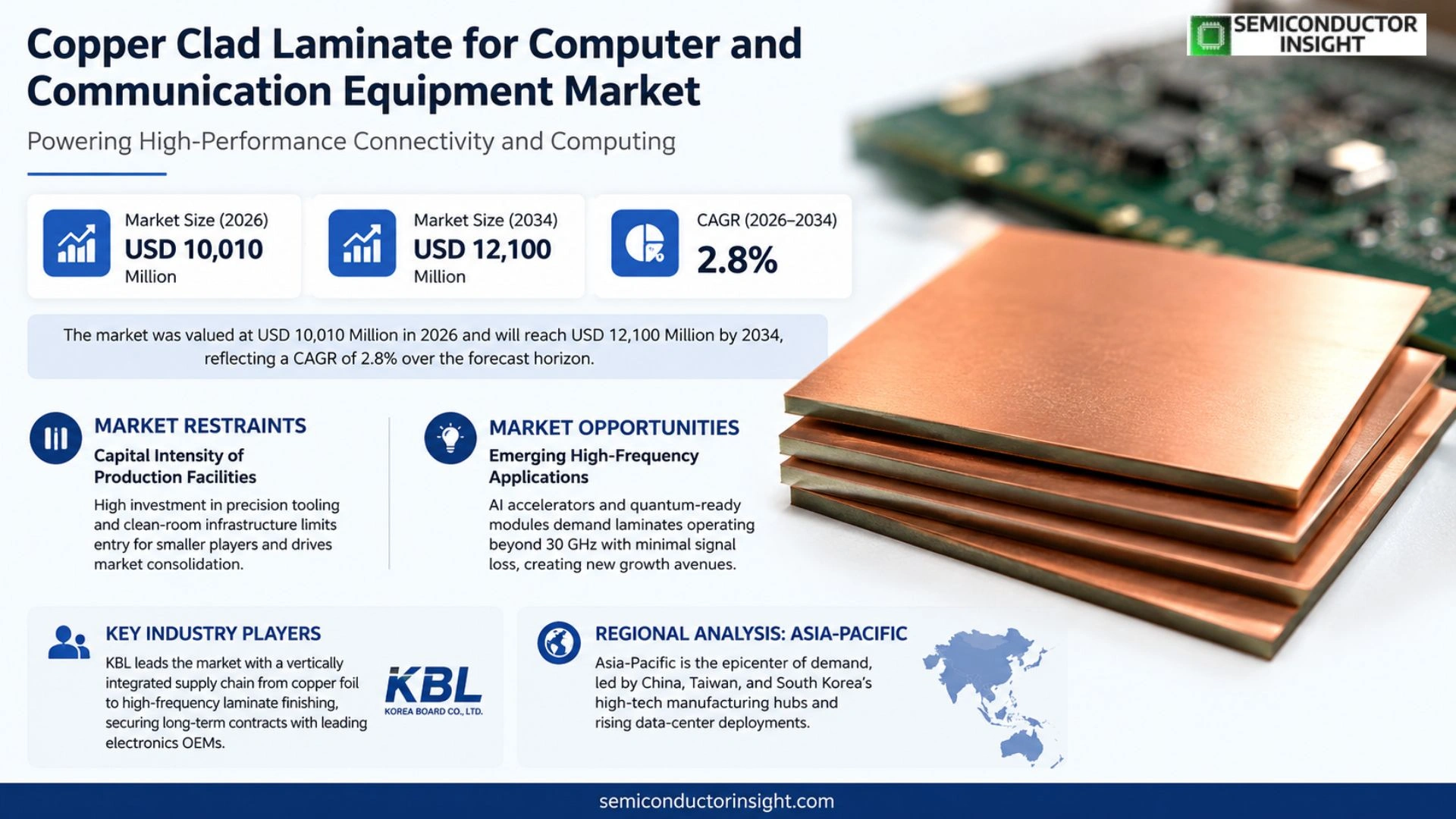
Copper Clad Laminate for Computer and Communication Equipment market was valued at USD 10,010 million in 2026 and will reach USD 12,100 million by 2034, reflecting a CAGR of 2.8% over the forecast horizon.
Copper clad laminate (CCL) serves as the foundational substrate for printed circuit boards, providing a copper‑coated dielectric layer that enables high‑frequency signal routing in devices such as computers, smartphones, televisions and networking equipment.
Growth is supported by rising demand for high‑performance PCBs in data‑center infrastructure and expanding rollout of 5G communication networks, which increase consumption of low‑loss, high‑temperature‐glass‐transition materials.
MARKET DRIVERS
Escalating Data‑Center Build‑Out
Operators are expanding server farms at a pace that outstrips previous cycles, compelling PCB manufacturers to secure larger volumes of high‑frequency laminate. The surge in edge‑computing installations further tightens the supply chain, prompting OEMs to lock in contracts for premium copper‑rich substrates. Strategic sourcing decisions now hinge on the ability to deliver consistent dielectric properties across massive orders.
Transition to 5G‑Enabled Telecommunications
Roll‑out of 5G networks mandates denser interconnects and tighter signal‑integrity margins, driving a shift toward copper‑clad laminates with lower loss tangents. Vendors that can balance thermal performance with high‑speed capability are gaining preference in carrier‑grade equipment. This technical imperative translates into a measurable uplift in annual procurement for the Copper Clad Laminate for Computer and Communication Equipment Market.
➤ Industry surveys report a 5‑6% YoY increase in laminate demand linked to data‑center and 5G deployments.
Beyond pure performance, sustainability pressures are nudging manufacturers toward greener production cycles. Recycled copper content and solvent‑free curing processes are becoming differentiators that influence buyer decisions, thereby adding another layer of momentum to market growth.
MARKET CHALLENGES
Supply‑Chain Volatility
Fluctuations in copper prices and periodic shortages of high‑purity copper foils create cost‑pass‑through dilemmas for end‑users. When raw‑material costs spike, many OEMs defer non‑essential upgrades, curbing short‑term demand despite longer‑term technology roadmaps.
Other Challenges
Regulatory Compliance
Stringent RoHS and REACH regulations in key regions require manufacturers to certify every batch, adding testing overhead and potentially delaying time‑to‑market for new laminate formulations.
Concurrently, the industry faces a talent gap in advanced material engineering, limiting the speed at which innovative dielectric compounds can be commercialized.
MARKET RESTRAINTS
Capital Intensity of Production Facilities
Establishing a fab line capable of handling ultra‑thin copper cladding demands multi‑million‑dollar investments in precision tooling and clean‑room infrastructure. Smaller players often lack the financial bandwidth to upgrade, resulting in market consolidation that can limit competition and constrain pricing flexibility.
MARKET OPPORTUNITIES
Emerging High‑Frequency Applications
Advancements in AI accelerators and quantum‑ready communication modules are creating a niche for laminates engineered to operate beyond 30 GHz with minimal signal loss. Early entrants that can certify such performance stand to capture a disproportionate share of future orders.
In parallel, the rise of modular data‑center designs offers a pathway for suppliers to embed custom laminate solutions within turnkey packages, opening a revenue stream that combines material sales with engineering services.
Copper Clad Laminate for Computer and Communication Equipment Market Trends
Increasing Adoption of High‑Frequency Substrates
The proliferation of 5G networks and edge‑computing facilities has heightened demand for PCBs that support higher signal frequencies. Manufacturers are therefore turning to copper‑clad laminates engineered with low‑loss dielectric materials, such as high‑Tg FR‑4 and specialized composite substrates. These materials preserve signal integrity at gigahertz ranges while maintaining the mechanical robustness required for compact enclosures. The shift is notable in both computer servers and communication gear, where bandwidth constraints directly affect product performance. Suppliers that can deliver consistent thickness and tight tolerance in these advanced laminates gain a strategic advantage, as design engineers increasingly specify materials early in the product development cycle to avoid costly redesigns. In addition, the transition supports thinner multilayer constructions, enabling manufacturers to meet aggressive weight and size targets that are critical for portable and aerospace applications.
Other Trends
Environmental Regulations Influencing Material Selection
Regulatory bodies across Europe and Asia have tightened limits on halogen emissions from printed circuit boards, prompting a move toward halogen‑free and low‑smoke formulations. End‑users in automotive and consumer electronics now prioritize compliance as a prerequisite for market entry, which forces laminate producers to reformulate resin systems and adopt alternative flame‑retardant chemistries. Although the material shift incurs higher raw‑material costs, it creates a niche for suppliers that already operate eco‑friendly production lines, allowing them to capture premium pricing and secure long‑term contracts with OEMs seeking to meet sustainability targets. The trend also encourages research collaborations between universities and industry to develop bio‑based resins that can match the dielectric performance of traditional compounds.
Supply Chain Consolidation Among Tier‑1 Manufacturers
Recent joint ventures between KBL and SYTECH, as well as strategic acquisitions by Panasonic, illustrate a consolidation pattern that reduces the number of independent sources for high‑performance laminates. By aggregating production capacity, these tier‑1 players achieve economies of scale, which translates into tighter price margins and more predictable lead times for downstream PCB assemblers. Consolidation also accelerates technology transfer, as shared R&D resources focus on next‑generation substrates designed for ultrafast data‑center interconnects. Smaller regional suppliers face pressure to specialize or align with larger entities to retain market relevance. For customers, the evolving supplier landscape means greater negotiating leverage on volume contracts, but also a need to monitor the concentration risk that may affect component availability during periods of rapid demand fluctuation.
COMPETITIVE LANDSCAPE
Key Industry Players
Copper Clad Laminate for Computer and Communication Equipment – Competitive Overview
The market is dominated by a handful of multinational firms that command the bulk of PCB‑grade CCL capacity. KBL, headquartered in South Korea, leverages a vertically integrated supply chain that stretches from copper foil production to high‑frequency laminate finishing, enabling it to secure long‑term contracts with leading electronics OEMs. Isola of the United States differentiates itself through a strong focus on specialty low‑loss laminates for 5G infrastructure, a segment that demands tight dielectric tolerances. Rogers Corp., also U.S.‑based, has carved a niche by supplying high‑performance fluoropolymer substrates to aerospace and defense customers, earning premium pricing power. Panasonic’s material arm in Japan contributes substantial volume in the standard FR‑4 tier, benefitting from the group’s extensive distribution network across Asia‑Pacific. Collectively, these leaders shape pricing benchmarks and drive technology standards that ripple through the supply chain.
Beyond the top tier, a diverse set of regional specialists adds depth to the competitive picture. SYTECH (Taiwan) and Nan Ya Plastics (Taiwan) excel in cost‑competitive paper‑based laminates, catering to high‑volume consumer electronics. South Korea’s DOOSAN and Korea‑based ITEQ focus on high‑temperature glass‑reinforced composites, attracting customers in automotive infotainment systems. Japan’s Showa Denko Materials and Germany’s EMC provide halogen‑free and high‑Tg variants that align with stringent environmental regulations in Europe. Smaller but agile firms such as GDM (China), TUC (South Korea), and Wazam New Materials (China) are rapidly expanding their R&D capabilities to serve emerging applications like edge‑computing modules. This tier of players sustains competitive pressure, forces incumbents to innovate, and offers buyers alternative sourcing options.
List of Key Copper Clad Laminate for Computer and Communication Equipment Companies Profiled
- KBL
- Isola
- Rogers
- Panasonic
- SYTECH
- Nan Ya Plastics
- DOOSAN
- ITEQ
- Showa Denko Materials
- EMC
- GDM
- TUC
- Wazam New Materials
- JinBao
- Chang Chun
Segment Analysis:
| Segment Category | Sub-Segments | Key Insights |
| By Type |
|
Normal FR‑4 is widely adopted owing to its balanced cost‑performance profile.
|
| By Application |
|
Computer remains the dominant application driver.
|
| By End User |
|
Consumer Electronics drives rapid iteration cycles.
|
| By Material Innovation |
|
Nano‑composite CCL is gaining traction for next‑generation RF performance.
|
| By Sustainability Drivers |
|
Halogen‑free compliance shapes product road‑maps.
|
Regional Analysis: Copper Clad Laminate for Computer and Communication Equipment Market
Expansion of multilayer press lines in Taiwan and South Korea has lifted output ceilings, allowing producers to meet the nuanced thickness specifications demanded by high‑frequency communication modules. Capacity upgrades are paired with automation that trims waste, a factor increasingly valued by cost‑sensitive OEMs.
Regional logistics hubs benefit from diversified port networks and robust rail corridors, mitigating disruptions that have plagued other continents. Firms are leveraging these assets to maintain buffer inventories without inflating carrying costs.
Growth in 5G infrastructure and edge‑computing nodes is reshaping laminate requirements, prompting a shift toward thinner, yet mechanically robust, constructions that support higher signal integrity at elevated frequencies.
Environmental directives across the region are steering manufacturers toward halogen‑free resin systems. Early adopters gain market credibility and avoid retrofitting costs as compliance thresholds tighten.
North America
The United States remains a pivotal consumer of high‑performance laminates, anchored by a mature data‑center ecosystem and a strong defense procurement pipeline. While domestic production has plateaued, the market compensates through strategic imports from Asia‑Pacific, ensuring a steady flow of material that meets stringent reliability standards. Companies are increasingly turning to collaborative research agreements with universities to pioneer next‑generation dielectric blends that can support the next wave of AI‑driven servers. Competitive pressures are prompting manufacturers to differentiate on turnaround speed and value‑added services such as custom testing, a trend that could reshape supplier‑buyer dynamics over the next decade.
Europe
European demand is shaped by a blend of automotive electrification projects and stringent EU environmental regulations. Countries like Germany and France are channeling public funds into low‑carbon manufacturing, which indirectly raises the bar for laminate suppliers to deliver greener resin chemistries. Simultaneously, the continent’s focus on data sovereignty fuels local procurement of circuit substrates for telecommunications gear, encouraging a modest resurgence of on‑shore production capacities. Market participants that can align product roadmaps with both sustainability mandates and the performance criteria of high‑speed networking equipment will likely secure a durable foothold.
South America
Growth in Brazil’s telecommunications rollout and Argentina’s expanding consumer electronics market is gradually elevating demand for copper‑clad laminate. However, the region grapples with import‑tax volatility and currency fluctuations, which can erode margin stability for foreign suppliers. Local distributors are mitigating risk by consolidating orders across multiple OEMs, thereby achieving economies of scale. Firms attentive to these dynamics and willing to offer flexible pricing structures may capture incremental shares as the market matures.
Middle East & Africa
Infrastructure investments in the United Arab Emirates and South Africa are catalyzing modest increases in laminate consumption, particularly for smart‑city initiatives and burgeoning data‑center clusters. The market’s nascent stage means procurement processes are still evolving, with a noticeable preference for proven suppliers that can guarantee consistent quality. Moreover, geopolitical considerations encourage regional players to diversify their supply base, opening opportunities for partnerships that blend Asian manufacturing prowess with local logistical expertise.
Report Scope
This market research report provides a comprehensive analysis of the Copper Clad Laminate for Computer and Communication Equipment Market , covering the forecast period 2026–2034. It offers detailed insights into market dynamics, technological advancements, competitive landscape, and key trends shaping the industry.
Key focus areas of the report include:
- Market Overview: The report begins with an overview outlining its current market scenario, key growth indicators, and industry transformation drivers. It discusses macroeconomic factors, demand–supply balance, regulatory landscape, and the strategic role of semiconductors in powering advancements across industries such as automotive, telecommunications, consumer electronics, and industrial automation.
- Market Size & Forecast: Historical data and future projections for revenue, unit shipments, and market value across major regions and segments.
- Segmentation Analysis: Detailed breakdown by product type, technology, application, and end-user industry to identify high-growth segments and investment opportunities.
- Regional Insights: Insights into market performance across North America, Europe, Asia-Pacific, Latin America, and the Middle East & Africa, including country-level analysis where relevant.
- Competitive Landscape: Profiles of leading market participants, including their product offerings, R&D focus, manufacturing capacity, pricing strategies, and recent developments such as mergers, acquisitions, and partnerships.
- Technology Trends & Innovation: Assessment of emerging technologies, integration of AI/IoT, semiconductor design trends, fabrication techniques, and evolving industry standards.
- Market Drivers & Restraints: Evaluation of factors driving market growth along with challenges, supply chain constraints, regulatory issues, and market-entry barriers.
- Stakeholder Insights: Insights for component suppliers, OEMs, system integrators, investors, and policymakers regarding the evolving ecosystem and strategic opportunities.
Primary and secondary research methods are employed, including interviews with industry experts, data from verified sources, and real-time market intelligence to ensure the accuracy and reliability of the insights presented.
FREQUENTLY ASKED QUESTIONS:
What is the current market size of Copper Clad Laminate for Computer and Communication Equipment Market?
-> Copper Clad Laminate for Computer and Communication Equipment market was valued at USD 10,010 million in 2026 and will reach USD 12,100 million by 2034
Which key companies operate in Copper Clad Laminate for Computer and Communication Equipment Market?
-> Key players include KBL, SYTECH, Panasonic, Nan Ya Plastic, GDM, DOOSAN, ITEQ, Showa Denko Materials, EMC, Isola, Rogers, Shanghai Nanya, Mitsubishi, TUC, Wazam New Materials, JinBao, Chang Chun, GOWORLD, Sumitomo, Grace Electron, Ventec, Chaohua.
What are the key growth drivers?
-> Key growth drivers include rising demand for printed circuit boards in computers, communication devices, and mobile electronics, increasing adoption of high‑frequency and high‑speed applications, and the shift toward environmentally friendly, halogen‑free and high‑Tg FR‑4 substrates.
Which region dominates the market?
-> Asia-Pacific dominates the market, driven by large‑scale PCB production in China, Japan, and South Korea, while North America and Europe remain important secondary markets.
What are the emerging trends?
-> Emerging trends include development of high‑Tg FR‑4 and halogen‑free boards, increased use of composite substrates for weight‑critical applications, and the growth of special and flexible board technologies to support 5G and IoT devices.
Get Sample Report PDF for Exclusive Insights
Report Sample Includes
- Table of Contents
- List of Tables & Figures
- Charts, Research Methodology, and more...
 Download Sample Report PDF