Conductive Adhesive (Isotropic, Anisotropic) Market Insights
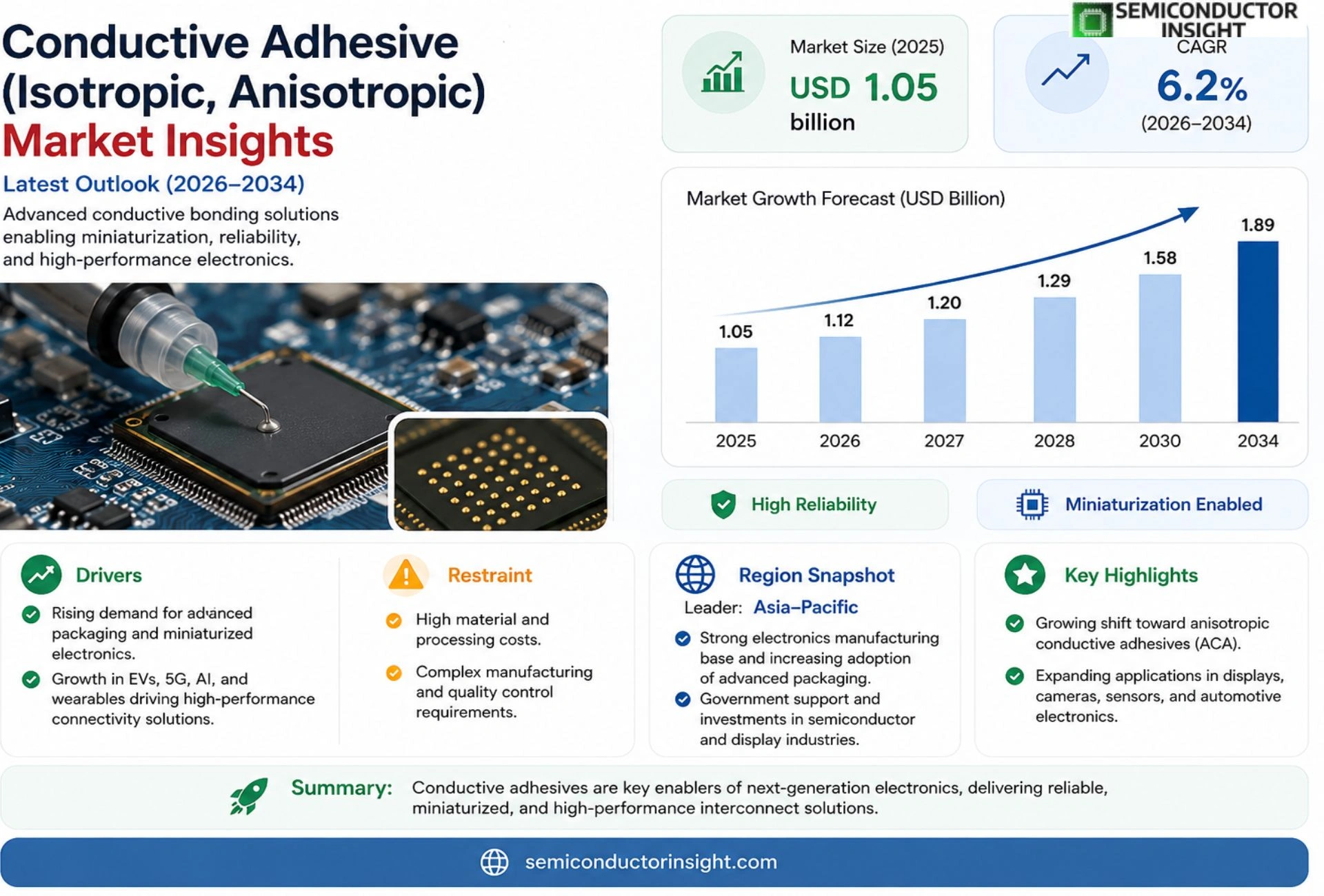
Global Conductive Adhesive (Isotropic, Anisotropic) Market size was valued at USD 1.05 billion in 2025. The market is projected to grow from USD 1.12 billion in 2025 to USD 1.89 billion by 2034, exhibiting a CAGR of 6.2% during the forecast period.
Conductive adhesives are specialized materials used to create electrical connections between components without traditional soldering. These adhesives are categorized mainly into isotropic conductive adhesives (ICA), which conduct electricity uniformly in all directions, and anisotropic conductive adhesives (ACA), which conduct electricity primarily in one direction. These materials are essential in electronics manufacturing, particularly in flexible circuits, display technologies, and semiconductor packaging.
The market growth is driven by increasing demand for miniaturized electronic devices and the need for environmentally friendly alternatives to lead-based solders. Furthermore, advancements in adhesive formulations that enhance conductivity and mechanical strength are propelling adoption across automotive, consumer electronics, and healthcare sectors. However, challenges such as high production costs and performance limitations under extreme conditions remain. Key players continue to innovate, focusing on improving adhesive reliability and expanding applications, thereby fueling sustained market expansion.
MARKET DRIVERS
Rising Demand for Miniaturized Electronics
Conductive Adhesive (Isotropic, Anisotropic) Market is significantly driven by the increasing demand for miniaturized and lightweight electronic devices. These adhesives provide reliable electrical connections without the need for soldering, supporting the production of compact and flexible electronics such as smartphones, wearables, and medical devices. Their ability to maintain conductivity while reducing component size is essential for meeting modern design requirements.
Advancements in Semiconductor Packaging Technologies
Technological progress in semiconductor packaging has propelled the usage of anisotropic and isotropic conductive adhesives. These materials offer excellent electrical performance and thermal stability, critical for ball grid arrays (BGAs) and flip-chip packaging. As electronic devices demand higher performance and greater reliability, manufacturers increasingly prefer conductive adhesives over traditional joining methods.
➤ Conductive adhesives enhance device reliability and facilitate eco-friendly manufacturing by eliminating lead-based solders.
Such environmental benefits, coupled with improved electrical and mechanical properties, render conductive adhesives indispensable in modern electronics manufacturing, further pushing market expansion.
MARKET CHALLENGES
Technical Limitations in High-Frequency Applications
One of the main challenges faced by Conductive Adhesive (Isotropic, Anisotropic) Market involves the limited performance of adhesives at very high frequencies. Signal integrity may degrade due to the inherent resistivity of the adhesive material, constraining their application in ultra-high-frequency communications and advanced computing systems.
Other Challenges
Long-Term Reliability Concerns
Despite improvements, some conductive adhesives demonstrate degradation under prolonged thermal or mechanical stress. This affects their suitability for harsh operating environments or automotive applications, where durability is paramount.
MARKET RESTRAINTS
High Production Costs Compared to Traditional Methods
The adoption of conductive adhesives is restrained by their relatively higher cost compared to conventional soldering and wire bonding. The manufacturing process requires precise formulation and quality control to ensure optimal conductivity and adhesion, which increases production expenses. This cost factor limits widespread use in price-sensitive markets, especially in large-scale consumer electronics manufacturing.
MARKET OPPORTUNITIES
Expanding Applications in Automotive and Renewable Energy
Growing demand for electric vehicles (EVs) and renewable energy systems presents a significant opportunity for Conductive Adhesive (Isotropic, Anisotropic) Market. These adhesives are increasingly utilized in battery assemblies, sensors, and energy harvesting devices requiring efficient electrical interconnections with flexibility and durability, driving new adoption.
The ongoing focus on sustainable and lead-free materials positions conductive adhesives as a preferred solution in evolving regulatory landscapes. Furthermore, R&D efforts aimed at enhancing adhesive conductivity and thermal resistance are expected to broaden their applicability across emerging technologies, fostering market growth throughout the forecast period.
Trends
Growing Demand for Miniaturization and Green Electronics
Conductive Adhesive (Isotropic, Anisotropic) Market is experiencing significant growth driven primarily by the increasing demand for miniaturized electronic devices. These adhesives enable precise electrical connections without the bulk associated with traditional soldering, which aligns perfectly with the industry’s push towards smaller, more integrated components. Additionally, the market is propelled by the rising emphasis on environmentally friendly alternatives, as these adhesives offer a lead-free solution that complies with stricter regulations aimed at reducing hazardous materials in electronics manufacturing.
Other Trends
Technological Advancements in Adhesive Formulations
Improvements in the formulations of isotropic and anisotropic conductive adhesives are enhancing both electrical conductivity and mechanical strength. These technical advancements allow the adhesives to perform reliably across a broader range of applications, including flexible circuits, display technologies, and semiconductor packaging. The enhanced performance characteristics are key factors accelerating adoption in high-growth sectors such as automotive electronics, consumer devices, and healthcare equipment.
Challenges in Cost and Environmental Stability
Despite the positive market momentum, production costs remain a challenge due to the complexity of manufacturing high-quality conductive adhesives. Moreover, performance under extreme environmental conditions such as high temperature and humidity poses limitations that manufacturers continue to address through research and development. Overcoming these hurdles is critical to expanding the use of conductive adhesives into even more demanding industrial applications.
Innovation and Market Expansion Strategies
Key players Conductive Adhesive (Isotropic, Anisotropic) Market are prioritizing innovation focused on increasing adhesive reliability and broadening application scopes. Efforts include developing materials with superior conductivity and durability to meet the stringent requirements of emerging technologies. These strategies not only sustain market growth but also reinforce the adhesives’ role as essential components in evolving electronics manufacturing paradigms.
COMPETITIVE LANDSCAPE
Key Industry Players
Leading Companies Driving Innovation in Conductive Adhesive Technologies
Conductive Adhesive (Isotropic, Anisotropic) Market is prominently led by a few global corporations that dominate through extensive R&D investment, diversified product portfolios, and strategic partnerships. Henkel AG & Co. KGaA stands as a market frontrunner, recognized for its advanced adhesive formulations suitable for various electronics applications. Similarly, 3M Company leverages its material science expertise to supply innovative conductive adhesives catering to flexible electronics and automotive sectors. These key players enjoy a structured market presence aided by proprietary technologies and global supply networks, thus consolidating their leadership position in an otherwise competitive and evolving landscape.
In addition to the dominant leaders, several niche manufacturers also play critical roles by addressing specific industry needs or regional markets. Companies like Panacol-Elosol GmbH specialize in high-performance anisotropic conductive adhesives tailored for semiconductor packaging, while DELO Industrial Adhesives provide cutting-edge isotropic conductive materials for consumer electronics. Other significant participants include Indium Corporation and AI Technology, Inc., which focus on innovative solutions enabling miniaturization and environmentally compliant replacements for traditional soldering methods. Collectively, these organizations contribute to diversifying product offerings and advancing technological capabilities across the market.
List of Key Conductive Adhesive Companies Profiled
- Henkel AG & Co. KGaA
- 3M Company
- Panacol-Elosol GmbH
- DELO Industrial Adhesives
- Indium Corporation
- AI Technology, Inc.
- Momentive Performance Materials
- Masterbond Inc.
- Henkel Loctite
- Tokyo Ohka Kogyo Co., Ltd.
- Shin-Etsu Chemical Co., Ltd.
- DuPont
- EIC Laboratories, Inc.
- Sunhayato Corporation
- Creative Materials Inc.
Segment Analysis:
| Segment Category | Sub-Segments | Key Insights |
| By Type |
|
Isotropic Conductive Adhesive (ICA) dominates this segment due to its uniform conductivity in all directions, which enhances flexibility in electronic assembly. – It is preferred in applications requiring reliable interconnections without directional constraints. – Continuous innovation in adhesive formulations has improved mechanical strength and durability, fostering adoption in complex circuit designs. – Meanwhile, Anisotropic Conductive Adhesive (ACA) is gaining traction for applications demanding directional conductivity, critical in compact and miniaturized devices, supporting the trend toward device miniaturization and enhanced precision. |
| By Application |
|
Display Technologies hold a significant position due to the rising demand for thinner, lighter, and flexible display panels. – Conductive adhesives provide reliable electrical connections critical for advanced display functionalities. – Flexible Circuits applications benefit substantially from the versatility of conductive adhesives in maintaining performance under mechanical stress. – Semiconductor Packaging is another vital application area where the adhesives enhance packaging integrity and thermal management, vital for device longevity and performance. |
| By End User |
|
Consumer Electronics are the leading end users driven by rapid technological advancements and consumer demand for sleek, durable, and compact gadgets. – This segment benefits from adhesives that support miniaturization and flexible designs. – Automotive applications increasingly adopt conductive adhesives to meet stringent safety and reliability standards while enabling innovative electronics integration. – The Healthcare sector values these materials for their biocompatibility and performance in medical devices requiring precision and reliability. |
| By Material Composition |
|
Silver-based adhesives are preferred for their superior conductivity and reliability, especially in high-performance electronics. – The cost factor remains a challenge, prompting research into alternative compositions. – Carbon-based adhesives offer an economical alternative with adequate conductivity for less demanding applications, gaining momentum in cost-sensitive markets. – Innovations in other metallic particles aim to balance performance and cost to broaden application scopes. |
| By Environmental Compliance |
|
RoHS Compliant adhesives are increasingly favored as regulatory frameworks push for environmentally friendly alternatives to lead-based solders. – Adoption of RoHS compliant materials supports sustainability goals and market acceptance. – Non-RoHS adhesives still find niche applications where regulatory impact is limited, maintaining steady demand. – Continuous innovation aims to increase performance of eco-friendly adhesives to match traditional products while ensuring compliance. |
Regional Analysis: Asia-Pacific Conductive Adhesive (Isotropic, Anisotropic) Market
Asia-Pacific’s manufacturers prioritize continuous innovation in conductive adhesive formulations, focusing on enhancing isotropic and anisotropic properties to cater to next-generation electronic components. This innovation fosters improved device reliability and connectivity.
Rapid expansion of electronics, automotive, and renewable energy sectors in Asia-Pacific creates substantial demand for conductive adhesives that enable efficient assembly and electrical conductivity in compact and flexible components.
The region’s well-established supply chains and resource availability reduce production costs and delivery times, supporting quick market responsiveness and allowing regional firms to remain competitive against global players.
Stringent regulatory frameworks and increasing consumer preference for eco-friendly materials promote sustainable conductive adhesive solutions, encouraging manufacturers to align product development with environmental standards.
North America
The North American Conductive Adhesive Market is characterized by advanced technological integration and strong presence of key market players focusing on high-performance adhesives for electronics and aerospace applications. Innovation in anisotropic conductive films and pressure-sensitive adhesives is prevalent, driven by demand for reliable electronic packaging and wearable technologies. Strategic partnerships and significant R&D investments bolster market growth, while strict regulatory oversight ensures product safety and environmental compliance, enhancing market credibility and long-term sustainability.
Europe
Europe’s market for conductive adhesives witnesses steady growth due to its focus on automotive electrification and renewable energy solutions. The region emphasizes development of adhesives with enhanced thermal management and electrical performance suitable for electric vehicle battery packs and photovoltaic cells. European manufacturers prioritize sustainability, pushing for bio-based and low-emission adhesive alternatives. Collaborative initiatives between industry and government facilitate innovation, ensuring adherence to stringent quality and environmental regulations, thereby driving the market’s evolution.
South America
South America is emerging as a promising market for conductive adhesives, supported by increasing industrialization and investment in electronics manufacturing hubs. Growth is propelled by expansion in consumer electronics and automotive electronics sectors. Challenges such as infrastructure limitations and demand volatility exist, yet improving trade relations and gradual technological advancements foster market potential. Manufacturers focus on scalable solutions adaptable to diverse applications, emphasizing cost-effectiveness while maintaining performance parameters.
Middle East & Africa
The Middle East & Africa region shows gradual adoption of conductive adhesives, primarily driven by burgeoning electronics assembly and telecommunications sectors. Investments in infrastructure and industrial diversification efforts create new opportunities, albeit growth is moderated by limited local production capabilities. Import dependence encourages collaborations with global suppliers and a push towards capacity building. Market participants aim to enhance product portfolios to cater to emerging smart device and automotive electronics applications, focusing on customization and supply chain optimization.
Report Scope
This market research report provides a comprehensive analysis of the Conductive Adhesive (Isotropic, Anisotropic) Market , covering the forecast period 2026–2034. It offers detailed insights into market dynamics, technological advancements, competitive landscape, and key trends shaping the industry.
Key focus areas of the report include:
- Market Overview: The report begins with an overview outlining its current market scenario, key growth indicators, and industry transformation drivers. It discusses macroeconomic factors, demand–supply balance, regulatory landscape, and the strategic role of semiconductors in powering advancements across industries such as automotive, telecommunications, consumer electronics, and industrial automation.
- Market Size & Forecast: Historical data and future projections for revenue, unit shipments, and market value across major regions and segments.
- Segmentation Analysis: Detailed breakdown by product type, technology, application, and end-user industry to identify high-growth segments and investment opportunities.
- Regional Insights: Insights into market performance across North America, Europe, Asia-Pacific, Latin America, and the Middle East & Africa, including country-level analysis where relevant.
- Competitive Landscape: Profiles of leading market participants, including their product offerings, R&D focus, manufacturing capacity, pricing strategies, and recent developments such as mergers, acquisitions, and partnerships.
- Technology Trends & Innovation: Assessment of emerging technologies, integration of AI/IoT, semiconductor design trends, fabrication techniques, and evolving industry standards.
- Market Drivers & Restraints: Evaluation of factors driving market growth along with challenges, supply chain constraints, regulatory issues, and market-entry barriers.
- Stakeholder Insights: Insights for component suppliers, OEMs, system integrators, investors, and policymakers regarding the evolving ecosystem and strategic opportunities.
Primary and secondary research methods are employed, including interviews with industry experts, data from verified sources, and real-time market intelligence to ensure the accuracy and reliability of the insights presented.
FREQUENTLY ASKED QUESTIONS:
What is the current market size of Conductive Adhesive (Isotropic, Anisotropic) Market?
-> Conductive Adhesive (Isotropic, Anisotropic) Market was valued at USD 1.05 billion in 2025 and is expected to reach USD 1.89 billion by 2034.
Which key companies operate Conductive Adhesive (Isotropic, Anisotropic) Market?
-> Key players include Axalta Coating Systems, AkzoNobel, BASF SE, PPG, Sherwin-Williams, and 3M, among others.
What are the key growth drivers?
-> Key growth drivers include increasing demand for miniaturized electronic devices and need for environmentally friendly alternatives to lead-based solders.
Which region dominates the market?
-> Asia-Pacific is the fastest-growing region, while Europe remains a dominant market.
What are the emerging trends?
-> Emerging trends include advancements in adhesive formulations enhancing conductivity and mechanical strength as well as expanding applications in automotive, consumer electronics, and healthcare sectors.

Get Sample Report PDF for Exclusive Insights
Report Sample Includes
- Table of Contents
- List of Tables & Figures
- Charts, Research Methodology, and more...
 Download Sample Report PDF