Common Mode L-Section Filters Market Insights
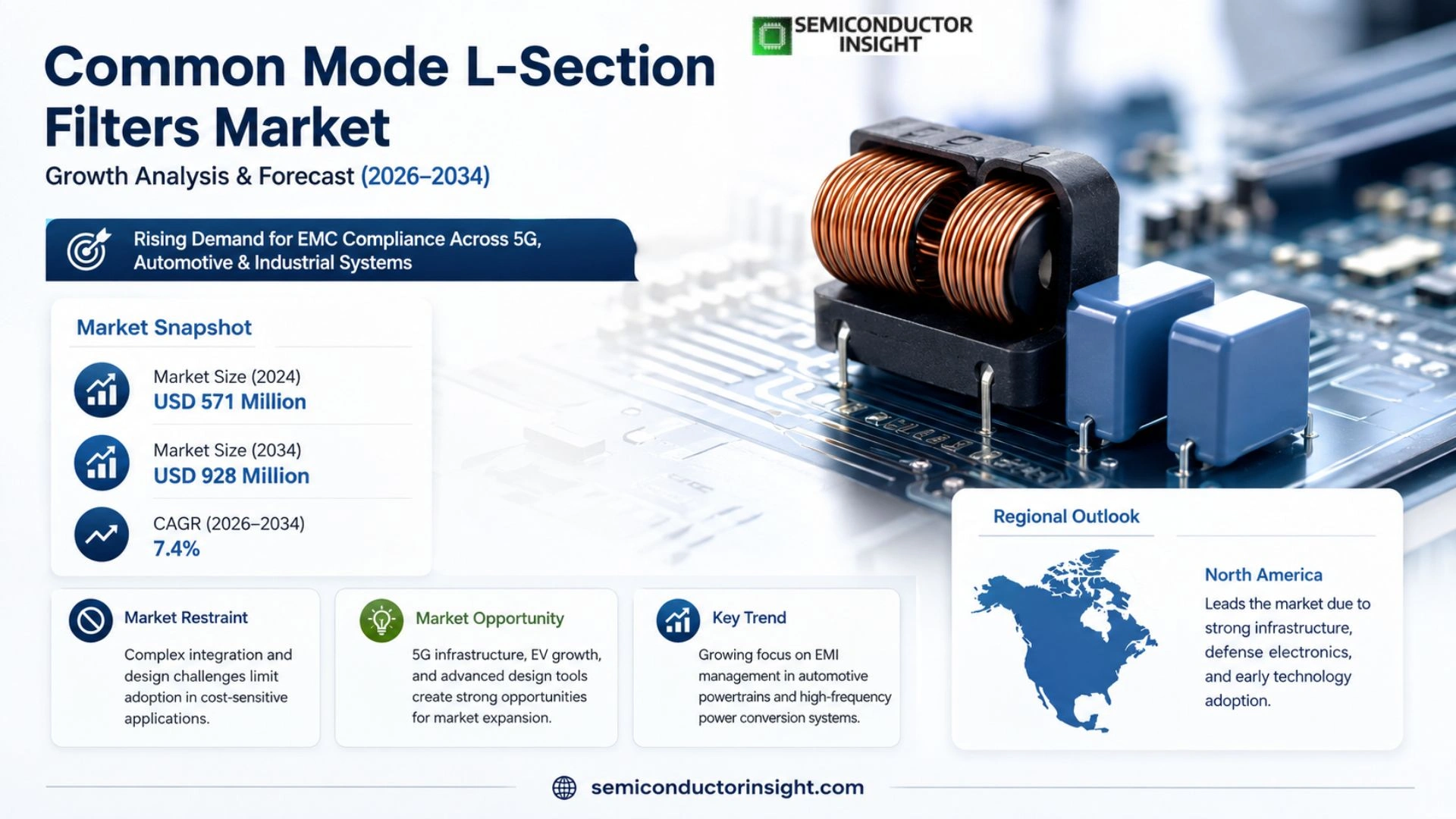
Common Mode L-Section Filters market size was valued at USD 571 million in 2024 and is expected to reach USD 928 million by 2034, reflecting a CAGR of 7.4% over the forecast period.
Common mode L‑section filters consist of two or more insulated windings mounted on a single magnetic core; the inductor and capacitor form an inverted “L” shape. Each winding is placed in series with a conductor so that their magnetic fields combine, presenting high impedance to unwanted noise signals.
The rise of mobile devices, laptops, IoT gadgets and electric vehicles has heightened the need for effective noise suppression, because electromagnetic interference can degrade performance and reliability. In addition, expanding renewable‑energy installations such as solar inverters and wind‑turbine converters rely on these filters to meet stringent EMI standards. Manufacturers are also introducing compact magnetic cores that reduce board space while maintaining attenuation efficiency.
MARKET DRIVERS
Rising Electromagnetic Interference Standards
The proliferation of high‑speed digital interfaces in automotive and industrial equipment has tightened electromagnetic compatibility (EMC) regulations. Manufacturers are compelled to integrate more effective filtering solutions, and Common Mode L-Section Filters Market benefits directly from this pressure. Companies that can demonstrate measurable attenuation at critical frequencies gain a competitive edge, prompting accelerated product development cycles.
Shift Toward Miniaturized Power Architectures
Power‑density improvements in converters and inverters demand compact filtering topologies. L‑section designs offer a favorable size‑to‑performance ratio, enabling system designers to reclaim board real estate. This trend fuels demand for filters that occupy minimal footprint while delivering low insertion loss, driving adoption across telecommunications and renewable‑energy installations.
➤ Design teams that embed L‑section filters early in the schematic reduce downstream redesign costs by up to 15 %.
Overall, the convergence of stricter EMI guidelines and the push for smaller, more efficient power modules creates a sustained pull for advanced common‑mode suppression techniques, positioning the market for steady expansion over the next five years.
MARKET CHALLENGES
Cost Sensitivity in High‑Volume Applications
While performance benefits are clear, many OEMs operate on razor‑thin margins, especially in consumer electronics. The added bill of materials for precise L‑section components can trigger price resistance, forcing suppliers to balance material quality against unit cost.
Other Challenges
Supply Chain Volatility
Fluctuations in copper and specialty alloy availability have led to lead times extending beyond three months, complicating just‑in‑time manufacturing strategies.
MARKET RESTRAINTS
Complex Integration Requirements
Deploying L‑section filters often necessitates precise impedance matching and careful layout to avoid unintended resonances. Engineers lacking specialized expertise may encounter performance shortfalls, slowing rollout and discouraging adoption in smaller firms.
Furthermore, legacy designs that rely on conventional common‑mode choke solutions can be resistant to change, as retrofitting L‑section networks may require redesign of the entire power path, adding engineering overhead.
These technical hurdles, combined with the need for rigorous validation, act as a brake on rapid market penetration, especially in cost‑conscious segments.
MARKET OPPORTUNITIES
Emerging 5G Infrastructure Deployments
The rollout of dense 5G networks introduces high‑frequency power conversion equipment that is particularly vulnerable to common‑mode noise. Filter vendors that can certify compliance with next‑generation EMC criteria stand to capture a sizable share of the infrastructure spend.
In parallel, the automotive industry’s transition to electric drivetrains creates demand for robust filtering in on‑board chargers and motor‑controller modules. Tailoring L‑section configurations to meet automotive-grade reliability standards opens a lucrative niche.
Finally, advances in simulation tools enable faster optimization of filter geometries, reducing time‑to‑market for customized solutions. Companies that leverage these digital design capabilities can offer differentiated products with shorter development cycles, unlocking new revenue streams.
Common Mode L-Section Filters Market Trends
EMI Management in Automotive Powertrains
The automotive sector is integrating higher‑voltage architectures to meet efficiency standards and electrification targets. As converters and fast‑switching devices proliferate, the susceptibility to common‑mode noise rises sharply. Engineers are therefore opting for L‑section filter topologies that combine inductive choke action with capacitive shunting in a compact footprint. This approach yields a high impedance path for unwanted signals while preserving the DC‑bias required by vehicle control units. The shift is not merely technical; it translates into lower warranty claims and improved compliance with electromagnetic‑compatibility regulations, which are tightening worldwide. Suppliers that can deliver filters tolerant of harsh temperature cycles and vibration are gaining preference, prompting a redesign of supply chains toward robust, automotive‑grade components.
Other Trends
Miniaturization of Magnetic Cores
Advances in amorphous‑metal and nanocrystalline alloys have enabled core volumes to shrink without sacrificing saturation flux density. The result is an L‑section filter that can be placed directly on high‑density printed‑circuit boards, a critical advantage for portable medical equipment and aerospace avionics where board real‑estate is at a premium. Smaller cores also reduce parasitic capacitance, sharpening the filter’s attenuation profile at the frequencies most associated with radio‑frequency interference. Manufacturers that have invested in automated winding technology are able to maintain tight tolerance bands, which in turn minimizes variability across production lots and supports tighter design margins for downstream OEMs.
Rising Demand from Consumer IoT Devices
IoT gadgets,ranging from smart wearables to edge‑computing sensors,operate on low‑power, high‑frequency converters that generate measurable common‑mode emissions. End‑users expect seamless wireless connectivity, yet electromagnetic disturbances can degrade battery life and data integrity. Incorporating L‑section filters close to the power entry point has become a standard practice to preserve signal fidelity while meeting the strict power‑consumption targets of battery‑operated devices. This trend is encouraging component makers to develop filter families tailored to specific form‑factors, such as through‑hole versus surface‑mount designs, thereby expanding the choice set for product designers. The broader implication for Common Mode L-Section Filters Market is a diversification of end‑use scenarios that reduces reliance on any single industry, fostering a more resilient revenue base as global electronics consumption continues to accelerate.
COMPETITIVE LANDSCAPE
Key Industry Players
Competitive Landscape of Common Mode L‑Section Filters Market
Murata Manufacturing dominates the high‑frequency segment, leveraging its deep R&D infrastructure and a portfolio that spans from discrete chokes to integrated EMI suppression modules. The company’s ability to secure long‑term contracts with major smartphone assemblers and automotive OEMs has created a de‑facto standard‑setting role, compelling smaller rivals to align their specifications. Murata’s vertical integration,from ferrite core production to surface‑mount packaging,compresses lead times and sustains a pricing edge that reinforces a moderately consolidated market structure. While Murata captures a sizable slice of global revenue, the overall landscape remains fragmented, with a tier‑1 core surrounded by a host of specialized suppliers that address niche applications such as aerospace avionics or medical imaging equipment.
Beyond Murata, a cohort of diversified firms fuels competitive dynamics. TDK’s extensive magnetic material library and aggressive cost‑optimization program make it a preferred source for consumer‑electronics OEMs seeking compact solutions. Yageo (through its Chilisin subsidiary) excels in high‑volume SMD choke production, anchoring its market share in data‑center power supplies. TAIYO YUDEN and Vishay deliver robust automotive‑grade components, capitalising on stringent reliability standards. Sunlord Electronics, Sumida, and Coilcraft each target rapid‑growth segments like IoT gateways and renewable‑energy inverters, where size‑to‑performance ratios are paramount. Eaton and Schaffner focus on industrial power‑conversion platforms, leveraging global service networks to bundle filters with safety‑critical systems. Laird Performance Materials, Hitachi Metals, Nippon Chemi‑Con, Bourns, and AVX round out the field, offering differentiated magnetic cores, custom winding techniques, or value‑added testing services that help end‑users mitigate EMI without inflating bill‑of‑material costs. The breadth of expertise across these players creates a competitive pressure that drives continual miniaturisation, material innovation, and supply‑chain resilience.
List of Key Common Mode L‑Section Filters Companies Profiled
- Murata Manufacturing Co., Ltd.
- TDK Corporation
- YAGEO (Chilisin)
- TAIYO YUDEN Co., Ltd.
- Cyntec
- Sunlord Electronics Co., Ltd.
- Vishay Intertechnology
- TAI‑TECH Advanced Electronic Co., Ltd.
- Sumida Corporation
- Eaton Corporation
- Schaffner Holding AG
- Laird Performance Materials
- TABUCHI ELECTRIC Co., Ltd.
- TAMURA CORPORATION
- Hitachi Metals, Ltd.
- Coilcraft, Inc.
- Nippon Chemi‑Con Corporation
- Bourns, Inc.
- AVX Corporation
Segment Analysis:
| Segment Category | Sub-Segments | Key Insights |
| By Type |
|
SMD Type
|
| By Application |
|
Consumer Electronics
|
| By End User |
|
Original Equipment Manufacturers (OEMs)
|
| By Frequency Range |
|
Mid Frequency
|
| By Integration Mode |
|
Integrated L‑Section Modules
|
Regional Analysis: Common Mode L-Section Filters Market
The push toward electric drivetrains intensifies the need for precise common‑mode filtering, as inverter‑driven motors produce higher harmonic content. OEMs are specifying L‑section filters that can withstand wide temperature swings while maintaining low profile footprints, a requirement that shapes supplier design priorities across the continent.
Factories adopting smart‑factory concepts rely on variable‑frequency drives and servo‑systems that generate substantial common‑mode currents. North American integrators prefer L‑section filters that combine high attenuation with easy retrofit capability, prompting manufacturers to develop modular kits that reduce installation downtime.
Aircraft and missile programs demand filters that meet rigorous weight and reliability targets. L‑section designs are being optimized for lightweight composites, and suppliers that can document long‑term radiation tolerance are gaining contracts in classified programs.
High‑speed transceivers used in hyperscale data centers produce fast‑edge common‑mode noise. Engineers in North America are selecting L‑section filters that offer tight pass‑band control, enabling higher data rates without compromising signal integrity.
Europe
European manufacturers benefit from harmonised EMC directives that create a consistent testing environment across the EU. The automotive sector, especially in Germany and France, is integrating L‑section filters to satisfy the Euro NCAP electric‑vehicle guidelines. In parallel, the renewable‑energy push, notably offshore wind farms, introduces new load‑side filtering challenges that European suppliers are addressing through collaborative standards workgroups. The region’s emphasis on sustainability also drives design choices that favor recyclable materials, nudging the market toward greener filter constructions.
Asia‑Pacific
Asia‑Pacific’s growth trajectory is propelled by rapid industrialisation in China, India, and Southeast Asian economies. While cost sensitivity remains high, the surge in consumer electronics,particularly smartphones and IoT devices,creates a niche for compact L‑section filters that can be mass‑produced. Moreover, the region’s expanding railway electrification projects demand robust common‑mode suppression to protect signaling equipment, prompting local firms to invest in design‑for‑manufacturability capabilities that balance performance with volume pricing.
South America
In South America, Brazil and Argentina dominate demand for L‑section filters within the oil‑and‑gas and mining sectors, where heavy‑duty motors generate significant electromagnetic interference. Emerging renewable‑energy installations, such as solar farms in Chile, are also contributing to a modest uptick in filter adoption. Market participants are focusing on local assembly to overcome import‑tariff barriers, thereby cultivating a nascent supply chain that can respond to regional compliance requirements.
Middle East & Africa
The Middle East’s strategic emphasis on petrochemical processing and large‑scale desalination plants creates a steady need for high‑power common‑mode filtering solutions. UAE and Saudi Arabia’s investments in smart‑city infrastructure further expand the application base into building‑automation systems. In Africa, the acceleration of telecom network rollouts drives demand for reliable filtering in base‑station equipment, encouraging a handful of niche distributors to source L‑section filters that meet both climatic and regulatory demands.
Report Scope
This market research report provides a comprehensive analysis of the Common Mode L-Section Filters Market , covering the forecast period 2026–2034. It offers detailed insights into market dynamics, technological advancements, competitive landscape, and key trends shaping the industry.
Key focus areas of the report include:
- Market Overview: The report begins with an overview outlining its current market scenario, key growth indicators, and industry transformation drivers. It discusses macroeconomic factors, demand–supply balance, regulatory landscape, and the strategic role of semiconductors in powering advancements across industries such as automotive, telecommunications, consumer electronics, and industrial automation.
- Market Size & Forecast: Historical data and future projections for revenue, unit shipments, and market value across major regions and segments.
- Segmentation Analysis: Detailed breakdown by product type, technology, application, and end-user industry to identify high-growth segments and investment opportunities.
- Regional Insights: Insights into market performance across North America, Europe, Asia-Pacific, Latin America, and the Middle East & Africa, including country-level analysis where relevant.
- Competitive Landscape: Profiles of leading market participants, including their product offerings, R&D focus, manufacturing capacity, pricing strategies, and recent developments such as mergers, acquisitions, and partnerships.
- Technology Trends & Innovation: Assessment of emerging technologies, integration of AI/IoT, semiconductor design trends, fabrication techniques, and evolving industry standards.
- Market Drivers & Restraints: Evaluation of factors driving market growth along with challenges, supply chain constraints, regulatory issues, and market-entry barriers.
- Stakeholder Insights: Insights for component suppliers, OEMs, system integrators, investors, and policymakers regarding the evolving ecosystem and strategic opportunities.
Primary and secondary research methods are employed, including interviews with industry experts, data from verified sources, and real-time market intelligence to ensure the accuracy and reliability of the insights presented.
FREQUENTLY ASKED QUESTIONS:
What is the current market size of Common Mode L-Section Filters Market?
-> Common Mode L-Section Filters market is expected to reach USD 928 million by 2034, reflecting a CAGR of 7.4% over the forecast period.
Which key companies operate in Common Mode L-Section Filters Market?
-> Key players include Murata, YAGEO (Chilisin), TDK, TAIYO YUDEN, Cyntec, Sunlord Electronics, Vishay, TAI-TECH Advanced Electronic, Sumida, Eaton, Schaffner, Laird Performance Materials, TABUCHI ELECTRIC, TAMURA CORPORATION, Hitachi Metals, Coilcraft, Nippon Chemi-Con Corporation, Bourns, AVX Corporation, among others.
What are the key growth drivers?
-> Key growth drivers include rising demand for noise reduction in consumer electronics (mobile phones, tablets, laptops, IoT devices), increasing adoption in automotive and transportation sectors, expansion of clean‑energy installations (solar, wind), and advancements in industrial automation that require robust EMI/RFI suppression.
Which region dominates the market?
-> Asia‑Pacific is the leading region, driven by rapid growth in consumer electronics manufacturing, automotive production, and extensive adoption of common mode choke technology across multiple end‑use markets.
What are the emerging trends?
-> Emerging trends include development of more compact and efficient magnetic cores, integration of common mode chokes in renewable‑energy power converters, and continuous improvements in EMI/RFI mitigation performance to support higher‑frequency and higher‑density electronic systems.
Get Sample Report PDF for Exclusive Insights
Report Sample Includes
- Table of Contents
- List of Tables & Figures
- Charts, Research Methodology, and more...
 Download Sample Report PDF