Commercial Blu-ray Discs Market Insights
Commercial Blu‑ray Discs market was valued at USD 438 million in 2024. The market is expected to rise from this level in 2026 to USD 664 million by 2034, reflecting an annual growth rate of approximately 6.3% over the forecast horizon.
Commercial Blu‑ray discs are high‑capacity optical storage media that typically start at 50 GB capacity and extend upward through 100 GB, 200 GB, 300 GB and other variants. These formats serve enterprise data archiving, university research repositories, hospital imaging archives, and assorted professional applications where long‑term reliability outweighs cost concerns.
The upward trend stems from enterprises coping with exploding data volumes while seeking offline backup options immune to cyber‑threats. At the same time, manufacturers such as Panasonic, Sony, CMC Magnetics and Ritek are broadening production capabilities and introducing higher‑density layers. Recent strategic moves,like Panasonic’s alliance with a cloud‑service provider to bundle archival solutions,highlight how players are diversifying revenue streams even as price competition intensifies.
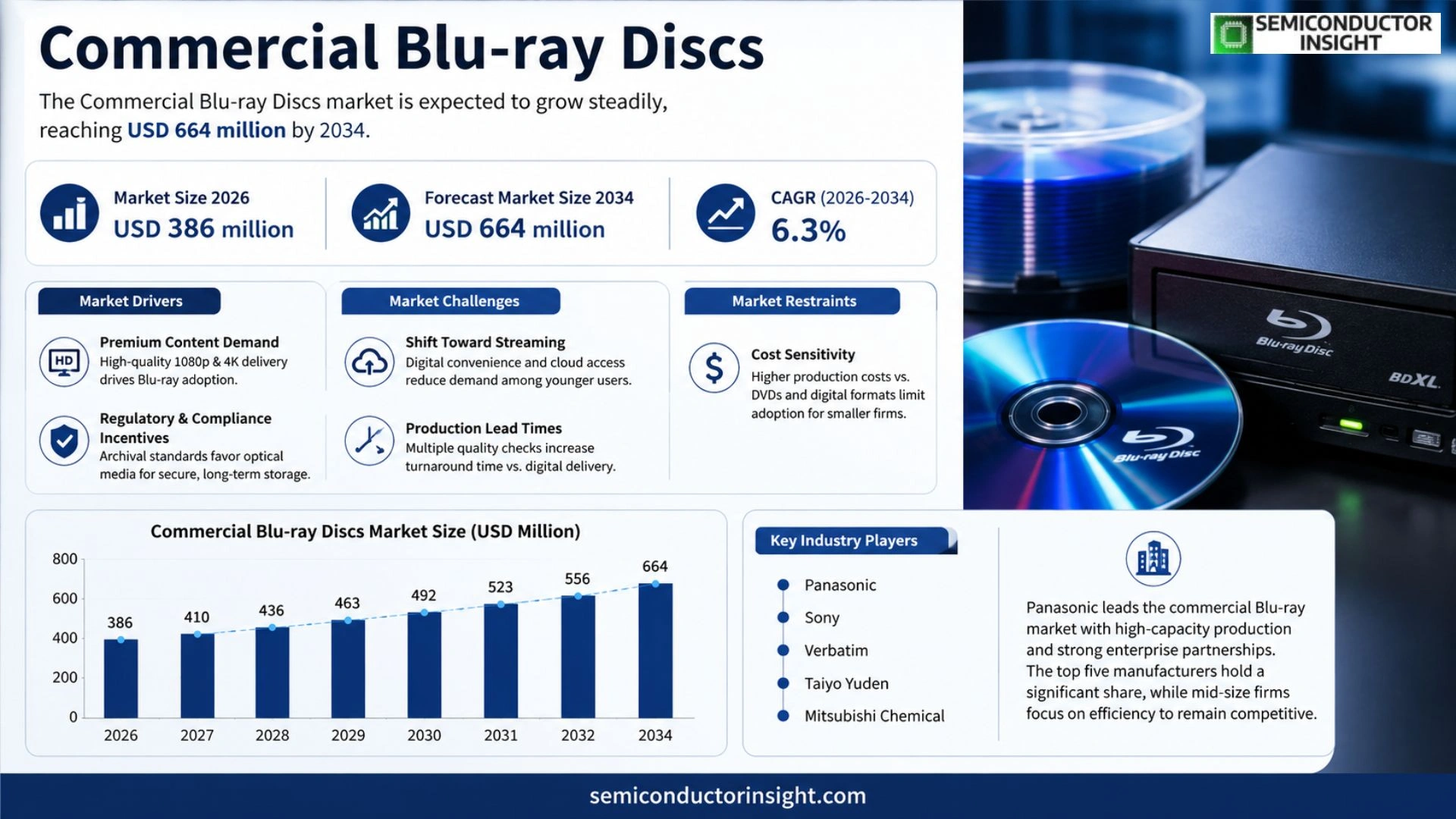
MARKET DRIVERS
Premium Content Demand
Enterprises with high‑value visual assets are increasingly opting for Blu‑ray as the preferred distribution medium. The format’s ability to preserve 1080p and 4K resolution without compression artifacts gives studios and corporate trainers a reliable way to deliver uncompromised quality, which in turn justifies higher pricing and encourages repeated purchases.
Regulatory and Compliance Incentives
Several jurisdictions have enacted archival standards that specifically recognize optical media for long‑term record keeping. Organizations seeking to meet these guidelines find Blu‑ray discs a cost‑effective alternative to magnetic tape, especially when the media must survive fluctuating temperature and humidity without frequent rewrites.
➤ “The durability of optical storage, combined with its accessibility, makes Blu‑ray a strategic choice for confidential corporate distributions.”
These forces converge to elevate Commercial Blu-ray Discs Market beyond a niche hobby, turning it into a viable channel for enterprises that value security, fidelity, and compliance.
MARKET CHALLENGES
Shift Toward Streaming Platforms
While Blu‑ray offers unmatched visual integrity, the convenience of cloud‑based delivery is eroding its appeal among younger demographics. Companies that rely on on‑demand access find it difficult to justify the logistics of physical disc handling when digital rights management can be administered remotely.
Other Challenges
Production Lead Times
Manufacturing processes for commercial‑grade Blu‑ray involve multiple quality‑control checkpoints, inflating turnaround times compared with instant digital uploads. This latency hampers time‑sensitive campaigns, prompting some marketers to reconsider physical media.
MARKET RESTRAINTS
Cost Sensitivity Across Segments
Production costs for high‑capacity Blu‑ray discs remain higher than those for standard DVD or basic digital storage. Small‑ to mid‑size firms, in particular, view the expense as a barrier, especially when budget allocations favor measurable ROI from streaming analytics.
MARKET OPPORTUNITIES
Customization and Niche Applications
Advances in on‑demand printing enable brands to order small batches of personalized Blu‑ray packages, opening a revenue stream for limited‑edition releases, corporate training kits, and secure government documentation. By leveraging these capabilities, suppliers can capture value from markets that prioritize exclusivity over volume.
Commercial Blu-ray Discs Market Trends
Shift Toward Higher‑Capacity Formats
Commercial Blu-ray Discs Market is witnessing a clear movement toward capacities of 100 GB and above. Customers in enterprise data‑centers and research institutions are opting for the 200 GB and 300 GB variants because they reduce the number of media required for petabyte‑scale archives. This preference cuts handling costs and simplifies inventory management, which explains why manufacturers have accelerated tooling for higher‑density layers. The shift also aligns with the broader industry push for cold‑storage solutions that can survive decades without degradation. As a result, the 50 GB segment is plateauing, while the 100 GB and larger categories are gaining incremental volume each quarter.
Other Trends
Regional Demand Divergence
In North America, adoption rates are buoyed by federal data‑retention mandates that reference optical media as an acceptable backup format. The United States, in particular, is allocating budget toward secure archival storage, nudging distributors to prioritize stock of 100 GB discs. Conversely, Chinese enterprises are scaling rapidly, driven by a national initiative to modernize archival infrastructure across universities and hospitals. The Chinese market’s surge is reflected in a sharp rise in orders for 200 GB media, which are favored for large‑scale imaging archives. This geographic split creates a supply‑chain dynamic where manufacturers must balance tooling for both high‑volume, lower‑capacity runs and lower‑volume, high‑capacity batches to satisfy distinct regional preferences.
Competitive Consolidation Accelerates
Competitive consolidation accelerates as the top ten producers vie for market share through strategic acquisitions and joint‑development agreements. Panasonic’s recent partnership with a semiconductor supplier aims to refine the bonding process, reducing defect rates on 300 GB discs. Meanwhile, Sony and Ritek have announced a co‑branding effort to bundle software for enterprise backup, enhancing value‑added services. These moves signal a shift from pure hardware competition toward integrated solution offerings, compelling smaller players to either niche‑specialize or seek alliances. For Commercial Blu-ray Discs Market, the emerging emphasis on end‑to‑end reliability and service differentiation is likely to reshape pricing structures and channel strategies over the next several years.
COMPETITIVE LANDSCAPE
Key Industry Players
Commercial Blu‑ray Discs Market – Competitive Overview
Panasonic commands the upper tier of the commercial Blu‑ray segment, largely because its production lines can sustain the 50 GB and higher capacity formats that enterprise customers demand. The company’s longstanding partnerships with data‑center operators and film‑distribution chains give it preferential access to bulk orders, reinforcing a tiered market where the top five manufacturers collectively capture a decisive share of revenue. Consolidation among mid‑size firms has intensified price pressure, prompting many to pursue cost‑efficiency initiatives such as robotic handling and in‑line quality testing. This environment rewards scale and the ability to guarantee consistent media integrity across large batches.
Beyond the dominant quartet, a diverse cohort of specialists sustains competitive pressure. CMC Magnetics leverages its expertise in thin‑film technology to serve niche Asian distributors, while Sony differentiates through a premium branding strategy aimed at archival institutions. Ritek and Technicolor focus on custom‑printing solutions for the entertainment sector, adding value‑added services that command higher margins. New Cyberian Systems, CDA GmbH and CD Video Manufacturing occupy regional strongholds in Eastern Europe and the Middle East, often bundling media with localized support. Companies such as Smartbuy, Tongfang, Lenovo, Tsinghua Unigroup, Centurion, Nanjing Superstack and Beijing Shengzan round out the field, each targeting either price‑sensitive segments or specialized applications like university research labs and hospital imaging archives.
List of Key Commercial Blu-ray Discs Companies Profiled
- Panasonic
- CMC Magnetics
- Sony
- Ritek
- Technicolor
- New Cyberian Systems
- CDA GmbH
- CD Video Manufacturing
- Smartbuy
- Tongfang
- Lenovo
- Tsinghua Unigroup
- Centurion
- Nanjing Superstack
- Beijing Shengzan
Segment Analysis:
| Segment Category | Sub-Segments | Key Insights |
| By Type |
|
High‑Capacity Discs
|
| By Application |
|
Enterprise Archival
|
| By End User |
|
Media Production
|
| By Distribution Channel |
|
OEM Partnerships
|
| By Technology Trend |
|
Encryption‑Enabled Media
|
Regional Analysis: Commercial Blu-ray Discs Market
North America
Large corporations favour Blu‑ray for secure distribution of training modules, leveraging its tamper‑evident format to protect intellectual property while ensuring playback across legacy hardware still prevalent in many facilities.
Studios negotiate tiered licensing fees that reflect the commercial intent of the media, enabling bespoke pricing structures for niche sectors such as hospitality, where seasonal catalog updates are common.
Press manufacturers have invested in high‑speed optical disc presses that balance volume with tight control over disc quality, a critical factor for clients that cannot tolerate playback errors during public events.
Emerging digital‑distribution platforms compel disc producers to differentiate through value‑added features,interactive menus, multilingual subtitles, and on‑disc analytics that track usage patterns.
Europe
European enterprises prize Blu‑ray for its ability to meet stringent data‑protection directives while delivering high‑resolution content to a fragmented network of conference rooms and in‑flight entertainment systems. The region benefits from a dense cluster of content aggregators who specialize in localized subtitle tracks, making the format attractive for multilingual training programmes. Manufacturers in the United Kingdom and Germany have focused on eco‑friendly disc substrates, aligning product offerings with sustainability mandates that many European corporations now embed in procurement policies. Consequently, demand is anchored not by consumer hype but by pragmatic considerations around security, compliance, and environmental stewardship.
Asia‑Pacific
In Asia‑Pacific, rapid expansion of domestic airline fleets and a burgeoning boutique hotel sector create a steady appetite for reliable, high‑capacity media. While digital streaming gains ground in consumer markets, commercial operators value Blu‑ray’s resilience against intermittent connectivity and its ability to store extensive bonus content without additional bandwidth costs. Localized content production houses are leveraging the format to distribute region‑specific promotional material, often coupling discs with QR‑code driven digital extensions that bridge physical and online experiences. This hybrid approach sustains the commercial relevance of Blu‑ray across diverse market segments.
South America
South American businesses are navigating a cost‑sensitive environment where the upfront investment in Blu‑ray production is justified by the format’s longevity and low‑maintenance playback requirements. Educational institutions and government agencies frequently select discs for distance‑learning initiatives, capitalising on the medium’s ability to function in regions with limited broadband penetration. Partnerships between regional press operators and multinational content owners have yielded tailored catalogues that address cultural nuances, reinforcing Blu‑ray’s role as a dependable conduit for corporate communication.
Middle East & Africa
The Middle East & Africa experience a unique blend of high‑end hospitality venues and emerging corporate training ecosystems. Luxury hotels in the Gulf employ Blu‑ray to showcase curated destination films, capitalising on the format’s visual fidelity to enhance guest experience. In African markets, NGOs and development agencies rely on discs to disseminate educational content where internet infrastructure remains patchy. The durability of Blu‑ray under harsh climatic conditions further cements its suitability, prompting distributors to invest in region‑specific packaging that protects discs during transport across challenging logistics networks.
Report Scope
This market research report provides a comprehensive analysis of the Commercial Blu-ray Discs Market , covering the forecast period 2026–2034. It offers detailed insights into market dynamics, technological advancements, competitive landscape, and key trends shaping the industry.
Key focus areas of the report include:
- Market Overview: The report begins with an overview outlining its current market scenario, key growth indicators, and industry transformation drivers. It discusses macroeconomic factors, demand–supply balance, regulatory landscape, and the strategic role of semiconductors in powering advancements across industries such as automotive, telecommunications, consumer electronics, and industrial automation.
- Market Size & Forecast: Historical data and future projections for revenue, unit shipments, and market value across major regions and segments.
- Segmentation Analysis: Detailed breakdown by product type, technology, application, and end-user industry to identify high-growth segments and investment opportunities.
- Regional Insights: Insights into market performance across North America, Europe, Asia-Pacific, Latin America, and the Middle East & Africa, including country-level analysis where relevant.
- Competitive Landscape: Profiles of leading market participants, including their product offerings, R&D focus, manufacturing capacity, pricing strategies, and recent developments such as mergers, acquisitions, and partnerships.
- Technology Trends & Innovation: Assessment of emerging technologies, integration of AI/IoT, semiconductor design trends, fabrication techniques, and evolving industry standards.
- Market Drivers & Restraints: Evaluation of factors driving market growth along with challenges, supply chain constraints, regulatory issues, and market-entry barriers.
- Stakeholder Insights: Insights for component suppliers, OEMs, system integrators, investors, and policymakers regarding the evolving ecosystem and strategic opportunities.
Primary and secondary research methods are employed, including interviews with industry experts, data from verified sources, and real-time market intelligence to ensure the accuracy and reliability of the insights presented.
FREQUENTLY ASKED QUESTIONS:
What is the current market size of Commercial Blu-ray Discs Market?
-> Commercial Blu-ray Discs Market is expected to reach USD 664 million by 2034, growing at a CAGR of 6.3% over the forecast period.
Which key companies operate in Commercial Blu-ray Discs Market?
-> Key players include Panasonic, CMC Magnetics, Sony, Ritek, Technicolor, New Cyberian Systems, CDA GmbH, CD Video Manufacturing, Smartbuy, Tongfang, among others.
What are the key growth drivers?
-> Key growth drivers include the surge in data generation requiring high‑capacity offline storage, increasing adoption of 50G+ Blu‑ray discs in enterprise, university and hospital settings, and continued investments in secure archival solutions.
Which region dominates the market?
-> Asia-Pacific leads the market, driven primarily by rapid expansion in China, while North America remains a significant contributor.
What are the emerging trends?
-> Emerging trends include the development of higher‑capacity segments such as 100G, 200G and 300G Blu‑ray discs, integration of advanced anti‑tamper technologies, and growing demand for eco‑friendly manufacturing processes.

Get Sample Report PDF for Exclusive Insights
Report Sample Includes
- Table of Contents
- List of Tables & Figures
- Charts, Research Methodology, and more...
 Download Sample Report PDF