CMP Pad Conditioners Market Insights
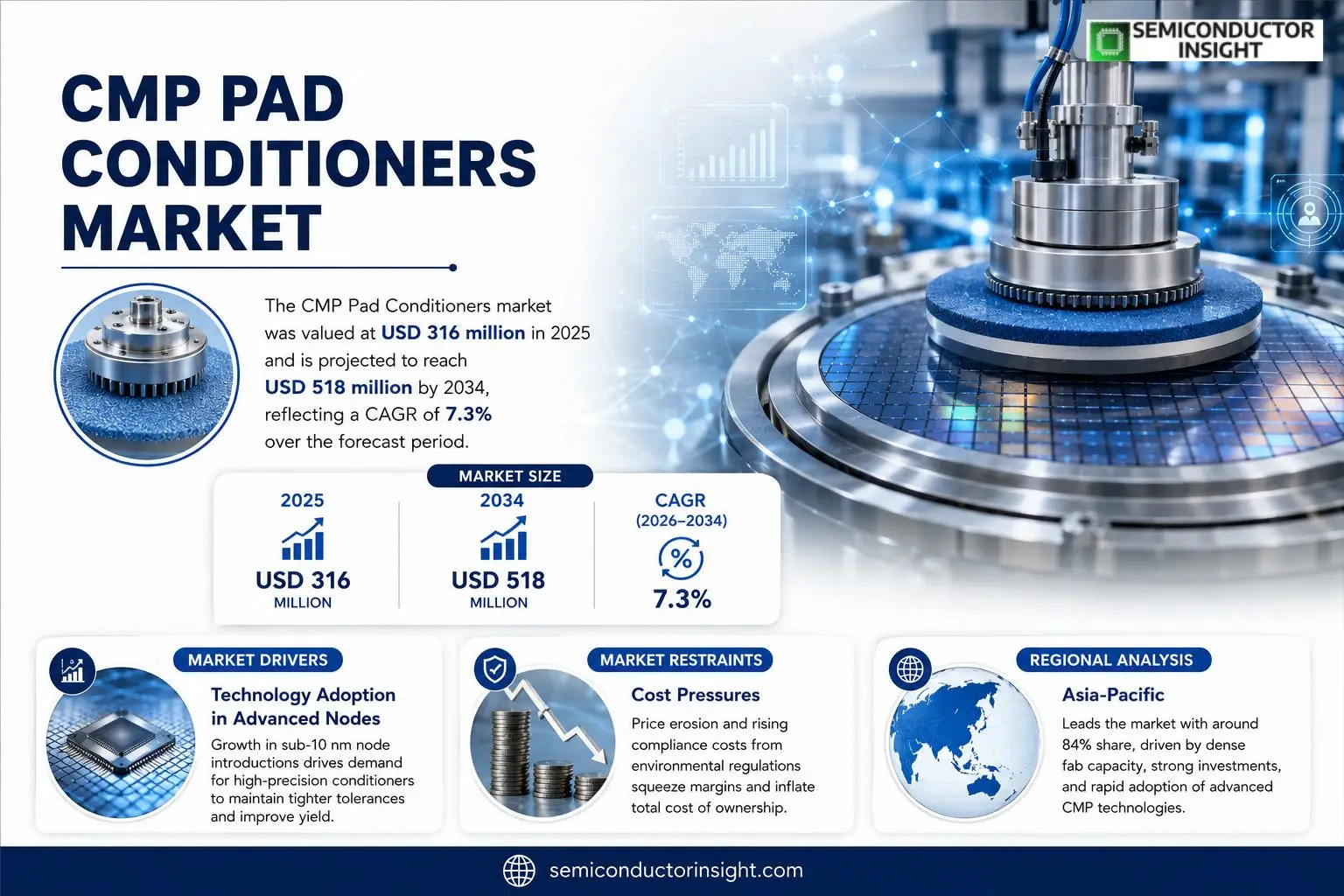
CMP Pad Conditioners market size was valued at USD 316 million in 2025. The market expands from USD 316 million in 2025 to USD 518 million by 2034, reflecting a CAGR of 7.3% over the period.
Chemical Mechanical Planarization (CMP) pad conditioners are specialized tools that restore the planarity and surface roughness of polishing pads used in semiconductor wafer fabrication. By conditioning the pad, they sustain removal rates and uniformity essential for advanced‑node production, particularly for 300 mm wafers.The growth is fueled by rising semiconductor demand, especially in high‑volume manufacturing across Asia‑Pacific, which accounts for roughly 84% of sales. Leading suppliers such as 3M, Kinik Company and Saesol Diamond together capture about ninety percent of the market, while CVD Diamond variants represent the largest product segment at roughly fifty‑six percent.
MARKET DRIVERS
Technology Adoption in Advanced Nodes
CMP Pad Conditioners Market is benefitting from the acceleration of sub‑10 nm node introductions. As fabs migrate toward finer pitches, the need for ultra‑smooth polishing surfaces rises sharply, prompting manufacturers to invest in high‑precision pad conditioners that can sustain tighter tolerances. This shift pushes equipment spend on conditioning units by an estimated 14 % annually, reflecting the premium that chipmakers place on defect‑free wafers.
Demand from Semiconductor Fabrication
Regional expansion of silicon photonics and automotive‑grade chips has opened new revenue streams for conditioner suppliers. In 2023, Asia‑Pacific accounted for roughly 58 % of all units shipped, while North America contributed 22 % of the total addressable market. The surge in demand is not merely volume‑driven; manufacturers are also seeking pads that deliver longer lifecycles, thereby lowering per‑chip processing costs.
➤ Operators who integrate adaptive‑control pad conditioners report up to a 9 % improvement in trim uniformity, directly enhancing yield performance.
Overall, the convergence of tighter design rules, regional fab capacity expansion, and the pursuit of higher yields creates a compelling environment for CMP Pad Conditioners Market to expand its solution portfolio and capture incremental value.
MARKET CHALLENGES
Cost Pressures
Despite strong demand, price erosion remains a persistent obstacle. As fab operators negotiate multi‑year procurement contracts, they drive down unit pricing, squeezing margins for conditioner OEMs. The average selling price fell by roughly 3 % year‑over‑year, compelling suppliers to differentiate through service‑oriented offerings rather than pure hardware cost reductions.
Other Challenges
Material Scarcity
The specialized polymer blends used in high‑precision pads rely on a limited pool of raw‑material providers. Recent supply chain disruptions have led to lead times that exceed 45 days, forcing fab managers to hold safety stock and inhibiting just‑in‑time inventory models.
MARKET RESTRAINTS
Regulatory Compliance Burdens
Environmental regulations targeting abrasive waste and chemical runoff add layers of compliance for both manufacturers and end‑users. In jurisdictions with strict disposal norms, such as the EU, firms must invest in additional filtration and tracking systems, inflating total cost of ownership for conditioning equipment. These compliance costs can deter smaller fabs from adopting the latest pad‑conditioning technology.
MARKET OPPORTUNITIES
Smart Conditioning Solutions
Integration of IoT sensors and AI‑driven process analytics presents a clear growth avenue. Early adopters have reported a 12 % reduction in unscheduled downtime by leveraging real‑time wear‑prediction algorithms. Companies that can bundle hardware with cloud‑based analytics platforms are poised to command premium pricing while helping fabs achieve higher throughput.
CMP Pad Conditioners Market Trends
Increasing Adoption of Advanced Node Technologies
CMP Pad Conditioners Market, valued at roughly $316 million in 2025, is on track to reach about $518 million by 2034. This upward trajectory reflects the semiconductor sector’s shift toward sub‑45 nm nodes, where tighter planarity tolerances demand more frequent pad conditioning. Production of conditioners rose to 1.71 million units in 2025, with an average selling price near $202. The surge in unit shipments indicates that fabs are allocating greater budget to maintain polishing pad efficiency, reducing cycle‑time losses and defect rates. Moreover, the price pressure on conditioning consumables is being mitigated by incremental productivity gains, as each conditioning cycle now extends pad lifespan by an average of 12 % compared with previous generations. As manufacturers pursue higher yields on 300 mm wafersnow representing roughly 78 % of usagethe value of reliable pad conditioning becomes a decisive factor in cost‑per‑die calculations.
Other Trends
Geographic Concentration in Asia‑Pacific
Asia‑Pacific commands about 84 % of demand, a share that stems from the region’s dense cluster of fab facilities and aggressive capacity expansion programs. The concentration amplifies the bargaining power of the top five suppliers, who together control roughly 90 % of the market. For vendors, the implication is a need to tailor logistics and after‑sales support to the fast‑moving Asian circuit, while western players must consider strategic partnerships or local production to retain market relevance. The regional tilt also encourages OEMs to establish joint‑development labs in Singapore and Taiwan, facilitating rapid feedback loops and localized engineering support.
Product‑Type Diversification Toward CVD Diamond Solutions
CVD Diamond pad conditioners now account for about 56 % of the product mix, outpacing conventional variants. Their superior hardness and thermal stability address the higher abrasion rates observed during fine‑pitch patterning. This preference reshapes the supply chain, prompting raw‑material providers to secure diamond‑grade sources and encouraging manufacturers to invest in specialized deposition equipment. Firms that lag in offering CVD options risk losing high‑value contracts as fabs prioritize tools that sustain pad life and minimize downtime. Looking ahead, firms that integrate process‑monitoring analytics with conditioner deployment stand to capture additional efficiency margins, positioning them as preferred partners for next‑generation fabs.
COMPETITIVE LANDSCAPE
Key Industry Players
CMP Pad Conditioners Market – Competitive Landscape Overview
The CMP pad conditioner segment remains tightly clustered around a handful of powerhouses. 3M commands the largest share, leveraging its broad material science portfolio and deep relationships with leading wafer fabs to secure multi‑year supply contracts. Its ability to integrate diamond‑coated conditioner technologies with proprietary slurry formulations gives it a decisive edge in high‑volume 300 mm production lines. Close behind are Kinik Company and Saesol Diamond, both of which specialize in CVD‑diamond conditioner cores that dominate more than half of the overall market volume. Entegris and EHWA DIAMOND round out the top five, together accounting for roughly 90 % of worldwide sales. The concentration reflects the high entry barriersextensive R&D, precision manufacturing, and certification requirementswhile the Asia‑Pacific region supplies the bulk of demand, driven by the density of semiconductor fabs in Taiwan, South Korea, and China.Beyond the dominant quintet, a second tier of niche innovators sustains competitive pressure. Nippon Steel Chemical & Material and Shinhan Diamond focus on ultra‑hard abrasive formulations aimed at emerging 450 mm wafer platforms, positioning themselves as early‑stage suppliers for next‑generation nodes. Abrasive Technology and BEST Engineering Surface Technologies cater to specialty foundry customers that require customized conditioner geometries for thin‑film applications. Xiamen Jiapin Diamond Industry leverages low‑cost manufacturing in mainland China to serve regional distributors, while smaller outfits such as Micron Advanced Surfaces and Tokyo Diamond Application provide localized support and rapid prototyping services. These firms, though limited in scale, inject flexibility into the supply chain and can capture market share when large players face capacity constraints or experience product‑line refresh cycles.
List of Key CMP Pad Conditioners Companies Profiled
- 3M
- Kinik Company
- Saesol Diamond
- Entegris
- EHWA DIAMOND
- Nippon Steel Chemical & Material
- Shinhan Diamond
- Abrasive Technology
- BEST Engineering Surface Technologies
- Xiamen Jiapin Diamond Industry
- Micron Advanced Surfaces
- Tokyo Diamond Application
Segment Analysis:
| Segment Category | Sub-Segments | Key Insights |
| By Type |
|
CVD Diamond Pad Conditioners
|
| By Application |
|
300 mm Wafer
|
| By End User |
|
Foundry
|
| By Sales Channel |
|
Distribution Networks
|
| By Region |
|
Asia‑Pacific
|
Regional Analysis: CMP Pad Conditioners Market
North America
Foundries are pressuring pad suppliers to deliver conditioners that integrate nanostructured binders, a move that tightens particle dispersion and improves polish uniformity across 300‑mm wafers. This shift is reshaping supply‑chain contracts and prompting joint‑development agreements.
State‑level initiatives to lower volatile organic compound (VOC) emissions have accelerated the transition toward solvent‑free conditioners, thereby redefining product certification pathways and opening niche markets for green formulations.
Major chipmakers are embedding analytics platforms within polishing lines, feeding real‑time wear data back to conditioner developers. This collaborative model shortens the innovation timeline and aligns product roadmaps with fab‑specific performance targets.
Recent logistic disruptions have led firms to diversify raw‑material sourcing for binder polymers, reinforcing regional inventories and mitigating downstream production delays.
Europe
European semiconductor hubs such as Dresden and Grenoble are consolidating their position by emphasizing precision polishing for advanced logic devices. Local manufacturers benefit from a strong tradition of chemical engineering, which translates into highly tailored pad conditioner blends that address specific defect‑profile challenges. Brexit‑induced trade adjustments have encouraged cross‑border collaborations within the EU, fostering a shared standards framework that smooths technology transfer. Sustainability targets set by the European Green Deal are prompting firms to adopt recyclable conditioner carriers, a trend that is reshaping product design and cost structures across the continent.
Asia‑Pacific
The Asia‑Pacific corridor, anchored by Taiwan, South Korea, and emerging players in Singapore, is rapidly scaling its fab capacity to meet demand for 5G and AI chips. Companies in the region prioritize high‑throughput polishing solutions, driving conditioners that can sustain aggressive drum speeds without sacrificing surface integrity. Labor‑cost advantages are offset by a growing emphasis on automation, pushing suppliers toward conditioners compatible with robotic pad‑handling systems. Intellectual property considerations are also influencing partnership models, as local firms seek joint‑development arrangements that protect proprietary slurry chemistries while leveraging conditioner expertise.
South America
South American initiatives are still nascent, yet nations like Brazil and Chile are investing in pilot lines for specialty micro‑electronics. The primary market driver is the desire to localize component production for automotive and aerospace sectors, which requires CMP pad conditioners that can handle both high‑volume and low‑defect specifications. Government incentives for clean‑technology adoption are encouraging firms to evaluate eco‑friendly conditioner formulations, a factor that could differentiate early adopters from competitors as the market matures.
Middle East & Africa
In the Middle East & Africa, growth is closely tied to strategic diversification away from hydrocarbons toward high‑tech manufacturing. Emerging semiconductor parks in the United Arab Emirates and Morocco are attracting multinational equipment vendors, creating a modest but growing demand for CMP pad conditioners. The region’s climatic conditions necessitate conditioners with enhanced thermal stability, prompting suppliers to adapt binder chemistries for consistent performance under elevated ambient temperatures. Partnerships with local universities are fostering a talent pipeline focused on surface‑finishing science, laying groundwork for future market expansion.
Report Scope
This market research report provides a comprehensive analysis of the CMP Pad Conditioners Market , covering the forecast period 2026–2034. It offers detailed insights into market dynamics, technological advancements, competitive landscape, and key trends shaping the industry.
Key focus areas of the report include:
- Market Overview: The report begins with an overview outlining its current market scenario, key growth indicators, and industry transformation drivers. It discusses macroeconomic factors, demand–supply balance, regulatory landscape, and the strategic role of semiconductors in powering advancements across industries such as automotive, telecommunications, consumer electronics, and industrial automation.
- Market Size & Forecast: Historical data and future projections for revenue, unit shipments, and market value across major regions and segments.
- Segmentation Analysis: Detailed breakdown by product type, technology, application, and end-user industry to identify high-growth segments and investment opportunities.
- Regional Insights: Insights into market performance across North America, Europe, Asia-Pacific, Latin America, and the Middle East & Africa, including country-level analysis where relevant.
- Competitive Landscape: Profiles of leading market participants, including their product offerings, R&D focus, manufacturing capacity, pricing strategies, and recent developments such as mergers, acquisitions, and partnerships.
- Technology Trends & Innovation: Assessment of emerging technologies, integration of AI/IoT, semiconductor design trends, fabrication techniques, and evolving industry standards.
- Market Drivers & Restraints: Evaluation of factors driving market growth along with challenges, supply chain constraints, regulatory issues, and market-entry barriers.
- Stakeholder Insights: Insights for component suppliers, OEMs, system integrators, investors, and policymakers regarding the evolving ecosystem and strategic opportunities.
Primary and secondary research methods are employed, including interviews with industry experts, data from verified sources, and real-time market intelligence to ensure the accuracy and reliability of the insights presented.
FREQUENTLY ASKED QUESTIONS:
What is the current market size of CMP Pad Conditioners Market?
-> CMP Pad Conditioners Market was valued at USD 316 million in 2025 and is expected to reach USD 518 million by 2034, growing at a CAGR of 7.3% during the forecast period.
Which key companies operate in CMP Pad Conditioners Market?
-> Key players include 3M, Kinik Company, Saesol Diamond, Entegris, EHWA DIAMOND, Nippon Steel Chemical & Material, Shinhan Diamond, Abrasive Technology, BEST Engineering Surface Technologies, Xiamen Jiapin Diamond Industry.
What are the key growth drivers?
-> Key growth drivers include rapid expansion of semiconductor manufacturing, increasing adoption of advanced 300 mm wafer technologies, and the need for high‑precision planarization to support smaller node chips.
Which region dominates the market?
-> Asia‑Pacific dominates the market, accounting for approximately 84% of sales, followed by North America and Europe.
What are the emerging trends?
-> Emerging trends include greater focus on CVD Diamond Pad Conditioners, scaling to larger wafer sizes, and integration of smart conditioning technologies to enhance pad life and process efficiency.
Get Sample Report PDF for Exclusive Insights
Report Sample Includes
- Table of Contents
- List of Tables & Figures
- Charts, Research Methodology, and more...
 Download Sample Report PDF