CIS for Automotive (ADAS, Surround View) Market Insights
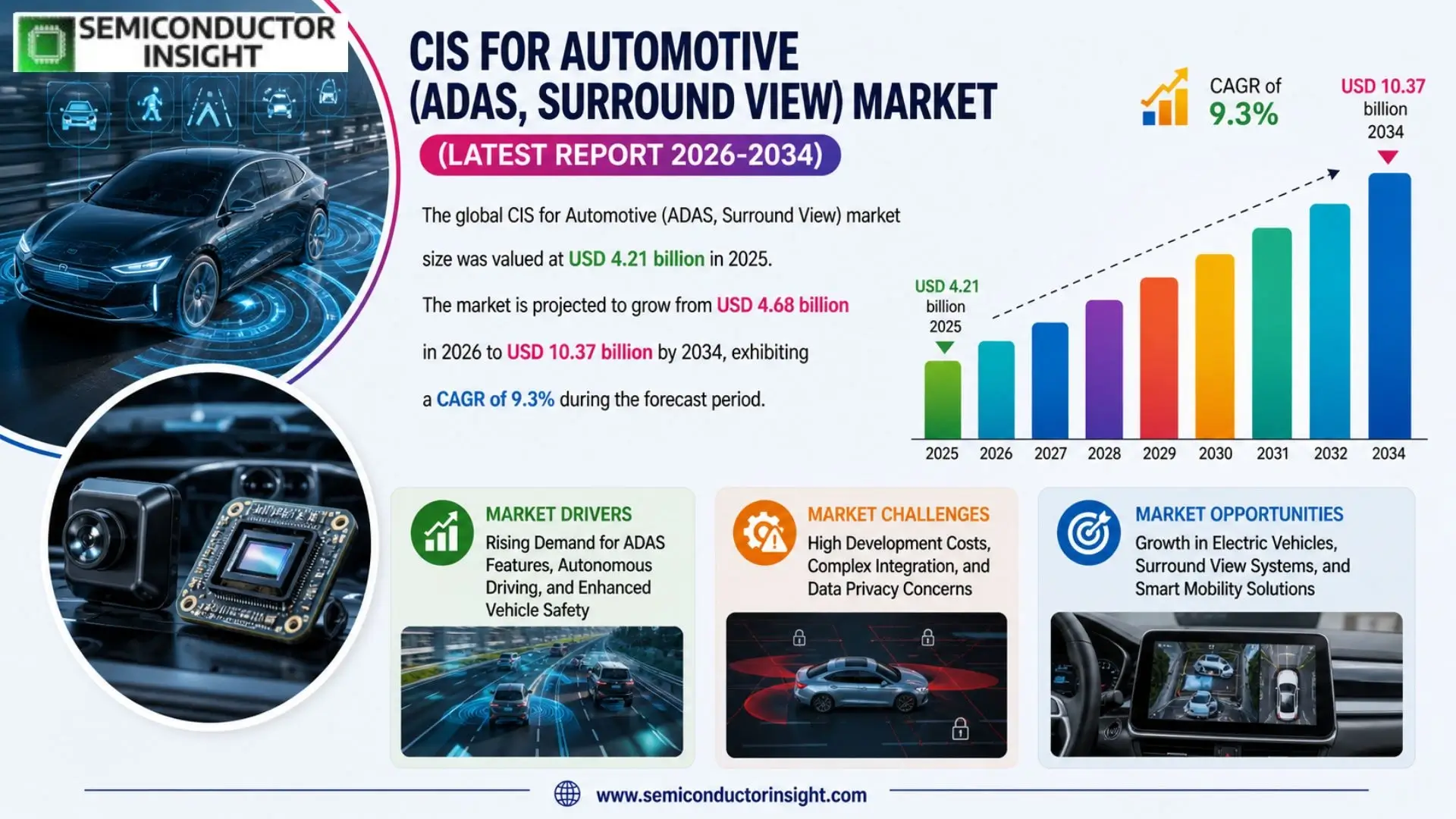
CIS for Automotive (ADAS, Surround View) Market size was valued at USD 4.21 billion in 2025. The market is projected to grow from USD 4.68 billion in 2026 to USD 10.37 billion by 2034, exhibiting a CAGR of 9.3% during the forecast period.
CMOS Image Sensors (CIS) for automotive applications are semiconductor devices designed to capture high-quality visual data for use in advanced driver assistance systems (ADAS) and surround view monitoring systems. These sensors convert light into electronic signals, enabling critical vehicle safety functions such as lane departure warning, automatic emergency braking, blind-spot detection, pedestrian recognition, and 360-degree surround view imaging. Automotive-grade CIS are engineered to operate reliably under extreme temperature ranges, high vibration, and varying lighting conditions, making them distinctly more demanding than consumer-grade image sensors.
The market is witnessing strong momentum driven by tightening global vehicle safety regulations, rapid electrification of vehicle fleets, and growing consumer demand for semi-autonomous and autonomous driving features. Furthermore, the proliferation of multi-camera systems in modern vehicles , where a single car may integrate six or more image sensors , is significantly expanding per-vehicle sensor content. Key industry players such as Sony Semiconductor Solutions Corporation, OmniVision Technologies, Samsung Electronics, ON Semiconductor, and STMicroelectronics continue to invest heavily in next-generation automotive CIS platforms to address evolving ADAS requirements.
MARKET DRIVERS
Rising Adoption of ADAS Technologies Fueling Demand for Automotive CIS
CIS for Automotive (ADAS, Surround View) Market is experiencing robust growth, driven primarily by the accelerating global adoption of advanced driver assistance systems (ADAS). As automakers integrate features such as automatic emergency braking, lane departure warning, blind-spot detection, and pedestrian recognition into mainstream vehicle platforms, the demand for high-performance contact image sensors has surged considerably. These systems rely on precise, high-resolution visual data capture to function safely and effectively, making automotive-grade CIS a foundational component in modern vehicle architectures.
Surround View Systems Expanding CIS Integration Across Vehicle Segments
Surround view monitoring systems, which stitch together real-time imagery from multiple cameras positioned around a vehicle, have become increasingly standard across mid-range and premium vehicle segments. This multi-camera architecture significantly multiplies the number of CIS units required per vehicle, directly boosting overall market volume. Automotive OEMs and Tier-1 suppliers are actively sourcing wide dynamic range (WDR) and high-sensitivity CIS modules capable of delivering reliable imaging performance under challenging lighting conditions, including nighttime, glare, and adverse weather scenarios.
➤ Global regulatory mandates, including requirements for rearview camera systems and evolving NCAP safety rating criteria, continue to act as powerful structural drivers for CIS for Automotive (ADAS, Surround View) Market, ensuring sustained baseline demand across all vehicle categories.
The progressive advancement toward higher levels of vehicle automation is further reinforcing CIS adoption. Vehicles targeting SAE Level 2 and Level 2+ autonomy now routinely deploy six to twelve cameras per platform, each requiring dedicated image sensors optimized for automotive operating environments. This trend is compelling semiconductor manufacturers and sensor suppliers to invest heavily in next-generation CIS technologies featuring improved resolution, lower noise floors, and enhanced functional safety compliance aligned with ISO 26262 standards, collectively strengthening the market’s long-term demand trajectory.
MARKET CHALLENGES
Stringent Automotive-Grade Qualification Requirements Posing Barriers for CIS Suppliers
One of the most significant challenges facing CIS for Automotive (ADAS, Surround View) Market is the extensive and time-consuming qualification process required for automotive-grade components. Unlike consumer electronics image sensors, automotive CIS must satisfy demanding reliability standards encompassing wide temperature ranges, vibration resistance, electromagnetic compatibility, and long operational lifespans often exceeding ten years. These requirements substantially extend development cycles and increase certification costs, creating considerable barriers particularly for emerging or mid-tier sensor suppliers attempting to enter the automotive supply chain.
Other Challenges
Intense Price Pressure from Automotive OEMs
Despite the technical sophistication required, automotive OEMs and Tier-1 suppliers continue to exert significant downward price pressure on CIS components, particularly for volume applications such as rearview and surround view cameras. This creates a difficult dynamic for sensor manufacturers who must simultaneously invest in advancing technology, maintaining rigorous quality standards, and absorbing cost reduction demands , compressing profit margins and potentially limiting R&D reinvestment capacity across CIS for Automotive (ADAS, Surround View) Market.
Supply Chain Vulnerabilities and Semiconductor Capacity Constraints
The automotive CIS segment remains susceptible to broader semiconductor supply chain disruptions. Specialized fabrication processes required for high-performance automotive image sensors limit the number of qualified manufacturing facilities globally. Capacity constraints at advanced foundries, combined with competing demand from consumer and industrial electronics sectors, can create supply shortfalls that challenge automakers’ production schedules and complicate long-term procurement planning for CIS-dependent ADAS and surround view systems.
MARKET RESTRAINTS
High Development Costs and Technology Complexity Limiting Rapid Market Expansion
The development of automotive-grade CIS solutions demands substantial capital investment in specialized semiconductor design, advanced pixel architecture engineering, and extensive validation testing. Achieving the combination of high dynamic range, low-light sensitivity, minimal motion blur, and full compliance with functional safety standards requires sophisticated engineering resources that are concentrated among a relatively small number of established players. This technological complexity acts as a meaningful restraint on the pace of new entrant participation and product diversification withCIS for Automotive (ADAS, Surround View) Market.
Dependency on Legacy Camera Architectures Slowing Next-Generation CIS Adoption
A significant portion of the automotive industry continues to operate on established vehicle platforms and camera system architectures designed around earlier-generation CIS specifications. Transitioning these platforms to newer, higher-performance image sensors involves non-trivial integration challenges, including compatibility with existing image signal processors, serializer-deserializer chipsets, and embedded software stacks. This architectural inertia can delay the uptake of advanced CIS technologies even when superior solutions are commercially available, creating a restraint on the growth rate achievable within the broader CIS for Automotive (ADAS, Surround View) Market.
Furthermore, the concentration of automotive CIS supply among a limited number of dominant semiconductor manufacturers introduces sourcing risk and reduces competitive pricing dynamics. Automakers dependent on a narrow supplier base for critical imaging components face vulnerability to supply disruptions and have limited leverage in negotiating favorable technology roadmap alignment, which can collectively restrain the pace of innovation diffusion across ADAS and surround view applications globally.
MARKET OPPORTUNITIES
Transition Toward Higher Levels of Vehicle Autonomy Creating Substantial CIS Demand
The ongoing industry transition toward SAE Level 3 and Level 4 vehicle automation represents a transformative opportunity for CIS for Automotive (ADAS, Surround View) Market. Autonomous driving architectures at these levels require a significantly expanded array of cameras with enhanced imaging specifications, including higher resolution output, improved frame rates, and greater robustness across all environmental conditions. Each incremental step up the autonomy ladder translates directly into increased CIS content per vehicle, offering sensor manufacturers and their supply chain partners a compelling long-term demand expansion pathway.
Emerging Markets and Electric Vehicle Platforms Offering New Growth Vectors
Rapidly growing automotive markets across Asia-Pacific, particularly in China and India, are increasingly mandating ADAS features as part of evolving local safety regulations and consumer preference shifts. Simultaneously, the global acceleration of electric vehicle adoption is creating fresh platform development cycles where automakers are integrating advanced surround view and ADAS camera systems from the ground up, without the constraints of legacy internal combustion engine architectures. This convergence of regulatory momentum, EV platform proliferation, and rising consumer safety awareness presents a multidimensional growth opportunity for suppliers positioned withCIS for Automotive (ADAS, Surround View) Market.
Advances in stacked CIS architecture, event-based imaging, and AI-integrated sensor designs are additionally opening new application frontiers beyond traditional surround view and ADAS use cases. In-cabin monitoring systems for driver drowsiness and occupant detection, as well as exterior perception systems for intelligent parking and low-speed maneuvering, are emerging as incremental CIS application segments. Suppliers capable of developing scalable, software-configurable image sensor platforms that address both exterior ADAS and interior monitoring requirements simultaneously will be well positioned to capture disproportionate value as automotive imaging ecosystems continue to broaden and deepen globally.
CIS for Automotive (ADAS, Surround View) Market Trends
Rising Regulatory Mandates Accelerating Adoption of Automotive CIS
CIS for Automotive (ADAS, Surround View) Market is experiencing significant momentum as governments and regulatory bodies across major automotive markets intensify safety mandates. Regulatory frameworks in Europe, North America, and Asia-Pacific are increasingly requiring the integration of advanced driver assistance systems in new vehicle models. These mandates are directly driving the deployment of CMOS image sensors across a widening range of vehicle segments, from passenger cars to commercial vehicles. Automotive-grade CIS must meet stringent performance benchmarks, operating reliably across extreme temperature ranges, high-vibration environments, and challenging lighting conditions, distinguishing them fundamentally from consumer-grade alternatives.
Other Trends
Proliferation of Multi-Camera Architectures in Modern Vehicles
One of the defining trends shaping CIS for Automotive (ADAS, Surround View) Market is the rapid adoption of multi-camera systems within a single vehicle platform. Modern vehicles increasingly integrate six or more image sensors to support functions such as 360-degree surround view imaging, blind-spot detection, lane departure warning, and automatic emergency braking. This expansion in per-vehicle sensor content is substantially increasing the overall addressable market for automotive CIS manufacturers and suppliers.
Electrification and Semi-Autonomous Driving Features Fueling Demand
The accelerating electrification of global vehicle fleets is creating new integration opportunities for automotive CMOS image sensors. Electric vehicles, particularly those positioned in premium and semi-autonomous segments, are adopting advanced ADAS camera systems as a core safety and differentiation feature. Growing consumer expectations around pedestrian recognition, adaptive cruise control, and automated parking are further reinforcing demand withCIS for Automotive (ADAS, Surround View) Market.
Strategic Investment by Key Industry Players in Next-Generation CIS Platforms
Leading participants CIS for Automotive (ADAS, Surround View) Market, including Sony Semiconductor Solutions Corporation, OmniVision Technologies, Samsung Electronics, ON Semiconductor, and STMicroelectronics, are channeling substantial investment into next-generation automotive image sensor platforms. These developments are focused on enhancing resolution, dynamic range, low-light performance, and functional safety compliance to meet evolving ADAS requirements. Continued innovation in sensor architecture and semiconductor design is expected to drive competitive differentiation and expand the application scope of automotive CIS across both current and emerging vehicle platforms globally.
COMPETITIVE LANDSCAPE
Key Industry Players
CIS for Automotive (ADAS, Surround View) Market: Competitive Dynamics and Leading Manufacturers
Global CIS for Automotive (ADAS, Surround View) Market is characterized by intense competition among a concentrated group of semiconductor and imaging technology giants. Sony Semiconductor Solutions Corporation commands a leading position in this space, leveraging its proprietary STARVIS and STARVIS 2 sensor technologies to deliver high-sensitivity, low-noise image sensors purpose-built for automotive ADAS and surround view applications. Sony’s deep integration with Tier 1 automotive suppliers and original equipment manufacturers (OEMs) has reinforced its dominance, particularly in rear-view, front-facing, and multi-camera surround view systems. OmniVision Technologies and Samsung Electronics are also prominent forces, offering a broad portfolio of automotive-grade CMOS image sensors engineered to meet stringent AEC-Q100 qualification standards, high dynamic range (HDR) performance requirements, and functional safety specifications aligned with ISO 26262. The competitive intensity is further heightened by the rapid proliferation of multi-camera architectures in modern vehicles, where a single platform may integrate six or more image sensors, driving per-vehicle sensor content significantly upward.
Beyond the market leaders, several specialized and diversified semiconductor companies are carving out significant niches within the automotive CIS ecosystem. ON Semiconductor (onsemi) has established a strong foothold through its AR series of automotive image sensors, which are widely deployed across ADAS camera modules globally. STMicroelectronics contributes expertise in automotive-grade imaging silicon, while Panasonic and Omnivision continue to invest in next-generation pixel architectures optimized for low-light and high-speed detection scenarios critical to pedestrian recognition and automatic emergency braking. Emerging players such as Smartsens Technology and GalaxyCore are intensifying competitive pressure, particularly in cost-sensitive surround view system segments, as automotive OEMs seek to broaden their supplier bases. The competitive landscape is further shaped by strategic collaborations between CIS manufacturers and Tier 1 suppliers such as Bosch, Continental, and Aptiv, as these partnerships accelerate the integration of advanced image sensing capabilities into production-ready ADAS platforms.
List of Key CIS for Automotive (ADAS, Surround View) Companies Profiled
- Sony Semiconductor Solutions Corporation
- OmniVision Technologies
- Samsung Electronics Co., Ltd.
- onsemi (ON Semiconductor)
- STMicroelectronics N.V.
- Panasonic Corporation
- Smartsens Technology Co., Ltd.
- GalaxyCore Inc.
- Brillnics Japan Inc.
- Gpixel Inc.
- Teledyne Technologies (Teledyne DALSA)
- Tower Semiconductor Ltd.
- Himax Technologies, Inc.
- Renesas Electronics Corporation
- Omnivision Holdings, Inc.
Segment Analysis:
| Segment Category | Sub-Segments | Key Insights |
| By Type |
|
Global Shutter CIS is rapidly emerging as the preferred sensor type for demanding automotive ADAS environments, driven by its ability to capture fast-moving objects without motion distortion or image artifacts.
|
| By Application |
|
Advanced Driver Assistance Systems (ADAS) represents the dominant application segment, underpinned by expanding global regulatory mandates and automaker commitments to enhancing active vehicle safety.
|
| By End User |
|
Original Equipment Manufacturers (OEMs) constitute the leading end-user segment, as the integration of automotive CIS is increasingly embedded at the vehicle design and engineering stage rather than added post-production.
|
| By Resolution |
|
Mid Resolution (2 MP – 8 MP) sensors currently hold the leading position across automotive CIS deployments, offering an optimized balance between image detail, processing bandwidth, and system integration complexity.
|
| By Vehicle Type |
|
Passenger Cars represent the dominant vehicle type segment for automotive CIS adoption, reflecting the broad rollout of mandatory safety features and the high volume of consumer vehicle production globally.
|
Regional Analysis: CIS for Automotive (ADAS, Surround View) Market
Asia-Pacific
China’s regulatory push for mandatory ADAS features in new passenger vehicles is a primary catalyst accelerating CIS for Automotive adoption. Domestic automakers are embedding surround view camera systems as standard features even in mid-range segments. Local CIS chipmakers and Tier-1 suppliers are scaling production rapidly, reducing dependence on international components while meeting stringent automotive-grade quality thresholds demanded by global OEMs operating within the country.
Japan and South Korea leverage world-class semiconductor expertise to supply precision CIS components for ADAS and surround view applications. Established players in both markets maintain advanced fabrication nodes that enable high dynamic range and low-light performance critical for automotive safety systems. Strategic partnerships between sensor manufacturers and global OEMs continue to deepen, solidifying both nations as indispensable nodes in the regional CIS for Automotive supply chain.
North America
North America represents one of the most technologically advanced and regulatory-driven markets for CIS for Automotive (ADAS, Surround View) applications. The United States, anchored by federal mandates requiring rear-view camera systems in all new light-duty vehicles, has created a substantial and sustained baseline demand for automotive-grade contact image sensors. Beyond compliance-driven adoption, the region is witnessing accelerated integration of surround view systems and multi-camera ADAS platforms in premium and commercial vehicle segments. The thriving autonomous vehicle development ecosystem in the United States, concentrated in Silicon Valley and Detroit, is fostering intensive research into next-generation CIS architectures optimized for machine vision. Canada and Mexico, as deeply integrated partners in North American automotive manufacturing, contribute to regional supply chain depth. Tier-1 suppliers and technology startups across the continent are actively collaborating with semiconductor companies to develop CIS solutions capable of meeting the perception requirements of Level 2 and Level 3 automated driving platforms, ensuring sustained market momentum well into the 2026–2034 forecast window.
Europe
Europe occupies a strategically pivotal position CIS for Automotive (ADAS, Surround View) Market, underpinned by some of the world’s most stringent vehicle safety legislation and a premium automotive manufacturing heritage. The European Union’s General Safety Regulation, which mandates a comprehensive suite of ADAS features across new vehicle categories, has substantially elevated demand for high-performance CIS solutions integrated into camera-based driver assistance systems. Germany, as home to globally recognized luxury and volume OEMs, serves as a critical innovation hub where advanced surround view and perception camera technologies are refined and standardized. France, Sweden, and Italy further contribute through their robust automotive supply ecosystems. European semiconductor and imaging companies are investing in next-generation CIS architectures addressing thermal resilience and functional safety compliance per ISO 26262 standards. The region’s strong emphasis on data privacy also shapes the design philosophy of automotive vision systems, encouraging on-device processing capabilities embedded within CIS modules deployed across ADAS platforms.
South America
South America is an emerging frontier in Global CIS for Automotive (ADAS, Surround View) Market, currently in early-stage adoption relative to more mature regions. Brazil, as the continent’s largest automotive market, is the primary driver of regional demand, with OEMs gradually introducing ADAS-equipped vehicles into a price-sensitive yet increasingly safety-conscious consumer base. Regulatory frameworks are progressively aligning with international vehicle safety benchmarks, creating a favorable environment for the broader adoption of surround view camera systems and CIS-based driver assistance technologies. Economic volatility and import cost pressures remain structural challenges that moderate the pace of technology penetration; however, the growing proportion of internationally branded vehicles entering the South American market is organically elevating the installed base of automotive CIS components. As infrastructure investment improves and consumer affordability expands, South America is expected to register steady, if measured, growth in CIS for Automotive adoption through the forecast period.
Middle East & Africa
The Middle East and Africa region presents a distinctively differentiated landscape for CIS for Automotive (ADAS, Surround View) Market, characterized by contrasting adoption patterns across sub-regions. The Gulf Cooperation Council countries, particularly the United Arab Emirates and Saudi Arabia, exhibit strong demand for premium and luxury vehicles equipped with comprehensive ADAS and surround view camera systems, driven by high per-capita income levels and a preference for technologically advanced automobiles. Government-led smart mobility and road safety initiatives across the Gulf further support the integration of CIS-based automotive vision technologies. In contrast, Sub-Saharan African markets remain at nascent adoption stages, where affordability constraints and infrastructure limitations restrict the penetration of advanced driver assistance systems. South Africa stands out as a relatively more developed automotive market within the continent, serving as a regional gateway for technology introduction. Overall, the Middle East and Africa region is expected to contribute incrementally to global CIS for Automotive market growth, with the Gulf cluster driving the majority of regional demand through 2034.
Report Scope
This market research report provides a comprehensive analysis of the CIS for Automotive (ADAS, Surround View) Market , covering the forecast period 2026–2034. It offers detailed insights into market dynamics, technological advancements, competitive landscape, and key trends shaping the industry.
Key focus areas of the report include:
- Market Overview: The report begins with an overview outlining its current market scenario, key growth indicators, and industry transformation drivers. It discusses macroeconomic factors, demand–supply balance, regulatory landscape, and the strategic role of semiconductors in powering advancements across industries such as automotive, telecommunications, consumer electronics, and industrial automation.
- Market Size & Forecast: Historical data and future projections for revenue, unit shipments, and market value across major regions and segments.
- Segmentation Analysis: Detailed breakdown by product type, technology, application, and end-user industry to identify high-growth segments and investment opportunities.
- Regional Insights: Insights into market performance across North America, Europe, Asia-Pacific, Latin America, and the Middle East & Africa, including country-level analysis where relevant.
- Competitive Landscape: Profiles of leading market participants, including their product offerings, R&D focus, manufacturing capacity, pricing strategies, and recent developments such as mergers, acquisitions, and partnerships.
- Technology Trends & Innovation: Assessment of emerging technologies, integration of AI/IoT, semiconductor design trends, fabrication techniques, and evolving industry standards.
- Market Drivers & Restraints: Evaluation of factors driving market growth along with challenges, supply chain constraints, regulatory issues, and market-entry barriers.
- Stakeholder Insights: Insights for component suppliers, OEMs, system integrators, investors, and policymakers regarding the evolving ecosystem and strategic opportunities.
Primary and secondary research methods are employed, including interviews with industry experts, data from verified sources, and real-time market intelligence to ensure the accuracy and reliability of the insights presented.
FREQUENTLY ASKED QUESTIONS:
What is the current market size of CIS for Automotive (ADAS, Surround View) Market?
-> CIS for Automotive (ADAS, Surround View) Market was valued at USD 4.21 billion in 2025 and is expected to reach USD 10.37 billion by 2034, growing at a CAGR of 9.3% during the forecast period from 2026 to 2034.
Which key companies operate CIS for Automotive (ADAS, Surround View) Market?
-> Key players include Sony Semiconductor Solutions Corporation, OmniVision Technologies, Samsung Electronics, ON Semiconductor, and STMicroelectronics, among others.
What are the key growth drivers?
-> Key growth drivers include tightening global vehicle safety regulations, rapid electrification of vehicle fleets, growing consumer demand for semi-autonomous and autonomous driving features, and the proliferation of multi-camera systems in modern vehicles.
Which region dominates the market?
-> Asia-Pacific is the fastest-growing region, driven by high vehicle production volumes and rapid adoption of ADAS technologies, while North America and Europe remain significant markets due to stringent vehicle safety mandates.
What are the emerging trends?
-> Emerging trends include next-generation automotive CMOS Image Sensor platforms, integration of AI-powered vision systems, 360-degree surround view imaging, and the expansion of multi-camera configurations with six or more sensors per vehicle to support advanced autonomous driving capabilities.

Get Sample Report PDF for Exclusive Insights
Report Sample Includes
- Table of Contents
- List of Tables & Figures
- Charts, Research Methodology, and more...
 Download Sample Report PDF