Chip-on-Wafer (CoW) Assembly Market Insights
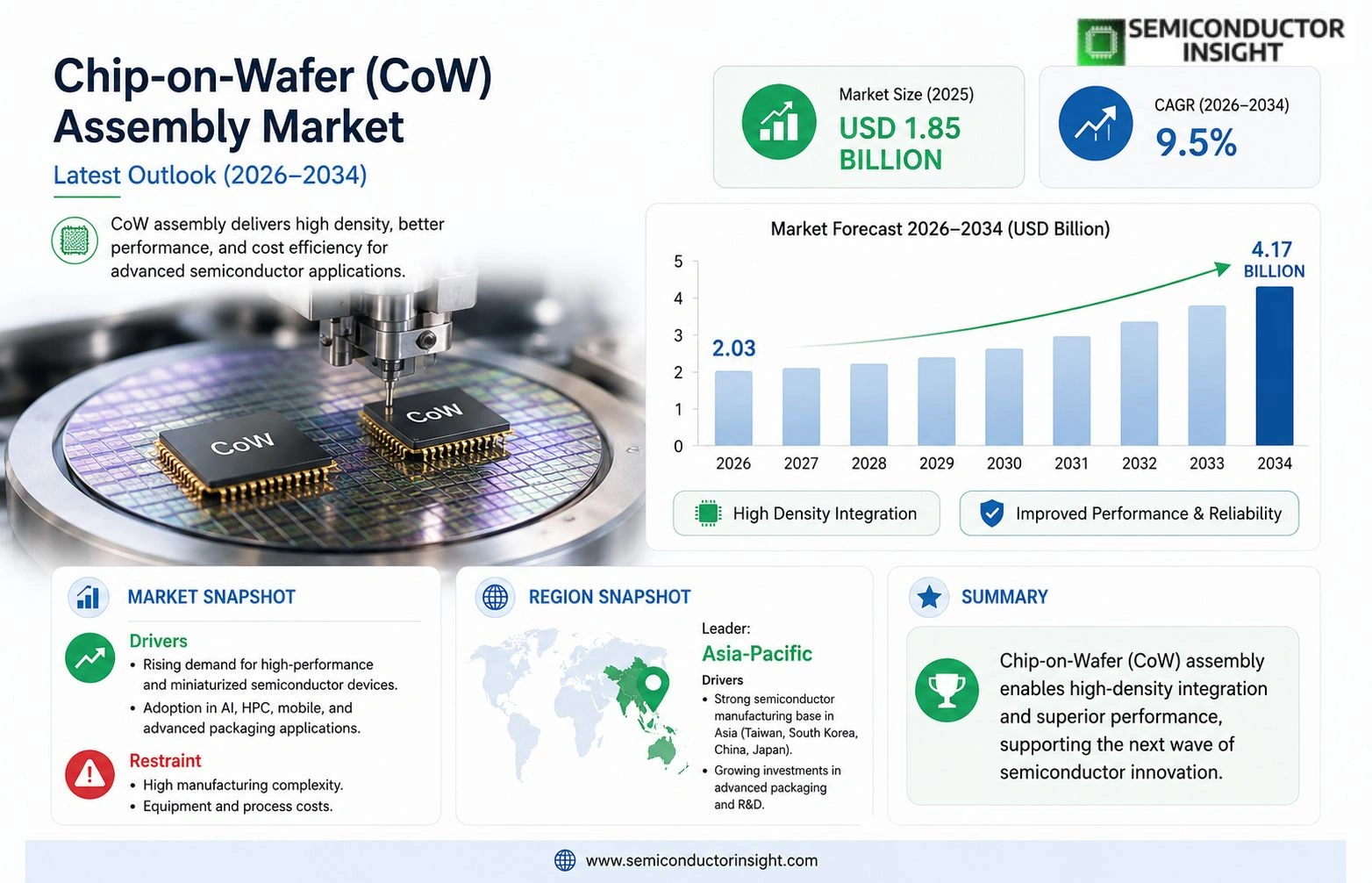
Global Chip-on-Wafer (CoW) Assembly Market size was valued at USD 1.85 billion in 2025. The market is projected to grow from USD 2.03 billion in 2026 to USD 4.17 billion by 2034, exhibiting a CAGR of 9.5% during the forecast period.
The Chip-on-Wafer (CoW) Assembly process represents an advanced semiconductor packaging technique where individual semiconductor dies are directly mounted onto a wafer substrate before dicing. This method enhances electrical performance, reduces form factor, and improves thermal management,critical factors for high-performance computing, artificial intelligence (AI), and 5G applications. CoW assembly integrates multiple components such as memory chips, logic processors, and sensors into a single package, enabling heterogeneous integration while optimizing yield and cost efficiency.
The rapid adoption of Chip-on-Wafer (CoW) Assembly is driven by surging demand for miniaturized yet powerful electronic devices, particularly in smartphones, automotive electronics, and data centers. Furthermore, advancements in fan-out wafer-level packaging (FOWLP) and system-in-package (SiP) technologies are accelerating market expansion. Leading semiconductor manufacturers are investing heavily in CoW assembly capabilities to meet the evolving requirements of next-generation applications.
MARKET DRIVERS
Rise in Demand for 3D Integration and System-in-Package Solutions
Chip-on-Wafer (CoW) Assembly Market is witnessing robust growth driven by the electronics industry’s urgent need for higher density and improved electrical performance without relying solely on extreme transistor scaling. As semiconductor manufacturers seek methods to enhance bandwidth and reduce latency in high-performance computing applications, CoW assembly offers a viable pathway to achieve these goals through efficient vertical integration.
Enhanced Thermal Management Capabilities
Efficient thermal dissipation remains a critical requirement for advanced electronics, particularly in artificial intelligence and automotive sectors. The stackable nature of CoW assembly allows for better heat spreading across multiple die layers, effectively addressing the thermal bottlenecks that often limit the performance of conventional packaging solutions. This capability makes Chip-on-Wafer (CoW) Assembly Market a preferred choice for power-sensitive applications requiring optimal thermal efficiency.
➤ Adoption of this technology reduces overall footprint while simultaneously maintaining or enhancing device performance metrics.
Furthermore, the expanding need for memory-intensive workloads in data centers is propelling the adoption of Chip-on-Wafer (CoW) Assembly Market solutions that facilitate direct die-to-die vertical connectivity, streamlining data transfer between processing units and memory arrays.
MARKET CHALLENGES
Navigating Alignment Precision Issues
One of the primary hurdles Chip-on-Wafer (CoW) Assembly Market is ensuring microscopic alignment accuracy during the die placement process. Any deviation in alignment can lead to electrical shorts or poor signal integrity, thereby necessitating the implementation of extremely sophisticated positioning mechanisms and rigorous quality control standards throughout the production lifecycle.
Other Challenges
Process Complexity and Yield Variability
The assembly process involves multiple critical steps including die bonding, wafer testing, and packaging, which collectively increases the risk of yield loss if not managed with absolute precision.
MARKET RESTRAINTS
Limited Supply Chain Maturity
Chip-on-Wafer (CoW) Assembly Market faces a significant constraint regarding the availability of specialized equipment and materials. Unlike conventional packaging, CoW requires equipment capable of handling fragile wafers and performing precision bonding simultaneously, creating a bottleneck in mass production scalability and complicating the supply chain establishment for new entrants.
MARKET OPPORTUNITIES
Expansion into Automotive and 5G Applications
There is a significant opportunity for Chip-on-Wafer (CoW) Assembly Market to penetrate the critical automotive and 5G telecommunications sectors. As vehicle electronics become increasingly complex and 5G infrastructure expands rapidly, the demand for robust, high-reliability packaging solutions that can withstand harsh environmental conditions will surge, presenting a lucrative growth avenue for technology providers.
Strategic partnerships between foundries, material suppliers, and original equipment manufacturers are expected to drive innovation, accelerating the development of proprietary CoW methods that cater to these specific high-volume application demands.
Trends
Advanced Process Heterogeneous Integration
The global electronics industry is currently witnessing a significant evolution in packaging methodologies driven by the functional constraints of Moore’s Law. The Chip-on-Wafer assembly process has emerged as a premier solution for achieving superior system throughput in high-demand environments. Specifically, this process facilitates the direct mounting of semiconductor dies onto a wafer substrate prior to the dicing process to maximize yield. By enabling direct interconnects, it ensures that the electrical performance is optimized while simultaneously reducing the final package footprint for portable applications. Enhanced thermal management capabilities allow for higher power densities, directly addressing the heat dissipation challenges inherent in complex consumer electronics and industrial control systems.
Other Trends
Miniaturization and Performance Optimization
The market trajectory is largely influenced by the relentless pursuit of smaller form factors and increased functionality without compromising on signal integrity. As devices become more compact, the limitations of traditional packaging become apparent, necessitating the adoption of more sophisticated integration strategies. Manufacturers are deploying advanced technologies such as Fan-Out Wafer Level Packaging to facilitate complex system-in-package designs. These developments are crucial for supporting the dense processing requirements of artificial intelligence and high-speed telecommunications equipment, effectively bridging the gap between logic performance and memory speed.
Automotive and 5G Infrastructure Growth
Further momentum is generated by the rigorous demands of the automotive sector and the rapid, massive expansion of 5G infrastructure. Automotive electronics require robust reliability under extreme environmental conditions, and this assembly method provides the necessary mechanical robustness for safety-critical systems. Simultaneously, data centers are seeking efficient integration solutions to handle massive computational loads. Consequently, top-tier semiconductor firms are prioritizing the development of assembly capabilities that offer higher yield rates and lower costs per device, reinforcing the market’s strategic importance in the global supply chain.
COMPETITIVE LANDSCAPE
Key Industry Players
Strategic Heterogeneous Integration for High-Performance Computing
The global Chip-on-Wafer (CoW) Assembly market is experiencing robust expansion, fueled by aggressive investments in fan-out wafer-level packaging (FOWLP) and system-in-package (SiP) technologies. Key players are prioritizing the enhancement of electrical performance and thermal management to meet the rigorous requirements of next-generation 5G and AI applications.
Leading semiconductor manufacturers are leveraging the CoW process to integrate critical components such as memory chips and sensors directly onto a wafer substrate. This approach allows the industry to optimize cost efficiency and yield rates while delivering miniaturized solutions for sophisticated automotive electronics and large-scale data centers.
List of Key Chip-on-Wafer Assembly Companies Profiled
- ASE Group
- Amkor Technology
- Siliconware Precision Industries (SPIL)
- Powertech Technology
- JCET (Jetion)
- Taiwan Semiconductor Manufacturing Company (TSMC)
- Samsung Electronics
- Micron Technology
- SK Hynix
- Nuvoton Technology
- Rohm Semiconductor
- ON Semiconductor
- GlobalFoundries
- Winbond Electronics
- Magnachip Semiconductor
Segment Analysis:
| Segment Category | Sub-Segments | Key Insights |
| By Type |
|
Flip Chip Assembly is emerging as the dominant sub-segment due to its superior signal transfer capabilities and higher thermal conductivity, which are critical for next-generation computing. Conversely, traditional wire bonding continues to hold significant market share within cost-sensitive applications. There is a noticeable industry pivot towards advanced die attach techniques that offer better mechanical stability during high-frequency signal processing, driving manufacturers to invest in precision assembly machinery and process optimization. |
| By Application |
|
Automotive and AI Applications represent the most lucrative growth engines for Chip-on-Wafer technologies. The automotive sector is placing immense pressure on the supply chain to deliver robust packaging solutions that can withstand harsh environmental conditions and electromagnetic interference. Similarly, the AI sector requires complex, high-performance logic and memory integration that necessitates advanced heterogeneous packaging methods to handle massive data throughput. |
| By End User |
|
OEMs are driving the innovation cycle by demanding multi-chip, high-density solutions that integrate various functionalities into a single package. Meanwhile, EMS providers are increasingly focusing on enhancing assembly yield rates and streamlining production workflows to meet the growing volume requirements of their clients. The collaboration between design engineers and assembly experts is becoming a critical determinant of market success, as it ensures that high-performance designs can be manufactured reliably at scale. |
| By Technology |
|
Fan-Out Wafer-Level Packaging is gaining traction for its ability to provide greater design flexibility compared to traditional wire bonding, allowing for more efficient routing and higher performance. Simultaneously, the adoption of Hybrid Bonding is surging as a preferred method to achieve ultra-high interconnect density, which is essential for the latest generation of semiconductors. These technologies are fundamentally changing how chips communicate, moving towards interfaces that support faster data transfer rates essential for advanced computing. |
| By Integration Method |
|
System-in-Package solutions are becoming the standard for compact consumer devices as they allow for the seamless integration of memory and logic components, significantly reducing the overall system footprint. The push towards 3D Heterogeneous Integration marks a significant strategic shift, as it enables vertical stacking of different chip types to maximize performance and minimize latency. This approach is particularly valuable for complex systems where spatial constraints and thermal dissipation are critical design challenges, forcing suppliers to innovate in packaging architecture. |
Regional Analysis: Chip-on-Wafer (CoW) Assembly Market
North America
The competitive landscape is defined by a synergistic relationship between specialized packaging houses and advanced foundries, fostering an environment where rapid technological iteration is the norm rather than the exception.
The automotive sector is a primary driver for growth, as the need for high-reliability electronic systems in electric vehicles and autonomous driving platforms creates complex requirements for advanced assembly techniques.
Successful market penetration in North America requires the formation of strategic alliances between original equipment manufacturers and packaging providers to ensure seamless integration of new technologies into existing production lines.
The adoption of Chip-on-Wafer (CoW) Assembly processes is accelerating among consumer electronics giants, driven by the relentless pursuit of miniaturization and the need to maintain power efficiency in smart devices.
Europe
Europe is establishing a significant stronghold by focusing closely on automotive-grade reliability and high-performance computing applications, leveraging the region’s deep heritage in mechanical precision and engineering to dominate high-end packaging solutions. Chip-on-Wafer (CoW) Assembly Market in this region benefits from strict regulatory standards that prioritize durability and safety, ensuring that the advanced packaging techniques developed here are widely accepted in the European automotive and industrial sectors.
Asia-Pacific
Asia-Pacific represents a dynamic and rapidly expanding growth engine, characterized by massive manufacturing capacity and a heavy concentration of consumer electronics OEMs that are rapidly integrating Chip-on-Wafer (CoW) Assembly processes to support high-volume production demands effectively. The region’s manufacturing ecosystem offers unparalleled scale, allowing for the cost-effective mass production of complex electronic components while simultaneously pushing the boundaries of what is possible in wafer-level packaging integration.
South America
Growth in the region is steady and is primarily driven by infrastructure modernization initiatives and the expansion of the local telecommunications sector, although adoption rates continue to remain moderate compared to more developed industrial zones. As the region seeks to modernize its digital infrastructure, there is a growing interest in adopting advanced semiconductor solutions that can enhance network connectivity and hardware processing capabilities locally.
Middle East & Africa
Chip-on-Wafer (CoW) Assembly Market is seeing a nascent but promising expansion in the Middle East and Africa, largely supported by government-led diversification strategies into the digital economy and the strategic establishment of regional semiconductor test facilities to serve export markets.
Report Scope
This market research report provides a comprehensive analysis of the Chip-on-Wafer (CoW) Assembly Market , covering the forecast period 2026–2034. It offers detailed insights into market dynamics, technological advancements, competitive landscape, and key trends shaping the industry.
Key focus areas of the report include:
- Market Overview: The report begins with an overview outlining its current market scenario, key growth indicators, and industry transformation drivers. It discusses macroeconomic factors, demand–supply balance, regulatory landscape, and the strategic role of semiconductors in powering advancements across industries such as automotive, telecommunications, consumer electronics, and industrial automation.
- Market Size & Forecast: Historical data and future projections for revenue, unit shipments, and market value across major regions and segments.
- Segmentation Analysis: Detailed breakdown by product type, technology, application, and end-user industry to identify high-growth segments and investment opportunities.
- Regional Insights: Insights into market performance across North America, Europe, Asia-Pacific, Latin America, and the Middle East & Africa, including country-level analysis where relevant.
- Competitive Landscape: Profiles of leading market participants, including their product offerings, R&D focus, manufacturing capacity, pricing strategies, and recent developments such as mergers, acquisitions, and partnerships.
- Technology Trends & Innovation: Assessment of emerging technologies, integration of AI/IoT, semiconductor design trends, fabrication techniques, and evolving industry standards.
- Market Drivers & Restraints: Evaluation of factors driving market growth along with challenges, supply chain constraints, regulatory issues, and market-entry barriers.
- Stakeholder Insights: Insights for component suppliers, OEMs, system integrators, investors, and policymakers regarding the evolving ecosystem and strategic opportunities.
Primary and secondary research methods are employed, including interviews with industry experts, data from verified sources, and real-time market intelligence to ensure the accuracy and reliability of the insights presented.
FREQUENTLY ASKED QUESTIONS:
What is the current market size of Chip-on-Wafer (CoW) Assembly Market?
-> Global Chip-on-Wafer (CoW) Assembly Market size was valued at USD 1.85 billion in 2025. The market is projected to grow from USD 2.03 billion in 2026 to USD 4.17 billion by 2034, exhibiting a CAGR of 9.5% during the forecast period.
Which key companies operate Chip-on-Wafer (CoW) Assembly Market?
-> Key players include Leading semiconductor manufacturers, who are investing heavily in CoW assembly capabilities to meet the evolving requirements of next-generation applications.
What are the key growth drivers?
-> Key growth drivers include surging demand for miniaturized yet powerful electronic devices, such as smartphones, automotive electronics, and data centers, as well as advancements in fan-out wafer-level packaging (FOWLP).
Which region dominates the market?
-> Asia-Pacific is the fastest-growing region, while Europe remains a dominant market.
What are the emerging trends?
-> Emerging trends include advancements in fan-out wafer-level packaging (FOWLP) and system-in-package (SiP) technologies.

Get Sample Report PDF for Exclusive Insights
Report Sample Includes
- Table of Contents
- List of Tables & Figures
- Charts, Research Methodology, and more...
 Download Sample Report PDF