Ceramic Vacuum Chuck Table Market Insights
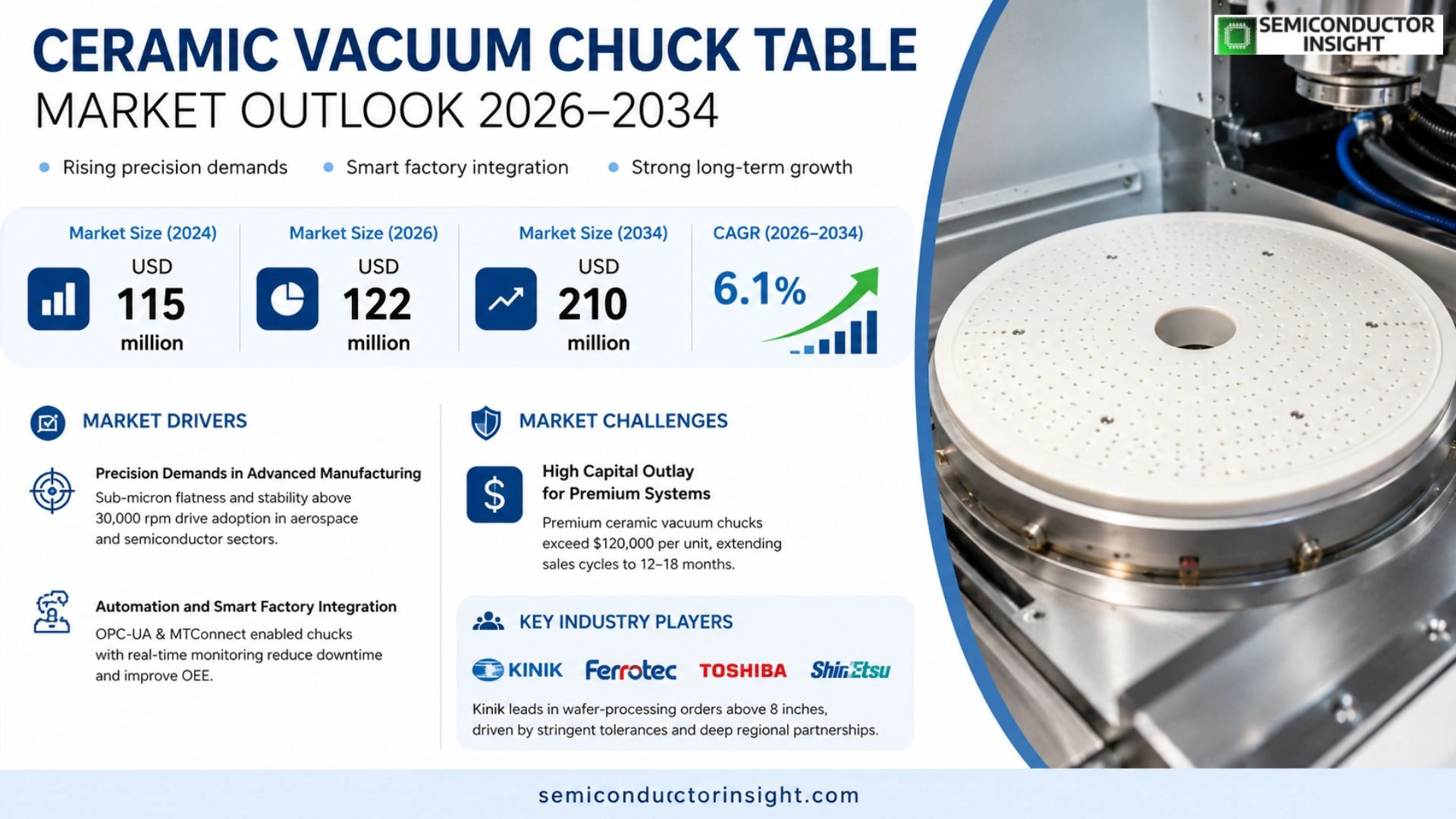
Ceramic Vacuum Chuck Table market size was valued at USD 115 million in 2024 and will rise from USD 122 million in 2026 to USD 210 million by 2034, showing a CAGR of 6.1 % during the forecast period.
Porous ceramic chuck tables serve as essential components in semiconductor equipment such as silicon wafer processing lines. These tables are employed across silicon wafer, compound wafer, piezoelectric ceramic, glass, LED, semiconductor package substrate, optical component thinning and cutting applications.
Market expansion reflects heightened adoption of high‑precision manufacturing across semiconductor, electronics and optics sectors. Investment in automation and digital transformation fuels demand for reliable vacuum chuck solutions, while advances in material engineering improve durability and vacuum performance. Recent activity includes a June 2024 partnership between Kinik and Kyocera to co‑develop next‑generation high‑porosity tables, and RPS’s launch of an ultra‑low‑outgassing model targeting advanced lithography tools. Other notable participants such as SemiXicon, NTK CERATEC and Witte Barskamp continue expanding their product portfolios.
MARKET DRIVERS
Precision Demands in Advanced Manufacturing
Manufacturers in aerospace and semiconductor sectors are tightening tolerances on flatness and surface integrity. Ceramic Vacuum Chuck Table Market suppliers that can guarantee sub‑micron flatness are capturing premium contracts, because even marginal deviations can trigger costly re‑work. The surge in high‑speed machining has forced end‑users to adopt chucks that maintain stability at spindle speeds above 30,000 rpm.
Automation and Smart Factory Integration
Factories moving toward fully automated workcells require chuck tables that communicate via OPC-UA or MTConnect. Vendors that embed sensors for vacuum pressure and temperature are seeing order growth of roughly 8% YoY, as plants replace legacy hardware with data‑rich equipment. The ability to feed real‑time status into Manufacturing Execution Systems reduces downtime and improves overall equipment effectiveness.
➤ “Customers are no longer buying a chuck; they are buying an integrated process node that delivers repeatable quality without manual calibration.”
These forces converge to elevate Ceramic Vacuum Chuck Table Market from a niche component to a strategic enabler of productivity. Companies that align product development with Industry 4.0 standards are positioning themselves for sustained revenue uplift.
MARKET CHALLENGES
High Capital Outlay for Premium Systems
Top‑tier ceramic vacuum chucks command prices that can exceed $120,000 per unit. Small‑ to medium‑size OEMs frequently defer purchases, extending the sales cycle to 12‑18 months. The upfront investment deters adoption in cost‑sensitive segments such as consumer electronics tooling.
Other Challenges
Supply‑Chain Volatility
Long lead times for high‑purity alumina and the limited number of specialized manufacturers create bottlenecks. When raw‑material shortages arise, price indices can spike by 15% within a quarter, compressing margins for end‑users who cannot pass costs onward.
MARKET RESTRAINTS
Technical Complexity and Training Requirements
Operating a ceramic vacuum chuck safely demands trained personnel familiar with vacuum system dynamics and ceramic handling protocols. Companies that lack in‑house expertise must allocate resources for training programs, which adds overhead and slows deployment.
Regulatory Compliance Pressures
In regulated industries such as medical device manufacturing, equipment must meet stringent ISO‑13485 and GMP standards. Certification processes for new chuck designs can extend time‑to‑market by several months, limiting the speed at which innovations reach customers.
These restraints temper the overall enthusiasm for Ceramic Vacuum Chuck Table Market, especially among firms that must balance rapid rollout against compliance and skill‑gap costs.
MARKET OPPORTUNITIES
Emerging Applications in Renewable Energy
Wind‑turbine blade manufacturing and solar‑panel assembly are adopting high‑precision machining processes where ceramic vacuum chucks can improve yield. Early pilots indicate a potential 6% uplift in component throughput, opening a new revenue stream for vendors.
Modular and Scalable Designs
Suppliers that offer plug‑and‑play modules,allowing customers to expand vacuum capacity in line with production growth,are differentiating themselves. Modular solutions lower the barrier to entry, enabling firms to start with a base unit and add capacity as demand materializes.
Capitalizing on these pockets of demand could accelerate Ceramic Vacuum Chuck Table Market beyond its current growth trajectory, provided players tailor their offerings to the specific performance criteria of emerging sectors.
Ceramic Vacuum Chuck Table Market Trends
Rising Utilization in Advanced Wafer Processing
The semiconductor sector is increasingly relying on porous ceramic chuck tables to achieve the flatness and thermal stability required for 300‑mm and emerging 450‑mm wafers. As device geometries shrink, manufacturers demand tighter control over wafer bow and vibration; the ceramic substrate’s low thermal expansion coefficient directly addresses those constraints. Consequently, equipment makers are redesigning process modules to incorporate larger‑diameter ceramic vacuum chuck tables, which in turn pushes component suppliers to expand capacity. This feedback loop accelerates investment in tooling upgrades and creates a noticeable uptick in order volumes for Ceramic Vacuum Chuck Table Market.
Other Trends
Adoption of Porous Ceramic Architectures
New manufacturing techniques such as additive‑layer sintering enable the production of uniformly porous ceramic layers with controllable void fractions. These layers improve vacuum hold‑down efficiency while reducing outgassing during high‑temperature cycles. End‑users report higher throughput because the reduced need for corrective alignment translates into shorter cycle times. Suppliers that have integrated these design capabilities into their product lines are seeing differentiated pricing power, as downstream fabs treat the enhanced performance as a cost‑avoidance measure rather than a simple equipment expense.
Geographic Shift Toward Asia‑Pacific Fabrication Hubs
Investment trends reveal that a majority of new wafer‑fab projects slated for the next five years are concentrating in China, South Korea, and Taiwan. The proximity of these facilities to major ceramic raw‑material producers shortens supply chains and lowers logistics overhead. Moreover, regional policy incentives aimed at advancing semiconductor self‑sufficiency have prompted local fabs to adopt cutting‑edge vacuum chuck solutions earlier than peers in Europe or North America. For vendors, this means tailoring product portfolios to meet specific regulatory and environmental standards prevalent in the Asia‑Pacific corridor, a strategic move that can secure long‑term contracts and enhance market share within Ceramic Vacuum Chuck Table Market.
COMPETITIVE LANDSCAPE
Key Industry Players
Ceramic Vacuum Chuck Table Market Competitive Overview
The sector is dominated by a handful of firms that have built vertically integrated supply chains around high‑purity porous ceramics and precision machining. Kinik, leveraging a network of semiconductor equipment makers in Japan and Taiwan, commands the largest share of wafer‑processing orders above 8 inches, where tolerances are most stringent. Kyocera follows closely, differentiating its product line through proprietary sintering technology that reduces vacuum leakage and extends table life, enabling it to secure long‑term contracts with major display‑panel manufacturers. RPS and SemiXicon have carved out specialist niches in the emerging 12‑inch wafer segment, where demand for higher throughput drives investment in larger chuck tables. These leaders benefit from deep engineering resources, strong IP portfolios, and the ability to customize tables for niche applications such as piezoelectric ceramic handling and optical component thinning.
Beyond the top tier, a diverse set of mid‑size and regional players injects competition into specific geographic or application niches. NTK CERATEC and Krosaki Harima, both headquartered in Japan, focus on ultra‑high‑vacuum solutions for semiconductor packaging and maintain strong relationships with equipment OEMs in North America. Mactech Corporation and eNOVA supply cost‑effective tables for PCB and LED substrates, leveraging lower‑cost raw material sourcing in Southeast Asia. Provis and Nishimura Advanced Ceramics address the display market in Europe by offering modular designs that simplify table change‑over. Portec, Witte Barskamp, Gennex, and Shenzhen Fangtai New Material Technology round out the field, each providing either a focused product size (e.g., 6‑inch tables) or a service‑oriented approach such as on‑site refurbishment, which resonates with smaller fabs seeking to extend asset lifecycles.
List of Key Ceramic Vacuum Chuck Table Companies Profiled
- Kinik
- Kyocera
- RPS
- SemiXicon
- NTK CERATEC
- Krosaki Harima
- Mactech Corporation
- eNOVA
- Provis
- Nishimura Advanced Ceramics
- Portec
- Witte Barskamp
- Gennex
- Shenzhen Fangtai New Material Technology
Segment Analysis:
| Segment Category | Sub-Segments | Key Insights |
| By Type |
|
Porous Ceramic
|
| By Application |
|
Semiconductor Processing
|
| By End User |
|
Equipment Manufacturers
|
| By Technology |
|
Hybrid Composite Designs
|
| By Market Trend |
|
Automation‑Driven Production
|
Regional Analysis: Ceramic Vacuum Chuck Table Market
Europe
Car manufacturers across the continent exploit the rigidity of ceramic vacuum tables to hold lightweight alloy blanks during high‑speed milling. The reduced vibration translates into tighter tolerances, a prerequisite for electric‑vehicle drivetrain components. This capability strengthens competitive positioning for firms that blend speed with surface integrity.
Aerospace suppliers rely on the thermal inertia of ceramic surfaces to maintain dimensional stability under prolonged machining cycles. The technology mitigates thermal drift, enabling the production of turbine blades and structural skins that meet exacting certification standards.
In the realm of printed‑circuit‑board and semiconductor equipment, the low particle generation of ceramic vacuum chucks supports clean‑room compliance. Manufacturers value the ability to secure delicate substrates without introducing contaminants that could affect yield.
Small‑batch medical device makers are experimenting with ceramic vacuum tables to fasten bio‑compatible polymers during machining. The inert surface reduces adhesion risks, accelerating tool changeovers and enhancing throughput for niche production runs.
North America
In North America, Ceramic Vacuum Chuck Table Market benefits from a consolidation of advanced machining hubs in the United States and Canada. OEMs prioritize equipment that can sustain high spindle speeds while preserving surface finish, especially in defense and renewable‑energy sectors. The region’s investment in additive‑manufacturing research has sparked interest in hybrid processes, where vacuum‑based fixtures provide the stability needed to machine complex, lattice‑structured parts. Vendor partnerships with local universities generate pilot programs that test ceramic tables on emerging alloys, reinforcing a feedback loop that accelerates product refinement. While the market is competitive, manufacturers gravitate toward solutions that lower total cost of ownership by extending tool life and minimizing downtime related to fixture wear. This pragmatic approach underscores a willingness to adopt technology that delivers measurable productivity gains without excessive capital outlay.
Asia‑Pacific
Asia‑Pacific represents a diverse landscape where rapid industrialization coexists with mature precision sectors. Countries such as Japan and South Korea exhibit deep expertise in high‑speed machining, making ceramic vacuum tables a logical extension for processes that demand sub‑micron accuracy. Meanwhile, emerging economies in Southeast Asia are scaling up automotive and electronics factories, creating a demand for equipment that can handle mixed‑product environments with minimal re‑setup. The region’s cost‑sensitive mindset drives distributors to negotiate bundled service contracts that include training and on‑site calibration, ensuring that end users extract the full performance envelope of the tables. Intellectual‑property considerations also shape purchasing decisions, as firms seek platforms that can be customized without infringing on existing patents. Altogether, the Asia‑Pacific dynamic balances aspiration for cutting‑edge capability with a pragmatic focus on operational efficiency.
South America
South American manufacturers are navigating a transition from legacy machining practices to more sophisticated fixturing solutions. Ceramic Vacuum Chuck table’s resistance to corrosion aligns well with the region’s emphasis on processing alloys used in mining equipment and oil‑field components. Local distributors emphasize the equipment’s ability to run longer cycles without coolant contamination, a factor that resonates with sustainability initiatives gaining traction in Brazil and Argentina. Infrastructure constraints, such as intermittent power supply, have led firms to value the low maintenance profile of ceramic surfaces, which reduces the need for frequent onsite service visits. Partnerships with European suppliers facilitate technology transfer, allowing South American plants to integrate precision tooling while cultivating indigenous engineering talent.
Middle East & Africa
The Middle East & Africa segment is driven by strategic investments in aerospace and defense manufacturing hubs, particularly in the United Arab Emirates and Saudi Arabia. Decision‑makers prioritize equipment that delivers high reliability under harsh environmental conditions, where temperature fluctuations can compromise conventional fixtures. Ceramic vacuum tables address this concern through their thermal resilience and minimal outgassing, qualities that align with the region’s quality assurance frameworks. In Africa, burgeoning automotive assembly lines are exploring the technology to improve component fitment without inflating scrap rates. Collaborative programs with European technology partners focus on training local technicians, ensuring that the expertise needed to maintain and optimize these systems remains in‑house. The overall trajectory points toward gradual adoption as firms reconcile upfront costs with long‑term operational advantages.
Report Scope
This market research report provides a comprehensive analysis of the Ceramic Vacuum Chuck Table Market , covering the forecast period 2026–2034. It offers detailed insights into market dynamics, technological advancements, competitive landscape, and key trends shaping the industry.
Key focus areas of the report include:
- Market Overview: The report begins with an overview outlining its current market scenario, key growth indicators, and industry transformation drivers. It discusses macroeconomic factors, demand–supply balance, regulatory landscape, and the strategic role of semiconductors in powering advancements across industries such as automotive, telecommunications, consumer electronics, and industrial automation.
- Market Size & Forecast: Historical data and future projections for revenue, unit shipments, and market value across major regions and segments.
- Segmentation Analysis: Detailed breakdown by product type, technology, application, and end-user industry to identify high-growth segments and investment opportunities.
- Regional Insights: Insights into market performance across North America, Europe, Asia-Pacific, Latin America, and the Middle East & Africa, including country-level analysis where relevant.
- Competitive Landscape: Profiles of leading market participants, including their product offerings, R&D focus, manufacturing capacity, pricing strategies, and recent developments such as mergers, acquisitions, and partnerships.
- Technology Trends & Innovation: Assessment of emerging technologies, integration of AI/IoT, semiconductor design trends, fabrication techniques, and evolving industry standards.
- Market Drivers & Restraints: Evaluation of factors driving market growth along with challenges, supply chain constraints, regulatory issues, and market-entry barriers.
- Stakeholder Insights: Insights for component suppliers, OEMs, system integrators, investors, and policymakers regarding the evolving ecosystem and strategic opportunities.
Primary and secondary research methods are employed, including interviews with industry experts, data from verified sources, and real-time market intelligence to ensure the accuracy and reliability of the insights presented.
FREQUENTLY ASKED QUESTIONS:
What is the current market size of Ceramic Vacuum Chuck Table Market?
-> Ceramic Vacuum Chuck Table market will rise from USD 122 million in 2026 to USD 210 million by 2034, showing a CAGR of 6.1 %
Which key companies operate in Ceramic Vacuum Chuck Table Market?
-> Key players include Kinik, Kyocera, RPS, SemiXicon, NTK CERATEC, Krosaki Harima, Mactech Corporation, eNOVA, Provis, Nishimura Advanced Ceramics, Portec, Witte Barskamp, Gennex, Shenzhen Fangtai New Material Technology, among others.
What are the key growth drivers?
-> Key growth drivers include increasing demand for high‑precision manufacturing in semiconductor, electronics, optics and precision machining, advancements in industrial automation, and digital transformation accelerating adoption of ceramic vacuum chuck tables.
Which region dominates the market?
-> Asia holds the largest share owing to extensive semiconductor manufacturing hubs, while North America shows strong growth driven by advanced optics and precision machining sectors.
What are the emerging trends?
-> Emerging trends include integration of porous ceramic technology for enhanced vacuum stability, development of larger‑diameter tables (12 inches and above), and customization for emerging applications such as LED and advanced display manufacturing.

Get Sample Report PDF for Exclusive Insights
Report Sample Includes
- Table of Contents
- List of Tables & Figures
- Charts, Research Methodology, and more...
 Download Sample Report PDF