Ceramic Heaters for Semiconductor Equipment Market Insights
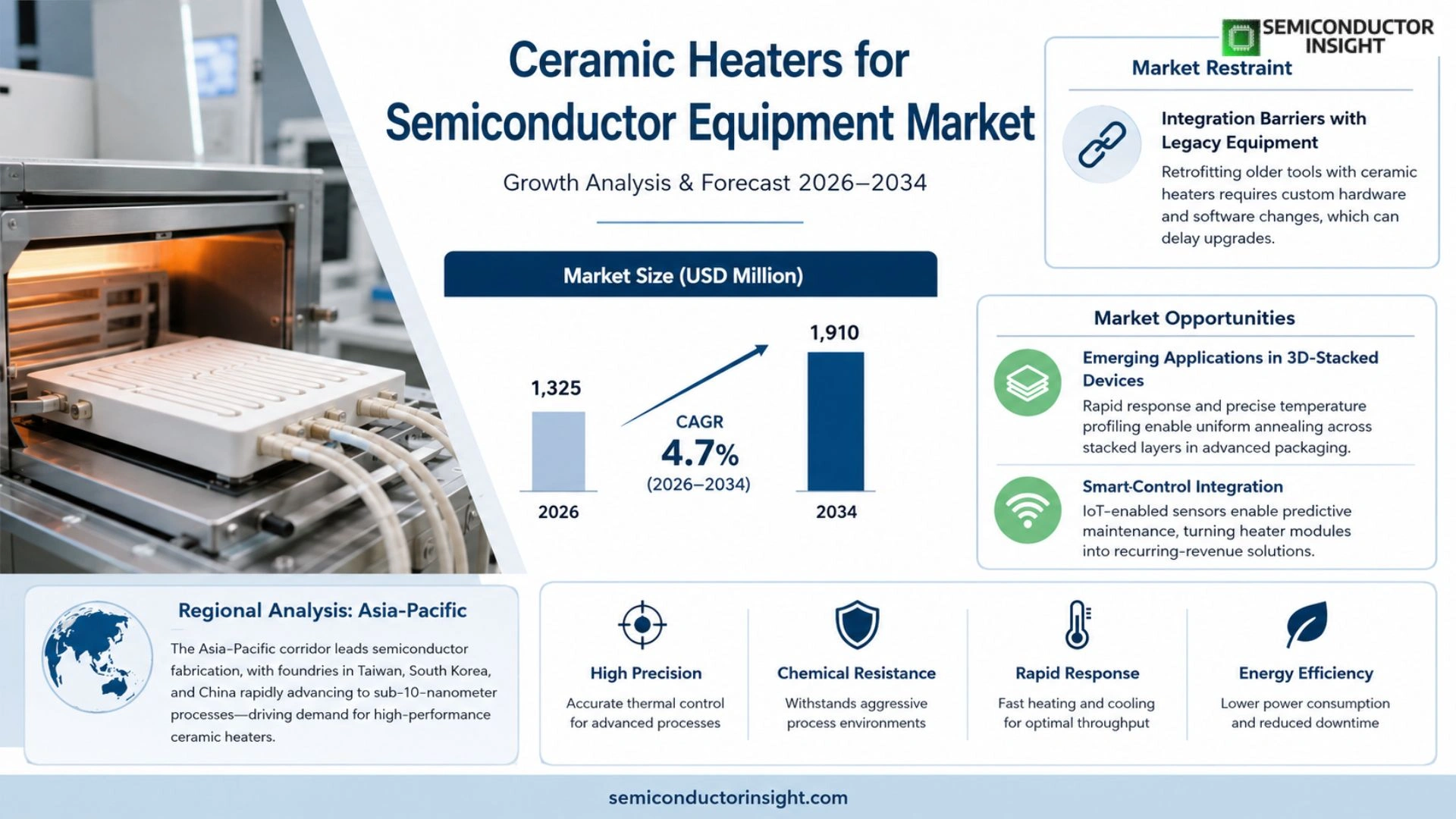
Ceramic Heaters for Semiconductor Equipment market is projected to grow from USD 1,325 million in 2026 to USD 1,910 million by 2034, exhibiting a CAGR of 4.7% during the forecast period.
Aluminum Nitride (AlN) ceramic heaters are engineered specifically for semiconductor wafer processing. Made from AlN material with high thermal conductivity, these heaters are co‑sintered with resistance elements to deliver uniform temperature distribution and lower metal contamination risk on silicon substrates.
The broader semiconductor sector is expanding toward US$ 790 billion by 2029, propelled by rising IoT deployments and increasing demand for analog and sensor ICs,segments that require precise thermal management solutions such as AlN heaters.
Manufacturers including Sumitomo Electric, Kyocera and NGK Insulators are advancing heater designs while addressing cost pressures and supply‑chain constraints.
MARKET DRIVERS
Thermal Efficiency Gains in Advanced Nodes
The shift toward sub‑10 nm patterning has forced equipment makers to adopt heating solutions that minimize thermal lag. Ceramic Heaters for Semiconductor Equipment Market players that can certify a 10‑15 % reduction in cycle time are seeing immediate uptake, because tighter temperature control directly translates into higher yield on costly silicon wafers.
Regulatory Pressure for Energy‑Smart Manufacturing
Stringent energy‑consumption standards in major fabs are prompting a rapid refresh of legacy heating modules. Facilities that replace resistive coils with ceramic elements report up to 20 % lower power draw, a saving that compounds across dozens of process tools. This regulatory environment therefore serves as a catalyst for new‑generation heater adoption.
➤ “Customers are willing to pay a premium for heaters that cut down both energy bills and defect density,” notes a senior engineering manager at a leading lithography supplier.
Beyond pure efficiency, the robustness of ceramic substrates under repeated thermal cycling reduces preventive‑maintenance intervals. Operators report maintenance windows shrinking by roughly half, freeing up production capacity and reinforcing the case for capital investment in these devices.
MARKET CHALLENGES
Cost Sensitivity in High‑Volume Manufacturing
Although performance advantages are clear, the upfront bill of materials for ceramic heating assemblies remains higher than for conventional options. Fab managers juggling tight CapEx budgets must justify the differential expense against projected savings, a calculation that can stall procurement cycles.
Other Challenges
Supply‑Chain Complexity
The raw materials required for high‑purity ceramic ceramics are sourced from a limited pool of suppliers. Any disruption,geopolitical or logistical,can ripple through the production line, creating lead‑time volatility that discourages over‑reliance on a single heating technology.
MARKET RESTRAINTS
Integration Barriers with Legacy Equipment
Older process tools were engineered around specific thermal footprints. Retrofitting these machines with ceramic heaters often demands custom mounting brackets and revised control software, tasks that can erode the perceived advantage of a switch. Consequently, customers may defer upgrades until a full equipment replacement is on the roadmap.
MARKET OPPORTUNITIES
Emerging Applications in 3D‑Stacked Devices
Three‑dimensional integration introduces localized hot‑spots that traditional heating methods struggle to address. Ceramic heaters, with their rapid response and precise temperature profiling, are uniquely positioned to enable uniform annealing across stacked layers. This niche is gaining traction among manufacturers exploring advanced packaging, opening a new revenue stream for suppliers.
Smart‑Control Integration
Embedding IoT‑enabled temperature sensors within ceramic heater blocks creates a feedback loop that can be leveraged for predictive maintenance. Firms that bundle this capability with their heating modules stand to capture a service‑oriented premium, turning a hardware product into a recurring‑revenue platform.
Ceramic Heaters for Semiconductor Equipment Market Trends
Elevated Adoption of AlN Ceramic Heaters
The semiconductor fabrication environment demands temperature precision that rivals the tolerances of advanced lithography processes. Aluminum Nitride (AlN) heaters have become the preferred solution because their intrinsic thermal conductivity enables rapid heat distribution across silicon wafers while maintaining a low metal‑contamination profile. Equipment manufacturers are integrating co‑sintered AlN elements directly into process modules, thereby reducing thermal gradients that can cause device variability. This shift is not merely a technical upgrade; it translates into higher yield per wafer and shorter cycle times, giving fab operators a measurable competitive edge. The trend also reflects a broader industry move toward materials that can sustain the thermal loads of emerging 3‑nm and sub‑3‑nm nodes without compromising equipment reliability.
Other Trends
Materials Diversification Across Heater Types
While AlN dominates high‑performance segments, Alumina (Al₂O₃) and Silicon Nitride (Si₃N₄) retain relevance in niche applications. Alumina’s cost advantage makes it attractive for mid‑volume equipment where extreme thermal uniformity is less critical. Conversely, Si₃N₄’s superior mechanical strength supports heater designs exposed to aggressive plasma environments, extending component life in dry‑etch tools. Vendors are expanding product portfolios to offer mixed‑material assemblies that balance performance, durability, and price, allowing customers to tailor heater selections to specific process windows. This diversification mitigates supply‑chain risks and gives fab managers flexibility when aligning equipment procurement with budgetary constraints.
Geographic Realignment of Supply Chains
Regional production hubs in East Asia, particularly China and South Korea, are scaling up capacity to meet the rising demand for AlN‑based heaters. Simultaneously, North American fabs are investing in local supplier partnerships to shorten lead times and reduce logistics complexity. This geographic realignment is prompted by tighter delivery schedules linked to fast‑track development cycles for next‑generation chips. Companies that secure reliable, proximal sources of ceramic heaters can respond more swiftly to process changes, thereby preserving runway for innovation. The evolving supply landscape also encourages strategic inventory management, prompting manufacturers to adopt just‑in‑time practices while maintaining safety stocks for critical materials.
COMPETITIVE LANDSCAPE
Key Industry Players
Ceramic Heaters for Semiconductor Equipment – Competitive Overview
Ceramic‑heater segment is dominated by a handful of vertically integrated manufacturers that couple high‑purity AlN expertise with advanced wafer‑processing know‑how. Sumitomo Electric, leveraging its legacy in conductive ceramics, commands roughly a quarter of global shipments and sets pricing benchmarks through its proprietary co‑sintered technology. Kyocera and NGK Insulators follow closely, each differentiating on reliability metrics that matter to IDM and foundry customers seeking sub‑micron thermal uniformity. The concentration around these three firms creates a de‑facto tiered structure: the top tier supplies the majority of high‑volume fabs, while a second tier of specialized players offers niche alloys or custom form factors that address emerging process nodes.
Beyond the headline names, a broader cohort of mid‑size firms sustains the ecosystem with differentiated materials or regional service networks. Mico Ceramics, BACH Resistor Ceramics, and Oasis Materials target niche applications such as low‑contamination SiC processes, whereas CoorsTek, Durex Industries, and Xiamen Innovacera focus on scaling AlN production capacity in response to the 4.7% annual market expansion. New entrants like Ferrotec and TDK Electronics are investing in hybrid heater designs that blend ceramic substrates with thin‑film resistance layers, aiming to capture the modest but growing demand from advanced packaging lines. This mix of entrenched leaders and agile innovators generates a competitive pressure that encourages continuous material refinement and incremental cost reductions.
List of Key Ceramic Heaters for Semiconductor Equipment Companies Profiled
- Sumitomo Electric
- Kyocera Corp
- NGK Insulators
- Mico Ceramics
- BACH Resistor Ceramics
- CoorsTek
- Durex Industries
- Oasis Materials
- Cactus Materials
- Xiamen Innovacera
- Ferrotec Corporation
- TDK Electronics
- CeramTec GmbH
- Luvata
- IHI Corporation
Segment Analysis:
| Segment Category | Sub-Segments | Key Insights |
| By Type |
|
Aluminum Nitride (AlN) is the dominant type because:
|
| By Application |
|
Integrated Device Manufacturing (IDM) drives segment growth through:
|
| By End User |
|
Device Manufacturers prioritize ceramic heaters because:
|
| By Material |
|
Composite Ceramics are gaining preference due to:
|
| By Process |
|
Co‑sintering with Resistive Elements remains the leading process because:
|
Regional Analysis: Ceramic Heaters for Semiconductor Equipment Market
Asia-Pacific
Proximity to bulk silicon wafer producers shortens logistics, allowing heater manufacturers to synchronize deliveries with equipment assembly cycles. Regional ports and rail links reduce transit latency, minimizing exposure to temperature‑sensitive components and associated warranty costs.
Clustered research institutes specialize in high‑temperature ceramics, offering shared facilities that lower entry barriers. Collaborative patents emerging from these hubs accelerate material breakthroughs directly applicable to semiconductor heater designs.
Targeted subsidies for advanced manufacturing drive capital allocation toward equipment upgrades, creating a predictable demand pipeline for precise thermal solutions across the region.
A dense network of fab operators, from legacy CMOS producers to emerging memory specialists, generates diverse specifications that push heater suppliers to broaden their product portfolios and enhance customization capabilities.
North America
North America retains a strong foothold in equipment engineering, yet its heater market lags behind Asia‑Pacific in sheer volume. The United States focuses on niche applications such as quantum‑computing modules, where thermal stability is paramount. Collaborative ventures between defense contractors and semiconductor firms nurture innovative heater designs, but the limited scale of domestic fabs restrains broader adoption. Companies eyeing growth must navigate a market that values reliability over cost, often opting for premium ceramic solutions to meet stringent performance benchmarks.
Europe
European manufacturers emphasize sustainability, integrating energy‑efficient ceramic heaters into equipment destined for the automotive and industrial IoT sectors. Regulatory pressure to reduce carbon footprints has spurred design revisions that prioritize rapid heat‑up cycles while limiting waste heat. However, the region’s fragmented fab landscape,centered in Germany, the Netherlands, and France,creates a patchwork of standards, compelling suppliers to customize offerings for each niche. Strategic alignment with EU research programs can unlock funding streams, yet market penetration remains cautious due to longer procurement cycles.
South America
South America’s semiconductor footprint is modest, largely confined to assembly and test operations. The demand for ceramic heaters here stems from localized equipment refurbishment projects rather than cutting‑edge fab construction. Operators seek cost‑effective retrofits that extend the life of legacy tools, fostering a market niche for mid‑range heater models that balance performance with affordability. While growth prospects are limited, firms that deliver dependable, low‑maintenance solutions can secure steady, albeit small, contracts across Brazil and Chile.
Middle East & Africa
The Middle East & Africa region is at an early stage of semiconductor ecosystem development, with emerging investments in smart‑city infrastructure and automotive electronics. Heater manufacturers are beginning to engage with pilots that explore localized production of ceramic components, leveraging the region’s growing petrochemical expertise. Nonetheless, the market remains nascent; adoption hinges on the success of government‑backed technology parks that aim to attract foreign fab operators. Early entrants who provide adaptable heater designs stand to benefit from first‑mover advantage as the ecosystem matures.
Report Scope
This market research report provides a comprehensive analysis of the Ceramic Heaters for Semiconductor Equipment Market , covering the forecast period 2026–2034. It offers detailed insights into market dynamics, technological advancements, competitive landscape, and key trends shaping the industry.
Key focus areas of the report include:
- Market Overview: The report begins with an overview outlining its current market scenario, key growth indicators, and industry transformation drivers. It discusses macroeconomic factors, demand–supply balance, regulatory landscape, and the strategic role of semiconductors in powering advancements across industries such as automotive, telecommunications, consumer electronics, and industrial automation.
- Market Size & Forecast: Historical data and future projections for revenue, unit shipments, and market value across major regions and segments.
- Segmentation Analysis: Detailed breakdown by product type, technology, application, and end-user industry to identify high-growth segments and investment opportunities.
- Regional Insights: Insights into market performance across North America, Europe, Asia-Pacific, Latin America, and the Middle East & Africa, including country-level analysis where relevant.
- Competitive Landscape: Profiles of leading market participants, including their product offerings, R&D focus, manufacturing capacity, pricing strategies, and recent developments such as mergers, acquisitions, and partnerships.
- Technology Trends & Innovation: Assessment of emerging technologies, integration of AI/IoT, semiconductor design trends, fabrication techniques, and evolving industry standards.
- Market Drivers & Restraints: Evaluation of factors driving market growth along with challenges, supply chain constraints, regulatory issues, and market-entry barriers.
- Stakeholder Insights: Insights for component suppliers, OEMs, system integrators, investors, and policymakers regarding the evolving ecosystem and strategic opportunities.
Primary and secondary research methods are employed, including interviews with industry experts, data from verified sources, and real-time market intelligence to ensure the accuracy and reliability of the insights presented.
FREQUENTLY ASKED QUESTIONS:
What is the current market size of Ceramic Heaters for Semiconductor Equipment Market?
-> Ceramic Heaters for Semiconductor Equipment market is projected to grow from USD 1,325 million in 2026 to USD 1,910 million by 2034, exhibiting a CAGR of 4.7%
Which key companies operate in Ceramic Heaters for Semiconductor Equipment Market?
-> Key players include Sumitomo Electric, Kyocera, NGK Insulators, Mico Ceramics, BACH Resistor Ceramics, BOBOO Hitech, Semixicon, CoorsTek, Durex Industries, Oasis Materials, Cactus Materials, and Xiamen Innovacera, among others.
What are the key growth drivers?
-> Key growth drivers include rising semiconductor manufacturing volume, need for high thermal conductivity and uniformity, adoption of Aluminum Nitride (AlN) heaters for silicon wafer processing, and the overall expansion of the global semiconductor market.
Which region dominates the market?
-> Asia holds the largest share of the Ceramic Heaters for Semiconductor Equipment market, driven by major semiconductor production hubs in China, Japan, South Korea, and Taiwan.
What are the emerging trends?
-> Emerging trends include advancements in Aluminum Nitride (AlN) heater technology, integration of ceramic heaters with advanced process control systems, and increasing focus on reducing metal contamination in wafer processing.
Get Sample Report PDF for Exclusive Insights
Report Sample Includes
- Table of Contents
- List of Tables & Figures
- Charts, Research Methodology, and more...
 Download Sample Report PDF