Carrier Tape and Cover Tape Market Insights
Carrier Tape and Cover Tape market was valued at USD 1.18 billion in 2026 and is projected to reach USD 2.05 billion by 2035, exhibiting a CAGR of 8.5% during the forecast period.
Carrier tape refers to adhesive‑backed flexible materials employed as protective packaging for electronic components throughout manufacturing stages; cover tape offers additional shielding against environmental contaminants such as moisture or static discharge.
The sector advances as semiconductor demand escalates alongside sophisticated packaging techniques,wafer‑level integration demands tapes that combine high dimensional stability with excellent thermal performance,while automotive electronics push requirements toward higher temperature tolerance (upward of 200°C) under vibration conditions.
The United States accounted for approximately USD 350 million of global revenue in 2026, whereas China’s share is estimated near USD 480 million.
The carrier tape sub‑segment alone is set to hit USD 950 million by 2035, growing at a CAGR close to 9% over the next six years.
In 2026, the top five manufacturers,3M, ZheJiang Jiemei, Advantek, Shin‑Etsu & Lasertek,captured roughly sixty percent of worldwide revenue.
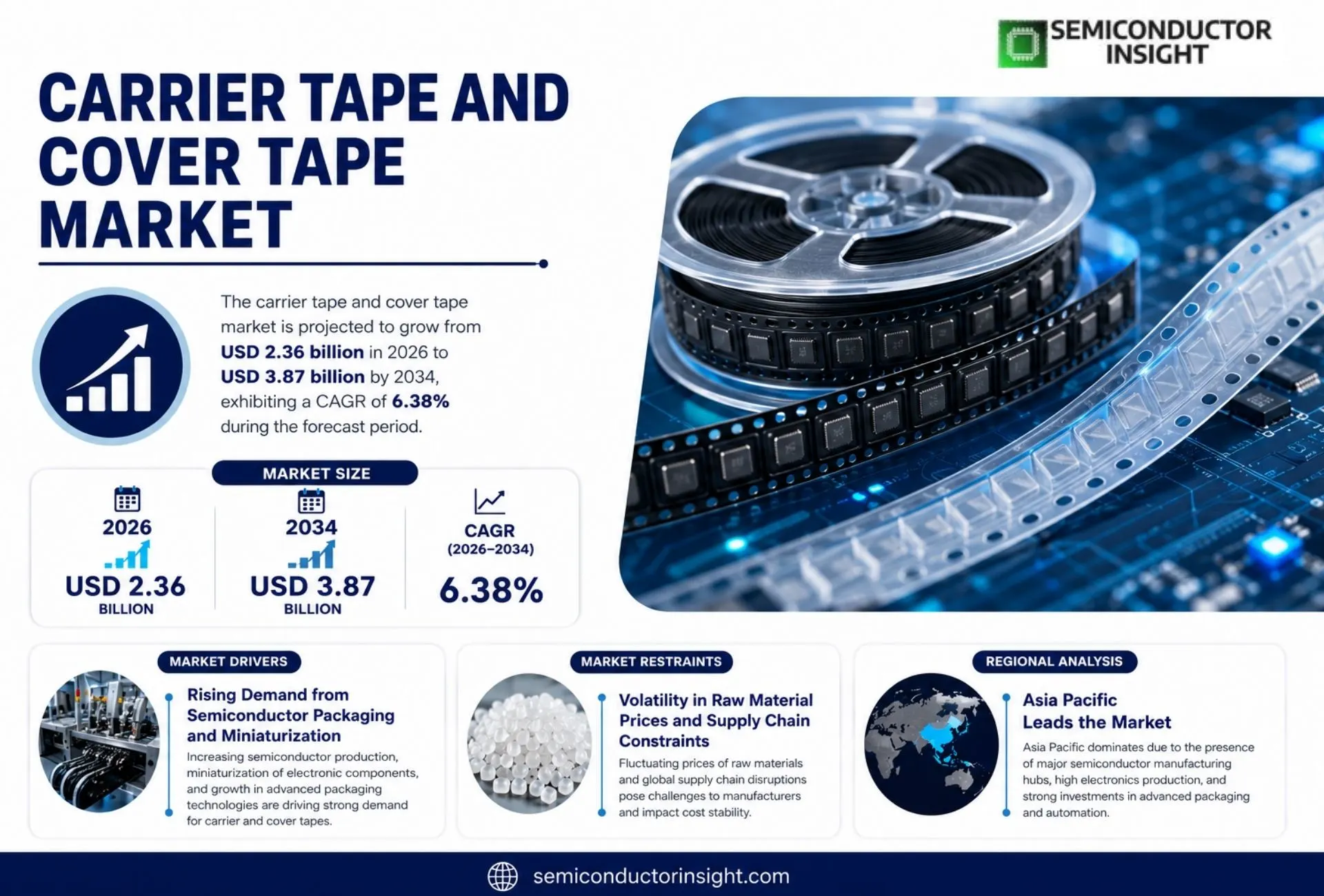
MARKET DRIVERS
Adoption of Smart Packaging Solutions
Adoption of integrated sensor and RFID technologies within shipping containers has accelerated the need for reliable uplink tapes that can withstand the mechanical stresses of automated handling systems. Carrier tape, with its high tensile modulus and engineered adhesion profile, becomes essential for maintaining the integrity of wirelessly‑tagged parcels as they transit through conveyor belts, robotic pick‑up stations, and pneumatic transport units. The convergence of additive manufacturing and data‑driven logistics requires packaging materials that not only provide physical protection but also support the digital life‑cycle,this positions carrier tape as a pivotal component in the value chain. Firms that embed smart tags into shipping cartons can now rely on carrier tape to secure these tags without compromising signal readability, thus aligning physical and digital quality controls. Consequently, the consumer goods, pharmaceutical, and high‑tech sectors are expanding carrier tape orders to secure compliance with traceability regulations and to minimize the loss of encrypted data during transit. The synergy between smart packaging and carrier tape, therefore, is reshaping procurement strategies across supply‑chain hubs, driving an uptick in larger volume contracts and by‑product market penetration.
Rising Demand for Protective Packaging in E‑Commerce
E‑commerce has shifted packaging paradigms towards durability and damage mitigation, particularly for perishable and high‑value consumer electronics. As online sales continue to outpace traditional retail, carriers and fulfilment centers face pressure to reduce out‑of‑stock due to transit damage and to maintain brand reputation. Carrier and cover tape, distinguished by their robust adhesive backing and tailored film thicknesses, offer a means to lock structural integrity with minimal weight addition. Their chemical resistance properties prevent contamination of sensitive goods, which is especially relevant in the food‑service and cosmetic industries. The trend toward on‑site batch preparation of order‑pack cartons in fulfillment centers further elevates the need for quick‑apply, high‑strength tapes that integrate seamlessly into automated pouching lines. This demand, augmented by the scalability of polymer substrates, is generating a steady uptick in annual orders,estimates suggest a 3–4% year‑over‑year volume increase attributable solely to e‑commerce packaging trends.
➤ Packaging manufacturers leverage carrier tape’s superior shear strength to streamline logistics and reduce handling costs.
Looking beyond current volumes, the entry of sustainable polymers into carrier tape formulations is capturing attention. New bio‑based resins exhibit comparable mechanical performance with reduced environmental footprints, aligning with global circular‑economy mandates. Designers are now recycling such films without compromising adhesion, which can unlock cost efficiencies over the product life‑cycle. As a result, market participants anticipate a shift from conventional plastics to hybrid bio‑polymer carriers, facilitating compliance with forthcoming EU packaging regulations. This trajectory signals a dual advantage: enhanced brand image for eco‑conscious consumers and a strategic hedge against volatile commodity prices. Companies should therefore monitor material innovations while cultivating supplier relationships that can meet the emerging sustainability criteria without sacrificing performance standards.
MARKET CHALLENGES
Increasing Cost Volatility of Raw Materials
Fluctuations in the price of polypropylene (PP) and polyethylene terephthalate (PET)—the base polymers for most carrier and cover tapes,continue to destabilize cost structures. The upstream supply chain is sensitive to geopolitical tensions, particularly in regions that dominate polymer production, leading to abrupt price spikes that ripple through the packaging ecosystem. These spikes impair pricing predictability for manufacturers, who often operate on tight margins while servicing OEM contracts. Simultaneously, hedging strategies introduce an additional layer of complexity and expense, discouraging small‑to‑mid‑size players from entering the market. The volatility also hampers long‑term planning, compelling firms to adopt flexible manufacturing capabilities to absorb rapid cost shifts, which further escalates CAPEX commitments. In addition, the rising cost of solvent‑based adhesives and release agents compounds the problem, inflating the total cost of ownership for end‑users and curbing growth in scrap‑disposal‑heavy sectors such as logistics and retail packaging.
Other Challenges
Market Penetration in Developing Economies
Securing footholds in emerging markets presents unique barriers. Regulatory frameworks for packaging, especially concerning lead content and VOC emissions, differ significantly across countries, requiring extensive compliance testing. Import tariffs on polymeric goods continue to rise in key growth regions,particularly within the ASEAN and Latin American blocs,nearly doubling the landed cost for customised carrier tape solutions. Additionally, limited distribution networks and a prevailing preference for low‑cost, generic tapes impair conversion rates among cost‑conscious retailers. The lagging adoption rates correlate with a lack of local manufacturing capabilities, which forces multinational suppliers to transport finished goods over long distances, thereby adding logistical demands and sustainability concerns. Addressing these impediments calls for partnering with regional manufacturers, creating localized supply chains, and developing tailored fibre‑reinforced tape variants that meet both performance and regulatory thresholds.
MARKET RESTRAINTS
Sustainability and Environmental Standard Compliance
While the functional properties of carrier and cover tape make them indispensable for high‑value and fragile cargo, environmental sustainability restrictions pose a lingering restraint. Recent EU directives and U.S. federal standards now mandate resin content and recyclability metrics that many legacy formulations fail to meet. In practice, this translates into stricter product vetting and, for some manufacturers, costly reformulations or complete line replacements. The additional regulatory compliance time has also pressured procurement cycles, leading to a slower decision turnaround and reduced market agility. Moreover, the rising public and consumer scrutiny of single‑use packaging increases the importance of demonstration of eco‑credentials. Failing to align carrier tape offerings with these standards may result in portfolio shrinkage or forced withdrawal, thereby curtailing growth potential in markets that prioritize green logistics and closed‑loop circular systems. From a tactical standpoint, firms must invest in lifecycle assessments and partner with polymer innovators to stay ahead of regulatory curves without compromising mechanical integrity.
MARKET OPPORTUNITIES
Expansion of High‑Security Packaging for Pharmaceuticals
The pharmaceutical sector, driven by stringent supply‑chain security and traceability requirements, presents a fertile arena for carrier and cover tape innovations. Recent advances in tamper‑evident adhesive technologies enable secure sealing of blister packs, vials, and fragile devices while preserving sterility and integrity. As regulatory bodies enforce stricter end‑to‑end chain monitoring, packaging suppliers that can integrate tamper‑evident features without compromising fast‑lane production will command premium pricing. Manufacturers who invest in dual‑layer structures,combining a high‑strength core with a low‑friction release film,will be able to tailor solutions for cold‑chain management and quick release processes, thereby unlocking cross‑segment adoption. Companies leveraging this niche can also benefit from the 7–10% margin uplift reported for high‑security packaging solutions within the pharmaceutical market, a figure that dwarfs the average margin across general packaging lines. Strategic alliances with pharmaceutical OEMs and integration into digital monitoring platforms further enhance market penetration and foster recurring revenue streams.
Carrier Tape and Cover Tape Market TrendShift Toward Smart Connectivity and Through‑Bond Applications
The trend overriding current industry sentiment is the pivot toward high‑density, multi‑layer tapes designed for secure interconnects within consumer electronics, automotive power supplies, and renewable energy installations. Clients are moving beyond conventional single‑layer carriers to composite tapes that combine flame‑retardancy, pressure‑less bond strength, and low‑profile flexibility. This movement is driven by tightening safety regulations and the need for stricter weight control in product assemblies, forcing manufacturers to innovate in both formulation and application machinery. As a result, carriers with conformal coating and built‑in terminal compatibility are growing rapidly among top tier buyers, signalling a critical shift in the Carrier Tape and Cover Tape Market.
Other Trends
Integration of RFID and Traceability in Tape Solutions
Embedded RFID functionality has become a core competitive differentiator for tape suppliers. By hard‑ening microchips directly onto the tape web, distributors can offer end users a ready‑to‑install solution that eliminates third‑party tag placement. The real business value lies in enabling serial number capture at the point of cable assembly, reducing warranty costs and improving recall efficiency. The adoption curve is already in the first revenue‑critical tier and is accelerating as compliance audits demand traceability for safety‑critical components.
Sustainability and Eco‑Friendly Materials
Sustainability is no longer a market side note; it has crystallised as a decisive purchasing criterion. Several leading regions have mandated a shift to recyclable, thermoplastic bases, compelling tape makers to develop bio‑based polymers with comparable mechanical integrity. Early adopters report a 15% premium on price‑sensitive segments, while long‑term contracts hinge on lifecycle assessments. Consumers and OEMs alike are pushing for certified end‑of‑life disposal, making eco‑friendly tape development a new growth engine.
Consolidation and Regional Market Differentiation
As competition intensifies, consolidation through strategic alliances and acquisitions is reshaping the value chain. Smaller players in emerging economies are leveraging technology licenses to compete against global incumbents while expanding into niche automotive and medical device sectors. In North America, tariffs on imported raw materials are spurring a shift toward domestic sourcing of high‑performance adhesives, whereas in Asia, cost‑effective formulations remain dominant due to consumer price sensitivity. These dynamics are central to the Carrier Tape and Cover Tape Market, and business leaders must tailor regional strategies, balancing cost, compliance and innovation to capture market opportunities.
COMPETITIVE LANDSCAPE
Key Industry Players
Carrier Tape and Cover Tape: Competitive Landscape
At the apex of the carrier and cover tape arena, 3M commands a substantial share, owing to its deep technical capabilities and global reach across OEMs in automotive, aerospace and electronics. The company’s integrated supply chain, combined with relentless R&D into low‑profile, high‑adhesion tapes, has solidified a market position that peers struggle to emulate. Within North America and Europe, 3M’s portfolio of premium grades caters to high‑performance automotive and aerospace applications, where reliability and compliance are non‑negotiable. In contrast, the segment dominated by volume and price sensitivity,largely in consumer electronics and low‑voltage PCB assembly,is populated by mainland Asian manufacturers that lean on economies of scale and diversified product lines.
Japanese firms such as Asahi Kasei and Shin‑Etsu occupy significant niches by leveraging advanced polymer chemistry to deliver high‑temperature and high‑humidity resistant tapes. Chinese players,ZheJiang Jiemei, Accu Tech Plastics, and ANT Group (Acupaq)—have expanded rapidly through strategic partnerships with leading multinational OEMs, gaining traction among low‑to‑mid‑tier automotive and power electronics markets. Across the Pacific, Taiwan Carrier Tape (TCTEC) and Hongkang Dongguan have carved out footholds by mastering tape‑to‑circuit configuration solutions that reduce assembly time and improve yield. Meanwhile, U‑PAK, ROTHE, and ITW ECPS bring resilient coating solutions tailored for harsh environment applications, enhancing the market’s segment diversity.
List of Key Carrier Tape Companies Profiled
- 3M
- 3M
- Asahi Kasei
- Asahi Kasei
- Shin‑Etsu
- ZheJiang Jiemei
- Accu Tech Plastics
- ANT Group (Acupaq)
- U-PAK
- ROTHE
- ITW ECPS
- Taiwan Carrier Tape (TCTEC)
- Dongguan Hongkang
Segment Analysis:
| Segment Category | Sub-Segments | Key Insights |
| By Type |
|
Carrier Tape the leading sub‑segment is driven by its versatility across battery, power electronics and connected‑device manufacturing. It offers reliable adhesion under high‑temperature processing, efficient handling of large‑area wafers, and continuous innovation in thin, eco‑friendly substrates that meet tightening environmental regulations. The segment further benefits from a growing network of specialty distributors that provide customized solutions for diverse industry needs. |
| By Application |
|
Active Components dominate the application map due to the integration of pre‑diced ICs, sensors and power devices that require minimal defect risk during handling. The sector rewards tape solutions that deliver superior edge protection, high reworkability and compatibility with automated pick‑and‑place equipment. Continuous demand is exposed by the rapid expansion of wearable and automotive electronics that rely on vibration‑resistant, moisture‑sealed carriers. The industry also seeks cost‑effective solutions that preserve the performance of temperature‑sensitive components during assembly. |
| By End User |
|
Automotive emerges as the most demanding end user, given the stringent safety standards and the need for long‑term reliability in electric‑vehicle powertrains. The automotive sector values tapes that resist high mechanical flex, withstand flash‑sintering processes and maintain electrical integrity under rapid cycling. Supportive tooling, traceability of raw materials and compliance with global certification schemes further drive selection. Emerging lightweight construction and advanced driver‑assist systems reinforce the trajectory toward higher adoption of carrier‑tape‑based sub‑assembly. |
| By Material |
|
Polyethylene remains the backbone of carrier‑tape manufacturing, offering low cost, excellent moisture barrier properties and high processability across temperature ranges. The material supports rapid scaling of large‑area substrates required in semiconductor fabs. However, growing environmental scrutiny pushes developers to employ recycled resins and to reduce plastic footprints. Meanwhile, advanced poly (propylene) variants deliver superior chemical resistance, while silicone‑based tapes are selected for ultra‑high‑temperature chiller electronics and aerospace maintenance kits. |
| By Technical Feature |
|
Moisture Barrier is the most critical technical attribute for protecting microelectronic assemblies during storage, transport and end‑use. Sub‑strates engineered with low water uptake and barrier coatings become indispensable for battery modules and remote sensing nodes. Additionally, moisture‑resistant tapes are favored in harsh indoor/outdoor environments and in processing steps that involve aqueous fluxes. Ongoing research introduces nanolayered coatings and hybrid adhesives that deliver superior water vapor transmission rates while maintaining high peel strength for reliable device separation. |
Regional Analysis: Carrier Tape and Cover Tape Market
United States
U.S. players are concentrating on adhesion resilience, especially against fluctuating temperature ranges that affect packaging, while integrating recyclable cores to align with packaging waste mandates, thereby creating a dual‑value proposition for safety and sustainability.
The adoption of RFID‑enabled covers and carrier‑tape‑embedded sensors is reshaping inventory accuracy, allowing shippers to map condition data in real time and calibrate handling protocols throughout the movement chain.
Environmental mandates such as the 2026 packaging directive are accelerating the transition to low‑VOC adhesives, compelling suppliers to innovate while avoiding compliance lapses that could trigger costly recalls or fines.
The U.S. market features a cluster of niche suppliers offering customized adhesives, which competes with larger conglomerates that establish cross‑industry partnerships, a blend that sharpens price sensitivity and innovational agility.
Europe
Across the continent, carrier tape adoption is closely linked to stringent circular‑economy initiatives. European transportation agreements emphasize lower carbon footprints, guiding manufacturers to develop bio‑based adhesives without compromising strength. Distribution hubs, particularly in Central Europe, are investing heavily in automated sorting systems, demanding tapes that maintain integrity under high‑velocity handling. Companies that synchronize advanced material science with comprehensive compliance frameworks are building a stronghold in markets where regulatory gaps dictate supply‑chain stability. As a result, European leaders are forging collaborative ecosystem networks to integrate cost‑efficiency with environmental stewardship, thereby unlocking a differentiated market narrative. This dual emphasis on technological reliability and sustainability has reshaped competitive dynamics, demanding a proactive approach to compliance, preemptive investment in research, and agility in responding to policy shifts.
Asia‑Pacific
In the Asia‑Pacific region, the pace of urban development and fast‑fashion demand triggers an accelerated requirement for robust carrier tapes capable of handling fluctuating temperatures and high humidity. Local manufacturers are tailoring adhesive strengths to align with regional climatic extremes while also adopting lower‑VOC formulations to meet increasingly strict environmental standards. Small‑batch manufacturing hubs in emerging economies are emerging as innovation centres for custom short‑run tapes, offering a competitive edge against block‑production models. Supply‑chains here are becoming more resilient through vertical integration, allowing firms to respond rapidly to sudden spikes in demand or logistical disruptions. This transformation pressures incumbents to enhance flexibility in production and to embrace data‑driven logistics, ensuring stakeholder confidence in reliability and throughput.
South America
South America’s carrier tape market is shaped by a mix of export‑focused logistics corridors and regional distribution networks. Businesses are prioritizing adhesive durability for variable temperature swings typical of the continent’s coastal and inland routes. Small‑to‑medium enterprises are converting to greener tapes in response to import tariffs tied to environmental non‑compliance, while larger freight operators are investing in smart packaging that monitors strain and temperature mid‑haul. As cross‑border movement increases, the need for tamper‑evident tapes with robust repositioning capability becomes a strategic differentiator, driving adoption of high‑performance adhesives. The region’s institutional support for green logistics is cultivating a new challenger group of suppliers that combine low‑cost production with compliance‑aligned solutions, intensifying competitive pressures across the market spectrum.
Middle East & Africa
The Middle East and Africa exhibit a distinctive blend of high‑volume freight corridors and rapid urban expansion, elevating the demand for carrier tapes that can resist extreme heat and dust. Regulatory frameworks remain evolving, yet suppliers are already integrating VOC‑low adhesives to anticipate forthcoming environmental controls. The market is also nurturing a hybrid model of local production and global supply chain integration, enabling the rapid deployment of innovative products. Firms that achieve a balance between cost efficiency and functional resiliency,particularly in heat‑intensive logistics,stand to benefit from increasing freight volumes and regulatory compliance. Moreover, data‑enabled solutions that provide real‑time condition monitoring are gaining traction, allowing shippers to pinpoint degradation and re‑capitalize on risk mitigation, thereby differentiating service offerings in a competitive landscape.
Report Scope
This market research report provides a comprehensive analysis of the Carrier Tape and Cover Tape Market , covering the forecast period 2026–2035. It offers detailed insights into market dynamics, technological advancements, competitive landscape, and key trends shaping the industry.
Key focus areas of the report include:
-
Market Overview: The report begins with an overview outlining its current market scenario, key growth indicators, and industry transformation drivers. It discusses macroeconomic factors, demand–supply balance, regulatory landscape, and the strategic role of semiconductors in powering advancements across industries such as automotive, telecommunications, consumer electronics, and industrial automation.
- Market Size & Forecast: Historical data and future projections for revenue, unit shipments, and market value across major regions and segments.
- Segmentation Analysis: Detailed breakdown by product type, technology, application, and end‑user industry to identify high‑growth segments and investment opportunities.
- Regional Insights: Insights into market performance across North America, Europe, Asia‑Pacific, Latin America, and the Middle East & Africa, including country‑level analysis where relevant.
- Competitive Landscape: Profiles of leading market participants, including their product offerings, R&D focus, manufacturing capacity, pricing strategies, and recent developments such as mergers, acquisitions, and partnerships.
- Technology Trends & Innovation: Assessment of emerging technologies, integration of AI/IoT, semiconductor design trends, fabrication techniques, and evolving industry standards.
- Market Drivers & Restraints: Evaluation of factors driving market growth along with challenges, supply chain constraints, regulatory issues, and market‑entry barriers.
- Stakeholder Insights: Insights for component suppliers, OEMs, system integrators, investors, and policymakers regarding the evolving ecosystem and strategic opportunities.
Primary and secondary research methods are employed, including interviews with industry experts, data from verified sources, and real‑time market intelligence to ensure the accuracy and reliability of the insights presented.
FREQUENTLY ASKED QUESTIONS:
What is the current market size of Carrier Tape and Cover Tape Market?
-> The Carrier Tape and Cover Tape Market was valued at USD 1.18 million in 2026 and is projected to reach USD 2.05 million by 2035.
Which key companies operate in Carrier Tape and Cover Tape Market?
-> Key players include 3M, ZheJiang Jiemei, Advantek, Shin‑Etsu, Lasertek, U‑PAK, ROTHE, C‑Pak, Oji F‑Tex, Accu Tech Plastics, among others.
What are the key growth drivers?
-> Key growth drivers include industrial automation, automotive electronics demand, and advancement in semiconductor packaging technologies.
Which region dominates the market?
-> North America and Europe dominate the market with the largest share of global revenue, while Asia-Pacific is the fastest growing region.
What are the emerging trends?
-> Emerging trends include bio‑based carrier solutions, smart integration with IoT, and sustainable manufacturing practices.

Get Sample Report PDF for Exclusive Insights
Report Sample Includes
- Table of Contents
- List of Tables & Figures
- Charts, Research Methodology, and more...
 Download Sample Report PDF