Bluetooth RF System on a Chip Market Insights
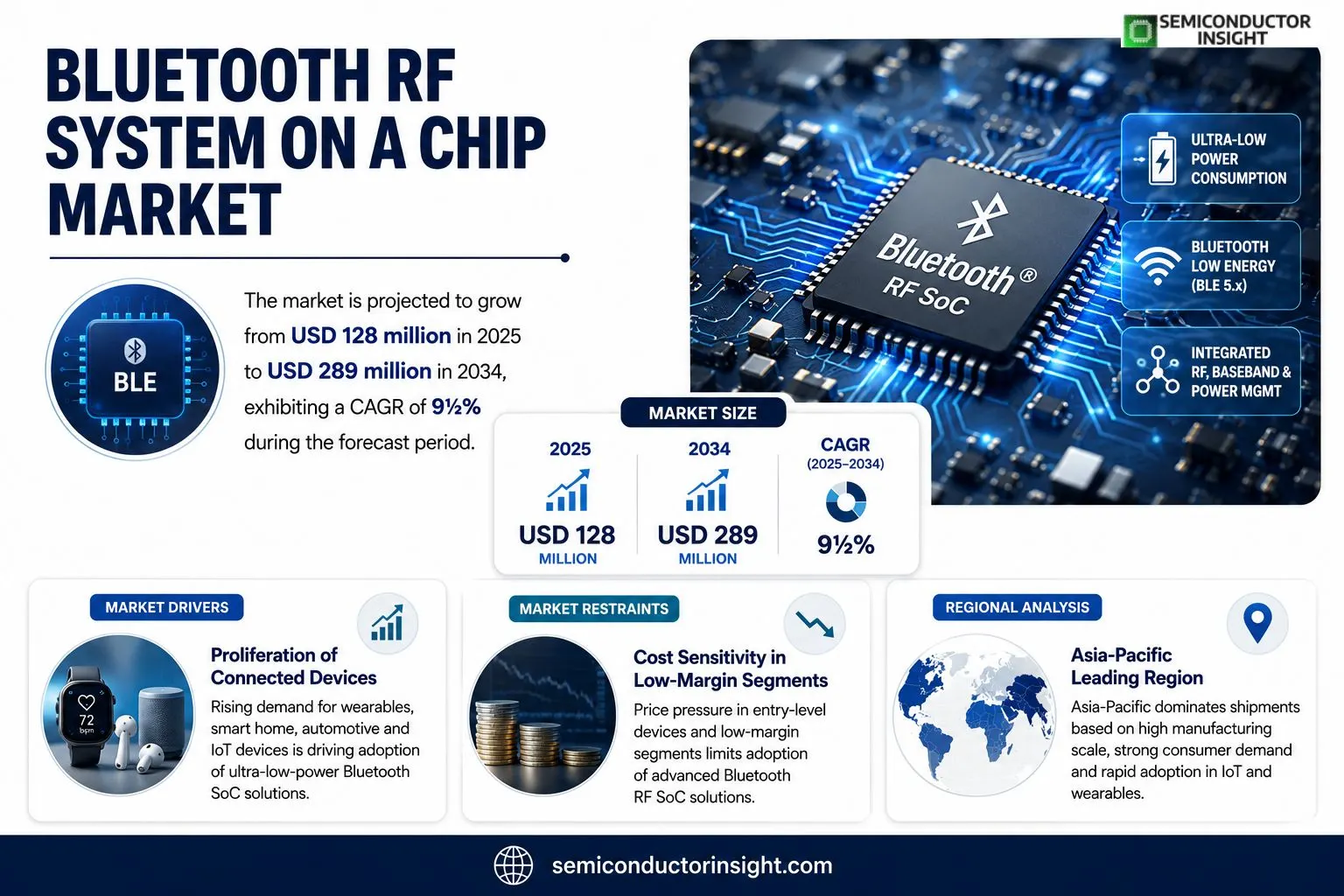
Bluetooth RF System on a Chip market size was valued at USD 128 million in 2025.The market is projected to grow from USD 289 million by 2034, exhibiting a CAGR of 9½ percent during the forecast period.
Bluetooth RF System on a Chip integrates an RF transceiver, baseband processor and power‑management circuitry into a single silicon die, delivering ultra‑low‑power Bluetooth Low Energy connectivity for wearables, IoT sensors and other wireless applications.The upward trend reflects manufacturers’ shift toward energy‑efficient wireless modules while inflationary pressures on semiconductor pricing and softer consumer demand create headwinds.
Nevertheless, strong analog‑and‑sensor segment growthstill posting double‑digit year‑over‑year increasescontinues to underpin demand for highly integrated BLE solutions.
MARKET DRIVERS
Proliferation of Connected Devices
Manufacturers of wearables, smart home hubs, and automotive infotainment systems are embedding Bluetooth RF System on a Chip solutions to meet consumer expectations for seamless connectivity. The **density of radio‑frequency modules** in everyday products is expanding, compelling chip designers to provide lower power consumption and higher integration levels. As a result, component suppliers are witnessing a steady rise in design wins across multiple OEM segments.
Stringent Energy‑Efficiency Regulations
Governments worldwide have introduced tighter energy‑use caps for battery‑operated devices. This legislative pressure forces developers to adopt Bluetooth RF System on a Chip platforms that deliver sub‑milliwatt standby currents while preserving link reliability. Companies that can certify compliance early gain a distinct advantage in winning contracts for large‑scale deployments.
➤ “Design teams that prioritize integrated power‑management blocks within Bluetooth SoCs report 20‑30 % faster time‑to‑market.”
In parallel, the migration toward 5G‑assisted edge computing is not diminishing the relevance of short‑range Bluetooth links; instead, it creates a dual‑mode architecture where Bluetooth RF System on a Chip devices serve as the first‑hop gateway to broader networks. This complementary role reinforces demand for flexible, software‑defined radio stacks that can adapt to evolving application profiles.
MARKET CHALLENGES
Fragmented Standard Landscape
Despite the maturity of Bluetooth Core specifications, divergent industry extensions (e.g., Audio, Mesh, Direction Finding) generate compatibility headaches for chip manufacturers. OEMs must juggle multiple certification pathways, inflating development budgets and extending launch timelines.
Other Challenges
Supply‑Chain Volatility
semiconductor shortages have intermittently throttled the availability of key substrates and passive components. Vendors that lack diversified sourcing strategies risk delayed shipments, which can erode confidence among high‑volume customers.
MARKET RESTRAINTS
Cost Sensitivity in Low‑Margin Segments
Commodity‑grade devices such as entry‑level fitness trackers operate on razor‑thin profit margins. Even marginal increases in Bluetooth RF System on a Chip pricing can tip the economics against mass adoption, prompting some manufacturers to consider legacy radio solutions that, while less capable, remain cheaper.
MARKET OPPORTUNITIES
Emergence of Ultra‑Low‑Power Protocol Enhancements
The upcoming Bluetooth LE Audio and Direction Finding specifications introduce features that enable devices to operate with **sub‑10 µW power envelopes** while delivering richer user experiences. Chipmakers that can embed these capabilities into a single silicon die stand to capture new contracts in the hearing‑aid, AR/VR, and asset‑tracking domains, where power budget and form factor are critical differentiators.
Bluetooth RF System on a Chip Market Trends
Shift Toward Ultra‑Low‑Power BLE Integration
The adoption of Bluetooth RF System on a Chip solutions is accelerating in wearables, smart home hubs, and industrial sensors because designers can meet battery‑life expectations without sacrificing connectivity. Manufacturers that embed BLE 5.1‑5.3 cores directly into silicon are capturing design wins that previously required separate transceiver modules. This consolidation reduces bill‑of‑materials, streamlines board layout, and shortens time‑to‑market, creating a competitive advantage for firms that prioritize integration.
Other Trends
Regional Divergence in Semiconductor Demand
While the semiconductor market recorded a modest 4.4 % rise last year, the Asia‑Pacific region posted a 2 % decline, reflecting tighter consumer spending and inventory adjustments. In contrast, the Americas posted a 17 % surge, and Europe grew 12.6 %, driven largely by automotive and industrial automation orders. The uneven performance influences supply‑chain strategies for Bluetooth RF System on a Chip providers, prompting many to diversify sourcing and increase capacity in North America and Europe to mitigate Asia‑Pacific volatility.
Emergence of New Application Segments
Beyond traditional consumer gadgets, an expanding cohort of industrial IoT deployments is specifying Bluetooth RF System on a Chip for short‑range mesh networks. The ultra‑low‑power characteristic aligns with predictive‑maintenance sensors that operate on multi‑year batteries. Simultaneously, the consumer electronics segment remains robust, with smart‑speaker manufacturers upgrading to the latest BLE specifications to support higher data rates and improved coexistence with Wi‑Fi. This dual‑track demand encourages vendors to broaden their product portfolios, offering differentiated families tuned for either high‑throughput consumer use cases or ultra‑efficient industrial sensors.
COMPETITIVE LANDSCAPE
Key Industry Players
Competitive Dynamics in the Bluetooth RF SoC Market
Silicon Laboratories commands the top tier of the Bluetooth RF System‑on‑Chip arena, leveraging its deep portfolio of ultra‑low‑power BLE transceivers and a well‑established design‑win ecosystem. The company’s strategy of integrating radio, MCU, and power‑management blocks within a single die has attracted OEMs seeking to shrink BOM costs while meeting stringent energy budgets. This approach has translated into a sizable share of the $117 million 2024 market, reinforcing a tiered competitive structure where a handful of integrated‑solution vendors dominate high‑volume consumer segments and dictate price‑performance benchmarks for downstream device makers.Beyond the market leader, a cluster of specialist firms sustains a vibrant niche ecosystem. Nordic Semiconductor continues to differentiate itself through flexible software stacks and rapid certification cycles, appealing to wearable and IoT startups. Espressif’s cost‑optimized modules have opened pathways into price‑sensitive Asian markets, while Texas Instruments leverages its extensive analog‑front‑end expertise to serve automotive‑grade applications. Broadcom, MediaTek, and NXP each contribute differentiated radio architectures that address premium wearables, smart home hubs, and industrial sensor nodes. Smaller yet technically adept players such as STMicroelectronics, Renesas Electronics, Analog Devices, and Infineon Technologies round out the field, often partnering with original equipment manufacturers to co‑develop bespoke RF solutions for sector‑specific requirements. The collective presence of these firms ensures a competitive pressure that spurs incremental innovation across power efficiency, spectrum agility, and integration density.
List of Key Bluetooth RF System on a Chip Companies Profiled
- Silicon Laboratories
- Nordic Semiconductor
- Espressif Systems
- Texas Instruments
- Broadcom Inc.
- MediaTek
- NXP Semiconductors
- STMicroelectronics
- Renesas Electronics
- Analog Devices
- Infineon Technologies
- Qorvo, Inc.
- Skyworks Solutions
- Marvell Technology Group
- Realtek Semiconductor Corp.
Segment Analysis:
| Segment Category | Sub-Segments | Key Insights |
| By Type |
|
Leading Segment The evolution from 5.1 to 5.3 brings progressively lower power consumption, richer feature sets and tighter latency control.
|
| By Application |
|
Leading Segment Consumer electronics continue to drive demand for ultra‑low‑power Bluetooth chips, especially in audio accessories and smart‑home hubs.
|
| By End User |
|
Leading Segment OEMs dominate adoption because they embed Bluetooth SoCs early in product development cycles, ensuring seamless firmware and certification pathways.
|
| By Integration Level |
|
Leading Segment System‑in‑Package configurations are gaining traction as they bundle antenna, crystal and power‑management components, offering compact footprints for wearables.
|
| By Connectivity Profile |
|
Leading Segment Bluetooth LE with mesh capabilities is emerging as the preferred profile for large‑scale sensor deployments.
|
Regional Analysis: Bluetooth RF System on a Chip Market
North America
Early integration of Bluetooth Low Energy with sensor hubs drives a cascade of new product categories, compelling chip designers to embed coexistence algorithms that mitigate interference in dense IoT environments.
Strategic partnerships between silicon fabs and packaging specialists ensure component availability despite geopolitical fluctuations, reinforcing the region’s ability to meet peak demand periods.
Harmonized FCC and Bluetooth SIG certification pathways streamline product launches, while emerging data‑privacy rules push manufacturers toward encrypted link‑layer solutions.
Demand from enterprise asset tracking and consumer wellness devices fuels a dual‑track strategy, balancing high‑volume automotive infotainment chips with low‑power, premium‑price health sensors.
Europe
European manufacturers benefit from a dense network of automotive clusters that prioritize robust, long‑range Bluetooth links for in‑vehicle infotainment. The region’s strong emphasis on sustainability translates into a preference for chips with ultra‑low power draw, prompting vendors to invest in advanced silicon‑on‑foundry processes. Regulatory bodies such as the European Telecommunications Standards Institute foster a common testing framework, easing cross‑border product rollout. Meanwhile, the rise of smart‑city initiatives in cities like Amsterdam and Barcelona creates a secondary demand wave for public‑space sensors that rely on Bluetooth mesh networking, expanding the addressable market beyond traditional consumer devices.
Asia‑Pacific
Asia‑Pacific’s scale advantage manifests through high‑volume manufacturing hubs in Taiwan, South Korea, and China, where cost efficiencies enable aggressive pricing for commoditized Bluetooth RF System on a Chip solutions. At the same time, the region’s burgeoning consumer electronics sector drives rapid iteration cycles, compelling suppliers to offer highly configurable platforms that accommodate diverse form factors. Emerging standards for 5G‑assisted Bluetooth coexistence are being piloted in Japan’s smart‑home projects, indicating a shift toward more integrated connectivity stacks. Local governments’ support for IoT development zones further accelerates adoption in logistics and smart‑factory deployments.
South America
In South America, market momentum hinges on the proliferation of affordable wearables and entry‑level automotive infotainment upgrades. Regional distributors prioritize partners who can provide localized technical support, prompting many vendors to establish on‑ground engineering teams in Brazil and Argentina. While overall spend remains modest compared with mature markets, the region’s growing middle class fuels a steady rise in demand for connected health and fitness devices, encouraging manufacturers to tailor chipsets for lower‑cost, battery‑optimized applications.
Middle East & Africa
The Middle East & Africa region reflects a blend of high‑value niche projects and emerging consumer adoption. In the Gulf Cooperation Council, corporate‑focused IoT deployments for asset tracking and smart‑building management demand Bluetooth solutions with ruggedized performance and extended range. African markets, driven by mobile‑first connectivity strategies, see increased use of Bluetooth for short‑range data exchange in agricultural sensors and community health kits. Partnerships with regional telecom operators are beginning to shape a distribution model that balances affordability with the need for secure, OTA‑updatable firmware.
Report Scope
This market research report provides a comprehensive analysis of the Bluetooth RF System on a Chip Market , covering the forecast period 2026–2034. It offers detailed insights into market dynamics, technological advancements, competitive landscape, and key trends shaping the industry.
Key focus areas of the report include:
- Market Overview: The report begins with an overview outlining its current market scenario, key growth indicators, and industry transformation drivers. It discusses macroeconomic factors, demand–supply balance, regulatory landscape, and the strategic role of semiconductors in powering advancements across industries such as automotive, telecommunications, consumer electronics, and industrial automation.
- Market Size & Forecast: Historical data and future projections for revenue, unit shipments, and market value across major regions and segments.
- Segmentation Analysis: Detailed breakdown by product type, technology, application, and end-user industry to identify high-growth segments and investment opportunities.
- Regional Insights: Insights into market performance across North America, Europe, Asia-Pacific, Latin America, and the Middle East & Africa, including country-level analysis where relevant.
- Competitive Landscape: Profiles of leading market participants, including their product offerings, R&D focus, manufacturing capacity, pricing strategies, and recent developments such as mergers, acquisitions, and partnerships.
- Technology Trends & Innovation: Assessment of emerging technologies, integration of AI/IoT, semiconductor design trends, fabrication techniques, and evolving industry standards.
- Market Drivers & Restraints: Evaluation of factors driving market growth along with challenges, supply chain constraints, regulatory issues, and market-entry barriers.
- Stakeholder Insights: Insights for component suppliers, OEMs, system integrators, investors, and policymakers regarding the evolving ecosystem and strategic opportunities.
Primary and secondary research methods are employed, including interviews with industry experts, data from verified sources, and real-time market intelligence to ensure the accuracy and reliability of the insights presented.
FREQUENTLY ASKED QUESTIONS:
What is the current market size of Bluetooth RF System on a Chip Market?
-> Bluetooth RF System on a Chip Market was valued at USD 117 million in 2024 and is expected to reach USD 220 million by 2031, growing at a CAGR of 9.6% during the forecast period.
Which key companies operate in Bluetooth RF System on a Chip Market?
-> Key players include Silicon Laboratories, Espressif, Nordic Semiconductor, Texas Instruments, among others.
What are the key growth drivers?
-> Key growth drivers include rising demand for ultra‑low‑power Bluetooth Low Energy connectivity in IoT devices, wearables, and consumer electronics, as well as increased integration of Bluetooth 5.x standards.
Which region dominates the market?
-> Asia‑Pacific remains the largest region for Bluetooth RF System on a Chip shipments, while North America and Europe also show strong adoption rates.
What are the emerging trends?
-> Emerging trends include adoption of Bluetooth 5.2/5.3 for enhanced range and throughput, integration of RF SoC solutions in industrial IoT applications, and growth of multi‑protocol chips supporting BLE, Thread, and Zigbee.
Get Sample Report PDF for Exclusive Insights
Report Sample Includes
- Table of Contents
- List of Tables & Figures
- Charts, Research Methodology, and more...