Bluetooth Audio Master Chips Market Insights
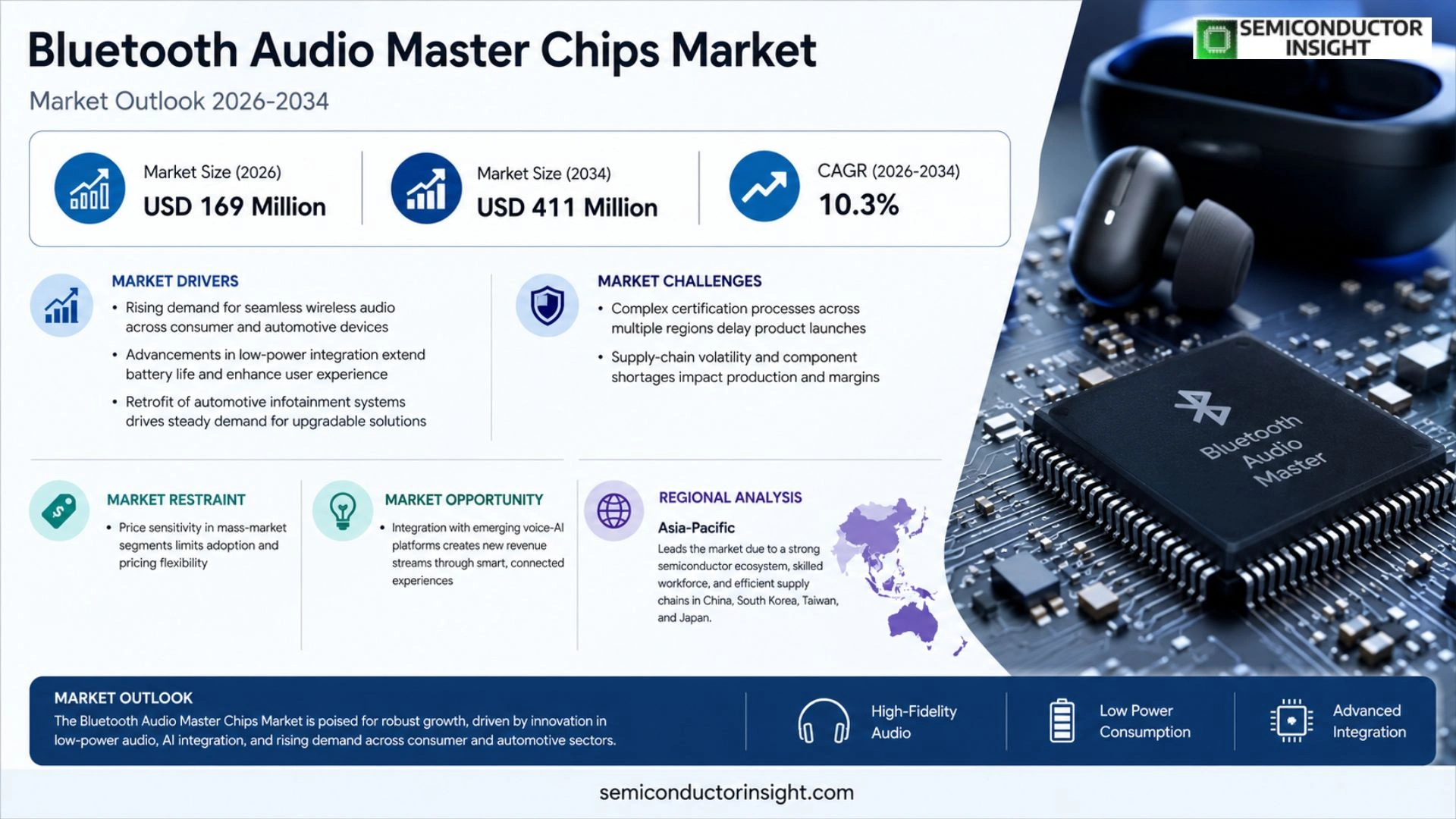
Global Bluetooth Audio Master Chips market size was valued at USD 169 million in 2025. The market is projected to grow from USD 169 million in 2026 to USD 411 million by 2034, exhibiting a CAGR of 10.3% during the forecast period.
Bluetooth Audio Master Chips are integrated circuits that manage audio processing, wireless connectivity, power management, and codec functions within Bluetooth-enabled devices such as speakers, non‑TWS headphones, TWS earbuds, and other consumer electronics that require high‑fidelity wireless sound.
The upward trajectory reflects continued consumer demand for premium audio experiences combined with broader semiconductor recovery after the post‑pandemic slowdown; analog segments recorded double‑digit growth in 2022 while overall semiconductor sales reached USD 580 billion, underscoring a supportive ecosystem for chip innovation.
MARKET DRIVERS
Rising Demand for Seamless Wireless Audio
Bluetooth Audio Master Chips Market benefits from consumer preference for tangle‑free listening experiences across smartphones, wearables and automotive infotainment. As manufacturers prioritize integration of high‑fidelity codecs, chip suppliers that can deliver low‑latency, high‑resolution audio gain a decisive edge. This shift forces OEMs to redesign product architectures around a single master chip that can manage multiplexed streams, thereby generating a steady pull on component sales.
Advancements in Low‑Power Integration
Recent silicon‑on‑foundry breakthroughs have cut power consumption of Bluetooth audio masters by more than a third, a factor that is critical for battery‑restricted devices such as true‑wireless earbuds. The ability to embed advanced noise‑cancellation and voice‑assistant support without draining the battery makes these chips attractive to premium‑segment brands seeking to differentiate on endurance and feature set.
➤ Industry analysts note that every 10 % reduction in chip power draw can extend device battery life by roughly 15 %,a metric that directly influences buying decisions.
Beyond consumer gadgets, the automotive sector is retrofitting legacy infotainment platforms with over‑the‑air updatable Bluetooth audio masters, allowing manufacturers to offer refreshed sound experiences without costly hardware overhauls. This retrofit capability creates an ancillary revenue stream that reinforces the overall market momentum.
MARKET CHALLENGES
Complex Certification Landscape
Obtaining global regulatory clearance for Bluetooth audio master chips involves navigating fragmented testing regimes across regions. Each certification cycle adds months to product launch timelines and raises development budgets, especially for smaller players lacking dedicated compliance teams. The resulting barrier slows the introduction of innovative features and can lead to market consolidation.
Other Challenges
Supply‑Chain Volatility
The semiconductor ecosystem continues to experience episodic shortages of key materials such as high‑frequency substrates and advanced packaging components. Fluctuating lead times force chip makers to hold larger inventories, inflating working capital and compressing margins. Companies that have cultivated diversified supplier bases or leveraged in‑house wafer capacity are better positioned to weather these disruptions.
MARKET RESTRAINTS
Price Sensitivity in Mass‑Market Segments
While premium devices can absorb higher component costs, the bulk of Bluetooth‑enabled products,such as entry‑level speakers and budget wearables,are priced to compete fiercely on unit cost. Manufacturers that cannot achieve economies of scale may find their offerings priced out of the core consumer tier, limiting overall market penetration.
MARKET OPPORTUNITIES
Integration with Emerging Voice‑AI Platforms
Voice‑activated assistants are becoming omnipresent in smart homes and vehicles. Embedding AI‑ready audio processing within the master chip opens a revenue channel for suppliers that can offer bundled firmware updates and cloud‑linked analytics. Early adopters stand to capture significant share as OEMs look to differentiate their next‑generation products through seamless voice interaction.
Expansion into Health‑Monitoring Wearables
The convergence of audio streaming and biometric sensing in fitness bands creates a niche where low‑latency, high‑quality Bluetooth audio masters can support real‑time coaching cues alongside heart‑rate data. Companies that tailor chip architectures for dual‑purpose operation can tap into a growing segment of health‑focused consumers who demand both sound quality and precise physiological feedback.
Bluetooth Audio Master Chips Market Trends
Shift Toward Integrated SoC Solutions
The adoption of System‑on‑Chip (SoC) architectures is redefining product road‑maps for manufacturers of Bluetooth Audio Master Chips. By embedding the Bluetooth transceiver, digital‑to‑analog converter, power‑management unit, and sophisticated audio DSP into a single silicon package, suppliers such as Qualcomm, MediaTek, and Bestechnic are delivering a compelling value proposition: reduced component count, simplified board layout, and lower assembly cost. This integration aligns with OEM pressure to shrink device footprints in true‑wireless earbuds and compact Bluetooth speakers. Moreover, the SoC route offers a tighter lock‑step between firmware updates and hardware capabilities, allowing rapid rollout of features like adaptive noise cancellation and high‑resolution codecs. The market response is a gradual migration away from discrete master chips toward higher‑priced, higher‑margin SoC offerings, prompting vendors to adjust their product mix and R&D budgets accordingly.
Other Trends
Emergence of True Wireless Stereo (TWS) Headphones
TWS headphones continue to capture consumer imagination, driving a distinct demand curve for Bluetooth Audio Master Chips that can sustain low‑latency, high‑fidelity links between two independent earbuds. The synchronization challenge has spurred chip makers to embed ultra‑precise timing engines and AI‑enhanced acoustic echo cancellation directly on the master silicon. OEMs benefit from a single‑chip solution that eliminates the need for separate synchronization modules, thereby cutting BOM cost and improving reliability. As premium audio brands push envelope‑breaking sound staging, the competitive pressure compels chip suppliers to iterate faster, integrating newer codecs such as LC3plus and supporting higher sampling rates without sacrificing battery life.
Regional Divergence in Growth Rates
North America remains the most vigorous market segment, buoyed by strong disposable income and a cultural tilt toward smart‑home integration, where Bluetooth audio chips serve as the connective tissue between voice assistants, speakers, and IoT sensors. In Europe, regulatory emphasis on energy efficiency is accelerating the rollout of chips with advanced power‑saving modes, creating niche opportunities for firms that can certify compliance swiftly. Conversely, the Asia‑Pacific region, while dominant in volume, posted a slight contraction as inflation trimmed consumer spending on discretionary audio upgrades. Manufacturers therefore pursue tiered product strategies: cost‑optimized, feature‑light chips for price‑sensitive markets, alongside premium SoC families for high‑end applications. This bifurcated approach reshapes supply‑chain planning, prompting a re‑allocation of capacity toward flexible fabs capable of switching between high‑mix, low‑volume runs and mass‑production of baseline parts.
COMPETITIVE LANDSCAPE
Key Industry Players
Competitive Overview of the Bluetooth Audio Master Chip Sector
Qualcomm dominates the Bluetooth audio master chip arena, leveraging its extensive base of cellular and IoT patents to integrate high‑performance radio, power‑management, and DSP functions into a single silicon solution. The company’s recent SoC releases target premium true‑wireless earbuds, delivering low‑latency codecs and advanced echo‑cancellation. MediaTek follows closely, capitalizing on its strong relationships with OEMs in the Asia‑Pacific region. By bundling audio‑centric IP with its broader connectivity portfolio, MediaTek offers cost‑effective alternatives that suit mass‑market speakers and entry‑level headphones. Both firms have diversified away from pure silicon, providing firmware updates and reference designs that lock customers into their ecosystems, a strategic move that raises switching costs and secures recurring revenue streams.
Beyond the two giants, a cluster of specialised vendors fuels innovation in niche segments. Actions Technology and Bestechnic focus on ultra‑compact packages for wearable devices, emphasizing power‑efficiency and integrated voice‑assistant support. Bluetrum distinguishes itself with a portfolio of Bluetooth 5.2‑compliant chips that embed AI‑enhanced acoustic processing, appealing to smart‑home speaker manufacturers. Zhuhai Jieli Technology, Realtek, and Chipsea supply mid‑tier solutions that balance performance and price, often winning contracts with regional brands in Southeast Asia and Latin America. Larger semiconductor houses such as STMicroelectronics, Samsung Electronics, and Texas Instruments contribute legacy audio codecs and mixed‑signal expertise, enabling hybrid designs that blend analog front‑ends with digital master cores. Espressif’s low‑cost ESP‑AUDIO line has attracted hobbyist and DIY markets, while ROHM and Cirrus Logic maintain a foothold in automotive and premium consumer audio through highly linear analog front‑ends that complement the digital master chips.
List of Key Bluetooth Audio Master Chips Companies Profiled
- Qualcomm
- MediaTek
- Actions Technology
- Bestechnic
- Bluetrum
- Zhuhai Jieli Technology
- Realtek
- Chipsea
- Cirrus Logic
- Nuvoton
- STMicroelectronics
- Samsung Electronics
- Texas Instruments
- Espressif Systems
- ROHM Semiconductor
Segment Analysis:
| Segment Category | Sub-Segments | Key Insights |
| By Type |
|
SoC Chip is favored for its compact integration and design efficiency.
|
| By Application |
|
TWS Bluetooth Headphones drive innovation in personal audio.
|
| By End User |
|
Consumer Electronics remain the dominant driver for chip adoption.
|
| By Integration Level |
|
Integrated SoC is gaining traction across device categories.
|
| By Power Management |
|
Low‑Power Chips are crucial for extending usage in wearables and true‑wireless earbuds.
|
Regional Analysis: Bluetooth Audio Master Chips Market
Asia-Pacific
The cluster of design studios in Taiwan and South Korea accelerates feature integration, enabling chip architects to embed advanced noise‑cancellation and multi‑codec support without inflating die size. This technical agility feeds directly into competitive product roadmaps for local manufacturers.
Close proximity between silicon fabs and assembly lines minimizes lead times, allowing firms to absorb raw‑material fluctuations while maintaining steady output for high‑volume audio accessories.
Economies of scale achieved through regional wafer‑fabric capacity translate into lower unit costs, granting price‑sensitive brands the flexibility to launch feature‑rich products at aggressive price points.
Growth in smart‑home speakers and vehicle‑to‑device connectivity creates new demand vectors for Bluetooth audio master chips, prompting manufacturers to tailor solutions for extended range and power‑efficiency.
North America
North America sustains a premium‑focused segment of Bluetooth Audio Master Chips Market, where brand‑centric audio manufacturers prioritize high‑fidelity performance and integrated voice‑assistant capabilities. The region’s strong intellectual‑property framework encourages firms to invest in proprietary DSP algorithms, differentiating products through superior soundstage and adaptive equalization. Partnerships between chipset vendors and leading headphone brands sharpen time‑to‑market for flagship launches, while a mature retail ecosystem amplifies consumer willingness to pay for incremental acoustic improvements. Companies that align their chip portfolios with North American expectations for low latency and seamless cross‑device handoff can command higher margins and secure long‑term design wins with flagship OEMs.
Europe
Europe’s contribution to Bluetooth Audio Master Chips Market is shaped by stringent environmental regulations and a growing emphasis on sustainable product design. Manufacturers operating within EU jurisdictions adopt low‑power architectures to meet energy‑efficiency directives, while also navigating the push for recyclable component packaging. Automotive manufacturers across Germany and France increasingly embed Bluetooth audio subsystems into connected car platforms, demanding chips that satisfy both automotive‑grade reliability and consumer‑audio quality. The convergence of eco‑conscious policy and automotive integration encourages chip suppliers to offer modular solutions that can be reused across multiple vehicle models, enhancing cost predictability for OEMs.
South America
In South America, demand for Bluetooth audio master chips is anchored by expanding mobile penetration and the popularity of affordable wearable devices. Local distributors rely heavily on imported silicon, yet regional assembly plants are beginning to source chips directly from Asia‑Pacific fabs, reducing tariffs and lead times. Price sensitivity drives brands to seek chips that balance acceptable audio clarity with aggressive cost targets, prompting suppliers to provide stripped‑down configurations that still support essential codecs. As streaming services broaden their reach across the continent, consumer expectations for reliable wireless audio are rising, creating an opening for vendors that can blend cost efficiency with consistent performance.
Middle East & Africa
The Middle East & Africa region remains a nascent yet strategically important market for Bluetooth audio master chips, largely because of growing investments in smart‑city infrastructure and premium hospitality venues. While local semiconductor fabrication is limited, rapid adoption of connected entertainment systems in hotels and public venues accelerates import demand for fully integrated audio solutions. Operators prioritize chips that can sustain long‑range connectivity and operate reliably in high‑temperature environments, prompting suppliers to emphasize robust RF performance. Companies that position themselves as reliable partners for infrastructure projects can secure multi‑year contracts that serve as a gateway to broader consumer adoption as disposable incomes rise.
Report Scope
This market research report provides a comprehensive analysis of the Bluetooth Audio Master Chips Market , covering the forecast period 2026–2034. It offers detailed insights into market dynamics, technological advancements, competitive landscape, and key trends shaping the industry.
Key focus areas of the report include:
- Market Overview: The report begins with an overview outlining its current market scenario, key growth indicators, and industry transformation drivers. It discusses macroeconomic factors, demand–supply balance, regulatory landscape, and the strategic role of semiconductors in powering advancements across industries such as automotive, telecommunications, consumer electronics, and industrial automation.
- Market Size & Forecast: Historical data and future projections for revenue, unit shipments, and market value across major regions and segments.
- Segmentation Analysis: Detailed breakdown by product type, technology, application, and end-user industry to identify high-growth segments and investment opportunities.
- Regional Insights: Insights into market performance across North America, Europe, Asia-Pacific, Latin America, and the Middle East & Africa, including country-level analysis where relevant.
- Competitive Landscape: Profiles of leading market participants, including their product offerings, R&D focus, manufacturing capacity, pricing strategies, and recent developments such as mergers, acquisitions, and partnerships.
- Technology Trends & Innovation: Assessment of emerging technologies, integration of AI/IoT, semiconductor design trends, fabrication techniques, and evolving industry standards.
- Market Drivers & Restraints: Evaluation of factors driving market growth along with challenges, supply chain constraints, regulatory issues, and market-entry barriers.
- Stakeholder Insights: Insights for component suppliers, OEMs, system integrators, investors, and policymakers regarding the evolving ecosystem and strategic opportunities.
Primary and secondary research methods are employed, including interviews with industry experts, data from verified sources, and real-time market intelligence to ensure the accuracy and reliability of the insights presented.
FREQUENTLY ASKED QUESTIONS:
What is the current market size of Bluetooth Audio Master Chips Market?
-> Bluetooth Audio Master Chips market is projected to grow from USD 169 million in 2026 to USD 411 million by 2034, exhibiting a CAGR of 10.3%
Which key companies operate in Bluetooth Audio Master Chips Market?
-> Key players include Qualcomm, MediaTek, Actions Technology, Bestechnic, Bluetrum, Zhuhai Jieli Technology.
What are the key growth drivers?
-> Key growth drivers include rising consumer demand for wireless audio devices such as Bluetooth speakers and headphones, and increased integration of Bluetooth Audio Master Chips into IoT‑enabled consumer electronics.
Which region dominates the market?
-> Asia‑Pacific remains the largest region for Bluetooth Audio Master Chips, driven by a strong manufacturing base and high consumption of consumer electronics.
What are the emerging trends?
-> Emerging trends include development of SoC‑based Bluetooth Audio Master Chips, integration of AI/IoT capabilities, and expansion into new applications beyond traditional speakers and headphones.
Get Sample Report PDF for Exclusive Insights
Report Sample Includes
- Table of Contents
- List of Tables & Figures
- Charts, Research Methodology, and more...
 Download Sample Report PDF