Blu-ray Jukebox Market Insights
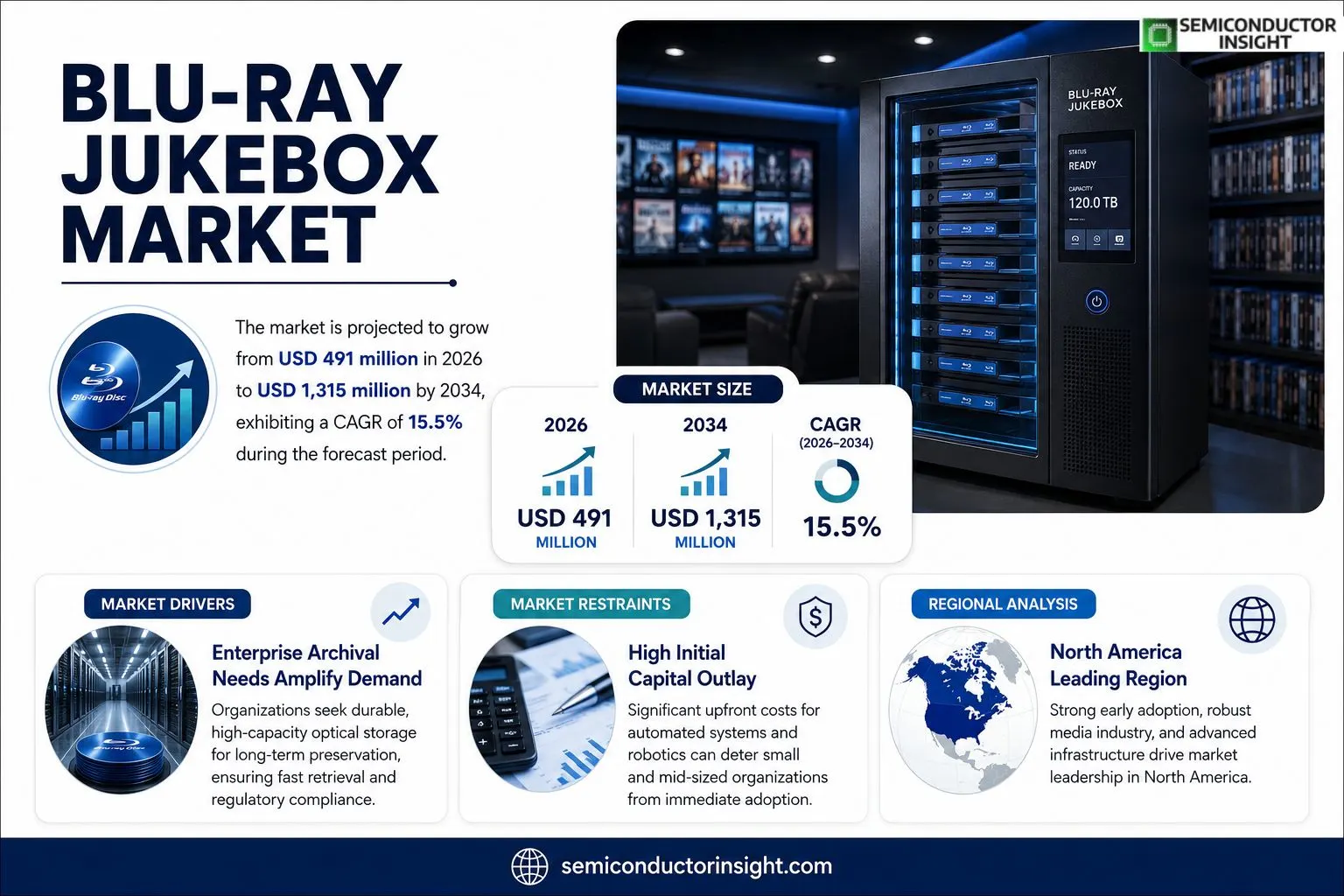
Blu-ray Jukebox market size was valued at USD 491 million in 2026. The market is projected to reach USD 1,315 million by 2034, exhibiting a CAGR of 15.5% during the forecast period.
Blu‑ray jukeboxes are high‑capacity optical storage systems that automate the loading and unloading of multiple Blu‑ray discs within a single chassis. Configurations range from sub‑24 TB units up to multi‑petabyte solutions, making them suitable for long‑term archival, media libraries, and enterprise backup where durability and low power consumption are priorities.The market is gaining momentum because organizations face mounting pressure to preserve ever‑growing volumes of digital assets while complying with regulatory retention mandates. Optical media’s longevityoften quoted as exceeding 50 yearsoffers an alternative to magnetic tape where degradation risk is higher. Moreover, falling disc manufacturing costs and advances in robotic handling have improved total cost of ownership. Leading manufacturers such as Panasonic, Sony, DISC Archiving System and China Hualu Group are expanding product portfolios and introducing higher‑density drives, which further fuels adoption across sectors including government archives, medical imaging repositories and media production houses.
MARKET DRIVERS
Enterprise Archival Needs Amplify Demand
Organizations that manage large volumes of high‑resolution video content are turning to the Blu-ray Jukebox Market as a pragmatic alternative to expensive tape libraries. The ability to retrieve a specific title within seconds reduces operational downtime and supports compliance initiatives that require rapid access to archived assets. Consequently, procurement budgets are being reallocated from legacy tape systems toward scalable optical solutions.
Cost‑per‑Byte Efficiency Drives Adoption
When the total cost of ownership is amortized over a five‑year horizon, the cost per gigabyte of a Blu‑ray jukebox falls below that of comparable hard‑disk arrays, especially in environments where cold‑storage capacity exceeds 100 TB. This price advantage is amplified by the low power draw of optical drives, which translates into measurable savings on data‑center electricity bills. Companies that prioritize fiscal prudence are therefore gravitating toward optical tiering strategies.
➤ “Our migration from tape to Blu‑ray reduced retrieval latency by 70 % while cutting storage costs by roughly 15 %.” – CIO, European Media House
Beyond economics, the durable nature of Blu‑ray mediaresisting magnetic interference and offering a lifespan of up to 50 yearsprovides a risk‑mitigation layer that many regulators now view as best practice. This durability, combined with the financial upside, creates a compelling proposition for enterprises seeking both resilience and cost control.
MARKET CHALLENGES
High Initial Capital Outlay
The upfront investment required for a fully automated Blu‑ray jukebox, including robotic handlers and management software, can exceed $250,000 for a 10‑petabyte configuration. Small‑to‑mid‑size firms often lack the budgetary flexibility to absorb such costs, prompting them to postpone adoption despite clear long‑term benefits.
Other Challenges
Compatibility Constraints
Many legacy archival workflows rely on tape‑native metadata structures. Translating these to Blu‑ray formats demands custom middleware, which can introduce integration delays and additional licensing fees.
MARKET RESTRAINTS
Physical Media Decline Offsets Growth
The broader shift toward cloud‑based storage services erodes the appeal of any on‑premise physical‐media solution. As enterprises migrate archival workloads to object storage platforms, the perceived relevance of the Blu-ray Jukebox Market diminishes, especially among organizations that prioritize remote accessibility over on‑site latency.
MARKET OPPORTUNITIES
Emerging Niche Segments
Specialized fields such as digital cinema distribution and medical imaging retain a preference for secure, offline storage due to regulatory constraints. Tailoring jukebox solutions with encryption modules and audit‑ready reporting opens a revenue stream that is insulated from the mainstream cloud migration trend. Early movers that develop turnkey packages for these niches can capture disproportionate market share.
Blu-ray Jukebox Market Trends
Consolidation of Capacity Segments Driving Enterprise Adoption
The segment of Blu‑ray jukeboxes under 24 TB, historically seen as a niche, now accounts for a sizable share of deployments in data‑intensive sectors such as media archiving and government record‑keeping. A combination of falling media costs and the maturation of automated retrieval algorithms has made small‑scale optical libraries attractive to organizations seeking a low‑cost alternative to magnetic tape while preserving long‑term durability. Because these units occupy modest rack space and require minimal power, enterprises can layer them alongside existing storage tiers, creating a heterogeneous ecosystem that postpones the need for costly capacity upgrades.
Other Trends
Shift Toward High‑Capacity Tiered Solutions
The Blu-ray Jukebox Market is seeing increased demand for high‑capacity tiered solutions. Customers with petabyte‑scale requirements are gravitating to the 100‑360 TB and above‑840 TB families. Manufacturers such as Panasonic and Sony have introduced multi‑cartridge chassis that integrate advanced robotic arms, reducing latency and increasing throughput. This evolution is fueled by the archive needs of video‑on‑demand platforms and scientific research institutes, where the ratio of ingest speed to retrieval latency directly impacts service levels. The strategic implication for vendors is clear: product roadmaps must prioritize modular scalability and seamless firmware upgrades to retain relevance in a market where capacity elasticity is a decisive purchase factor.
Geographic Divergence in Demand Patterns
While North America continues to be a strong early‑adopter region, demand in China is accelerating faster than any other market, driven by government‑mandated data retention policies and rapid expansion of cloud service providers. In the United States, enterprise buyers are emphasizing compliance‑driven storage, leading to higher uptake of jukeboxes equipped with encryption and audit‑trail capabilities. The divergent regulatory landscape compels OEMs to tailor feature sets regionally, otherwise risk ceding market share to local players that can more quickly align product specifications with domestic standards.
COMPETITIVE LANDSCAPE
Key Industry Players
Competitive Overview of Blu‑ray Jukebox Providers
Panasonic remains the market’s dominant supplier, leveraging a legacy of optical‑disc engineering and an established service network that spans North America, Europe, and Asia‑Pacific. Its Blu‑ray Jukebox portfolio, highlighted by the PX‑WJ4000 series, combines high‑density cartridge handling with integrated backup software, allowing enterprise customers to replace tape archives with a more durable medium. Sony, while slightly smaller in volume, differentiates through a focus on modular designs that can be scaled from 24 TB to 360 TB configurations, catering to media‑intensive firms that require flexible capacity increments. Both firms command a substantial share of OEM contracts with data‑center operators and governmental archives, a pattern that reflects their ability to meet rigorous reliability standards while offering competitive total‑cost‑of‑ownership calculations. Their R&D pipelines continue to emphasize reduced access latency and improved error‑correction algorithms, which are critical for sectors such as finance and public security where data integrity cannot be compromised.Beyond the two giants, a cluster of specialized manufacturers is reshaping niche segments. DISC Archiving System, based in Taiwan, has gained attention for its ultra‑compact cartridge format that targets archival libraries with space constraints. China Hualu Group Co and Amethystum Storage Tech, both headquartered in mainland China, are expanding their presence in the domestic market by bundling hardware with localized data‑management platforms, an approach that resonates with regional enterprises seeking integrated solutions. Smaller Chinese firms such as Suzhou NETZON and Beijing DMX concentrate on cost‑effective models under 48 TB, appealing to educational institutions and mid‑size companies that prioritize budget over maximum capacity. Tsinghua Tongfang Co and Beijing Xingzhen Tongyuan Digital System provide customized firmware for regulatory‑compliant environments, reinforcing their appeal to government archives. Emerging players like Bctop and Beijing Ji Cheng Technology are experimenting with AI‑enabled predictive maintenance, an innovation that could lower operational expenditures for long‑term storage deployments.
List of Key Blu‑ray Jukebox Companies Profiled
- Panasonic
- Sony
- DISC Archiving System
- China Hualu Group Co
- Amethystum Storage Tech
- Suzhou NETZON
- Tsinghua Tongfang Co
- Beijing Xingzhen Tongyuan Digital System
- Beijing DMX
- Beijing Ji Cheng Technology
- Bctop
- Shanghai BlueDisk
Segment Analysis:
| Segment Category | Sub-Segments | Key Insights |
| By Type |
|
Below 24TB remains the most widely adopted capacity tier because it balances cost and storage density.
|
| By Application |
|
Archival Industry drives the market through stringent data‑preservation standards.
|
| By End User |
|
Enterprises favor Blu‑ray jukeboxes for their balance of capacity and reliability.
|
| By Capacity Tier |
|
High (100‑360TB) is emerging as the preferred tier for data‑intensive sectors.
|
| By Technology Evolution |
|
Multi‑Layer Blu‑ray (BD‑XL) is driving innovation in the jukebox arena.
|
Regional Analysis: Blu-ray Jukebox Market
North America
Large hotel chains integrate Blu‑ray jukeboxes to differentiate guest experiences, leveraging the format’s robustness to handle high‑traffic use without compromising playback consistency.
Specialty electronics stores curate a selection of premium jukebox models, positioning them as centerpiece entertainment solutions for affluent consumers seeking tactile media experiences.
Film studios negotiate exclusive physical‑media windows, ensuring that Blu‑ray jukeboxes receive fresh releases that remain unavailable on streaming platforms for a defined period.
Manufacturers introduce hybrid models equipped with USB and network connectivity, allowing operators to blend legacy disc playback with modern content management tools.
Europe
European markets exhibit a nuanced demand profile, where cultural preferences for curated film festivals translate into a modest but steady appetite for Blu‑ray jukebox installations in boutique cinemas and upscale bars. Countries with strong domestic film production, such as France and Germany, support a localized catalog that feeds jukebox libraries with titles unavailable elsewhere. This localized content reduces reliance on streaming licenses and sustains a niche market for physical media aficionados. Additionally, the higher penetration of broadband services encourages hybrid usage patterns: patrons may start with a streamed preview before opting for the premium Blu‑ray experience, reinforcing the jukebox’s role as a complementary offering rather than a primary source of entertainment.
Asia‑Pacific
In the Asia‑Pacific region, consumer enthusiasm for cutting‑edge home‑theater setups fuels incremental growth of Blu‑ray jukebox deployments, especially in affluent urban centers like Tokyo, Seoul, and Singapore. While streaming dominates mainstream consumption, there remains a vibrant collector community that values the tactile and archival qualities of optical discs. This community often intersects with high‑end audio‑visual retailers who showcase jukebox units as status symbols. Moreover, regional film studios are beginning to release titles with region‑specific bonus features on Blu‑ray, creating a demand for jukeboxes that can showcase these exclusive assets in premium hospitality venues.
South America
South American operators tend to adopt Blu‑ray jukeboxes as a cost‑effective alternative to upgrading entire digital infrastructure in entertainment venues. The relatively lower broadband penetration in several markets makes reliable physical playback an attractive proposition for restaurants and cafés that wish to offer movie nights without the risk of buffering. Local distributors often bundle jukebox units with a curated selection of popular regional cinema, aligning product offerings with consumer taste for domestic storytelling. This pragmatic approach sustains a modest yet resilient demand curve that is less sensitive to rapid technological shifts.
Middle East & Africa
The Middle East and Africa present a fragmented landscape where premium entertainment solutions coexist with nascent digital ecosystems. In affluent Gulf Cooperation Council (GCC) hotels, Blu‑ray jukeboxes are deployed to reinforce luxury service standards, catering to international guests accustomed to high‑definition physical media. Conversely, in emerging African markets, the jukebox serves as a communal entertainment hub in malls and clubs where streaming bandwidth may be unreliable. Partnerships between local distributors and multinational manufacturers focus on rugged hardware designs capable of withstanding varied climatic conditions, ensuring the technology remains viable across diverse operating environments.
Report Scope
This market research report provides a comprehensive analysis of the Blu-ray Jukebox Market , covering the forecast period 2026–2034. It offers detailed insights into market dynamics, technological advancements, competitive landscape, and key trends shaping the industry.
Key focus areas of the report include:
- Market Overview: The report begins with an overview outlining its current market scenario, key growth indicators, and industry transformation drivers. It discusses macroeconomic factors, demand–supply balance, regulatory landscape, and the strategic role of semiconductors in powering advancements across industries such as automotive, telecommunications, consumer electronics, and industrial automation.
- Market Size & Forecast: Historical data and future projections for revenue, unit shipments, and market value across major regions and segments.
- Segmentation Analysis: Detailed breakdown by product type, technology, application, and end-user industry to identify high-growth segments and investment opportunities.
- Regional Insights: Insights into market performance across North America, Europe, Asia-Pacific, Latin America, and the Middle East & Africa, including country-level analysis where relevant.
- Competitive Landscape: Profiles of leading market participants, including their product offerings, R&D focus, manufacturing capacity, pricing strategies, and recent developments such as mergers, acquisitions, and partnerships.
- Technology Trends & Innovation: Assessment of emerging technologies, integration of AI/IoT, semiconductor design trends, fabrication techniques, and evolving industry standards.
- Market Drivers & Restraints: Evaluation of factors driving market growth along with challenges, supply chain constraints, regulatory issues, and market-entry barriers.
- Stakeholder Insights: Insights for component suppliers, OEMs, system integrators, investors, and policymakers regarding the evolving ecosystem and strategic opportunities.
Primary and secondary research methods are employed, including interviews with industry experts, data from verified sources, and real-time market intelligence to ensure the accuracy and reliability of the insights presented.
FREQUENTLY ASKED QUESTIONS:
What is the current market size of Blu-ray Jukebox Market?
-> Blu-ray Jukebox Market was valued at USD 491 million in 2026 and is expected to reach USD 1,315 million by 2034, at a CAGR of 15.5% during the forecast period.
Which key companies operate in Blu-ray Jukebox Market?
-> Key players include Panasonic, Sony, DISC Archiving System, China Hualu Group Co, Amethystum Storage Tech, Suzhou NETZON, Tsinghua Tongfang Co, Beijing Xingzhen Tongyuan Digital System, Beijing DMX, Beijing Ji Cheng Technology, among others.
What are the key growth drivers?
-> Key growth drivers include rising demand for high‑capacity archival storage, digital transformation initiatives across enterprises, and the need for reliable long‑term data preservation solutions.
Which region dominates the market?
-> North America currently leads the market due to early adoption of advanced storage solutions, while Asia‑Pacific shows rapid growth driven by expanding data‑intensive industries.
What are the emerging trends?
-> Emerging trends include development of ultra‑high capacity modules (above 840TB), integration of AI‑driven data management, and increased adoption of Blu‑ray Jukeboxes for cloud‑backed backup services.
Get Sample Report PDF for Exclusive Insights
Report Sample Includes
- Table of Contents
- List of Tables & Figures
- Charts, Research Methodology, and more...
 Download Sample Report PDF